Overview of Shikoku
Shikoku is the smallest of Japan’s four main islands and comprises four prefectures — Kagawa, Ehime, Tokushima and Kochi — each roughly corresponding to one of the four ancient provinces that gave the island its name. With a total area of about 18,800 square kilometers and a population of roughly 3.7 million, Shikoku has the lowest population of the four main islands and a markedly slower pace than Honshu. The island is separated from Honshu by the Seto Inland Sea to the north and from Kyushu by the Bungo Channel to the west, with the Pacific Ocean stretching along its southern shore. Although no shinkansen reaches the island, Shikoku is connected to Honshu by three bridge systems: the Great Seto Bridge (Okayama to Kagawa), the Akashi-Kaikyo and Naruto Bridges via Awaji Island (Kobe to Tokushima), and the Shimanami Kaido (Hiroshima to Ehime).
Shikoku is inseparable from the 88 Temple Pilgrimage (Ohenro), a 1,200-km circular route around the entire island visiting 88 Buddhist temples associated with the monk Kukai (Kobo Daishi), who founded Shingon Buddhism. The pilgrimage traditionally takes 30 to 50 days on foot, though many pilgrims — known as ohenro-san — complete sections at a time or by bus and car.
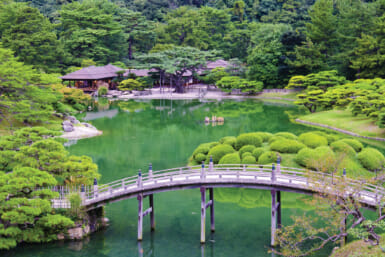
Kagawa, on the northeast coast, is Japan’s smallest prefecture and famous for sanuki udon noodles and Ritsurin Garden — counted among Japan’s finest landscape gardens — in the capital, Takamatsu. Ehime, on the northwestern coast, is home to Matsuyama (the largest city on Shikoku) with its magnificent original Matsuyama Castle and the legendary Dogo Onsen, one of Japan’s oldest recorded hot springs.
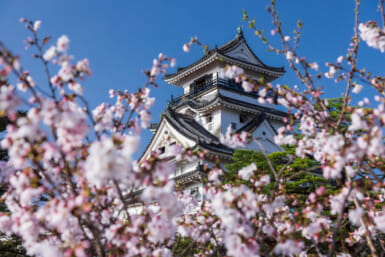
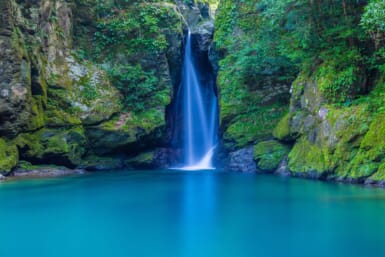
Tokushima, on the east coast closest to Kansai, is famous for the Awa Odori — one of Japan’s three biggest summer dance festivals, drawing over a million spectators to Tokushima city every August — and for the Naruto Whirlpools in the strait beneath the Naruto Bridge, among the world’s largest tidal whirlpools. Kochi, occupying the entire Pacific-facing southern half of Shikoku, is the island’s largest prefecture by area is home to Katsurahama Beach, the reconstructed Kochi Castle, the surfing coast of the Pacific and the untamed Shimanto River — often called Japan’s last clear stream.