There is footage now of Japan’s kamikaze pilots that no camera ever recorded.
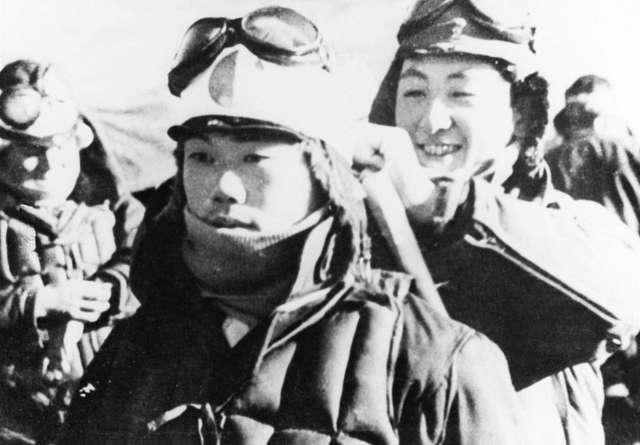
At first, there is only the photograph: Japanese pilots in flight suits, black-and-white and fixed in that peculiar tense of archival images, in which a person can be young forever and dead for 80 years. Then color arrives. Skin warms. A head turns. One man looks toward another; another smiles. Soon they are laughing together, young and handsome and startlingly alive.
These videos belong to a proliferating genre of AI-generated history circulating on YouTube and social media, where photographs of Japan’s wartime past are colorized, animated and turned into miniature emotional narratives. Special attack pilots — better known in English as kamikaze — make particularly potent material. Beneath such videos, commenters thank the men for protecting the Japan they live in today. Others say they cried. An NHK investigation found these videos have drawn more than 100 million views over two years.
NHK also found suspected fabrications in wills presented as the pilots’ own words, as well as videos that confused the kamikaze corps with Kaiten, Japan’s human-torpedo program. The alterations, in other words, can extend beyond making old photographs move.
Old photographs have always produced a particular kind of longing: the desire to know what happened immediately before and after the shutter clicked, what the person sounded like, whether the smile continued after the photograph ended. Until recently, there was nothing to do with that desire except imagine.
Now there is.
And it is arriving at an extraordinary moment. Eighty-one years after Japan’s surrender, the country is approaching the end of living memory of the war. Someone who remembers 1945 as a 10-year-old is now 91. A Kyodo News survey of 70 Japanese war museums found a quarter are running out of room to store deteriorating wartime materials.
For decades, the problem was how to preserve memory before its custodians disappeared. Now comes a stranger possibility: replacing them.
What Does a Smile Mean?
There could hardly be a more volatile subject on which to test it than the kamikaze. Japan has spent eight decades arguing over what these men were and what their deaths meant: patriots or victims, militarist fanatics or frightened boys, willing volunteers or young men caught inside a system in which refusal was almost unimaginable.
The surviving record is irritatingly human in this respect.
In a documentary broadcast this month, a former special attack pilot described his assignment as an order, not a choice. Yet he also said he did not question it at the time and did not remember being afraid. Another man, whose mission never happened because Japan surrendered first, recalled instead the guilt of surviving his comrades.
The dead left contradictions of their own. Chiran Peace Museum preserves thousands of letters, photographs and possessions associated with the pilots. Shortly before his death in 1945, 23-year-old Toshio Anazawa wrote to his fiancée about the books he still wanted to read and paintings he wanted to see. Most painfully ordinary of all, he wrote that he wanted to see her and talk with her. Historian Emiko Ohnuki-Tierney has similarly documented student pilots wrestling privately with philosophy, duty and an ideology of sacrifice they did not always embrace.
Eight decades of testimony and scholarship have produced no clean answer to what it felt like to be one of these men. Generative AI can produce one in seconds.
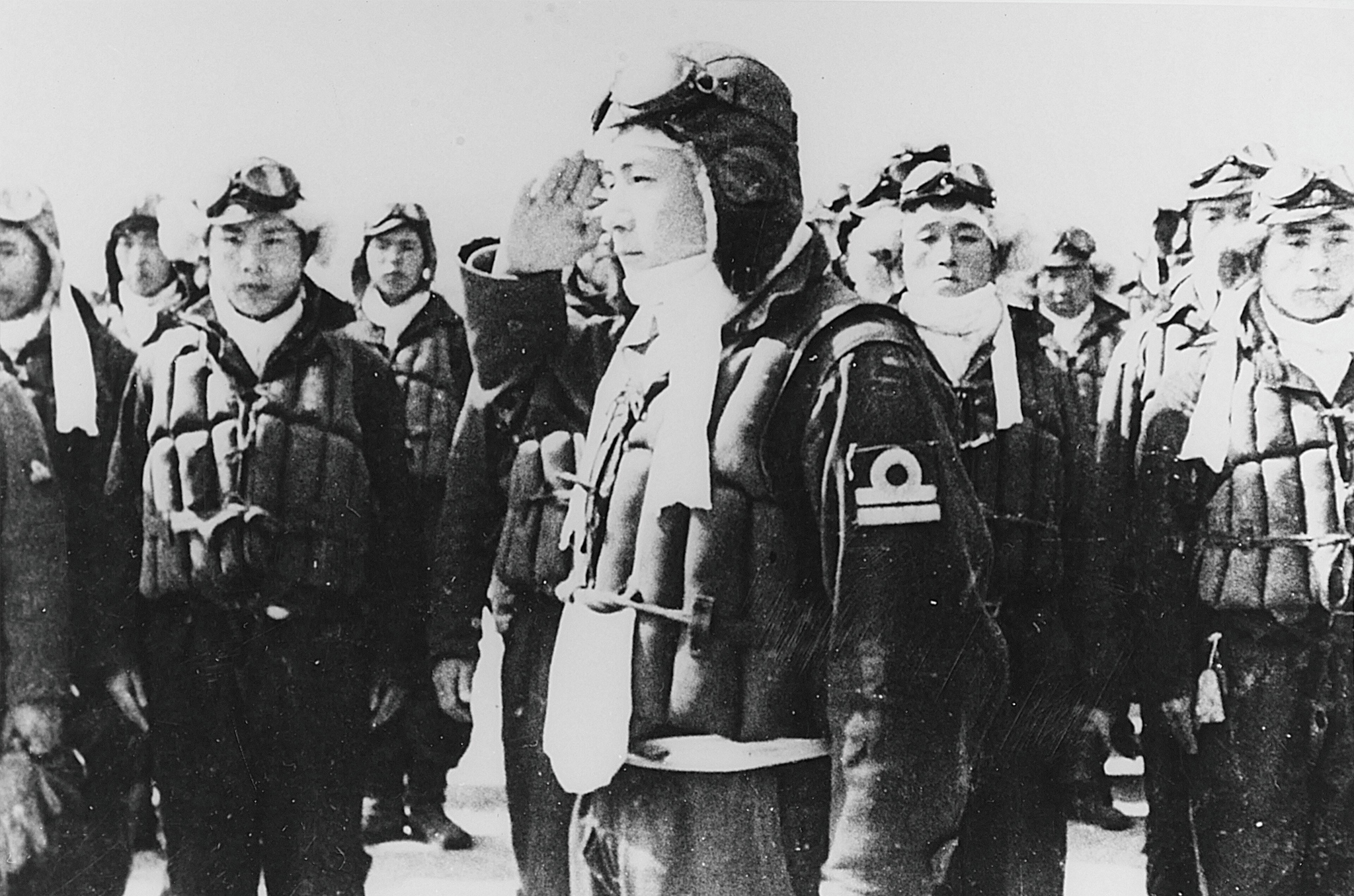
A Navy Kamikaze pilot salutes as he receives orders (c. 1944) | Public Domain via Wikimedia
From Preserving the Past to Generating It
There is nothing inherently sinister about wanting the dead to feel less remote. Nor does sympathy for a teenage pilot amount to an endorsement of Imperial Japan. In fact, humanizing people reduced for decades to the word “kamikaze” can itself correct a historical distortion.
The trouble is that on the contemporary internet, humanization and romanticization can be separated by approximately one soundtrack.
This is, after all, what the internet has become extraordinarily good at doing. Politics gets an edit. Serial killers get edits. Roman emperors get edits. Now the past gets fed through colorization, face enhancement and generative video until historical distance itself begins to collapse. A young pilot, an affectionate glance, swelling music, a caption about sacrifice: what was remote becomes intimate; what was complicated becomes immediately felt.
What fits less easily inside the frame are the institutions that sent him to die, Japan’s war of aggression across Asia, the people killed by special attacks or the possibility that one person could have held several incompatible feelings at once.
The feed wants a feeling. History is inconveniently full of several.
Research suggests this may matter beyond aesthetics. In a 2025 experiment involving 200 participants, AI-manipulated images and videos increased false recollections, with AI-generated videos based on altered photographs producing the strongest effect. Other research has found people valuing altered personal photographs because they seemed to represent how a memory felt, even when they knew the image was not real.
The AI pilot does not need to fool us. We can recognize the animation, know intellectually that the glance never happened, and still come away feeling we have seen something of him.
For generations, preserving war memory meant recording testimony before its bearer disappeared: the voice, the hesitation, the contradiction, the gaps in recollection. Japan is still racing to do exactly that. Museums preserve letters; broadcasters interview men nearing 100; younger people inherit the job of retelling what they heard.
For the archive, these absences are permanent. For generative AI, they are but prompts.
There is something almost philosophically perverse about this. A generative model doesn’t know the difference between a detail that has been lost and a detail that never existed. It cannot understand that sometimes the responsible answer to a historical question is we don’t know. It cannot recognize silence as evidence or the unknowability of another person’s interior life as a boundary worth respecting.
Give it the space between two frames and it will fill it. Give it a dead man’s face and it will decide what he does next.
This is the deranged proposition at the heart of synthetic memory: for the first time, our capacity to produce evidence-like images of the past is becoming effectively limitless while our capacity to contradict them is disappearing. The witnesses die. The archive stops growing. The simulations do not. Eventually, there may be more footage of the past that never happened than footage that did.
Related Posts
- Shueisha’s Manga Million Faces Backlash Over Suspected AI Use
- Hyogo Man Arrested Over AI-Generated Nude Images Exposes Legal Gray Area
- How the Sony Walkman Failed To Destroy Civilization
Updated On August 20, 2026