
After the Tokugawa shogunate was abolished during the Meiji Restoration of 1868, Japan tried to shed its supposed backward image and present itself as an enlightened nation to the world. That obviously worked, but the road there was … surprising.
Japan primarily tried to evolve through legislation, enacting laws that ended feudalism and did away with the samurai class. But it also banned things you wouldn’t have thought were a priority in the mid- to late 19th century. And yet, here are just some examples of the weirdest things targeted by Meiji officials, and the reasons behind their decisions:
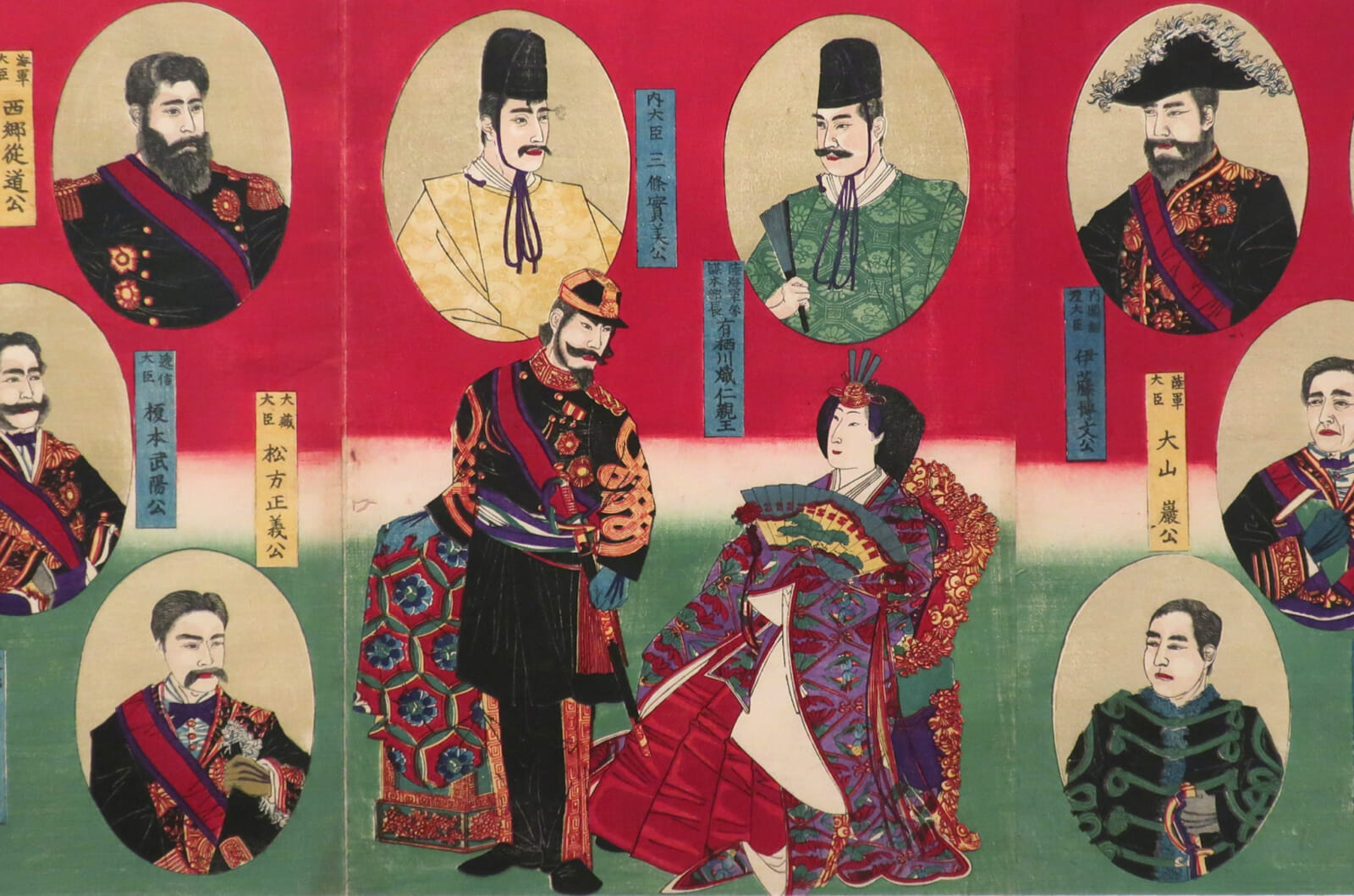
Emperor Meiji and government ministers by Hashimoto Chikanobu (1886)
Western Ink in Official Documents
The Law: Dajokan Directive No. 29, 1876
In an era when Japan was adopting all things Western, from clothes and technology to the idea of firearm-wielding serial killers, the new Japanese government drew the line at foreign ink. An exception was made for Western-language documents written on Western paper, but anything official and binding had to be recorded with native sumi.
The Meiji administration was probably worried about posterity. They were the new world order, essentially an experiment in governance that wanted to leave behind a paper trail of their doings. And they wanted it to last.
Calligraphy was imported to Japan from China in the fourth century CE, meaning that the country had over 1,500 years of experience with putting Asian ink on Asian paper. They knew how long it lasted, how to make it last and how to store it properly. In an era of constant change, it was a comfortable alternative to learning about the intricacies of Western-ink document preservation. Plus, consciously or not, it sent a signal that Japan was retaining its traditional culture while the country Westernized.
Fortunately, officials did not preserve traditional Japanese crucifixion, which the Meiji government did away with pretty much on day one.
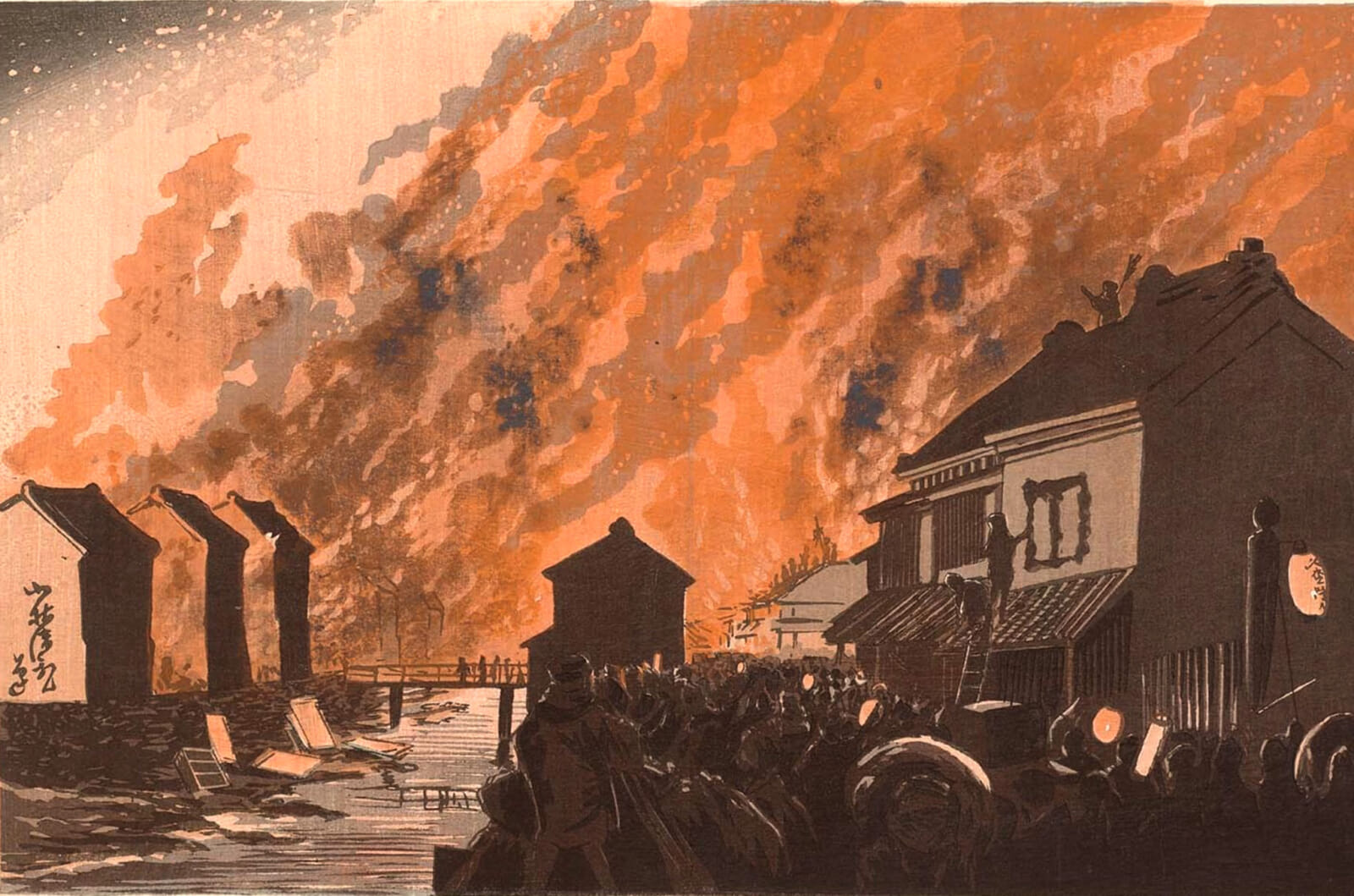
An 1881 depiction of fire by Kobayashi Kiyochika
Riding a Horse Within 109 Meters of a Fire in Hokkaido
The Law: Hokkaido Development Commission Headquarters Notice No. 23, 1879
Firefighting has a long, fascinating and brutal history in Edo (renamed to “Tokyo” during the Meiji Restoration). Up north in Hokkaido, the culture was different, so dealing with blazes wasn’t that bad. That said, it got a bit weird in 1879, when the law announced that people on horseback had to stay at least 109 meters away from firefighters at work. Why such specificity?
The “109 meters” bit is because the legislation used the (now) old Japanese measurement of 1 cho, equal to 109.1 meters. So, in 19th-century Japan, it was considered a nice round number. And SOME limit for approaching a fire while on a horse had to be officially set because people kept getting too close to burning buildings and interfering with rescue work.
Maybe in an era before television, a calamity was the best kind of free entertainment around, but the truth is that we don’t know for sure why the people of Hokkaido kept performing cavalry charges at fires. Maybe some genuinely wanted to help, but if they had been helpful, this law would never have been enacted.
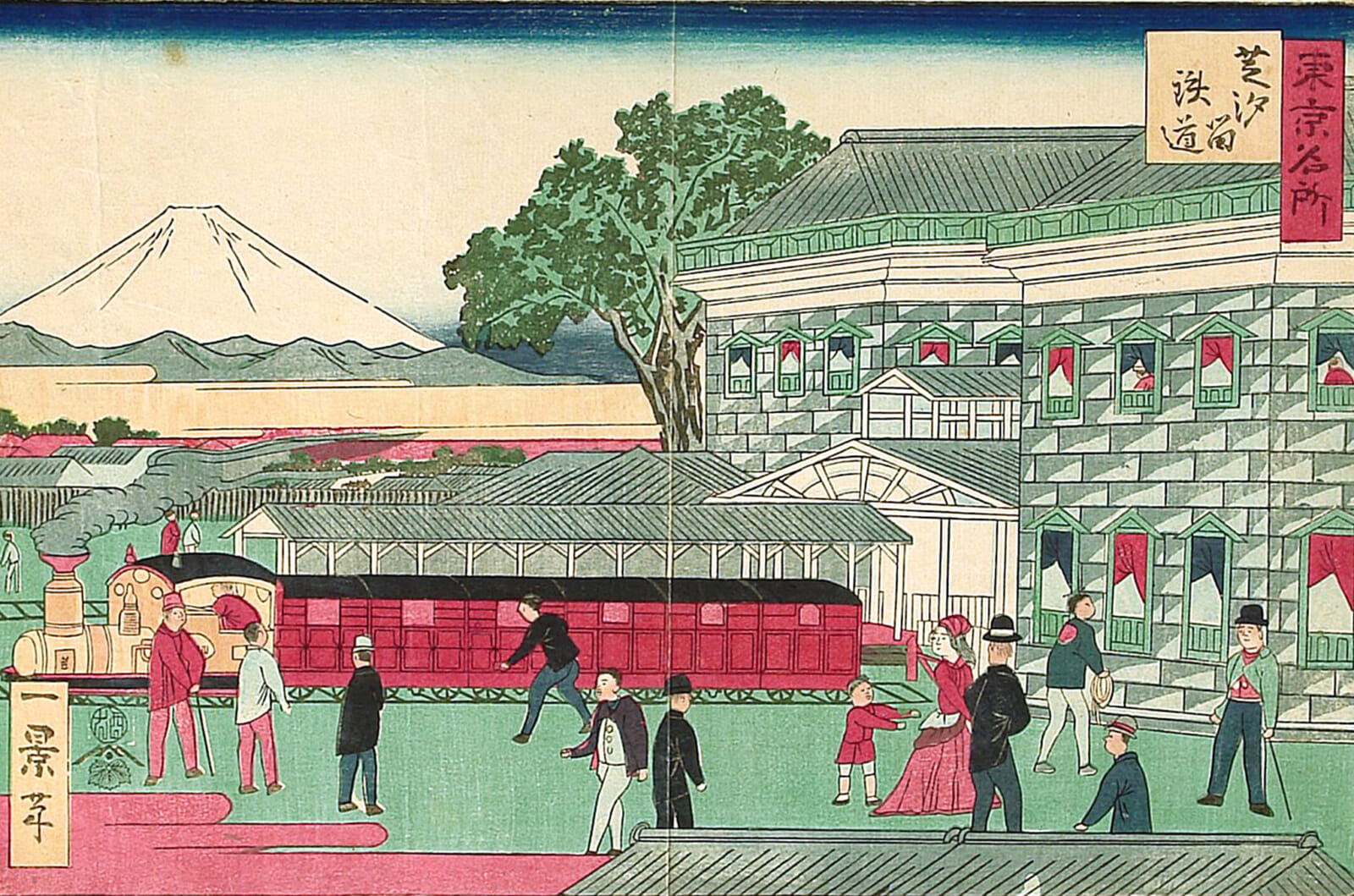
“Steam Train at Yokohama” by Shosai Ikkei (1879)
Men Entering Women-Only Train Cars
The Law: Dajokan Directive No. 61, Article 7, 1872
Some Meiji laws are surprising not because of their content but because of their timing. Anyone who’s ridden on Japanese trains will have noticed the women-only cars. You correctly assume that they mainly exist today because of gropers, but women-only cars first appeared on the books over 150 years ago in a time of steam locomotives. Perverts probably existed in Japan back then, but they hadn’t yet left their mark on trains.
The 1872 law coincided with the opening of Japan’s first railway route between Tokyo’s Shimbashi and Yokohama, meaning that as long as there have been Japanese trains, there have been women-only cars. But, again — not because of gropers. The end of feudalism tore down social barriers, allowing people of all former classes and current genders to share the same confined spaces, something that was unthinkable just a few years before, especially between unacquainted men and women.
Add to that the stories of some passengers reportedly relieving themselves out the windows (since Japan’s first trains had no toilets), and you can see how having women-only cars was more of a compromise for a society that was being asked to change too rapidly for some people’s liking. Interestingly, the same railway law also banned smoking outside designated station areas, which is very surprising given Japan’s history with tobacco.
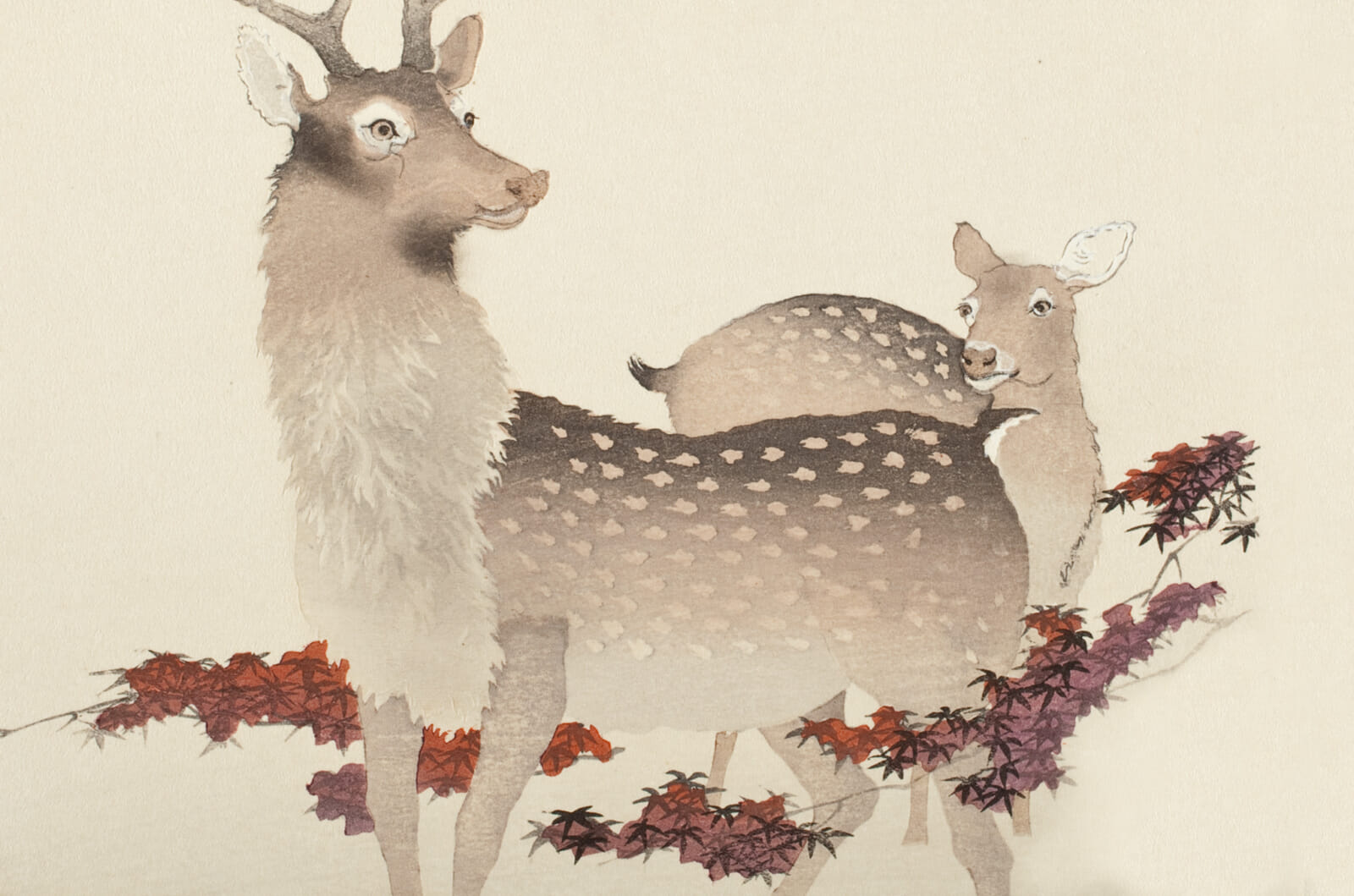
“Deer and Moon” by Ohara Koson (Meiji period, year unknown)
Unauthorized Exports of Stupid Bones
The Law: Hokkaido Development Commission Headquarters Notice No. 89, 1874
Some of you know that the famous Japanese word baka (“stupid,” “fool”) can be written with the characters for “horse” and “deer.” The reason for that is ateji: assigning characters to pre-kanji words based on phonetics rather than meaning. It’s interesting for linguists, but there’s no deeper story here. It does, however, make one 19th-century Japanese law sound hilarious.
An 1874 Hokkaido notice forbids the export of what to a modern reader of Japanese sure looks like “stupid bones” (baka-bone), as if someone was ticked off while drafting official legislation but stopped short of writing “and damned guns, and freaking drugs.” But here, the kanji duo of “horse” and “deer,” while still read as “baka,” does literally mean the animals, whose bones were supposed to stay put in Hokkaido unless you had proper government permission, presumably written in proper Japanese ink.
Deer bones were a hot commodity sold to China, where they were used to make traditional medicine and fertilizer, so there was a lot of money involved in their trade. Same for horses, which were widespread in Hokkaido as pack animals, making their bones easily available. But there might be a secondary explanation for the export controls on their skeletons.
Horses were also the favored snack of Hokkaido wolves. To cull their population, officials started poisoning horse carcasses and leaving them for the wolves to eat. So maybe the Meiji government didn’t want people shipping bones that were in contact with hazardous substances. And there’s a chance that whatever official did handle those bones called them “stupid” under his breath, bringing the entire case full circle.
Related Posts
- Horses in Japanese Mythology
- A History of Japanese Train Evolution
- What’s Up with Japan’s Women-only Cars?
Updated On November 27, 2026