During the Edo period (1603–1867), if you asked a commoner’s child in Japan’s capital, “What do you want to be when you grow up?” they’d probably look at you, all confused. But if you asked that same question in Japanese, they’d probably say: sumo wrestler (i.e., an athlete), policeman or firefighter. So pretty much the same as modern kids (if we ignore the ones who said YouTuber or streamer). Except, a career in firefighting looked a little different in the Edo period. Yes, firefighters received a lot of thanks and respect from the community for saving lives, but they were also feared for their gang-like ways and envied for their badass clothes. This is the story of the hikeshi.

“Great Fire at Ryōgoku” (1881) by Kobayashi Kiyochika | Image courtesy of the Los Angeles County Museum of Art
Killers of Edo Flowers
“Hikeshi” — literally “fire extinguishers” — arose in the early 17th century out of depressing necessity. Even before Edo (modern-day Tokyo) became the biggest city in the world with over a million inhabitants in the mid-1700s, it was still a massive metropolis with streets full of tightly packed commoner houses … wooden houses, covered in dry thatch and full of drier straw mats. If gasoline had been around back then, no doubt canisters of it would have been placed in every corner of Edo’s houses, considering how much they were already tempting fate.
Fires were so common in Japan’s capital that they were eventually given an ironic nickname — the “flowers of Edo.” And those flowers were frequently in bloom; there was even a special samurai SWAT team dedicated to investigating arson. Initially, ad-hoc groups of citizens, monks and samurai would form during a fire, but that proved inefficient, so the shogunate created official and tightly regulated firefighting teams: the jobikeshi. In response to it, local artisans, laborers and merchants formed their own brigades: the machibikeshi. And those guys didn’t always do things by the book.
The commoner hikeshi were tied closely to their local turf, where they had the agreed-upon authority to destroy houses. Bucket chains were occasionally employed, but the best way to stop a deadly blaze was by not giving it anywhere to go. Special hooked poles (possibly influenced by the invention of a legendary spear master) were used to tear down roofs, walls and even whole structures to create firebreaks. They also came in handy if another firefighting group showed up trying to claim the fire for themselves.

A kaji kabuto and shikoro helmet (left) as displayed at the George Walter Vincent Smith Art Museum, “Reviewing Of Members Of The Fire Department” photography (right) by Kusakabe Kimbei from the Museum of Photographic Arts Collections
A Fine Line Between Firefighter and Gangster
While the machibikeshi were made up of commoners of equal social rank, they had a rigid inner hierarchy, with the kashira boss on top and everyone else’s position determined by their reputation. Low-born hikeshi were obsessed with displays of machismo: rushing into burning buildings, climbing onto fiery roofs and generally trying to score cool points. Every fire was a chance to rise up the ranks in your brigade.
But fire didn’t always respect the carefully drawn borders between neighboring firefighting teams, and sometimes two or more groups ended up fighting over the same blaze. If fires were the flowers of Edo, then the bone-crunching sounds of rival hikeshi duking it out with fists and improvised weapons were the symphony of the city.
Technically, being the first to raise your brigade’s matoi banner by a fire meant that you got to claim it, but — as already mentioned — these guys didn’t always do things by the book, especially when prestige and gifts of food and drink from the townspeople were on the line. Although, those weren’t always given out of gratitude. Edo people often simply wanted to be on the good side of athletic brawlers who did not seem to fear death.
If, after a fire and a banquet, some of the hikeshi got blind drunk and obnoxious, they were given a wide berth and an awkward smile. It wasn’t just that the hikeshi could become violent: If you angered one, your house could randomly be chosen for destruction during the next fire. Rumors of protection rackets among the commoner hikeshi were frequent. They almost acted like … feudal mafioso.
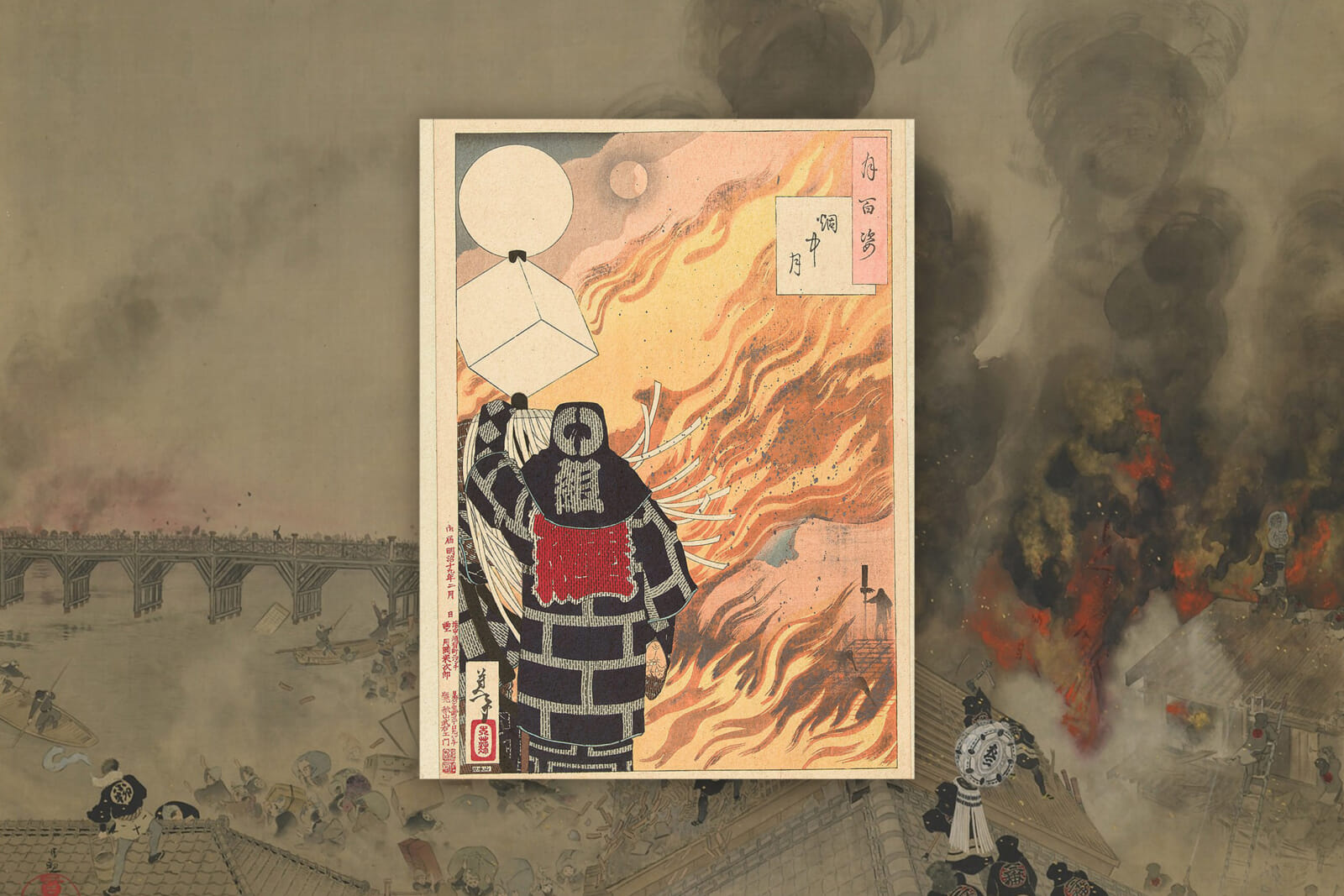
“Maan in Rook” by Tsukioka Yoshitoshi (top) courtesy of Rijksmuseum, “The Great Fire at Ryōgoku Bridge” by Kobayashi Kiyochika (bottom) courtesy of Princeton University Art Museum
The Rainbow-Colored Mafia
Some researchers do draw a pretty straight line from the hikeshi to modern yakuza, who are, in fact, descended from various groups, including gamblers and dock workers. But Edo’s firefighters are also in there and are likely responsible for the yakuza practice of full-body tattoos.
Tattoos as punishment for criminal behavior were all the rage in the Edo period, but they weren’t decorative. Thieves, for example, were tattooed with simple bands around their arms. That’s not the kind of ink the hikeshi were sporting. They took inspiration from ukiyo-e paintings and turned their bodies into canvases displaying scenes of great battles, sacred animals and really anything elaborate enough to prove that the wearer could withstand a lot of pain. These tattoos were frequently shown off after a fire when the hikeshi literally struck dramatic poses — possibly influenced by kabuki, which loved portraying the hikeshi in stage plays — while stripped down to the waist, sometimes even down to their underwear.
Those who did not have impressive enough ink were content with showing off their amazing jackets. Edo firefighters wore distinct and reversible coats known as hikeshi-banten. During a job, they were a simple indigo color, as it turned out that the indigo dye provided some amount of protection, with fabric simply charring a little instead of instantly catching fire. But once the fire was out, the jackets were turned inside out to reveal spectacularly stitched dragons, storms and deities on the inner lining, all in beautifully vivid colors.
The hikeshi were disbanded during the Meiji period (1868–1912), but some of their traditions, like acrobatic acts on bamboo ladders performed during Japan’s Coming-of-Age Day and other occasions, keep their memory alive in the modern era.