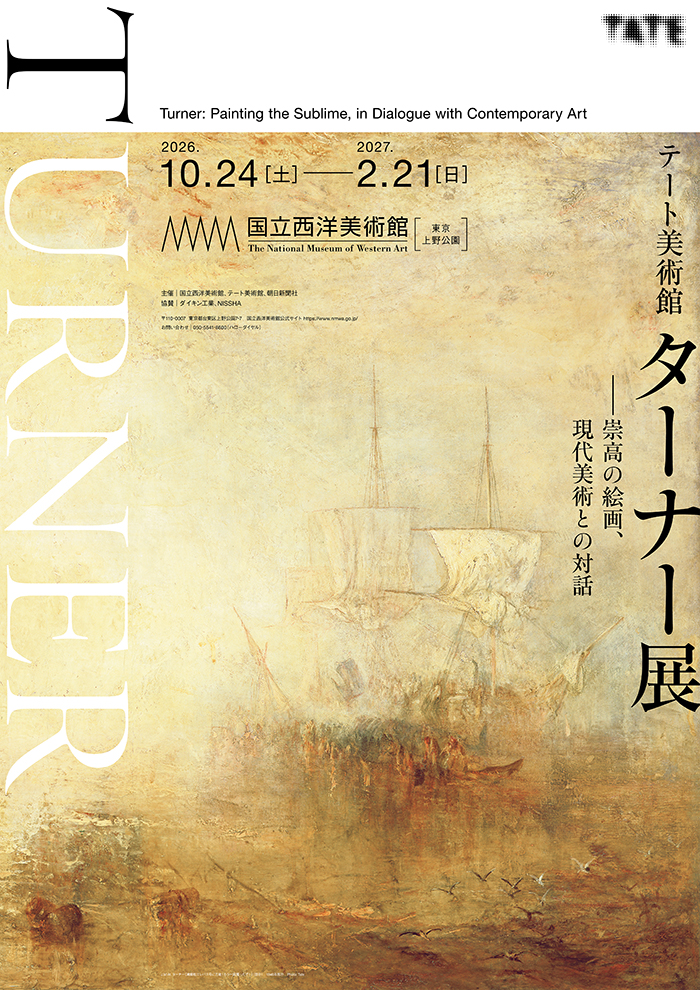
A Rare Chance To See Turner’s Dramatic Landscapes from London’s Tate Collection
For 18th- and 19th-century thinkers, writers and artists, few ideas held greater fascination than the sublime — a concept explored and defined by figures such as Edmund Burke and Immanuel Kant. Unlike traditional beauty, which emphasized harmony and order, the sublime was rooted in awe mixed with terror: the thrilling, overwhelming sensation of confronting vast natural forces beyond human control. English painter Joseph Mallord William Turner (1775–1851) became the visual master of this aesthetic principle, using sweeping light, turbulent weather and dissolving forms to capture a world where human ambition meets the scale of nature.
Bringing together over 80 works from London’s Tate collection — spanning dramatic seascapes, Venetian light studies and Alpine avalanches — this major exhibition positions Turner’s work in active dialogue with modern and contemporary practice. His 19th century masterpieces are set alongside works by artists like Mark Rothko, Olafur Eliasson, Katie Paterson and the Otolith Group.
These pairings highlight how the sublime has evolved from romanticized wilderness into urgent questions of technology, memory and environmental change. Turner’s sketches of glaciers sit opposite Eliasson’s photographic series tracking the rapid melting of those same ice sheets decades later; elsewhere, Turner’s late, near-abstract studies of pure atmospheric light share space with Rothko’s immersive color fields.