The kanabo war club is a hell of a weapon. For centuries now, the kanabo has had a strong association with oni, or demons. Even today, when you see cartoon depictions of Japanese demons, they’re almost always horned, wearing tiger loincloths and swinging around a club, sometimes wooden, sometimes reinforced with metal, often studded. There’s even a popular saying in Japan: oni ni kanabo (“to give an oni a kanabo”), meaning “to grant an advantage to someone already powerful.” But the saying might as well be “to give a samurai a kanabo” because they actually used those weapons in combat, and when they did, they turned into demons on the battlefield. This is the story of what is most likely Japan’s oldest weapon.
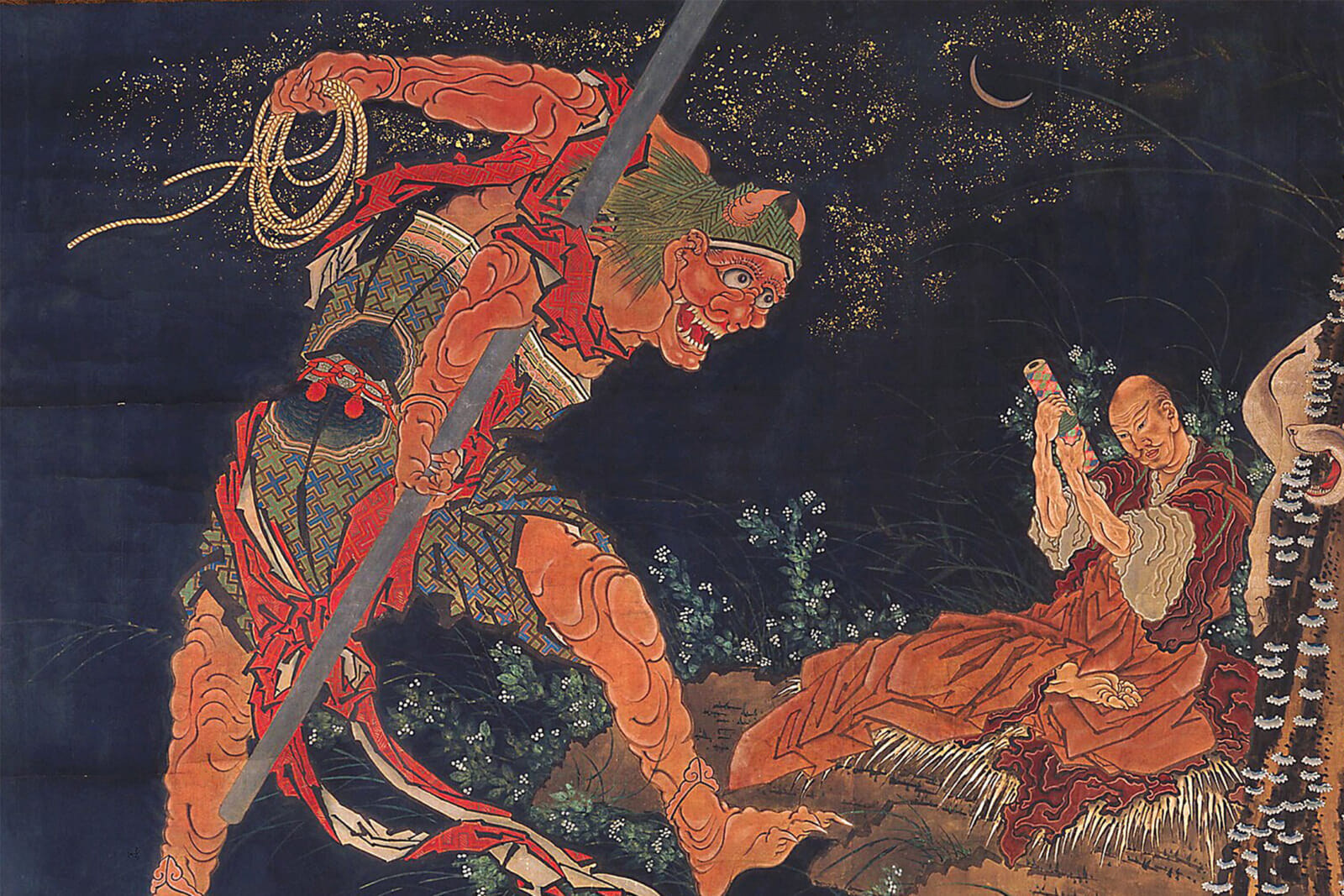
Depictions of oni usually show them carrying kanabo, such as in “Kobo Daishi Practicing the Tantra, with Demon and Wolf” by Hokusai
The Big Club: Its Name Is Kanabo
“Kanabo,” or “kanasaibo,” means “metal stick” and is technically a specific type of club in the larger striking-staff family of Japanese weapons that includes everything from heavy truncheons to massive iron-plated/studded pieces of wood that could double as roof beams. But with time, anything with a dead tree at its core (or a piece of blunt metal) that was used to hit enemies over the head started to be known as a kanabo.
This even applied to weapons that featured no metal at all, which is confusing given the “kana” (“metal”) part of the name, but it does make the nomenclature easier and lets us say with a clear conscience that the kanabo is probably the oldest weapon in Japan. Swords, bows and guns — the three most common weapons of the samurai — require pretty advanced technology to make. A heavy stick requires only finding a heavy stick and giving it a few finishing touches.
Some researchers believe that the kanabo might have roots in ritual boundary poles that guardsmen picked up during raids. But the simpler explanation is that the ancestor of the kanabo came about because the male desire to swing a stick around transcends borders and time periods. Metal was later added to it (or replaced the wood entirely) because “heavier and harder make more hurt.” Can’t argue with that logic.
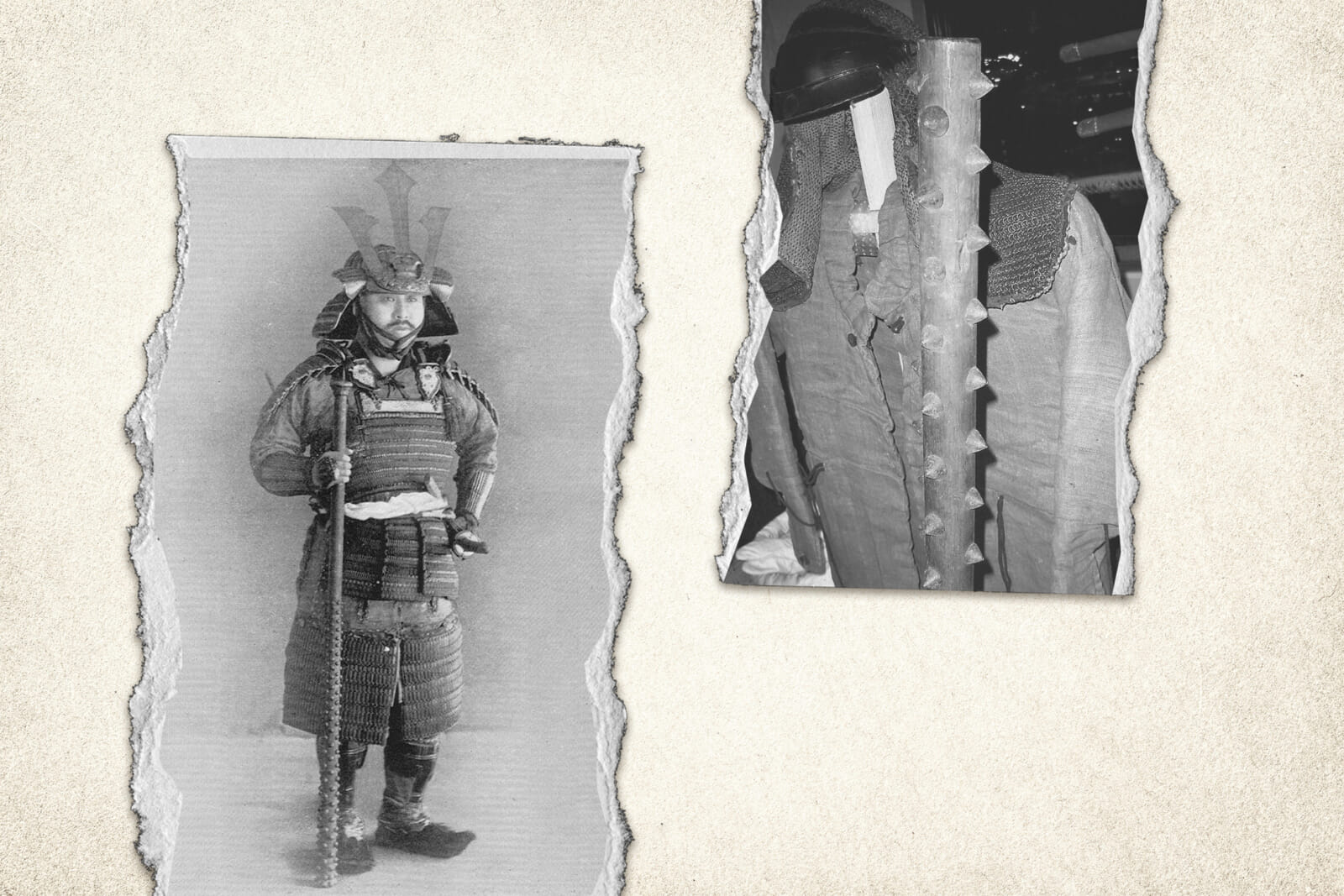
Nanhoku-cho period samurai from 1893 (left) and a tetsubo kanabo (right)
Wood-and-Iron Beats Bone, Armor and Door
The kanabo is a very simple weapon, which is why it was so popular with samurai and Japanese warriors from before the word “samurai” even existed. It was easy to make and very easy to use. All it needed was brute strength (kanabo martial arts did eventually develop as a subset of staff fighting but were rare).
However, with just a kanabo and some muscles, a person could do A LOT. Crushing the skulls and bones of your enemies was a given — with legs being a very popular target — but the clubs were also great for creating cracks in armor that a sword could slip through or stunning enemies long enough to decapitate them. There are also stories of larger kanabo being used as battering rams to break down doors during sieges.
The kanabo did not exist as some precursor to the katana or its crude alternative. A true warrior knew the right weapon for the right occasion. The katana was great for precision slashing. But in the midst of a bloody melee, trying to make your way through a throng of enemies, a heavy piece of timber and ore was much better for clearing the path. In fact, it was said that in dense, close combat, a kanabo club performed the work of 10 men.
The Kanabo Club Members
There are many stories of kanabo-wielding warriors great in both deed and stature, as the kanabo required a lot of upper-body strength. In the 14th-century historical epic Taiheiki, a warrior from the Hachishoji of Kumano is described as wielding a 242.2-centimeter-long octagonal kanabo made from oak, probably to underscore his own gigantic size. The semi-legendary samurai Miura Yoshioki (born 1496) was reportedly 2.27 meters tall and fought with the largest kanabo in recorded history, coming in at an unbelievable 3.64 meters long.
It was said that Yoshioki could fell five to 10 men in one swing of his kanabo, and had a total body count of 500, which earned him the nickname of the “warrior with the strength of 85 men,” which is so weirdly specific, it might just be true. We know for certain that warlord Mogami Yoshiaki (1546–1614) was fond of the kanabo because the statue of him in Yamagata shows him on horseback with an iron baton. He must have been really sure of his abilities because kanabo were reportedly great weapons to use against cavalry. In the historical Shiseki Shuran chronicle, one Ota Genrokuro Yasusuke struck down seven or eight mounted warriors in a single engagement using an iron kanabo.
Too Big to Succeed
The kanabo was wonderfully varied. It could be rounded, hexagonal or octagonal hardwood. It could be the same hardwood but with iron plates, iron bands, or studs or spikes. It could be made entirely from metal, either smooth or studded. It could be over 3 meters long or it could be as “short” as 140 centimeters.
Ultimately, though, it was a huge, heavy weapon for the singular warrior of great strength, and those mostly went away when Japanese warfare got more organized and spears became the big thing in the 16th century. And so, the kanabo, together with other large weapons like the odachi sword, simply fell out of use. But the club survived in the Japanese consciousness, mostly through the association with demons, as a symbol of physical strength. It’s not immediately thought of as the weapon of samurai, but Japanese warriors made frequent use of the kanabo when they didn’t have the luxury to be fancy and just needed to hit someone really, really hard.