Sadly, no samurai has ever fought a European knight or a high Renaissance-era soldier. But certain … overzealous fans of Japan are certain that in this theoretical clash, the samurai would come out victorious because, to those people, everything Japanese is superior. Things used to be the exact opposite in Japan itself, though. The birthplace of the samurai once experienced a prolonged period of fascination with European weapons and armor that forever changed the face of war in Japan. This time span is probably best understood through the lens of Kato Yoshiaki and his Japan-made Minakuchi rapier.
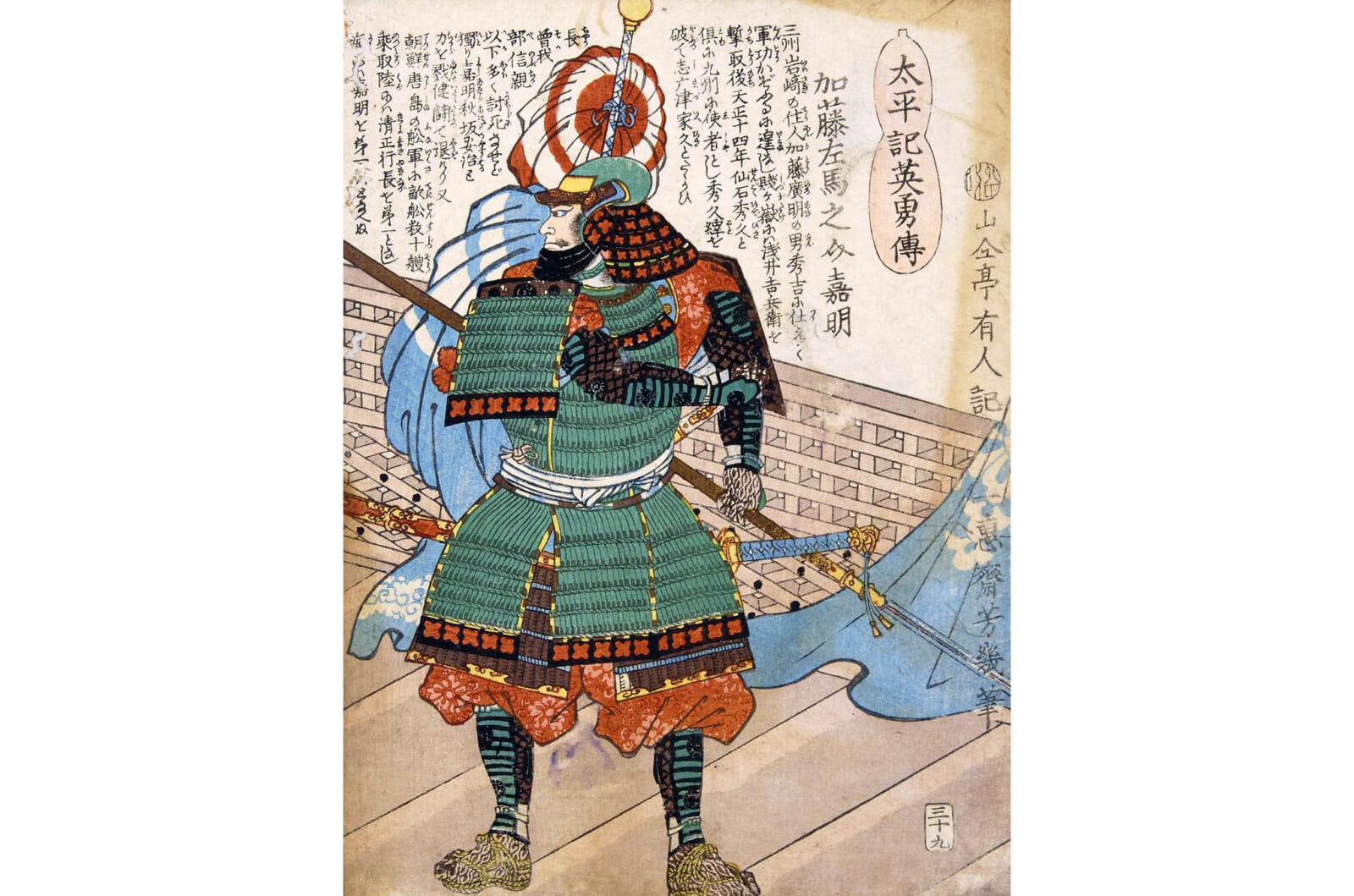
Depiction of Kayo Yoshiaki in “Heroic Legends vol. 39” by Utagawa Yoshiiku | Wikimedia
The Man: Kato Yoshiaki
It’s important to establish one crucial historical fact: Kato Yoshiaki (1563–1631) was a certified samurai badass. He came of age smack in the middle of one of the most brutal parts of the Sengoku (Warring States) period, living through the death of the Demon King Oda Nobunaga, the first unifier of Japan, and hitching his wagon to his successor, Toyotomi Hideyoshi.
Under Hideyoshi, Kato participated in the 1583 Battle of Shizugatake, a ruthless struggle for power following Nobunaga’s death. Needing to establish himself as Japan’s second great unifier, Hideyoshi moved against pretenders to the title at lightning speed, reportedly covering 52 kilometers in five hours to meet his enemies attacking the Shizugatake forts in modern-day Shiga Prefecture.
Hideyoshi reportedly crashed his enemies so badly that many ran, leaving their weapons and armor behind. Around 20,000 men fought for Hideyoshi in the decisive clash, but only seven were given the MVP title of the Seven Spears of Shizugatake in recognition of their battle prowess. Naturally, Kato Yoshiaki was one of them.
After this, Kato became one of Hideyoshi’s most trusted generals, commanding his naval forces during campaigns in Kyushu and Odawara. After Hideyoshi’s death, he sided with Tokugawa Ieyasu, the third great unifier of Japan, and distinguished himself as a leader during the Battle of Sekigahara (1600) that ensured over two and a half centuries of Tokugawa rule over Japan. For this, he was eventually made lord of the Aizu Domain (modern-day Fukushima), where he became known as an innovative administrator … with one hell of a conversation piece in his collection.
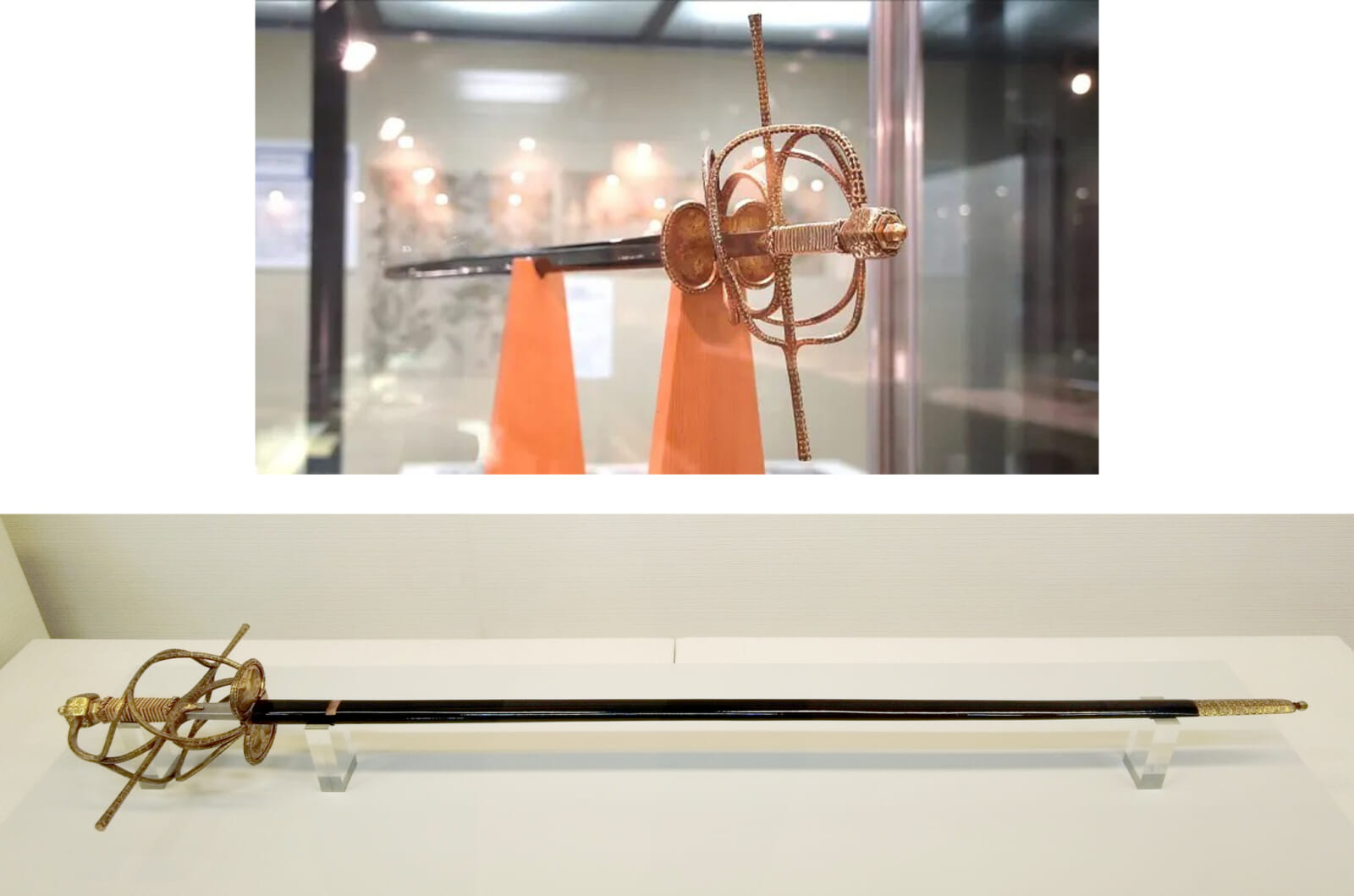
Images of the rapier on display
The Weapon: The Minakuchi Rapier
While being skilled with a katana, Kato was also the owner of a magnificent European-style rapier. It was very different from most weapons of the time. A thin thrusting blade 104.5 centimeters long with an ornate basket-type hilt decorated with intricate vine patterns, the Minakuchi rapier — named for the lands in Shiga traditionally associated with the Kato clan — was a one-handed grip sword, unlike the two-handed katana.
For years, it was thought that Yoshiaki obtained it from Portuguese or Spanish sailors after Europeans first arrived in Japan in 1543. But CT scans and examinations by an expert from the Metropolitan Museum of Art concluded that the weapon was Japan-made. The beautifully decorated copper hilt is definitely domestic, and while the blade technically could have been made in some other Asian nation, it shows specific swordsmithing techniques used in Japan, like folding the metal to remove impurities — an essential technique for mitigating the overall poor ore quality in the country.
The fact that Japanese smiths were able to create such a convincing replica shouldn’t be a surprise. It only took them a few years from seeing the first matchlock guns to faithfully copying the design and introducing firepower to Japanese battlefields.
The Minakuchi rapier does show some Japanese innovations, though. A unique screw-type “threaded pommel” mechanism attaching the blade to the hilt — a technique never observed in European rapiers — identifies Kato’s weapon as 100% Japanese. It also means, however, that the Minakuchi rapier would not have withstood actual battle conditions and was merely a decorative or ceremonial object. But it speaks to a much larger trend in mid- to late 16th-century Japan.
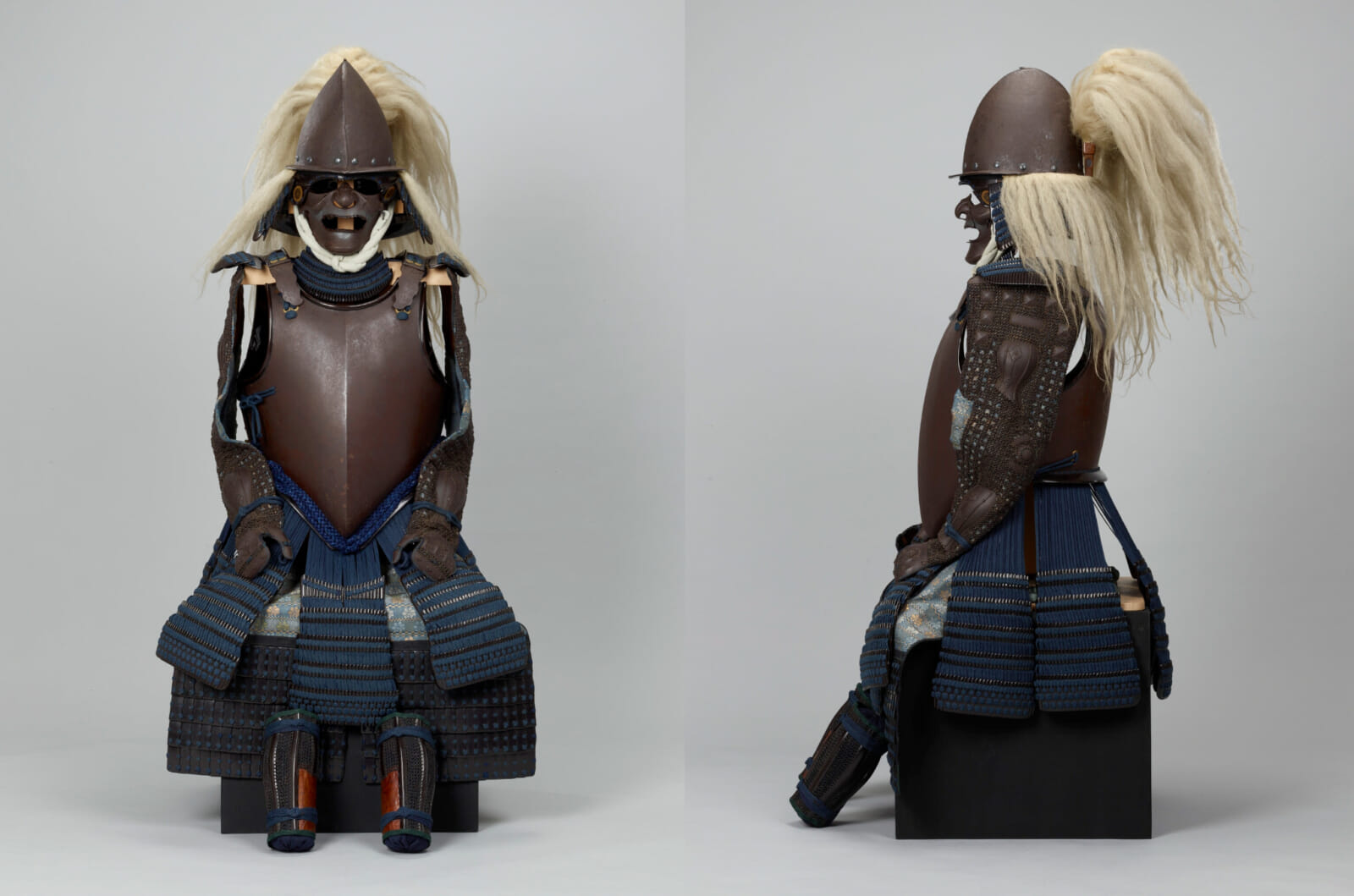
Nanban (Western style) Armor in the Tokyo National Museum collection | c/o TNM eMuseum, object no. F-20137
The Place: Europhile Feudal Japan
Japan’s interest in Europe started with the Tanegashima arquebuses, but it sure didn’t end there. With hot, flying metal projectiles now being a concern during battle, a new type of armor was required, and as it so happened, Europeans had an answer for that as well. Nanban dogusoku (southern barbarian armor, named after a general term for foreigners in Japan at the time, which shouldn’t be taken personally) was a meeting of the West and the East. It featured a European iron cuirass (breastplate) with Japanese-style guards of metal or leather plates all around, plus helmets that were varying combinations of Western and Japanese influences.
This fit the Japanese attitude toward warfare perfectly, which can best be described as “Hey, whatever works best!” Take swords, for example: A samurai with a straight-blade rapier would undoubtedly be a peculiar though very badass sight, but Japan’s pre-katana swords actually were straight. It was only with the introduction of superior armor, new troop formations and the cavalry that Japanese swords started to become curved. There’s nothing mystical or exotic about it: It’s just pure pragmatism. All samurai would have been using rapiers if they met their needs best, but being rather skinny and straight, they weren’t optimal for slashing from horseback or for iaido fast-drawing techniques.
And yet, a great warrior like Kato Yoshiaki thought that rapiers were neat, so he had a replica made for himself to … look at it and think: “Yeah, that’s cool.” In late 16th- and early 17th-century Japan, Europe was simply cool and “exotic.” Many Japanese warlords owned purely decorative nanban dogusoku and firearms, as well as European-style court clothing, all to show off just how chic they were. Yet even with all of that, the Minakuchi rapier was special. It remains the only known example of a Japan-made feudal replica of a European sword. And that really is cool.