Here’s a hypothetical scene that, for all we know, happened beat for beat and word for word during the Edo period (1603–1867): A merchant is sitting outside his shop, watching the people of Japan’s busy capital go about their business, when he spots a samurai police officer — possibly a SWAT member — leading a prisoner at the end of a rope.
“An arsonist?” he wonders, spitting on the ground in disgust. “Hope they burn him alive” — which was the punishment for arson in the tinderbox that was Edo (modern-day Tokyo). Taking a longer look, the merchant notices that the man has indeed already been sentenced and is being taken to the execution grounds. And, also, that summer has officially ended.
How did he get all that? Simple. He observed the hojojutsu used by the cop.
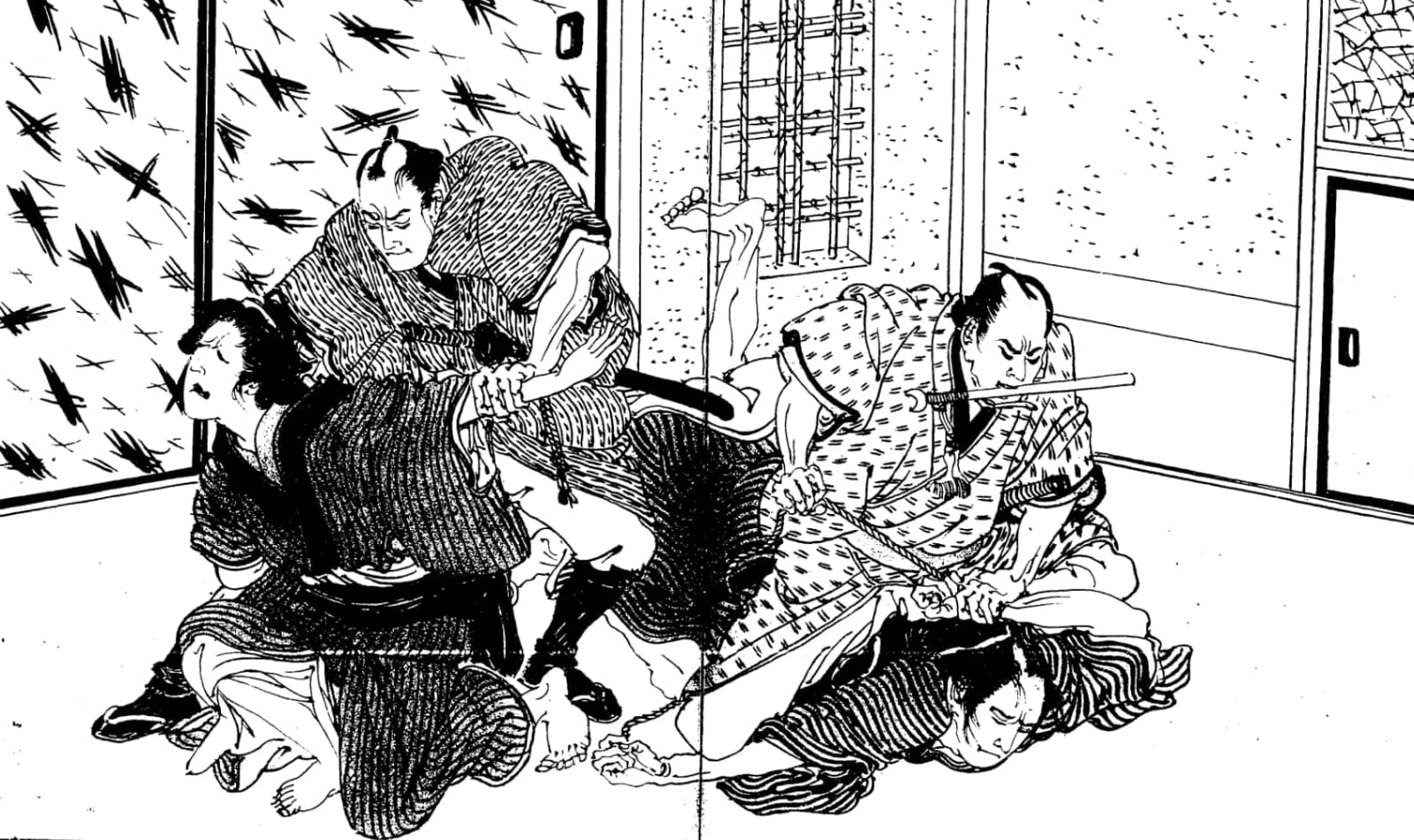
A page from the “Illustrated Guide to the Punishments of the Tokugawa Shogunate” by Fujita Shintaro, courtesy of the National Diet Library
Hojojutsu: The Art of Arrest
“Hojojutsu” literally means “rope-binding technique.” It’s a Japanese martial art focused on restraining prisoners with specially prepared cord and readying them for transport, either to the police station, Edo Castle, the city’s prison from hell or just generally through the streets as an act of public shaming. It’s also known as torinawajutsu (capturing rope technique) or simply nawajutsu (rope technique), and it was so much more than the feudal Japanese equivalent of slapping on a pair of handcuffs or using zip ties.
Hojojutsu was a form of combat. It was used almost exclusively by samurai police — who were encouraged not to kill in the course of their investigations or during arrests — but it was capable of inflicting a lot of damage if the rope-wielder wished it so (more on this in a bit). In the right (or wrong) hands, a piece of rope could be a terrifying weapon. Not surprising when you consider that the art evolved from practices first developed during the Warring States period of near-constant civil war.
Nearly 150 years before the Edo era, there was definitely less art and more torture to proto-hojojutsu. But during the 1600s, when samurai weren’t waging war, they had a lot of time to sit around and think up creative uses for a length of rope. With time, many different schools developed their own takes on hojojutsu, which eventually started to incorporate ceremonial and symbolic elements into the system until it became a fascinating expression of martial proficiency, social hierarchy and aesthetics.
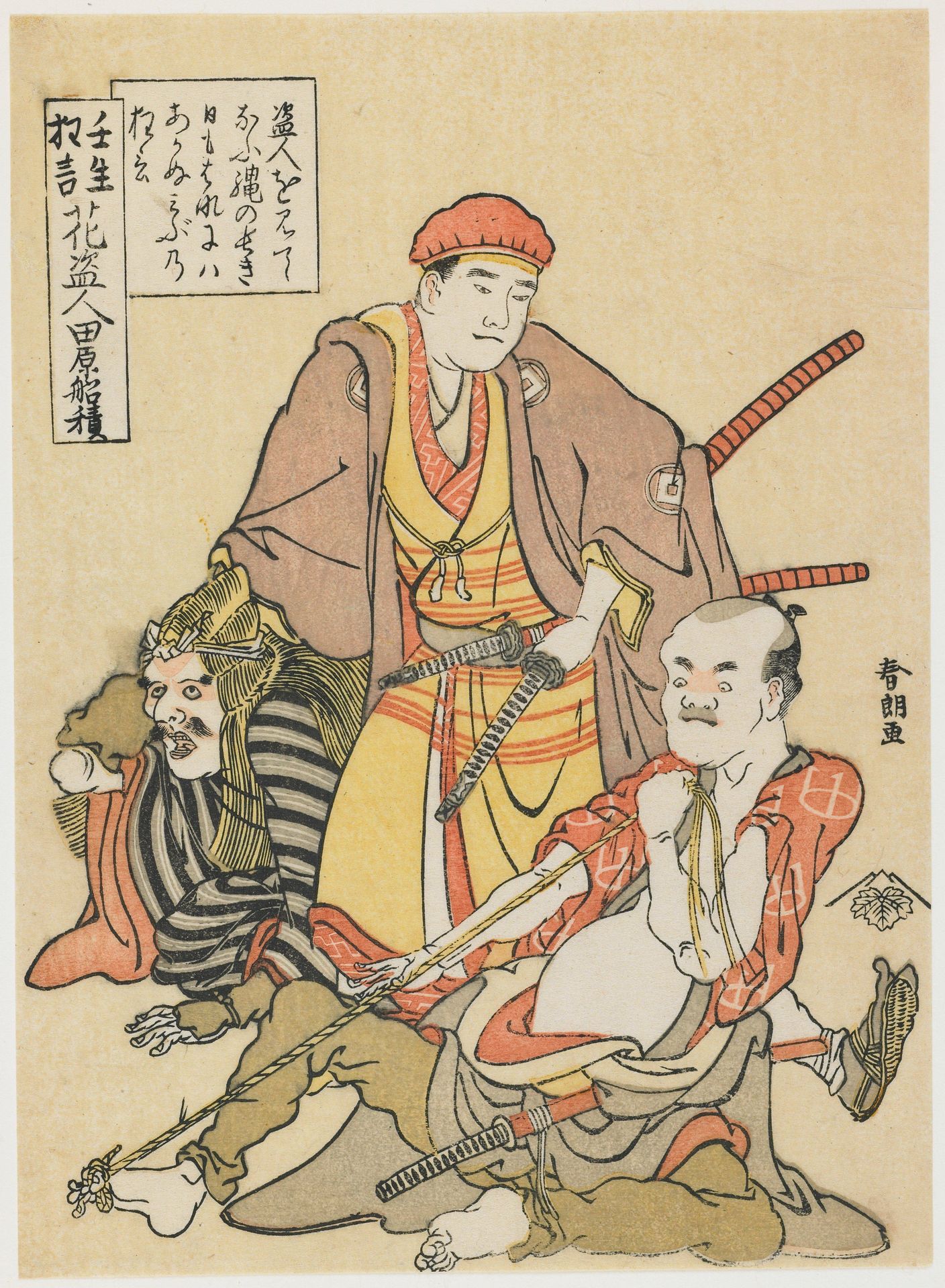
“Flower Thief” by Katsushika Hokusai (c. 1790), courtesy of the Minneapolis Institute of Art
Reading the Rope
Knots were an important part of hojojutsu training, but equally important was to know when to use them. The presence of a knot, especially with a binding around the neck, meant that a person was officially tied up. Like an animal. It was the height of disgrace in Edo culture. Merely having rope wrapped around you (using principles of leverage and friction) wasn’t necessarily shameful, which is why suspects who hadn’t been convicted of anything yet were usually restricted with no knots or tied up stealthily underneath their clothing. Convicted criminals, though, especially ones being taken away to their deaths, sported very distinct and also apparently beautiful knot patterns.
Later hojojutsu was meant to be both practical and aesthetically pleasing. It prevented escape while focusing on visual symmetry and eye-catching designs that told you all about the arrestee’s social status, gender, the severity of their crime and more. Samurai, for example, were bound with a “double diamond” pattern, while women of most classes got the “breast-hooking” tie. There were even special binding patterns for children, monks, the blind, strongmen and other segments of the population.
Also, if the rope was a simple cord made from hemp, it meant that it was a “fast rope” (hayanawa) employed for immediate capture and short-term restraint. Ornate binding indicated a honnawa “main rope” used for transporting a prisoner to a court appearance or their execution. Both types of rope often came in red … because they were dyed with animal blood.
This wasn’t just cool (although it was super cool) but it also made the rope more durable and easier to handle, since the salt in the blood preserved the fibers. However, Edo authorities would sometimes switch to different colors or tones depending on the time of year, like lighter in the spring, darker in the winter. It was a purposefully unnecessary detail that added authority to the practice. By spending time, manpower and money on changes to the color of rope used by Edo police officers, the ruling shogunate said: “We have the resources to do this. We’re the ones in charge.”
In the end, a person bound with hojojutsu rope could hide their face as much as they wanted. Their binding told their criminal history and fate to all those who knew how to read the rope.
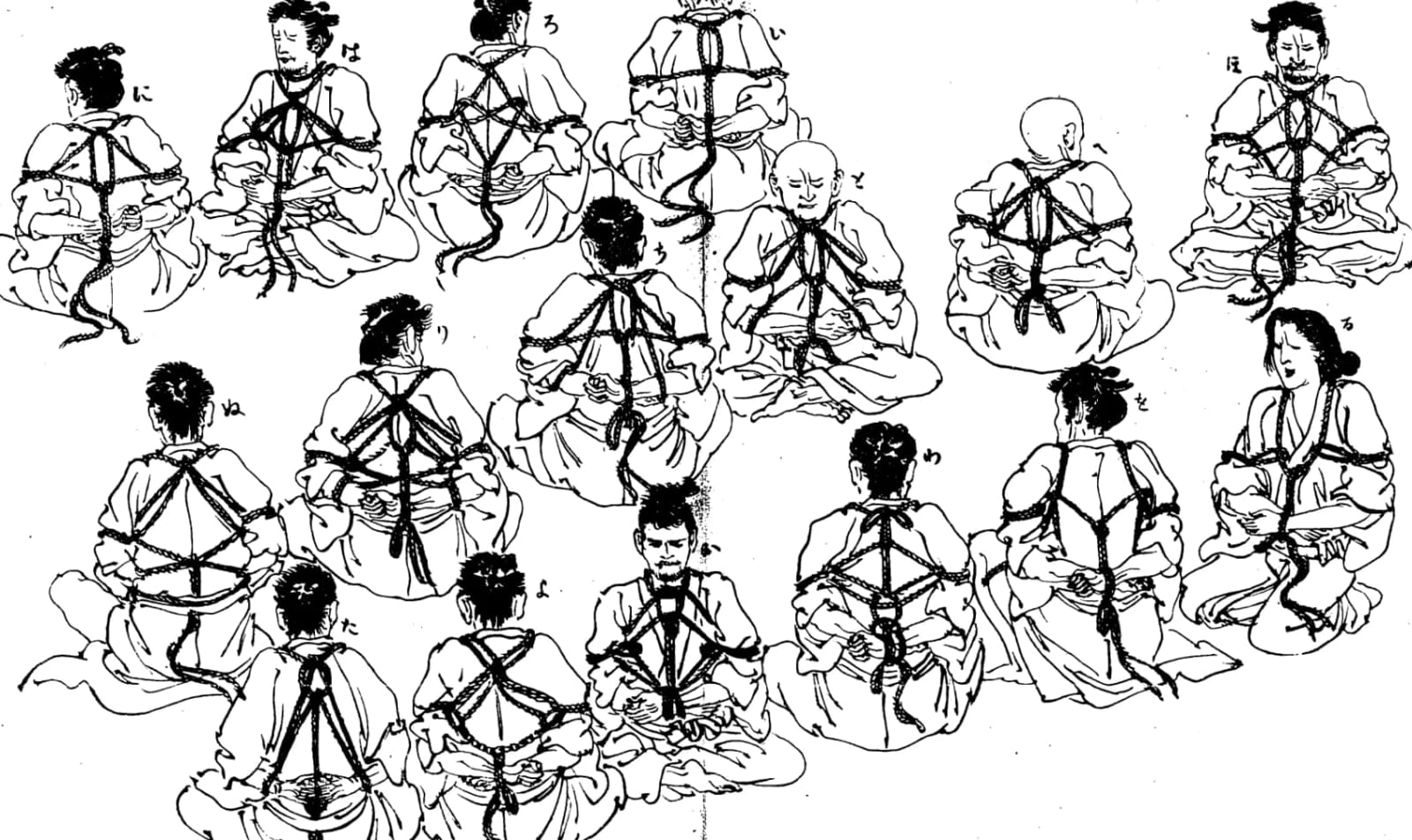
A page from the “Illustrated Guide to the Punishments of the Tokugawa Shogunate” by Fujita Shintaro, courtesy of the National Diet Library
Never Get Roped Into a Samurai Rope Fight
Hojojutsu was almost always taught alongside more traditional combat techniques like jujutsu. The rope was supposed to come out only after a suspect had been subdued. But no plan survives an encounter with the enemy, and since many Edo police officers didn’t carry swords, they sometimes had to resort to fighting with their hojojutsu ropes. Some honnawa would occasionally feature rings and hooks for easier, knot-free binding, which became serviceable improvised weaponry when an arrestee refused to surrender. There was also weighted rope that, in a pinch, could make for a good makeshift flail.
But the most damage that hojojutsu could inflict was during torture. Hojojutsu really was an art that was studied and improved upon until it unlocked the secrets of joint immobilization, leverage, applying pressure on the nerves and restricting blood flow. People who committed especially heinous crimes often found themselves at the end of a very unpleasant rope, where the pain crept up on them gradually and intensified when they made the tiniest move, forcing them into inhumanely uncomfortable positions. Tied up like lobsters or suspended from beams, many Edo criminals learned that, sometimes, a beatdown was the more merciful option.
Hojojutsu is still practiced today, sometimes by select police departments, although it’s primarily taught by traditional martial arts schools … and bondage enthusiasts. Techniques stemming directly from hojojutsu eventually found their way into the world of Japan’s BDSM, where they became erotic arts like shibari and kinbaku. Hey, as long as people are keeping tradition alive, there’s no reason to tie yourself in knots about how they’re doing it.