
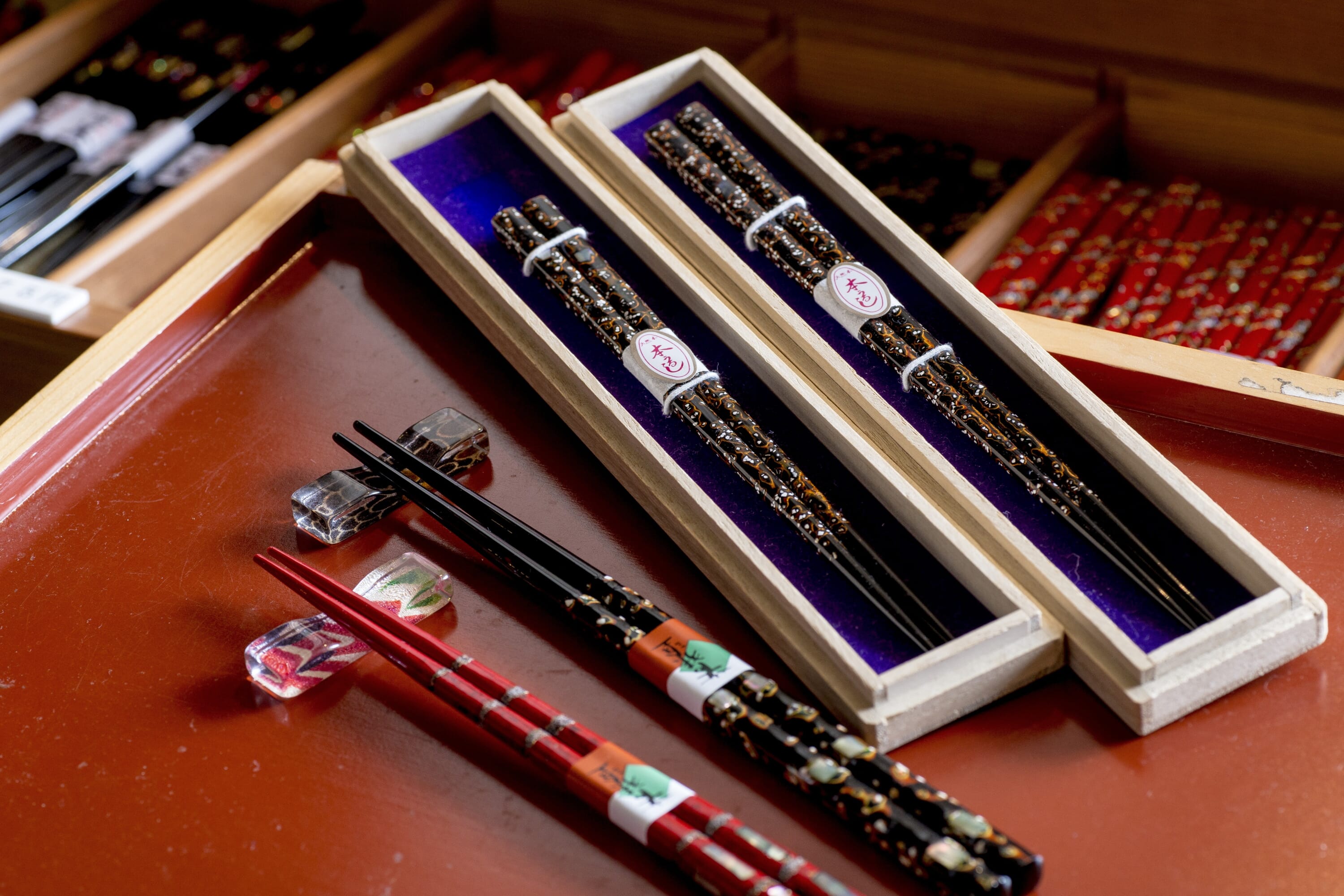
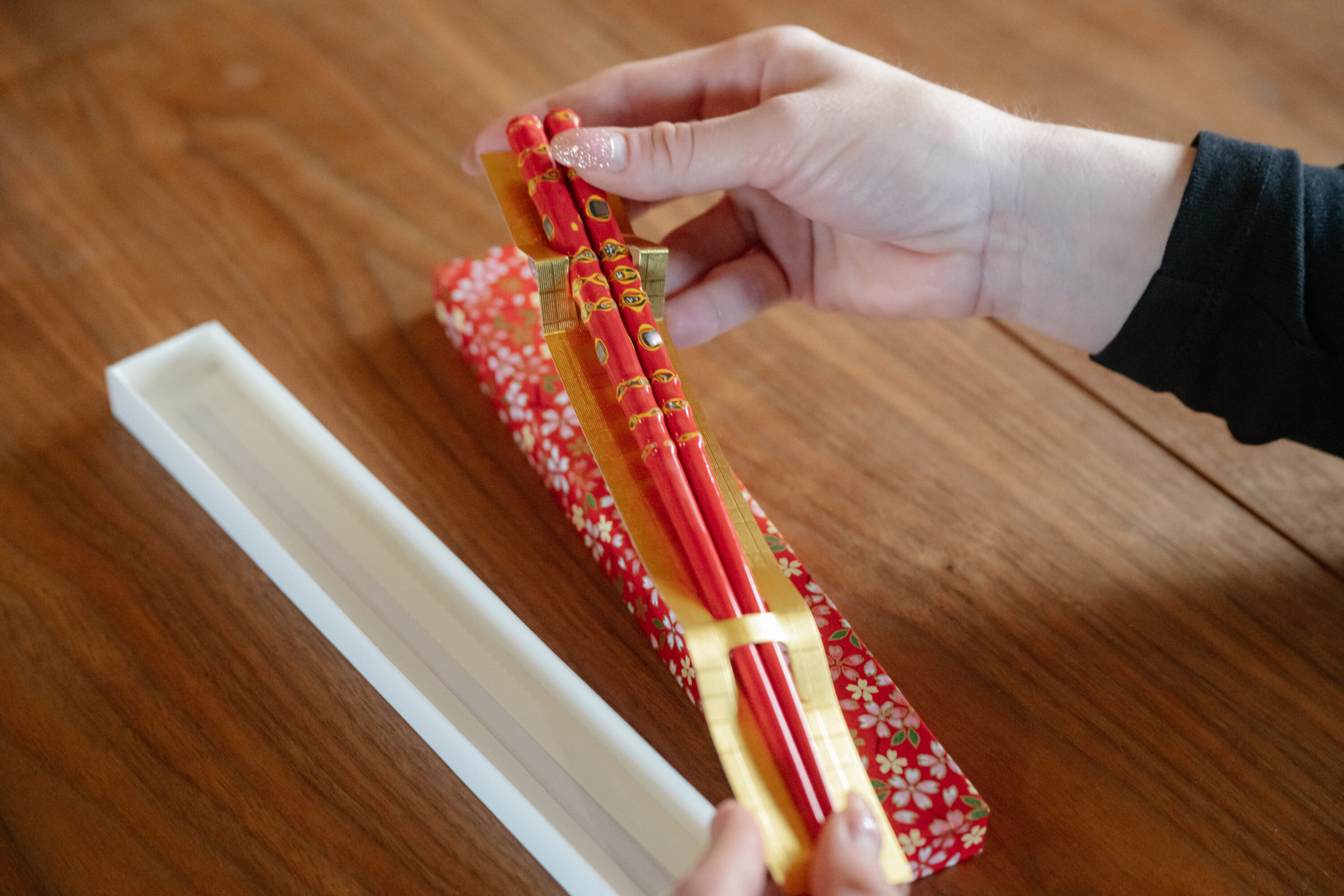
A pair of Wakasa lacquered chopsticks are immediately recognizable for their intricate patterns. Depending on the artisan’s design, you might see shimmering ribbons of mother-of-pearl, delicate flecks of crushed eggshell or bold geometric undertones of red, yellow and gold gleaming across a dark, polished surface. Originating in Fukui Prefecture’s Obama Bay during the Edo period, this heritage craft transforms an everyday utensil into a miniature, atmospheric landscape.
Today, Obama City produces roughly 80 percent of Japan’s domestically lacquered chopsticks. It’s a remarkable legacy for a small coastal city, where a craft once associated with elite court luxury has become closely intertwined with one of the most ordinary objects on the Japanese table.
It’s one of the many reasons why Fukui, despite remaining off the standard tourist trail, offers some of the country’s most rewarding detours. In Obama City, you can experience that rich craft culture firsthand at small workshops, where visitors can polish their own pair of chopsticks to take home as a one-of-a-kind souvenir.

Obama City: The Chopstick Capital
Fukui has long been famous for its lacquerware, fostering distinct regional craft lineages that carved out their own niches. In the prefecture’s northern region, for instance, Echizen draws on 1,500 years of lacquerware history, crafting both rounded soup bowls (marumono) and angular bento boxes (kakumono). Further south along the coast in the Wakasa region, Obama City built its craft identity differently through a focus on dining utensils. Over the centuries, Wakasa lacquerware became virtually synonymous with chopsticks.
The technique behind Wakasa lacquerware dates back to the early 17th century, when Matsuura Sanjuro — a craftsman serving the Obama domain — designed a pattern capturing the sunlit seabeds of Wakasa Bay. Impressed by its beauty, his lord officially named the style and promoted its production among lower-ranking samurai to boost the domain’s economy.
The Art of Wakasa Lacquerware
Unlike lacquer styles in which motifs are painted directly onto the surface, Wakasa lacquerware embeds its patterns beneath it: Artisans arrange natural materials — mother-of-pearl, pine needles, eggshells, rice husks — over an intermediate coat of lacquer, then seal them under multiple layers of color-dyed lacquer and gold leaf.
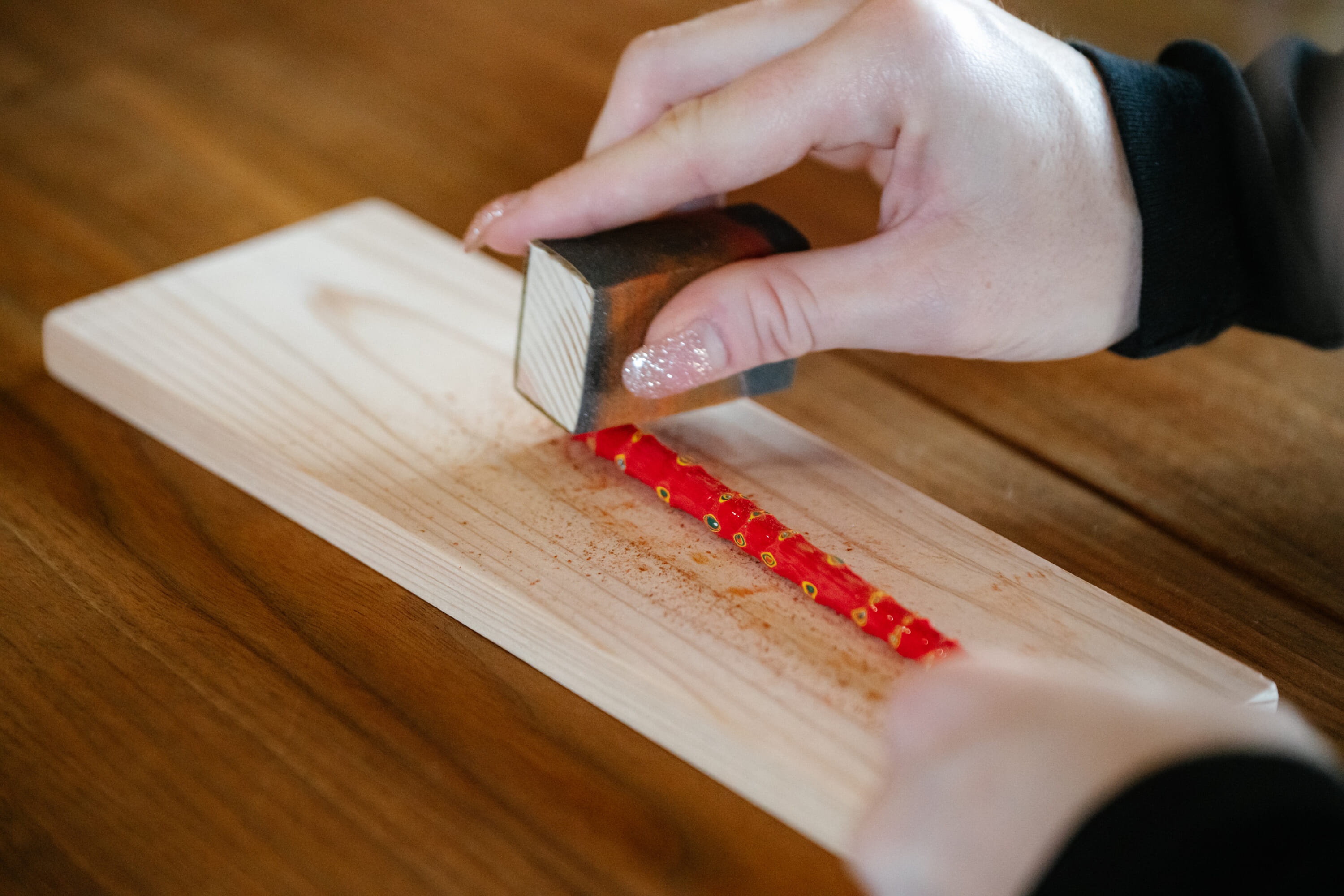
The design only emerges at the very end, through a painstaking, multi-step polishing process called togidashi. Using a series of progressively finer whetstones, charcoal and hand-rubbed oils, artisans sand away the outer dark coats of lacquer. The embedded materials gradually surface, reminiscent of light filtering through ocean water. Because a single craftsman handles every step, from the raw wood base to the final polish, no two pairs of chopsticks ever look identical.
During the Edo period, this labor-intensive process made Wakasa lacquerware a sought-after luxury among samurai families, court nobles and wealthy merchants. When Japan modernized during the Meiji period in the late 19th century, lacquered wooden chopsticks became an essential item in households across the country.
Obama’s artisans adapted their production to meet broader consumer demand, while preserving the beauty and intricacy of techniques honed over generations. That shift helped establish Obama as Japan’s chopstick capital — a legacy that continues today.
Chopstick Polishing Workshops in Obama City
While crafting traditional Wakasa lacquerware from scratch involves more than 60 steps and takes months to complete, the final step — togidashi polishing — takes less than an hour to try yourself.
Several workshop spaces in Obama City host hands-on sessions where instructors supply chopsticks that artisans have already pre-layered with lacquer and embedded materials. Using water and fine sanding tools, you can slowly rub away the dark outer coat to uncover the colorful patterns beneath. It’s a meditative and calming activity that gives you a glimpse into centuries of artisanship.
Here are three places in town where you can book a workshop:
Hashi no Furusatokan Wakasa (Chopstick Museum Wakasa)
- Details: Accommodates groups of up to 30 people (up to 10 participants at a time across 10 polishing stations). Parking available for cars and tour buses. Closed Thursdays and during the New Year holiday period.
- Duration: Approx. 10 minutes
- Fee: ¥1,100 per person
- Address: 8-1-3 Fukutani, Obama City, Fukui
- Website: https://wakasa-hashi.com/
- Reservations: Required by the previous day via phone (+81-770-52-1733), website or fax (+81-770-53-0043)
Miketsukuni Wakasa Obama Food Culture Museum
- Details: Capacity for 1 to 75 people. On-site parking available. Closed Wednesdays (open if Wednesday falls on a national holiday) and New Year holidays (Dec. 28 – Jan. 5).
- Duration: Approx. 40 minutes
- Fee: ¥1,500 per person
- Address: 3-4 Kawasaki, Obama City, Fukui
- Website: https://www1.city.obama.fukui.jp/obm/mermaid/en/
- Reservations: Bookings available via phone (+81-770-53-1034) or website.
Takatori Paper Industry Co., Ltd.
- Details: Multilingual support is available for international travelers. On-site parking available.
- Duration: Approx. 2 hours
- Fee: ¥5,500 per person
- Address: 14-1 Asama, Obama City, Fukui
- Website: https://www.takatoriproject.com/
- Reservations: Book through official LINE account.
(Note: Seiwa Chopsticks Co., Ltd. [6-2 Ryuzen, Obama City; TEL: +81-770-56-0884] remains a major industry landmark in Obama, though its on-site polishing workshops are currently suspended.)