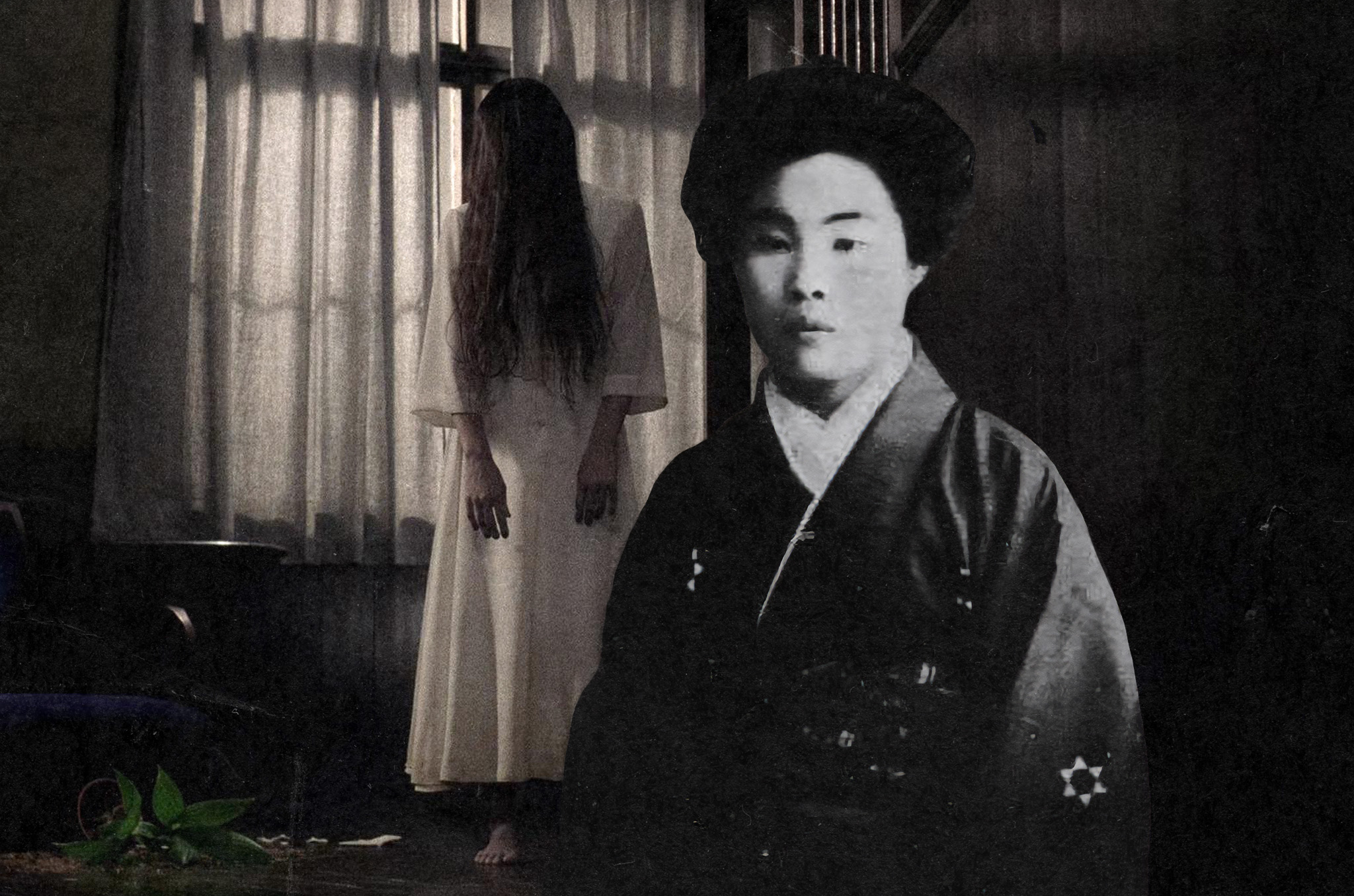
On Halloween, few images are as instantly unsettling as a ghost crawling out of a television screen. In The Ring, Sadako’s curse turns an ordinary recording into a source of terror. But behind this iconic horror story lies a real person whose life helped inspire its disturbing mythology: Chizuko Mifune, a Japanese woman who claimed to possess psychic abilities in the early 20th century.
Long before Sadako haunted screens around the world, Mifune’s alleged powers attracted public fascination, scientific scrutiny and controversy. They also inspired the backstory of Sadako’s mother, Shizuko Yamamura, in Hideo Nakata’s supernatural psychological horror film. This Halloween, Mifune’s story offers an opportunity to look beyond the cursed videotape and explore the real-life events and beliefs that helped shape a modern horror legend.
Chizuko Mifune and the Missing ¥50
Mifune was born on July 17, 1886, in Kumamoto Prefecture, Japan. Her father, Hidemasu Mifune, practiced traditional medicine, and she grew up in a household shaped by established healing traditions and religious beliefs. Accounts of her early life are limited, making it difficult to establish much about her childhood with certainty, though according to some accounts, she experienced progressive hearing loss from a young age.
In 1908, the then-22-year-old married Yoshikane Kawachi, an officer in the Imperial Japanese Army. Their time together was brief, as Kawachi was deployed to Manchuria just three weeks after their wedding. While he was away, Mifune remained with his parents. During this period, an incident involving missing money reportedly occurred, setting the stage for an unexpected turn in her life.
According to the most commonly recounted version of the story, ¥50 belonging to Kawachi went missing while he was away. Although accounts differ over the precise circumstances of the incident and who was responsible, the episode is frequently linked to the emergence of Mifune’s alleged psychic abilities, as she reportedly used a “sixth sense” to identify a cupboard near the household altar where the money could be found.
A New Chapter
The discovery reportedly sent shockwaves through the household. Instead of earning Mifune recognition, the revelation allegedly incited accusations of theft and deepened tensions with her in-laws. Accounts differ over who was driven to desperation: Some claim Mifune attempted to take her own life after being accused, while others say her mother-in-law did so, fearing she would be blamed for the missing money.
The incident is also linked to the breakdown of Mifune’s marriage, which ultimately ended in divorce. She subsequently returned to Kumamoto, reportedly in disgrace, at a time when divorce carried considerable social stigma for women. In Meiji-era Japan, a woman’s social standing was closely tied to her marriage and family, making separation a potentially isolating experience. For Mifune, it also marked the beginning of a new chapter.
Her sister’s husband, Takeo Kiyohara, had an interest in hypnotism and began experimenting with the practice on Mifune. He reportedly became convinced that she possessed clairvoyant abilities. Under his guidance, she took part in experiments to test her supposed powers, marking the beginning of a journey that would soon attract public attention and draw her into Japan’s growing fascination with psychic phenomena.
The Senrigan Phenomenon
Under Kiyohara’s guidance, Mifune reportedly used her alleged abilities to diagnose illnesses at the family clinic and even helped a local merchant strike it rich by identifying a vast underground coal deposit. These claims fueled the senrigan (clairvoyance) phenomenon, earning her local fame that eventually attracted the attention of Tomokichi Fukurai, a psychologist at Tokyo Imperial University whose research into psychic phenomena would open Mifune’s claims to wider scrutiny.
Fukurai investigated Mifune’s claims of tokenho, a form of clairvoyance said to allow her to see through sealed containers and solid objects. Initial experiments involved identifying characters concealed inside sealed envelopes. Public demonstrations were then held in Tokyo, attracting the attention of academics and newspaper reporters. These tests brought Mifune’s supposed abilities to a bigger audience — but questions remained about the reliability of the demonstrations.
The tests produced mixed results, but one incident proved particularly damaging: Mifune identified characters in a lead tube that turned out to be a practice object Fukurai had given her beforehand rather than the official test object. Fukurai maintained that the mix-up was unintentional, but suspicions of fraud spread. Facing criticism, Mifune returned to Kumamoto and died by suicide on January 19, 1911. She was 24.
The Ring Connection
Mifune’s story later found an echo in Japanese horror. Koji Suzuki’s 1991 novel Ring introduced Shizuko Yamamura, the psychic mother of Sadako, whose abilities become the subject of a public demonstration. In Hideo Nakata’s 1998 film adaptation, Ringu, screenwriter Hiroshi Takahashi drew on Mifune’s alleged psychic abilities to develop the film’s unsettling imagery of distorted photographs. Nakata discussed this influence in a 2000 interview.
“As a paranormal this woman, Mifune, was able to project written words on paper and make words materialize on paper, these are things that paranormals can usually do,” Nakata said. “This kind of shinrei shashin, which is the appearance of ghosts and spirits in photos, apparently really happened in Japan … All this is related to the photographs and the image distortion we used in the film.”
Mifune was not the only real-life psychic associated with Japanese horror. Sadako Takahashi, another woman studied by Fukurai, reportedly practiced nensha, or thoughtography, the alleged ability to project mental images onto photographic plates. Her story is linked to the origins of Sadako’s character, whose psychic powers form the basis of the curse. Together, Mifune and Takahashi helped shape the psychic mythology behind one of Japan’s most enduring horror franchises.