Many large retail complexes treat art as decoration — a sculpture in the lobby, a mural in the escalators. But Ginza Six, which opened in Tokyo’s Ginza district in 2017, approaches art with careful curatorial intent.
Its central atrium, for instance, has become one of the city’s most surprising venues for cutting-edge contemporary art, hosting major commissions by the likes of Yayoi Kusama, Kohei Nawa and Kenji Yanobe under the ongoing theme “From Ginza to the World.”
Essentially, Ginza Six isn’t just a shopping destination; it’s a cultural platform as well. Its latest collaboration makes that case more clearly than ever: Renowned British contemporary artist Julian Opie currently has works displayed across three distinct locations within the building — the ground floor entrance, the rooftop garden and the soaring central atrium.

The Rooftop Garden: A Playground in the Sky
Two new works by Opie are on display from April 10 through June 30, 2026. Both are centered on the figure of the walking child, and they appear at opposite ends of the building, bookending the visitor experience from the moment of arrival to its highest point.
On the rooftop Ginza Six Garden, 20 Children presents 20 sculptural figures modeled after real children, scattered across the open-air space. The works invite visitors to move among them, encountering each figure at close range against the Ginza skyline. When pushed, the figures swing back and forth and left and right, as if actually on a walk.
There’s also something quietly affecting about the scale and the stillness: children rendered at human height, unhurried and absorbed in their own movement, set within one of the more unexpectedly serene spaces in central Tokyo. The garden becomes a playground imagined in sculpture — open, unforced and oddly tender.
The Ground Floor Entrance: Animating Everyday Streetscapes
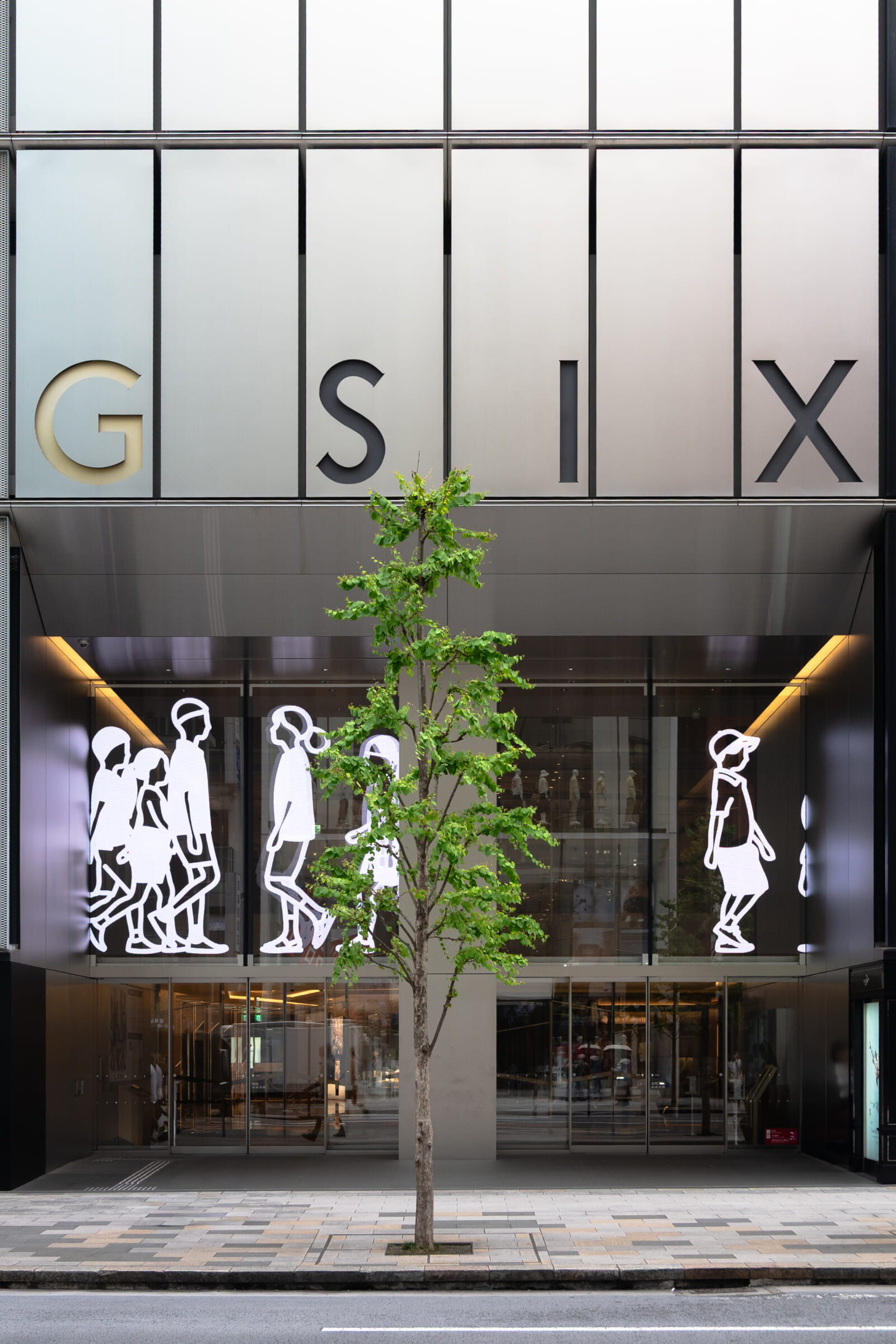
At the ground floor, Opie employs mesh LED technology for the first time, presenting Playground, a video work on a mesh-structured LED display installed across the glass windows above Ginza Six’s main entrance. Here, his minimal line-drawn figures mirror the unhurried pace of the pedestrians below.
Children of different ages seem to inhabit the same space as the city itself, the everyday world and Opie’s distilled version of it briefly occupying the same plane.
The Atrium: An Infinite Marathon
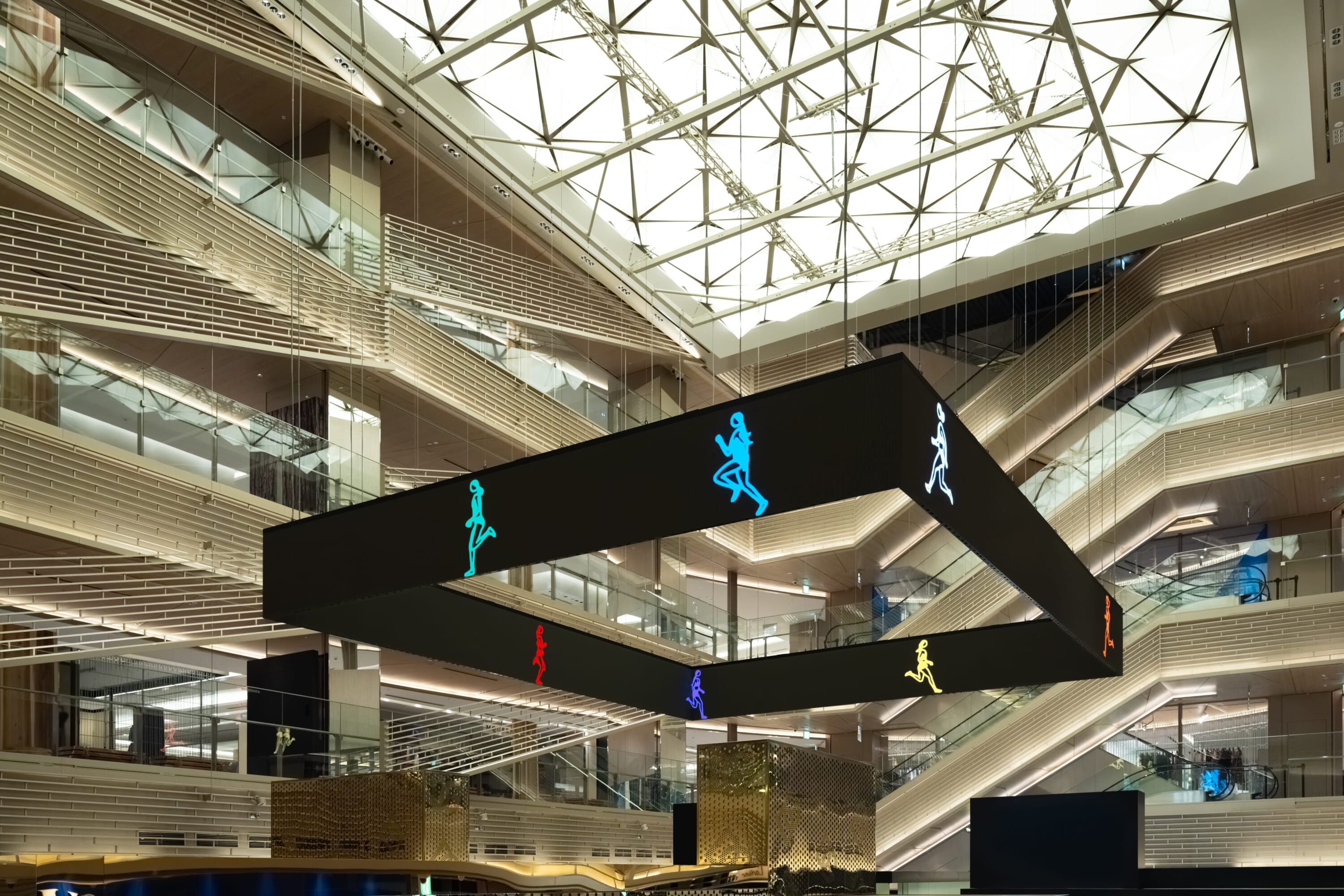
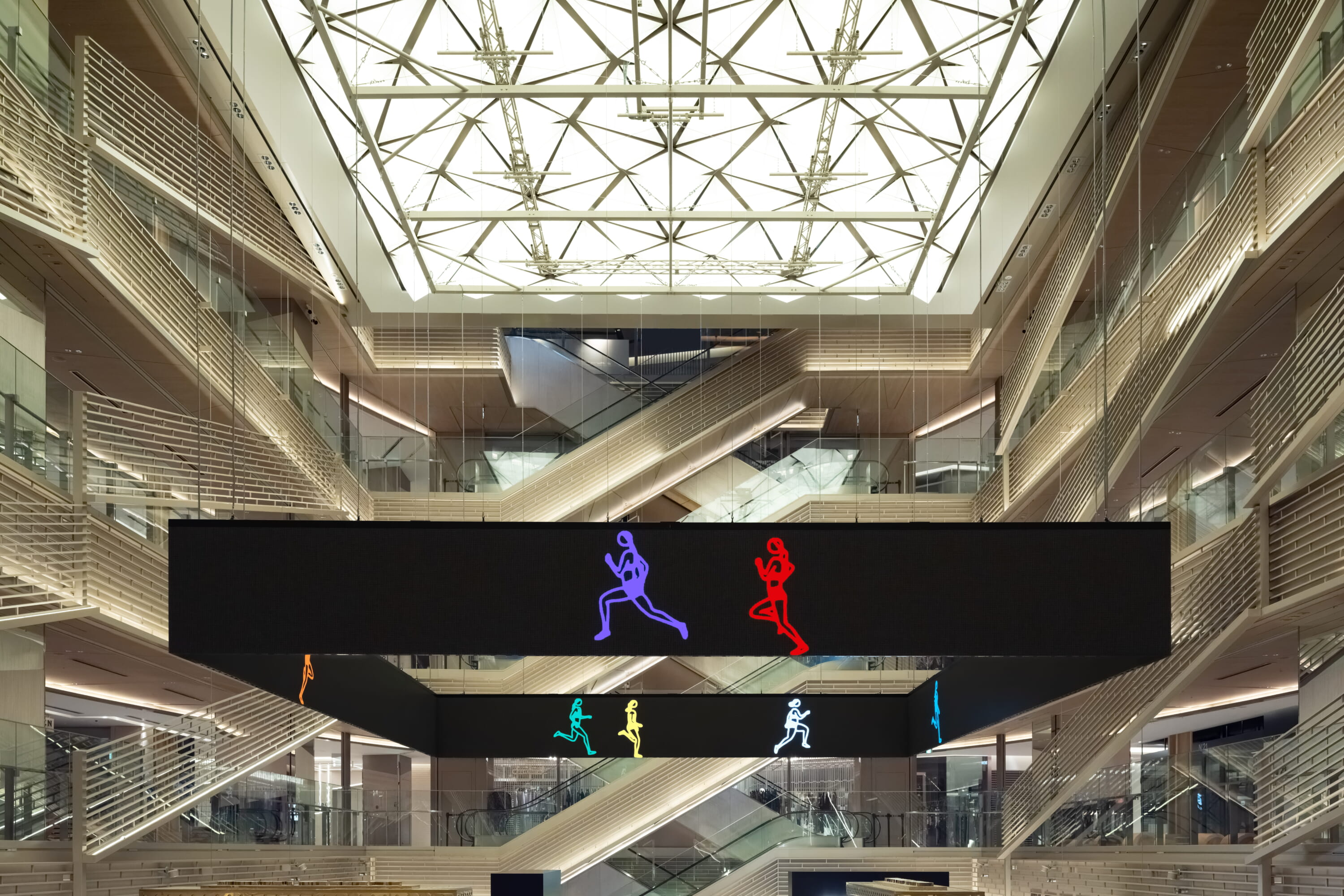
The building’s central atrium is Ginza Six’s most dramatic stage, and Marathon. Women., which has been on display since September 2025, makes full use of it. The large-scale LED film installation features seven runners inspired by British sprinters, each moving at a different speed and rendered in a different colour, endlessly crossing a floating rectangular screen.
The effect is hypnotic — a procession of simplified, vibrantly coloured figures caught in perpetual motion. Viewable from both sides of the screen across floors two through five, the piece rewards movement — experienced differently from above, below or while travelling between levels on the escalators.
“I am quite careful with public art projects,” Opie said in an interview with Ginza Six in June of 2025. “They should be engaging but not annoying. Galleries and museums are like a row of white rooms, but the real world is not like that. Taking art outside and attempting to bring it to the attention of more people in a space like Ginza Six is an interesting task.”
About Julian Opie
Opie’s central preoccupation, sustained across more than four decades, is a deceptively simple one: How much can you remove from an image of a person before it stops being recognizable as one? The resulting figures — bold outlines, flat color and no superfluous detail — occupy a strange and compelling middle ground; they read instantly like signage, yet carry the weight of portraiture.
Emerging in the early 1980s just before the generation that would define the YBA (Young British Artists) movement, Opie has shared that era’s appetite for collapsing the distance between high culture and everyday life, as embodied by his iconic cover artwork for Blur’s Best Of album in 2001. Since then, his public commissions have extended across the globe from London, the United States, Switzerland, Portugal, Hong Kong, as well as to Tokyo and Takamatsu.
“I am often asked what I think people will take away from looking at my work. I don’t have a clear answer, but to be honest, it’s not really my business,” Opie said in an interview with Ginza Six. “I see myself as a toddler playing in a sandpit or an explorer discovering a new world … Showing my work is more like an invitation to join me in playing, investigating or simply looking at things.”
More Information
Address: Ginza Six, 6-10-1 Ginza, Chuo-ku, Tokyo 104-0061
Phone: 03-6891-3390 (Inquiry hours: 10:30 – 20:30)
Shops & Cafes Hours: 10:30 – 20:30
Restaurant Hours: 11:00 – 23:00
*Hours may vary for some establishments.
Website: Ginza Six Art Program