
Hayden Panettiere passed away on Sunday at the age of 36. Her death has prompted an outpouring of grief from the actors and friends who knew her, including her former Heroes co-star Masi Oka, who remembered her as someone “way wiser beyond her years” and lamented that she was “gone too soon.” Panettiere, who rose to fame as the seemingly indestructible cheerleader Claire Bennet before starring in Nashville, was remembered by those around her for much more than her work onscreen. Yet one of the most remarkable chapters of her life took place far from Hollywood, in Taiji, a small coastal town on the Kii Peninsula in Wakayama Prefecture.
That was where the actress, who made a name for herself playing a cheerleader with the extraordinary ability to heal from almost any injury, put herself in the path of a real-world confrontation. After launching the “Save the Whales Again!” campaign alongside several of her Heroes castmates, she joined a group of activists working with the Whaleman Foundation in an attempt to disrupt the annual dolphin hunt in Taiji in the fall of 2007. It was an act of activism that would later become part of the Oscar-winning documentary The Cove. Along with five other surfers, Panettiere, who was just 18 at the time, paddled out into the cove where the hunt took place. The peaceful protest was broken up by fishermen.
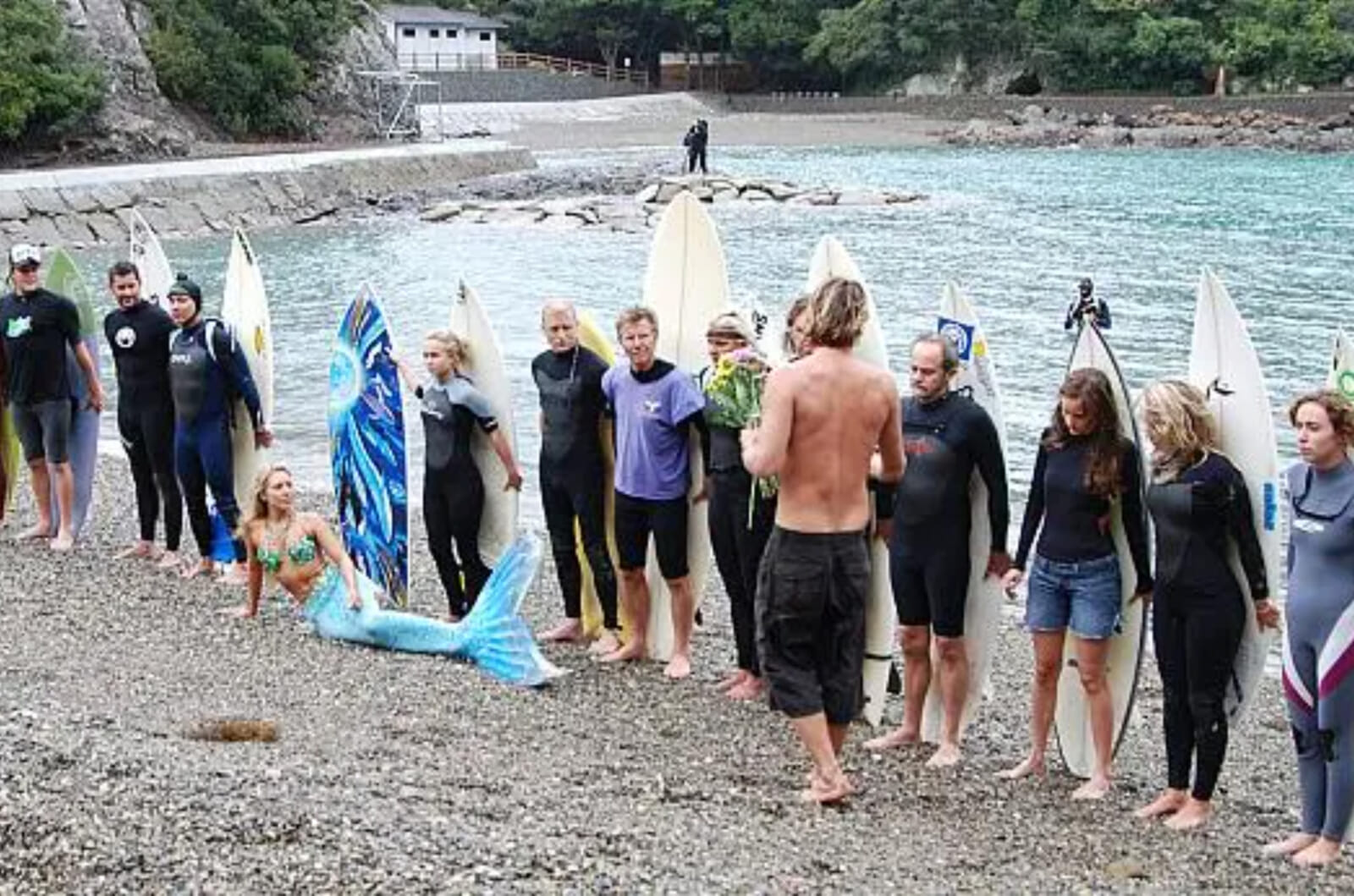
Hayden Panettiere (standing, fourth from left) with activists at Taiji, October 2007 | Image: ocregister.com via Internet Archive
The Water Turned ‘Fire Engine Red’
Describing the scene as she paddled out, Panettiere told Showbiz Tonight: “I can’t tell you exactly how many had already been slaughtered, but I can tell you that the water was about fire engine red,” so much so, she said, that “you probably could have stuck a paintbrush in it and painted a picture with the blood of the pilot whales.” The six surfers paddled into the cove in an attempt to document what was happening and raise awareness of the hunt. Panettiere recalled that the whales initially slowed as the surfers approached, surfacing around them, before the fishermen came over in their boats.
They used their propellers to drive the surfers away and wielded poles against their boards. One of the activists was physically struck. Yet Panettiere later said that she wasn’t afraid. Once she entered the water, she said, “fear never crossed my mind,” particularly as she thought about what the whales themselves must have been experiencing. She recalled that the animals initially seemed curious about the surfers, circling them as the group formed a tight ring in the water. The surfers held their position for as long as they could, but were eventually forced to turn their boards around and paddle back to shore, unable to save the pod.

Hayden Panettiere with Jeff Pantukhoff, founder of The Whaleman Foundation, during the filming of “The Cove” (2009) | Photo: Chris Guiness via IMDB
The Aftermath of Hayden Panettiere’s Taiji Protest
They left the country shortly afterward. The episode, however, did not end there. Panettiere later told E! News that she had learned there was an arrest warrant out for her in Japan in connection with the protest. While Japanese authorities subsequently disputed the reported existence of a warrant, Panettiere said the possibility of arrest would not deter her from doing it again. The incident brought further attention to Panettiere and the campaign. “We knew we were up against a huge obstacle in Taiji,” she later told Condé Nast Traveler. “In the course of the slaughter, I saw a species in need. The trip inspired me to continue the fight.”
In January 2008, Panettiere delivered letters of protest to the Japanese, Icelandic and Norwegian embassies in Washington, calling for an end to commercial whaling. To her surprise, she said the meetings were civil. “They were extremely respectful,” Panettiere later recalled, describing an open, if tense, dialogue with the diplomats. Two years later, she returned to Taiji, just weeks after The Cove won the Academy Award for Best Documentary Feature, to campaign against the dolphin drive hunts. Panettiere proposed sustainable alternatives to the hunt while warning about what she described as dangerously high levels of mercury in dolphin meat. For Panettiere, Taiji was more than a single protest. It became a lasting part of her legacy.