Ed Sheeran’s tour had already lost Macklemore and become, to many, a symbol of the cowardice of artists who preach political neutrality by the time Taka Moriuchi decided to defend him.
Ed Sheeran’s Tour Unravels
The controversy began on September 4 at MetLife Stadium, where opening act Macklemore told the crowd, “Free Palestine” and performed Hind’s Hall, his protest anthem named for Hind Rajab, the five-year-old Palestinian girl killed by Israeli forces in 2024. Images of the destruction in Gaza, where Israeli forces have killed more than 73,000 Palestinians since October 2023, played behind him.
Those comments triggered a petition from the Israeli-American Council calling for Macklemore’s removal. Soon after, some US venue owners, including Robert Kraft, whose company owns Gillette Stadium, reportedly told Sheeran’s team they would not host the show if Macklemore remained on the North American Loop tour. He was dropped quickly afterward.
Macklemore’s removal from the tour led to widespread backlash; in response, Sheeran issued a lengthy Instagram post, which was essentially an argument for why the tour had to keep moving. He said the decision belonged to promoters and venues; pointed to the fans, crew and musicians depending on the shows; and insisted his concerts were supposed to offer “safety and sanctuary” rather than become “a political forum.” He had his own views on Gaza, he said, but preferred to keep them private. “I am not complicit,” he added.
Within a day, every remaining support act had pulled out in solidarity with Gaza, including Finneas, Aaron Rowe, Lukas Graham and Beoga, Sheeran’s longtime collaborators and backing band.
Only then, on September 19, did Sheeran address Gaza directly onstage in Philadelphia, calling Israel’s treatment of Palestinians “catastrophic and unjustifiable,” criticizing venues for trying to control what artists could say and apologizing for how he had handled the fallout. He still maintained that Macklemore’s removal had been the promoter’s decision.
Taka Wades In
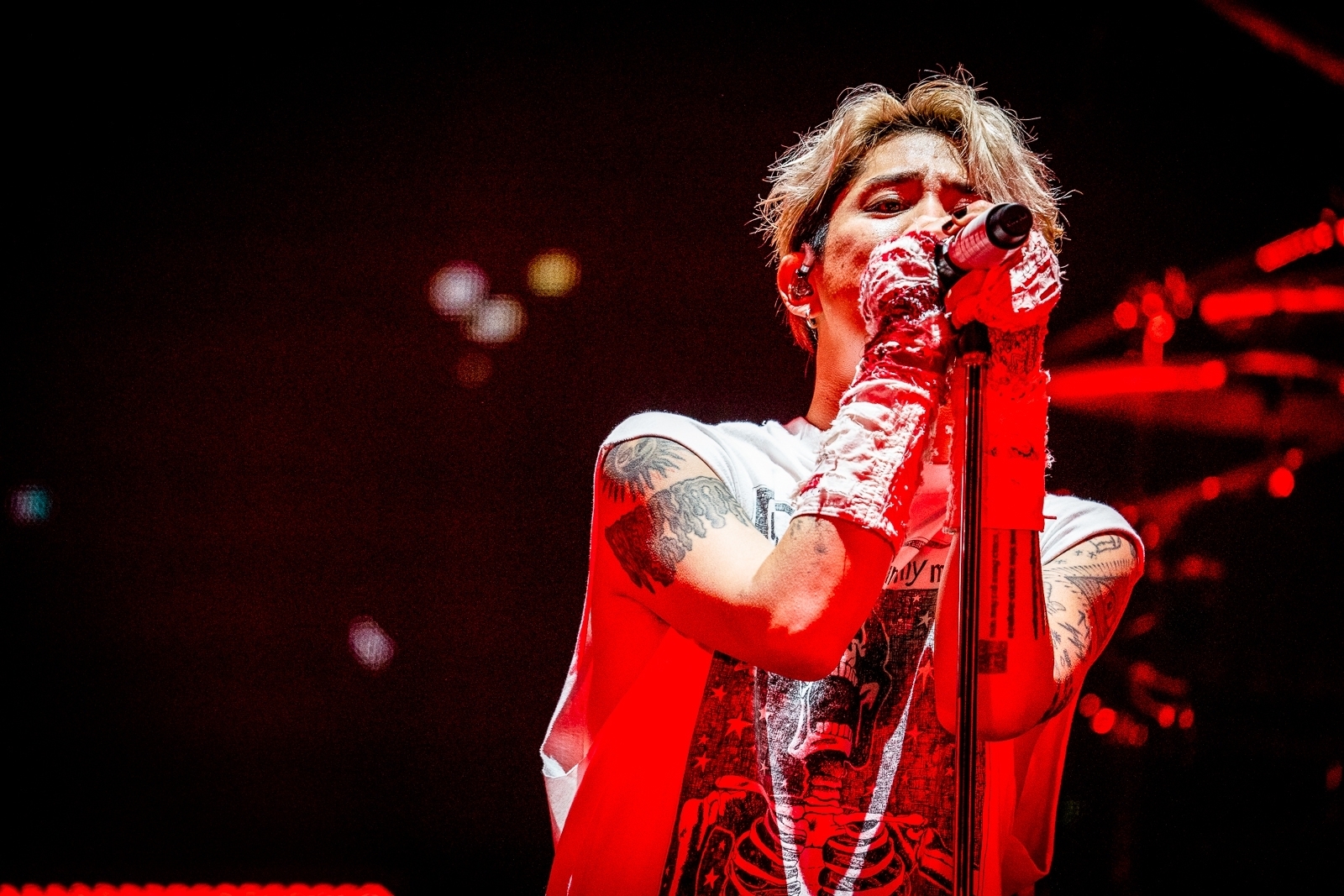
It was this speech that Taka Moriuchi, frontman of Japanese rock band One Ok Rock, described as courageous. The two have history: One Ok Rock opened for Sheeran on his 2019 Asia tour.
“Ed, that took courage. To me, you’re a mirror. Much respect,” he wrote under Sheeran’s Instagram post. The comment went over badly enough that Taka soon posted a clarification of his own.
Another clarification from Takahiro tonight
Everbody is against war, Aniki, really, not only you but everbody is against war. https://t.co/pbGbk69mAJ
— vulnera sanentur – No copycat allowed-Andriesians (@shavshavshav) September 20, 2026
Taka said he opposed war and the killing of civilians, and that artists should not be penalized for expressing their beliefs. But he also asked people to consider “the position and responsibilities” of those involved, arguing that outsiders cannot fully know what someone is carrying when they make a decision like Sheeran’s. He wanted, in other words, to defend Macklemore’s right to speak while also excusing Sheeran for choosing the tour over standing by him.
That attempt at neutrality was exactly what many critics objected to. “Stuff like ‘both sides are at fault’ or ‘let’s all calm down and respect each other’ are fake-hypocrite gestures … They don’t fly anywhere else in the world,” one Japanese user wrote, accusing Taka of reducing a profoundly unequal conflict to a matter of competing opinions. “When it comes to genocide, it’s non-negotiable: Whether it’s a friend or not (or perhaps especially because it’s a friend), you condemn it full-force.”
Other Japanese-language responses seemed genuinely baffled by the uproar, while some fans simply reiterated that they would support Taka regardless.
Meanwhile, in Indonesia, where the band’s following is especially large, the reaction went further than comment sections. One Ok Rock’s official Indonesian fanbase wrote that Taka’s remarks were hard to reconcile with Detox, the band’s newest album. Taka himself described Detox as an explicitly political record born from anxiety over polarization and global conflict, repeatedly saying its guiding idea was “world peace” and that One Ok Rock had a responsibility to use its platform to address what was happening in the world.
“At first, for us, the Detox album was a form of breaking through the current world situation which was experiencing various problems,” the account posted on September 21. “However, we then saw a difference in meaning between the message we captured from the album and the attitude of the people who made it.”
The fanbase cancelled planned event collaborations indefinitely.
Related Posts
- Japan’s Female Festival Dancers Are Facing a Growing Voyeurism Problem
- Ed Sheeran Takes Over Tokyo’s Oedo Line in Train Collaboration
Updated On September 25, 2026