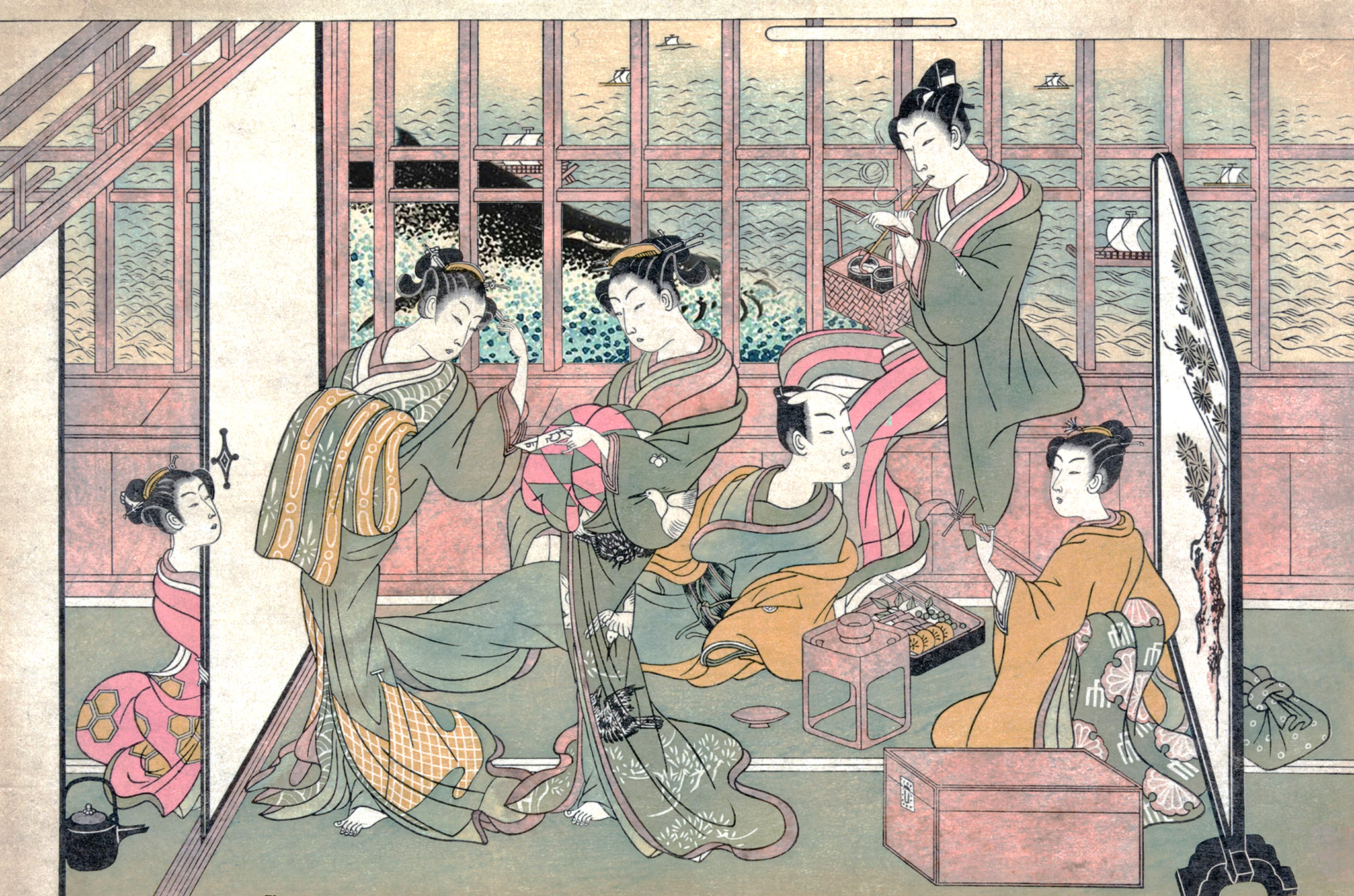
Near the end of the 18th century, a whale became a sex symbol in Japan. Thankfully not in the way that stingrays have. For a brief time, a few artists of erotic prints and paintings simply included a whale in the background of their work. Japanese art eventually moved on, inventing far more scandalous uses for animals in pornography like Hokusai’s famous diver and the two octopuses, and the story of the sex whale was largely forgotten. But studying it can still offer valuable insights into the Japanese erotic psyche, especially when animals are concerned.
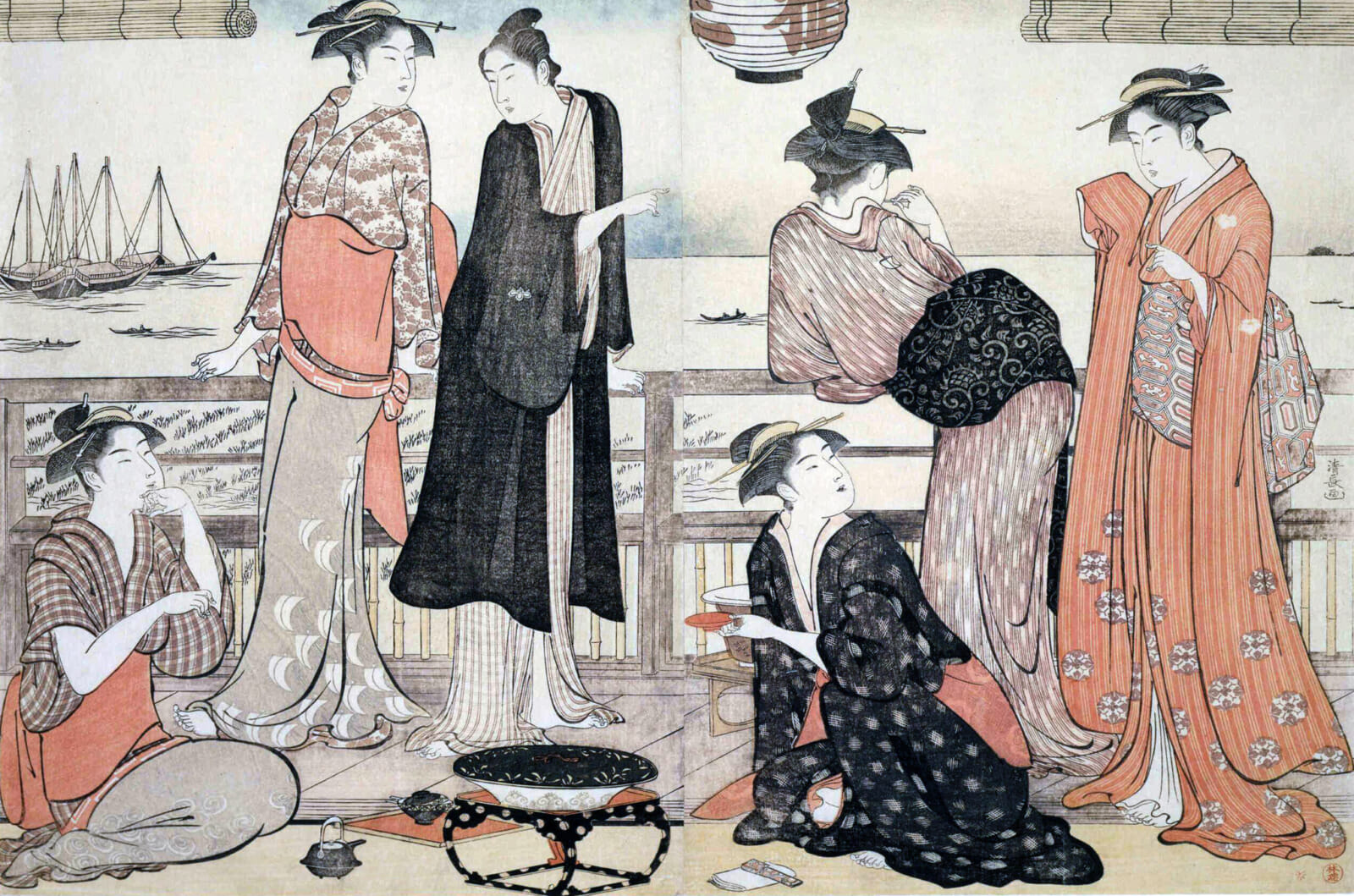
Women entertain a male guest in a Shinagawa teahouse, by Torii Kiyonaga (c.1784)
The Secret to Sexual Success: Location, Location, Location
In 1798, heavy rains hit Edo (modern-day Tokyo), disorientating a 17-meter-long whale and leading it into the bay outside Shinagawa. Accounts differ but it appears that local fishermen drove it onto a sandbar or trapped it in shallow waters in order to butcher it, but the appearance of the creature (as rare then as it is today) caused an immediate sensation across the city.
Soon, Edo people started coming out to see the whale from the shore or in party boats, peddlers peddled whale-shaped goods and even the shogun reportedly came out to see the sea mammal. After that, the animal became known as “the shogun’s whale,” but there was another thing that folks instantly associated with Shinagawa’s newest and largest resident: sex. And not because it was a sperm whale. That joke only works in English anyway.
At the time, Shinagawa was a post town serving as a gateway to Edo, and it was infamous for its underground sex trade. Yoshiwara was the official, government-sanctioned pleasure quarter of the capital, but due to the massive number of travelers stopping over in Shinagawa before entering the city proper, a lot of inns employed so-called meshimori-onna women ostensibly as meal-servers but actually as prostitutes. Though the government didn’t like it, it allowed each inn to have five such employees. Prostitution became such an integral part of Shinagawa that, half a century later, the area supplied Yokohama’s Blood Town with all of its prostitutes for the grand opening of the city.
The association between Shinagawa and sex work eventually rubbed off on the whale. Utagawa Toyomaru immortalized it in one of his erotic woodblocks, just chilling in the background as a couple got it on. The whale eventually died, and even though its celebrity got its bones interred at Kagata Shrine, the passing of the Tokyo Sex Whale effectively ended the appearance of cetaceans in Japanese erotica.
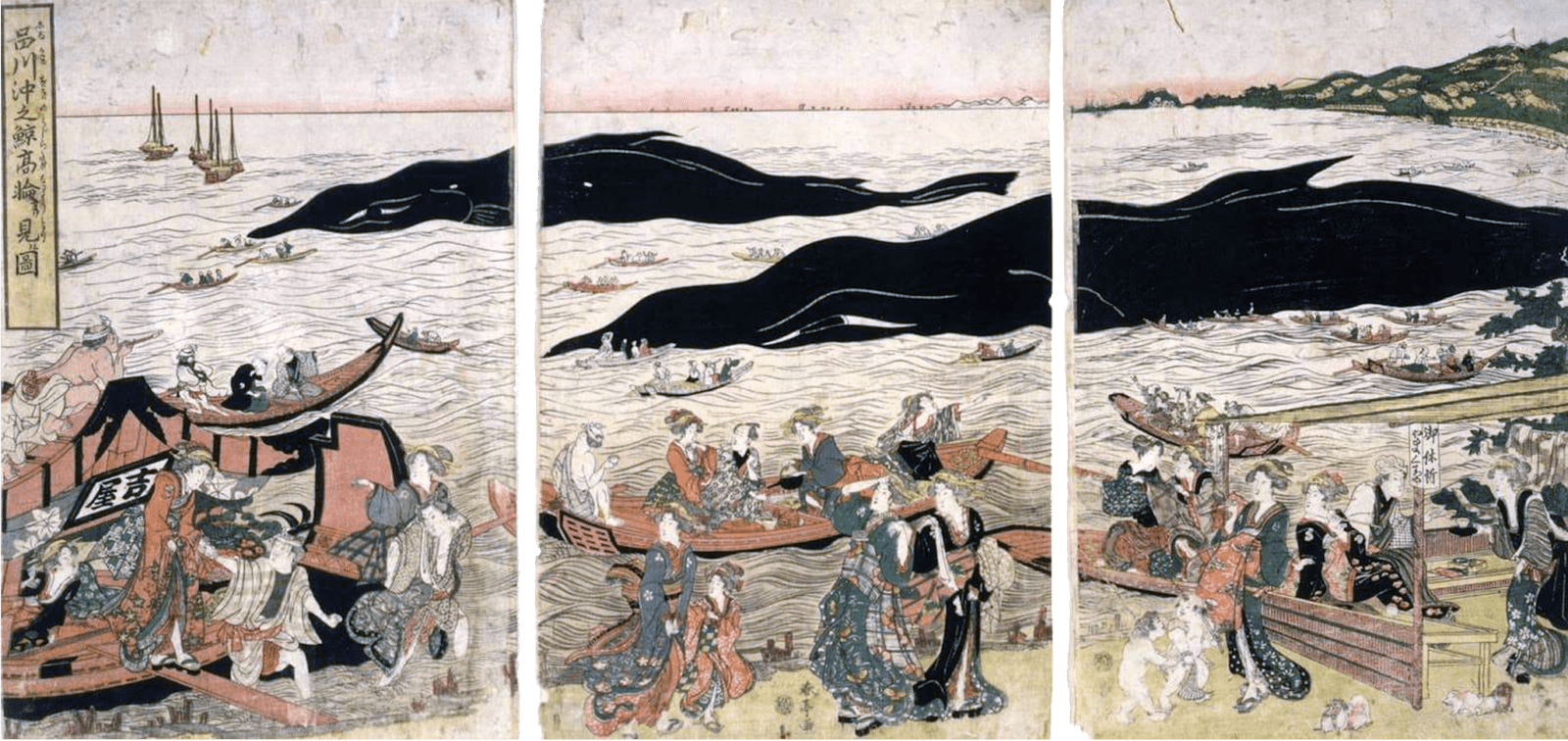
“Seeing the Whale in Shinagawa Bay at Takanawa” by Katsukawa Shuntei (c.1798)
Sexual Animal Magnetism
Bestiality is not uncommon in old-timey Japanese porn. The topic is more complex than it seems, partially going back to folkloric tales of “animal wives” where magical fauna like foxes, cranes and raccoons took on human forms, got married and sometimes had children. But unlike similar stories in the west, those legends almost always ended with the wives reverting back to animals. They never stayed human. Their stories were thus a kind of soft-bestiality that to some had the allure of safely breaking taboos explicitly forbidden in sacred Japanese texts. But animals and sex also came together in myths and art in less direct ways.
In many stories, couples simply absorb the animalistic sexual energy of non-humans, as was the case with Edo’s sex whale. Its presence is reminiscent of the tale of Izanami and Izanagi, the two gods who created Japanese islands via procreation after seeing copulating wagtails. The wagtail account, however, doesn’t appear in the original myths collected in the Kojiki or Nihon Shoki (the oldest texts in Japan). It’s most likely an invention of the Edo period (1603 – 1867), which was never arbitrary with its animal sexual provocateurs. Wagtails were included in the myth of Japan’s creation because of their complex courtship rituals and lifetime bonding. Similarly, the whale was a great subject for erotica because its blowhole spouts were believed to look a lot like ejaculations.
Sometimes, of course, an animal in Japanese feudal porn could serve dual purposes. Horses were one of the most popular subjects of erotic woodprints, sometimes being active participants, and sometimes simply being under two people copulating on its back. In the Edo period, horses were symbols of samurai and the shogun’s authority. It made sense that artists would borrow some of their majesty to add more sizzle to their old-timey smut. And yet, the sex whale remains a unique example because there was most likely another layer to its brief pornographic career.
Eroticizing Horror
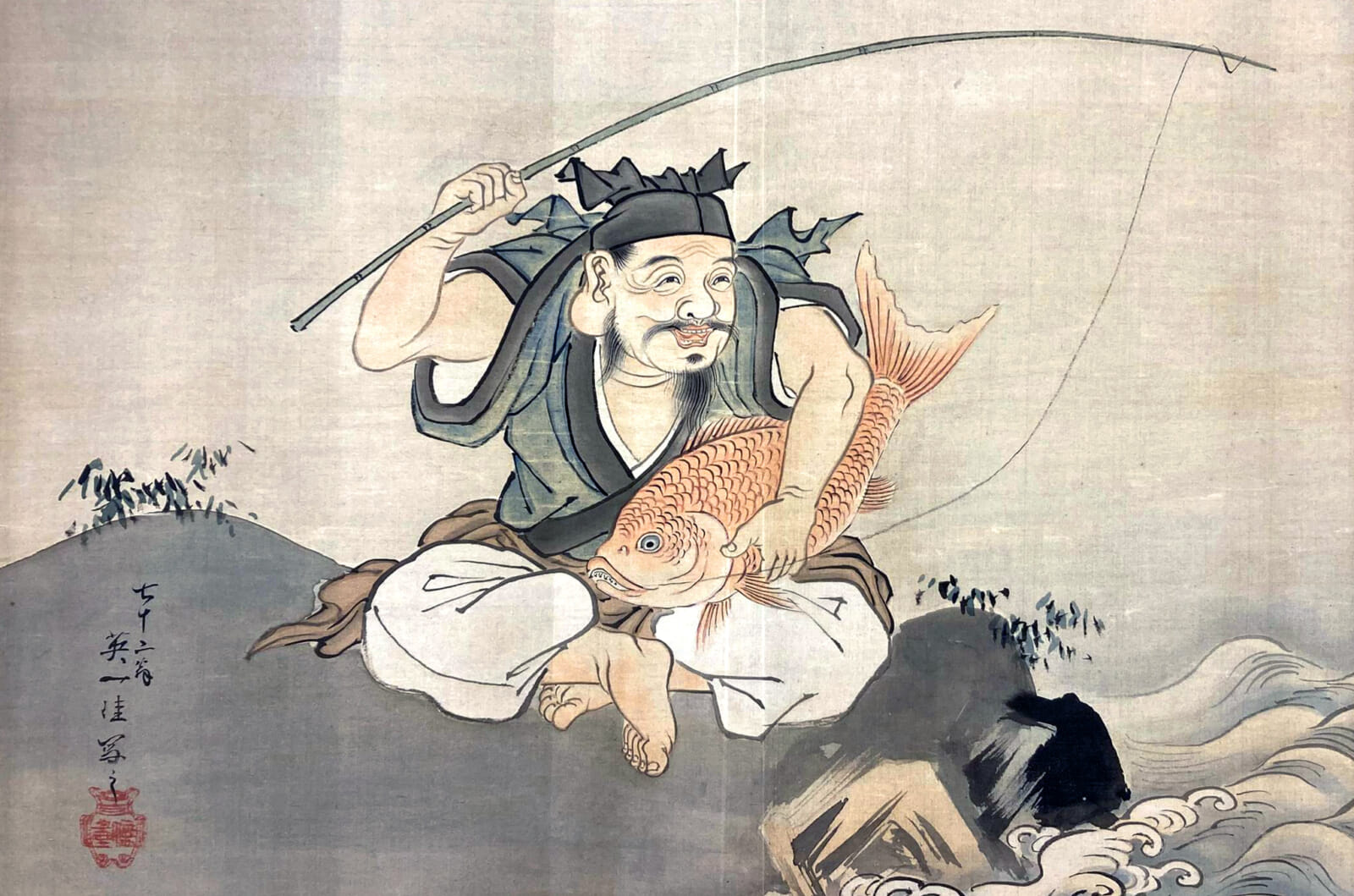
Today, the whale is primarily associated with Ebisu, a deity of wealth, fortune and fishing, making it a good-luck symbol. It makes perfect sense, considering that some places in Japan made a living from whaling. Just one whale could feed multiple villages for a long time. That didn’t change the fact, though, that many Japanese considered whales to be fearsome monsters.
This, too, makes perfect sense. Whales are gigantic. They’re the biggest animals on the planet and between Pinocchio and Moby Dick, even western audiences understand that they can be terrifying creatures. In Japan, this was understood since at least the 8th century and the Man’yoshu, a collection of Japanese waka poetry that makes a few mentions of “the whale-haunted sea,” alluding to whales as things to avoid. Another poem from the collection opens up unambiguously with the line, “Will the whale monsters be exterminated?”
These attitudes have survived well into the Edo period in stories like that of the bakekujira, a terrifying undead whale skeleton who brought death, famine and disease to all who saw it. Part of the popularity of the Shinagawa whale could have been that even-now familiar mixture of horror and sex, contrasting a symbol of death with the symbol of life. In any case, it makes for one whale of a tale.