Sushi, sake, samurai and sacred sites; it’s the ultimate Japan tourist checklist. But what if you combine them? For now, let’s focus on just two: samurai and sacred sites. Across Japan, you’ll find temples and shrines tied to samurai history, including shrines dedicated to shogun, the family temples of daimyo and even a booby-trapped temple-cum-defensive outpost. Exploring these sacred sites, you’ll unlock diverse pieces of samurai history.
Read on for seven shrines and temples with samurai stories to tell.
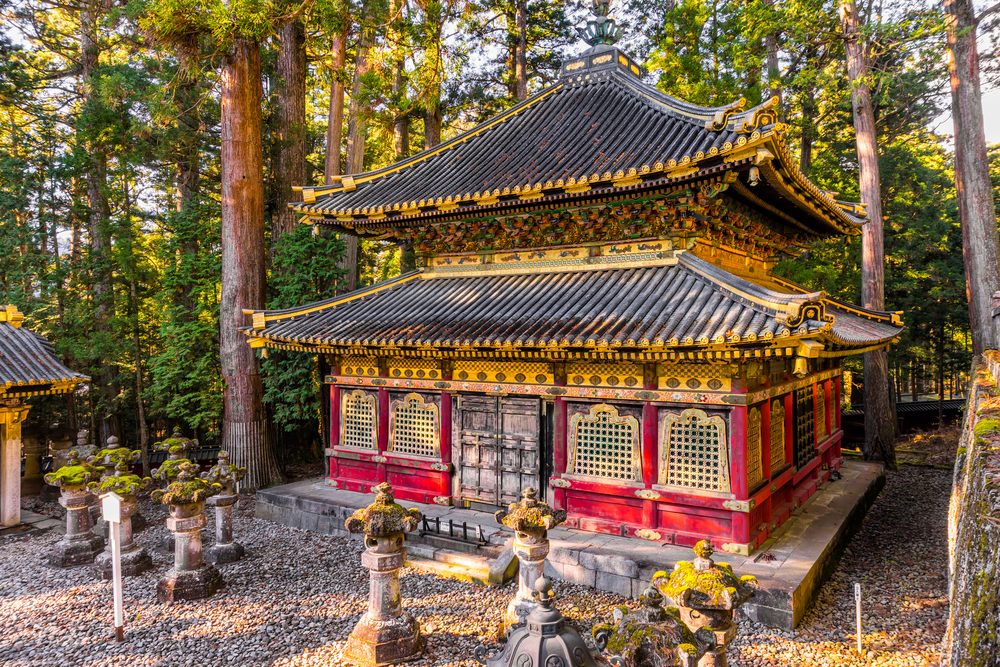
Toshogu Shrine is an awe-inspiring monument that enshrines the first shogun of the Tokugawa shogunate, Tokugawa Ieyasu. Born into a samurai family near modern-day Nagoya in late 1542 or early 1543, depending on the source, Ieyasu saw his fortunes rise significantly over the course of his life. After a childhood spent as a hostage with two separate families, he went on to ally himself with the powerful Oda Nobunaga, the first of Japan’s three great unifiers and, following Nobunaga’s death, Toyotomi Hideyoshi, Nobunaga’s successor and the second of the great unifiers.
During these years, Ieyasu expanded his territory, influence and might. In the power struggle that followed Hideyoshi’s death, Ieyasu emerged victorious, and the shogunate he founded ruled Japan from 1603 until 1867. Nikko’s grandiose Toshogu Shrine mirrors Ieyasu’s stature in Japanese history as the third and final great unifier.
Interestingly, Toshogu was first built as a modest mausoleum to Ieyasu by his son Hidetada. It wasn’t until Ieyasu’s grandson Iemitsu greatly expanded the mausoleum 20 years later that Toshogu began to resemble the extensive shrine complex we know today. Located around two hours north of central Tokyo, the shrine consists of dozens of buildings embellished with intricate carvings. Some, such as the “Three Wise Monkeys” and “Sleeping Cat,” have come to be known the world over.
Kunozan Toshogu Shrine, Shizuoka Prefecture
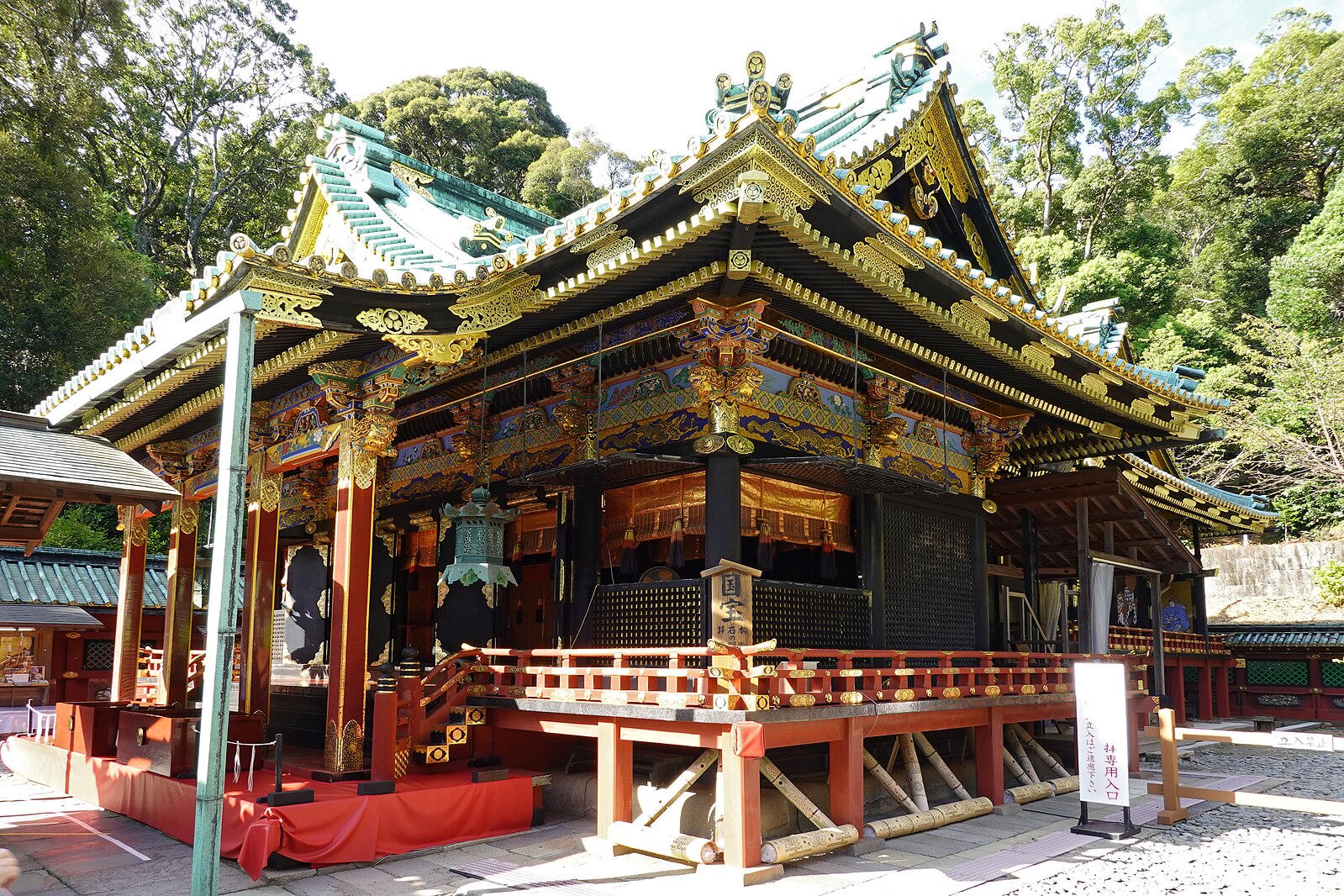
While Toshogu Shrine in Nikko is the most famous memorial to Tokugawa Ieyasu, it’s not the earliest — that distinction goes to Kunozan Toshogu Shrine, located over 300 kilometers south of Nikko in the city of Shizuoka, Shizuoka Prefecture.
After passing down the shogun mantle to his son in 1605, Ieyasu saw out the last 11 years of his life in Sumpu (modern-day Shizuoka city), where he had spent the formative years of his childhood. Far from retiring, in Sumpu, Ieyasu assumed responsibility for foreign relations, welcoming trade and hounding out Christian missionaries. Before he died in the spring of 1616, Ieyasu left instructions to be buried at Kunozan.
Construction of the shrine began in May 1616, with master craftsman Nakai Masakiyo at the helm, and was completed in just over a year and a half. The model for Nikko Toshogu and other Toshogu shrines across Japan, Kunozan Toshogu even ushered in a new style of shrine architecture, Gongen-zukuri, in which the inner sanctuary and hall of worship are connected by a small room, with all under a single, complex roof. In 2010, the nearly 400-year-old shrine was designated as a National Treasure of Japan.
The vibrantly painted shrine, like Nikko Toshogu, features plenty of ornamentation to admire, including carvings, sculptures and paintings. At the shrine museum, artifacts from Ieyasu’s life are on display, providing a deeper look into the life of the man who finalized the unification of Japan.
Myoryuji Temple, Ishikawa Prefecture
No self-directed tours are allowed at this temple in Ishikawa Prefecture’s capital city of Kanazawa: It’s too dangerous. Preschoolers are banned, too, for the same reason. The many halls, trap doors, trick staircases, extra floors and obstacles concealed within Myoryuji mean that it’s far too easy to get lost or hurt. Just how this temple, ostensibly a place of Buddhist worship, became a labyrinth riddled with booby traps is tied to the tensions that simmered between the Tokugawa shogunate and the Maeda family in the decades after Tokugawa Ieyasu unified Japan.
By the late 16th century, the powerful and wealthy Maeda family controlled Kaga domain — present-day Ishikawa and Toyama prefectures. For Ieyasu and his successors, the Maeda family’s fortunes and vast armies made them a threat. While the Maeda family cultivated an image of loyalty, secretly, they prepared to defend themselves should the shogunate ever attack. As part of these preparations, Myoryuji was relocated from its original site at Kanazawa Castle to the Tera-machi area of the castle town, where a cluster of temples served as outposts designed to buffer any attack before it reached the castle.
The impressive temple is a maze-like structure that, from the outside, appears to be two stories — in line with a Tokugawa shogunate rule controlling building height. However, it is, in fact, four stories with a further three hidden levels. It boasts 29 stairways, 23 rooms, secret escape routes and a watchtower. As a result of its cunning construction, Myoryuji is better known by its colloquial name, Ninjadera — the Ninja Temple.
Sengakuji Temple, Tokyo Prefecture
Sengakuji is a small temple in Tokyo’s Minato ward famed for being the burial site of the 47 ronin and Asano Naganori, the daimyo they avenged.
The basic story of the 47 ronin is well known: After Asano attacked protocol official Kira Yoshinaka at Edo Castle and was forced to commit seppuku, 47 of his now masterless samurai (“ronin”) swore vengeance, which they carried out one year and nine months later by breaking into Kira’s residence and killing him and 28 of his retainers. The details, however, differ by retelling, and though Asano is often portrayed sympathetically, he was known to be impetuous and was widely regarded with scorn.
Whatever the truth, following his ritual suicide, he was buried at Sengakuji, the family temple of the Asano family. It was here that, nearly two years later, the ronin carried Kira’s severed head, offering it to their former master at his grave. For their crimes, the ronin, like Asano, were sentenced to seppuku. They were then laid to rest at Sengakuji, where they continue to be memorialized as symbols of loyalty and duty.
Even now, over 300 years later, the graves of the 47 ronin draw visitors, especially on December 14, when Sengakuji holds its annual Ako Gishisai festival honoring the ronin. The event combines festive elements, like lively crowds and food stalls, with somber moments — a procession of 47 people dressed as the ronin that makes its way from Zojoji Temple to Sengakuji, a memorial service and traditional dances. The temple also houses artifacts related to the 47 ronin in the Akogishi Kinenkan, a small museum that shows multilingual videos on the history of the incident.
Sofukuji Temple, Gifu Prefecture
This ancient temple in the city of Gifu, Gifu Prefecture, has roots dating back to the Kamakura era (1185–1333), but it gained prestige in 1567 when it was made the family temple of the powerful Oda family. The family dominated the Gifu region until, shortly before the decisive Battle of Sekigahara in 1600, it fell to Tokugawa Ieyasu’s eastern army in the Battle of Gifu Castle. Oda Hidenobu, grandson of Oda Nobunaga, had made the mistake of betting against Ieyasu, and he paid for the miscalculation dearly. The Oda were soundly defeated, Hidenobu’s retainers dying or committing seppuku in the castle.
The violent fall of the Oda is connected to Sofukuji via the ceiling of the temple’s main hall, upon which visitors will notice strange stains. Though commonly mistaken for water damage, these blemishes are said to be blood stains from samurai who fell during the battle’s fierce fighting. While most of the castle was destroyed, the floorboards were preserved and installed in Sofukuji as a way to memorialize the dead and honor their resistance to Ieyusa’s consolidation of power.
Befitting the family temple of the Oda, Sofukuji also boasts several artifacts related to Nobunaga and is the final resting place of Nobunaga and his son Nobutada. Their mausoleum can be found behind the main hall. Every November, the temple holds the solemn Oda Nobunaga Memorial Ceremony during Gifu city’s lively Gifu Nobunaga Festival, which features parades, period costumes, music, dance and more.
Hanyu Gokoku Hachimangu Shrine, Toyama Prefecture
Hanyu Gokoku Hachimangu shrine sits in Kurikara Prefectural Park in the city of Oyabe, Toyama Prefecture. Though the peaceful park is now known for its 6,000 cherry blossom trees, its history is far less tranquil: Approximately 840 years ago, it was the site of the Battle of Kurikara.
The battle was a critical turning point in the Genpei War, a conflict between two powerful samurai families — the Minamoto (aka Genji) and the Taira (aka Heike) — that had begun in 1180. By the time of the Battle of Kurikara in 1183, the war had been on a low simmer for several years owing to natural and other disasters, including a typhoon, famine and widespread disease. At Kurikara, it flared back to life — and some might say that Hanyu Gokoku Hachimangu played a role in the skirmish’s outcome.
Prior to the battle, Minamoto no Yoshinaka, a general of the Minamoto army, visited the shrine, praying to Hachiman, god of war, for victory. Whether it was intervention by Hachiman, the Minamoto’s clever strategizing — which included sending torch-laden cattle stampeding into the Taira camp to cause confusion — or a combination of the two, the Minamoto emerged victorious. For the Taira, the Battle of Kurikara represented the beginning of the end.
In 1185, the war ended, and Minamoto no Yoritomo, a cousin of Yoshinaka, established the country’s first shogunate, ruling Japan from Kamakura, a fishing village-cum-military capital located in modern-day Kanagawa Prefecture. Though Yoritomo was the Minamoto to rise to shogun, it’s Yoshinaka who’s memorialized at Hanyu Gokoku Hachimangu. On the shrine grounds, a bronze Yoshinaka, garbed in armor, a golden maedate decorating his helmet, sits atop his horse. This statue is one of Japan’s largest statues of a mounted rider — but it may not be the most intriguing statue in the Kurikara Prefectural Park area. Among the cherry blossoms, visitors to the park will find large sculptures of cattle, flaming torches tied to their horns, in memory of what may have been the most imaginative battle strategy of the Genpei War.
Oyamazumi Shrine, Ehime Prefecture
The most isolated place of worship on this list, Oyamazumi Shrine is located on Omishima Island in the middle of the Seto Inland Sea. While the shrine itself is beautiful, with buildings dating to the Muromachi period (1336–1573), the main attraction is the shrine’s collection of historical items, especially those related to battle.
Oyamazumi Shrine possesses approximately 80% of all samurai artifacts registered as National Treasures and Important Cultural Properties. These include tachi long swords, katana, naginata bladed polearms, breastplates and helmets; its oldest weapon is a tachi from the mid-Heian period (794–1185).
The shrine’s incredible assortment of weaponry and armor comes from offerings made by some of Japan’s most renowned samurai, who would pray at Oyamazumi for success in battle. If success was forthcoming, they would return and present weapons or other items to the shrine. Artifacts of particular note include the armor of Minamoto no Yoritomo, the first shogun of the Kamakura shogunate, and a small suit of armor that belonged to Tsuruhime, the “Joan of Arc of the Seto Inland Sea,” who, beginning at age 16, took up arms to protect Omishima from invaders.