
In this week’s news report, we cover harassment allegations involving actress Ai Hashimoto and her co-star Jiro Sato. The yen plunges to a near 40-year low against the dollar. The Japanese government adopts a bill to revise the Imperial House Law. Chanson icon and Ghibli voice actor Akihiro Miwa dies at 91. Mister Donut announces it will end Mocchurin’s run early. And Brazil score deep into stoppage time to knock Japan out of the World Cup.
Jiro Sato Accused of Harassment by Co-Star Ai Hashimoto
On Wednesday, the weekly tabloid Shukan Bunshun published an article alleging that 57-year-old actor Jiro Sato engaged in “problematic behavior” and “serious harassment” toward his co-star Ai Hashimoto, 30, during filming of the Fuji TV drama Fufu Bessei Deka. The article claims that Sato made physical contact with the actress without her consent on multiple occasions and made comments that undermined her career. According to the report, Hashimoto’s management told Fuji TV to restrict unscripted or unnecessary male physical contact during filming due to a past trauma.
Sato’s agency, From First Production, claims he wasn’t informed about “restrictions regarding physical contact” and “accidentally touched Hashimoto’s chin with his hand during a scene.” Sato also denied the allegations on X. “I cannot hold it in any longer,” he wrote. “I repeatedly pleaded with them during filming, saying, ‘I’ve reached my limit, please let me step down from this drama. And all the facts should be made public.’ I should have made the decision sooner. I sincerely pray for the day when the numerous ‘truths’ come to light.”

Yen Plunges to 40-Year Low Against the Dollar
On Tuesday, the Japanese currency weakened to ¥162.83 against the US dollar, its lowest level in almost four decades. One of the main reasons is the gap in interest rates between Japan and the United States, with the recent conflict in the Middle East acting as an additional catalyst. The Bank of Japan (BOJ) raised its benchmark interest rate from 0.75% to 1.0% in June, but it remains well below the US Federal Reserve’s 3.75%, making dollar-denominated assets significantly more attractive to investors.
Repeating the government’s familiar refrain, Finance Minister Satsuki Katayama told reporters at a regular press conference on Tuesday that “It all comes down to being ready to respond appropriately to currency moves at any time.” Between April 28 and May 27, the Ministry of Finance and the Bank of Japan spent a record ¥11.73 trillion intervening in the foreign exchange market to prop up the yen. While it briefly caused the US dollar to drop sharply against the Japanese currency, the boost was short-lived.
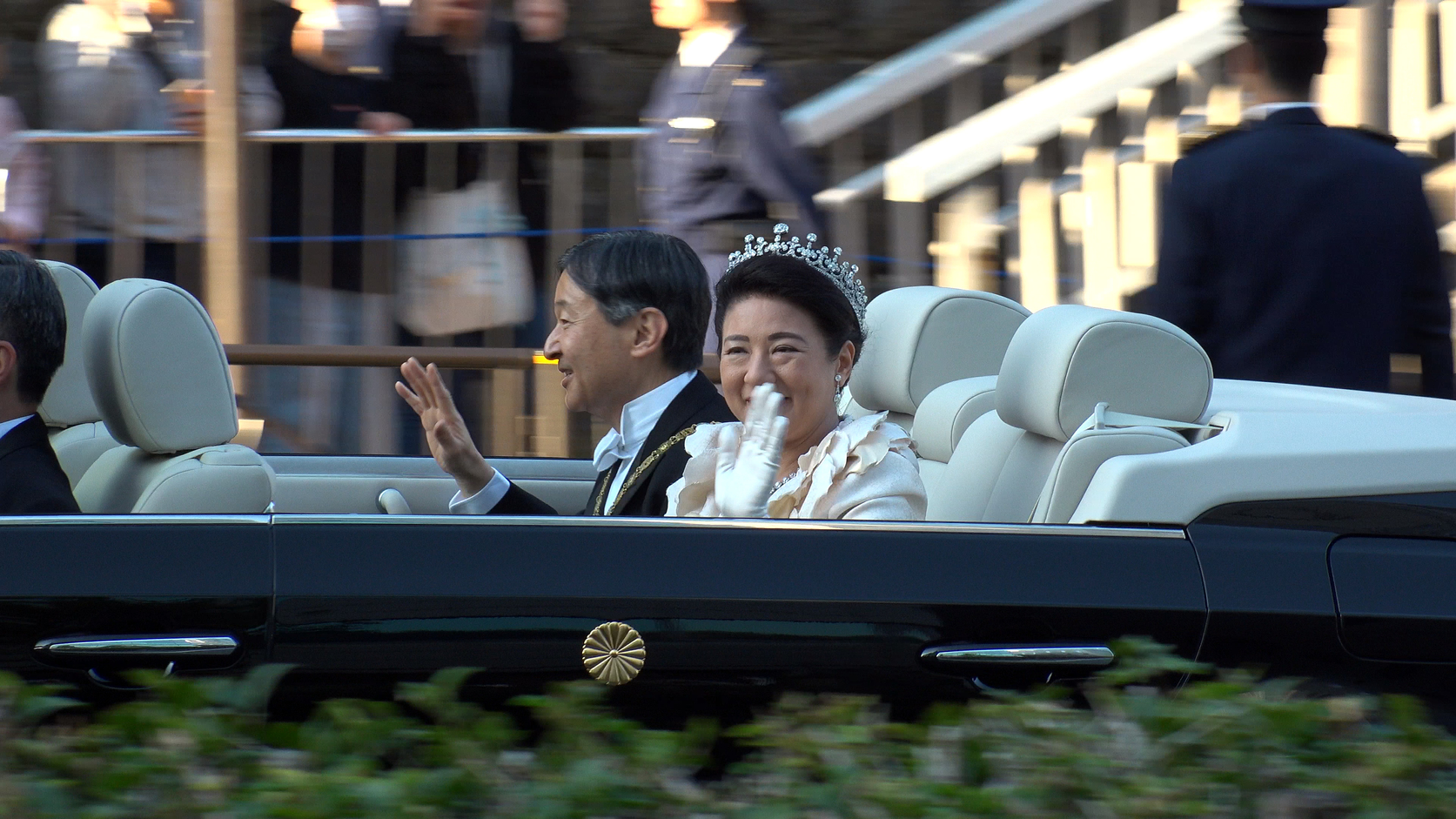
Japan’s Emperor Naruhito and Empress Masako on the vehicle at the royal parade to mark the enthronement of Emperor Naruhito.
Photo by StreetVJ / Shutterstock.com
Japan’s Imperial Revision Keeps Women in the Family But out of Succession
On Tuesday, the Japanese government adopted a bill to revise the Imperial House Law, a move aimed at addressing the shrinking size of the imperial family and securing its future stability. The proposed changes would allow female members to retain their status after marriage while also permitting the adoption of male, paternal-line descendants of former imperial branches that lost their status after World War II. The imperial revision does not, however, change the rules barring women from succeeding to the throne.
The move comes amid a long-running debate over how Japan should address the future of the monarchy. Public support in Japan for allowing a woman to ascend the Chrysanthemum Throne remains strong. Recent polls by The Asahi Shimbun and The Mainichi showed that more than 70% of respondents favored allowing a woman to become emperor. Conversely, only 28% said they supported the government’s proposal to allow male-line descendants of former imperial branches to become members of the family through adoption.

Akihiro Miwa, Japanese Chanson Icon and Ghibli Voice Actor, Dies at 91
On Sunday, the agency of Akihiro Miwa announced that the legendary singer and actor had died at the age of 91. A trailblazing performer who challenged gender norms, Miwa was best known for his hit chanson ballads, including “Yoitomake no Uta,” and for his unforgettable voice performances in the Studio Ghibli films Princess Mononoke and Howl’s Moving Castle. He also won critical acclaim for portraying the femme fatale and notorious jewel thief Madame Midorikawa in both the stage and film adaptations of Edogawa Rampo’s The Black Lizard.
Miwa, birth name Akihiro Maruyama, was born in 1935 in Nagasaki. At age 10, he was at home when the atomic bomb was dropped on the city. Though not directly injured by the blast, Miwa suffered long-term effects of radiation exposure, including hair loss and anemia. The catastrophe had a profound impact on his worldview. He became a vocal advocate for pacifism, regularly speaking out against war. “I can never forget all the cruel scenes of those days,” he once said. “These memories are the mainspring of my songwriting.”

Too Popular To Last: Mister Donut Ends Mocchurin Run Early
Usually, companies cancel products because nobody wants them. At Mister Donut, it’s the opposite. On Tuesday, the international doughnut-and-coffee chain announced it would end sales of the second wave of its “Mocchurin” doughnuts ahead of schedule after demand far exceeded expectations. The strawberry Mocchurin finished its run as planned at the end of June. However, the kinako and mitarashi varieties, originally scheduled to remain on sale until around mid-August, will instead disappear from stores in mid-July while supplies last.
A new flavor that had been scheduled for release in July has also been scrapped. “We have decided to cancel the release of the second series of products to avoid inconveniencing customers, as we anticipate their launch would lead to even greater congestion at our stores,” Mister Donut said. The company added: “We would like to express our heartfelt gratitude to the many customers who have enjoyed Mocchurin. We also deeply apologize to everyone — especially those who were looking forward to these products — for failing to meet your expectations.”

Brazil 2-1 Japan: Martinelli Strikes Late as Samurai Blue Exit the World Cup
Gabriel Martinelli broke Japanese hearts with an injury-time winner in Brazil’s Round of 32 World Cup clash against Japan in Houston. The match appeared destined for extra time until Ao Tanaka lost possession on the edge of the box. Bruno Guimarães slid a pass through to the Arsenal winger, who calmly slotted past goalkeeper Zion Suzuki. It was a devastating way for Japan to bow out, evoking painful memories of their 3-2 defeat to Belgium in 2018. Brazil’s Italian coach Carlo Ancelotti remained calm when the goal went in.
“People asked me why I didn’t celebrate, but football is also about respect,” he said. “Yes, we were happy to win, but I looked across and saw a Japanese team that had given absolutely everything. They fought with incredible courage, and I know exactly how painful a defeat like that can be.” Kaishu Sano gave Japan the lead just before the half-hour mark. Brazil leveled through Casemiro before Martinelli’s stoppage-time winner sent the five-time champions into the next round.
Related Posts
- Rafael van der Vaart Apologizes After Saying Japanese Players ‘Look Alike’
- Japan Captain Wataru Endo Out of World Cup, Retires From International Football
- Search Continues for Missing American Student in Japan
Updated On July 3, 2026