

Several years ago, the renowned wildlife photographer Mitsuaki Iwago was shooting in the Pantanal wetlands of Brazil. A nearby jaguar had attracted his attention, but he wasn’t satisfied with the shots he was getting. So he tried asking his subject politely: “Can you please roll over?” The big cat somehow complied immediately — a fearsome predator playfully lounging on its back like a common house pet waiting for belly scrubs, now the cover star of Iwago’s Pantanal book.
Iwago, who is 75 years old, has dedicated his life to documenting the otherworldly beauty of the animal kingdom. His father was also a wildlife photographer, and Iwago often assisted him on shooting excursions to far-flung places like the Galápagos Islands, where, against a background of turquoise waters, he completely fell in love with both nature and photography.
His work has taken him everywhere from Botswana to Madagascar to the Florida Keys, putting him in close proximity with intimidating creatures like crocodiles, cheetahs and lions, to name a few. He’s immensely prolific and highly esteemed in his field, the only Japanese photographer to have had his work featured on the cover of National Geographic twice.
_電子透かしあり-2048x1152.jpg)
© NHK
These days, though, Iwago is best known for taking pictures of everyday cats. He’s the head cameraman behind the beloved NHK television program Iwago Mitsuaki no Sekai Neko Aruki — Mitsuaki Iwago’s World Cats Travelogue in English — though calling him just the cameraman would be greatly underselling his role. True to its name, the show takes viewers on a tour of a region from a cat’s perspective, and Iwago functions as a sort of feline-whisperer throughout each episode.
During shooting, Iwago often ends up surrounded by the cats he encounters, who climb all over him without hesitation, as though they’re long-lost friends. Sometimes they’ll go right up to his camera lens, occasionally even blocking it. In several instances, the rest of the crew has captured a cat climbing on the photographer’s head while he films other felines.
Though Iwago tends to stay behind the camera, his presence is palpable — in nearly every episode, you can hear him offscreen, saying, “Ii ko da, ii ko da [good boy/girl]” in his signature soothing voice.
© NHK
The Cat Philosophy
Iwago Mitsuaki no Sekai Neko Aruki originated as a television special that premiered in 2012. The premise was simple: Instead of featuring a human host, the travel show brought viewers to places around the world through the lens of local cats. It covered Iwago’s adventures in the noted cat paradise of Istanbul, as well as in an Italian bay town and the island of Capri.
During the coronavirus pandemic, the program adapted, shifting toward domestic locations. As Iwago couldn’t travel internationally, the team took the opportunity to highlight locations across Japan instead of distant locales. Iwago has now filmed cats in all 47 prefectures.
_電子透かしあり-2048x1152.jpg)
© NHK
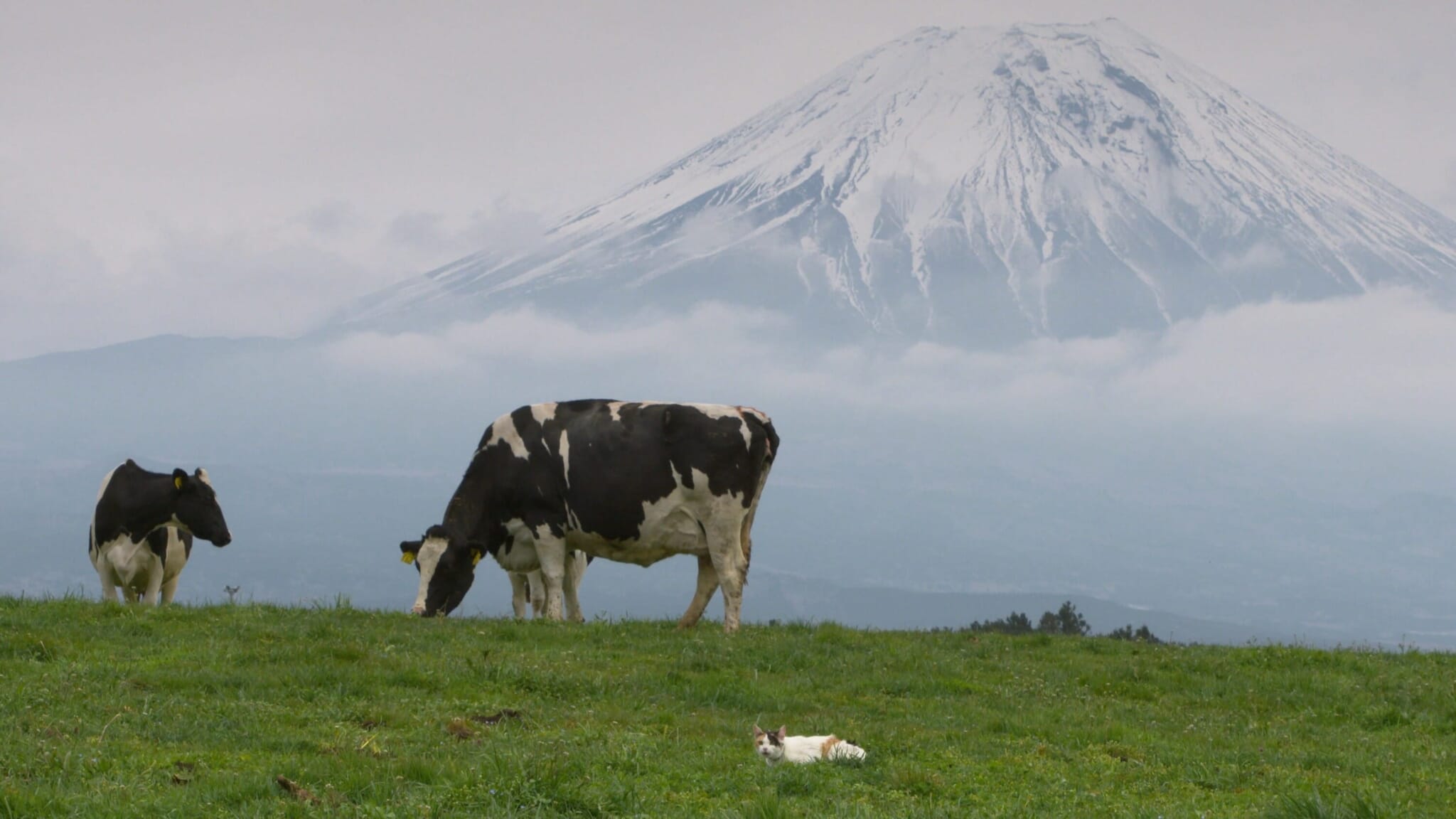
Each episode focuses on cats in a different region of Japan — roaming with cattle beneath a snow-capped Mount Fuji, peacefully watching farmers at work in a rice
paddy in rural Niigata, playing on the beaches of Kochi or accompanying monks in their daily meditation in Yamagata. Tuning in feels like taking a peaceful retreat; the audience can escape the chaos of the world, instead watching a kitten cradled by the gentle summer breeze and the shade of a countryside pear tree.
But the show’s allure extends beyond its coziness and aesthetic beauty. It also puts a spotlight on lesser-known and less-visited parts of Japan. Cats naturally like more reserved spots. In Iwago Mitsuaki no Sekai Neko Aruki, they act like mini tour guides, proudly showing around the best parts of their hometowns. They escort Iwago through hidden alleyways. They traverse World Heritage Sites and pass by traditional artisans working on their crafts. Whether it’s a temple, a workshop or a secluded garden, the feline presenters reveal sightseeing points that visitors might not know about.
“Cats and Japanese scenery just really go well together. Cats often help me see the beauty of [each] region,” Iwago explained in an NHK special.
_電子透かしあり-2048x1152.jpg)
© NHK
Little Tour Guides
It can be tricky to center a whole show around an unpredictable subject like cats. But the spontaneity leads to magical memories that can’t be planned for. The original Japanese program airs weekly; each episode is 59 minutes long, and Iwago and his team are usually allotted eight days to film. They rely on local word-of-mouth and social media to scout their cat stars.
The direction of the day’s shoot is entirely dependent on the chosen protagonist. “When the cat appears, they’re the ones that decide which way I’m going,” Iwago explains. The show introduces each cat’s name and age, along with a short title to sum up their role in their local community. Each has their own personality, which adds a delightful dash of variety — and
often a comedic tone — to the program. A laid-back, beach-loving cat enjoys surfers petting him, while a mischievous cat stalks a fisherman to try to get a bite of his catch. A chatty cat vocalizes at people passing by a temple. A playful cat runs to join kids in the playground of the town’s only school.
_電子透かしあり-2048x1152.jpg)
© NHK
Iwago’s resume now extends beyond documentary film. In 2019, he made his directorial debut with the film Neko to Jiichan (English title: The Island of Cats), which follows a 70-year-old widower and his pet cat, Tama, who find ways to fulfill and comfort each other. After filming wrapped, the crew asked if anyone wanted to adopt the star feline. Iwago jumped right in with open arms.
He named the cat Tamasaburo, or Tama for short — both as an homage to the cat’s on-screen character and to Iwago’s close friend, the renowned kabuki actor Bando Tamasaburo V. Iwago later also adopted Tama’s brother, Tomotaro, or Tomo for short, who is also named after a famed kabuki star. Today, Tama and Tomo both live with Iwago in his Tokyo home.
Even after traveling the world, Iwago’s career and overall life philosophy remains very simple: “The key is to do it with passion. Communicate with love.”
_電子透かしあり-2048x1152.jpg)
© NHK
More Info
To see more of Mitsuaki Iwago’s photography, please visit his website.
You can watch episodes of Iwago Mitsuaki no Sekai Neko Aruki on the NHK BS television channel every Tuesday from 9 a.m., and on the NHK BS Premium 4K channel every Friday from 10 p.m.
Broadcast schedules are subject to change, so please check the program’s official website for the latest information. Original Japanese episodes are available on NHK on Demand.
An abridged English version of the show, titled A Cat’s-Eye View of Japan, airs several times a week on NHK World-Japan and is also available to watch on the NHK World-Japan website and app and the NHK World-Japan YouTube channel.
Related Posts
- Japan Has a New Cat Stationmaster: Meet Yontama
- An Alternative Guide to Aoshima: Discover Japan’s Other Cat Islands
- Ken-Chan, The Beloved Cat Always Trying To Break Into a Museum, Passes Away
Updated On June 30, 2026