
There was a stretch in the mid-2010s when Yayoi Kusama’s Infinity Mirror Rooms seemed to be everywhere. Museums that normally drew weekend-only crowds suddenly had ticket systems buckling under demand, Instagram filled with iterations of the same mirror selfie: a figure in deep space, surrounded by glowing dots of light repeating outward forever. It was a phenomenon pivotal to Kusama’s transition from a name in art history to a global cultural icon.
Kusama’s seven-decade career stands as a testament to an artist who did so much more than create viral spaces or whimsical pumpkin sculptures. Her oeuvre holds a rare double legacy: She made vital contributions to Pop Art, minimalism and installation art, while building a world of motifs that resonated with millions — fundamentally altering how the public engages with contemporary art.
Kusama’s signature motifs — endlessly repeating dots, dense webs — originated in childhood visual hallucinations. Though she voluntarily lived in a Tokyo psychiatric facility from 1977 onward, to frame her purely as a reclusive outsider is to ignore her sharp professional ambition. Starting out in a mid-century art world that routinely sidelined women and Asian artists, Kusama staged controversial performance protests and pushed her work into public spaces. She built her first mirrored environment in 1965, laying the foundation for what would eventually become a worldwide frenzy for immersive installations.
At the core of her work was the concept of self-obliteration — the idea that endless repetition of a single motif would cause the boundary between oneself and the outside world to vanish. Though it began as a deeply personal way to navigate her inner world, it eventually grew into a universally recognized inner language — one that bridged fine art and pop culture at an unprecedented scale.
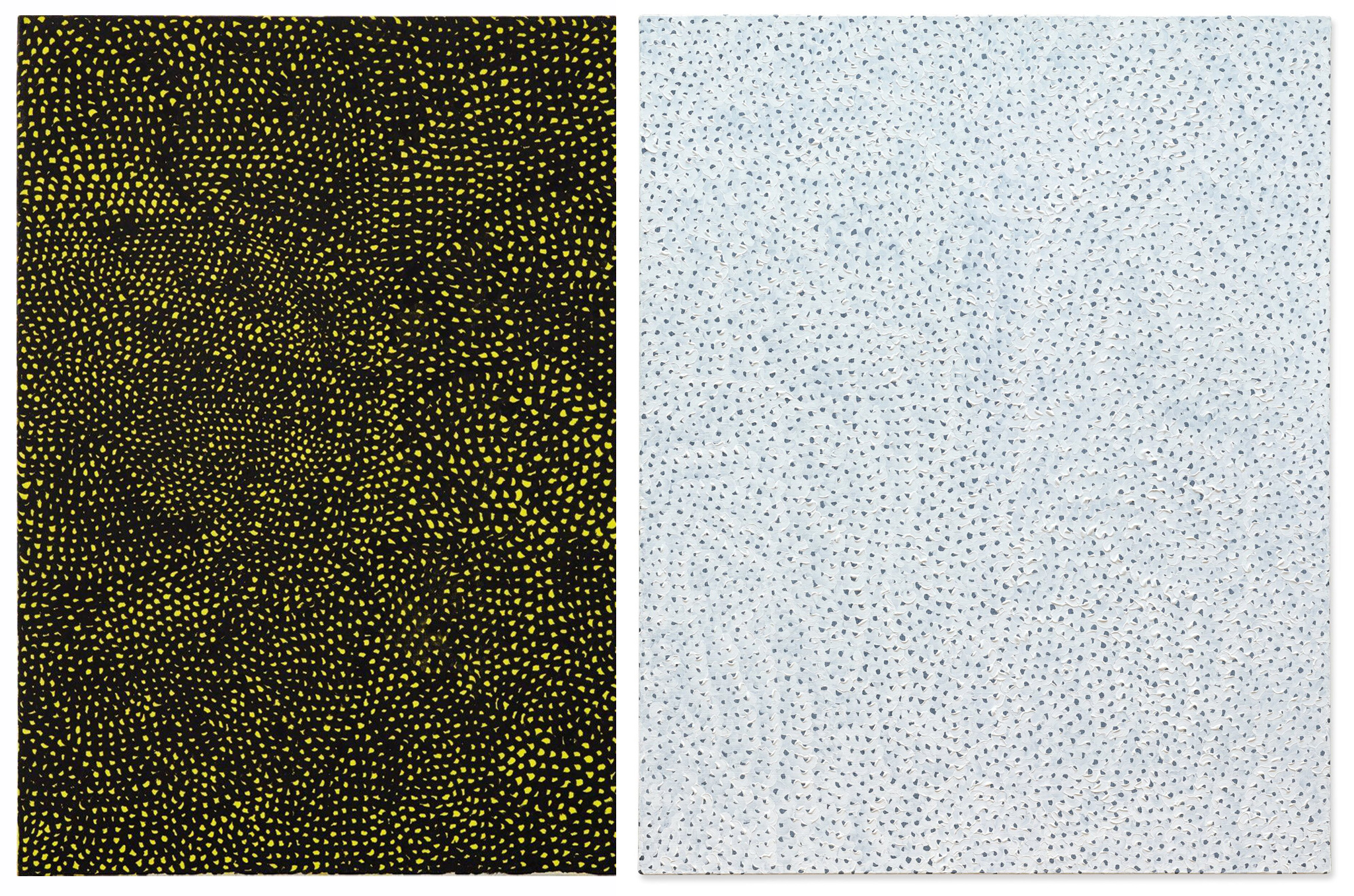
“Infinity Nets” paintings (c. 1984 and 2006) | Images via Christies
Infinity Nets (from 1959)
When Kusama moved to New York in 1958, the art world was dominated by Abstract Expressionism, a movement hailed for its large-scale, heroic brushwork and masculine bravado. Kusama’s response was the Infinity Nets series — epitomized by early pieces like “Pacific Ocean” (1959) — featuring endless, rhythmic loops of impasto paint layered over contrasting undercoats. Up close, each net is a dense lattice of thousands of tiny, crescent-shaped brushstrokes that seem to undulate and breathe, reaching infinitely past the frame.
Rooted in her childhood hallucinations, the meticulous technique was a process she called “self-obliteration” — painting until the individual ego dissolved into the canvas. “Our earth is only one polka dot among a million stars in the cosmos,” the artist once said. “Polka dots are a way to infinity. When we obliterate nature and our bodies with polka dots, we become part of the unity of our environment.”
Contemporaries like Donald Judd and Frank Stella recognized her genius early on and purchased her pieces, yet major institutions initially sidelined her as a young Japanese woman in post-war Manhattan. Despite this lack of institutional support, Infinity Nets laid essential groundwork for Minimalism, and are recognized today as crucial turning points in post-war abstraction.
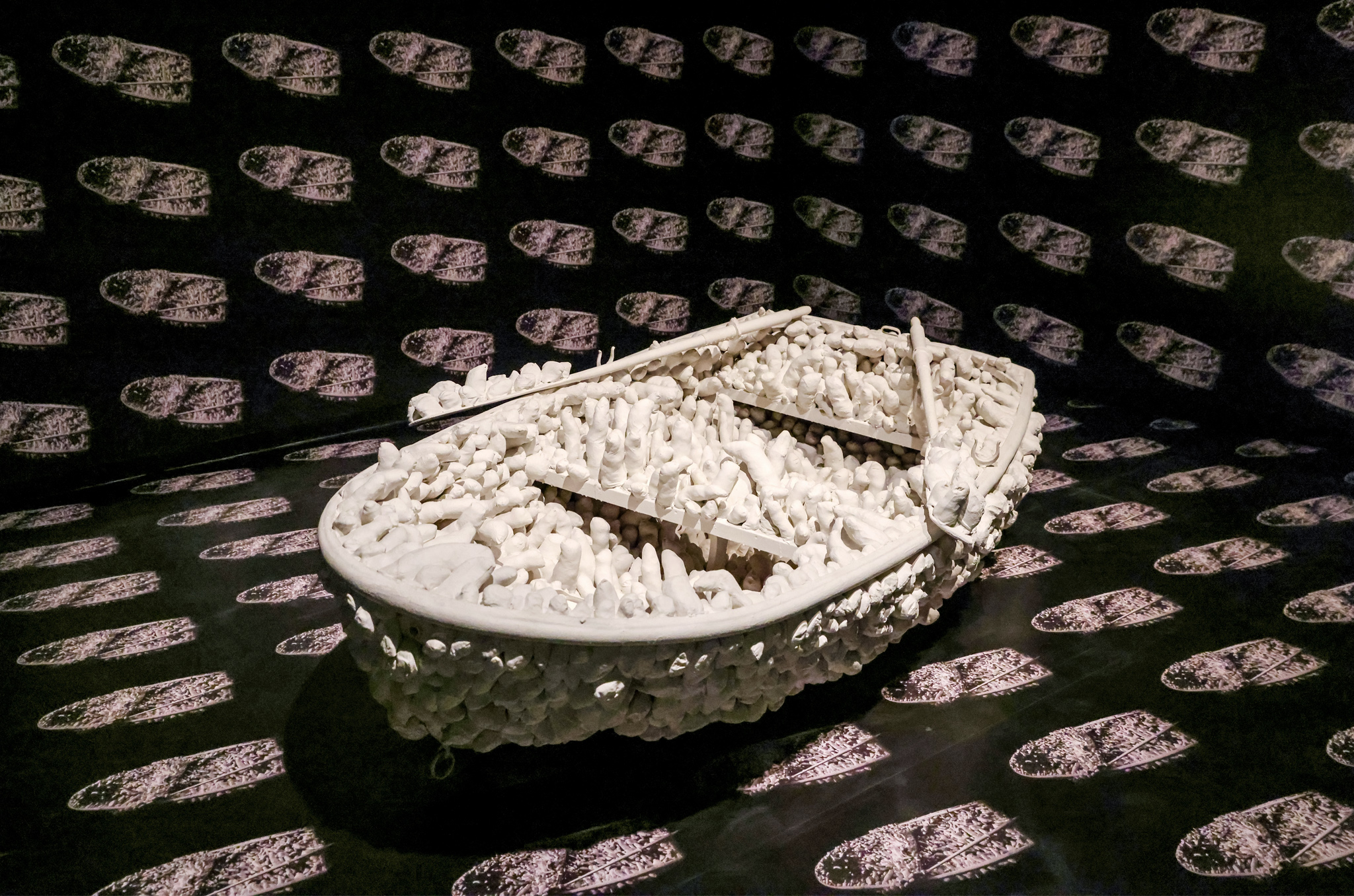
“Aggregation: One Thousand Boats Show” (1963) on display at the Stedelijk Museum, Amsterdam | Image: Shutterstock
Accumulation & Soft Sculptures (from 1962)
By the early 1960s, Kusama brought her repetitions off the canvas and into sculptures and spatial installations. She transformed found domestic objects — armchairs, ladders, shoes and sofas — into surreal “soft sculptures.” These were covered with hundreds of stuffed, hand-sewn fabric protrusions, unmistakably phallic, as seen in examples like “Accumulation No. 1” and “Accumulation No. 2.”
“My family was really conservative, really uptight,” she told Index. “I liberated myself from the fear [of sex] by creating these works.”
The series expanded into ambitious installations with “Aggregation: One Thousand Boats Show” (1963) at the Gertrude Stein Gallery, where she filled a rowing boat with soft-sculpture forms and lined the walls, floor and ceiling with 999 prints of the boat itself. Derived from her desire to confront deep-seated anxieties surrounding intimacy and patriarchy, these strange, organic objects made radical statements on gender, domesticity and trauma.
The Accumulation series sat at a critical intersection of 1960s art history, pioneering spatial and repetition techniques that resonated across New York; It’s widely understood, for instance, that Andy Warhol lifted the technique of room-spanning, repeated wallpaper directly from the “One Thousand Boats” show, which he attended and praised. His “Cow Wallpaper” famously appeared two and a half years later at the Leo Castelli Gallery in 1966.
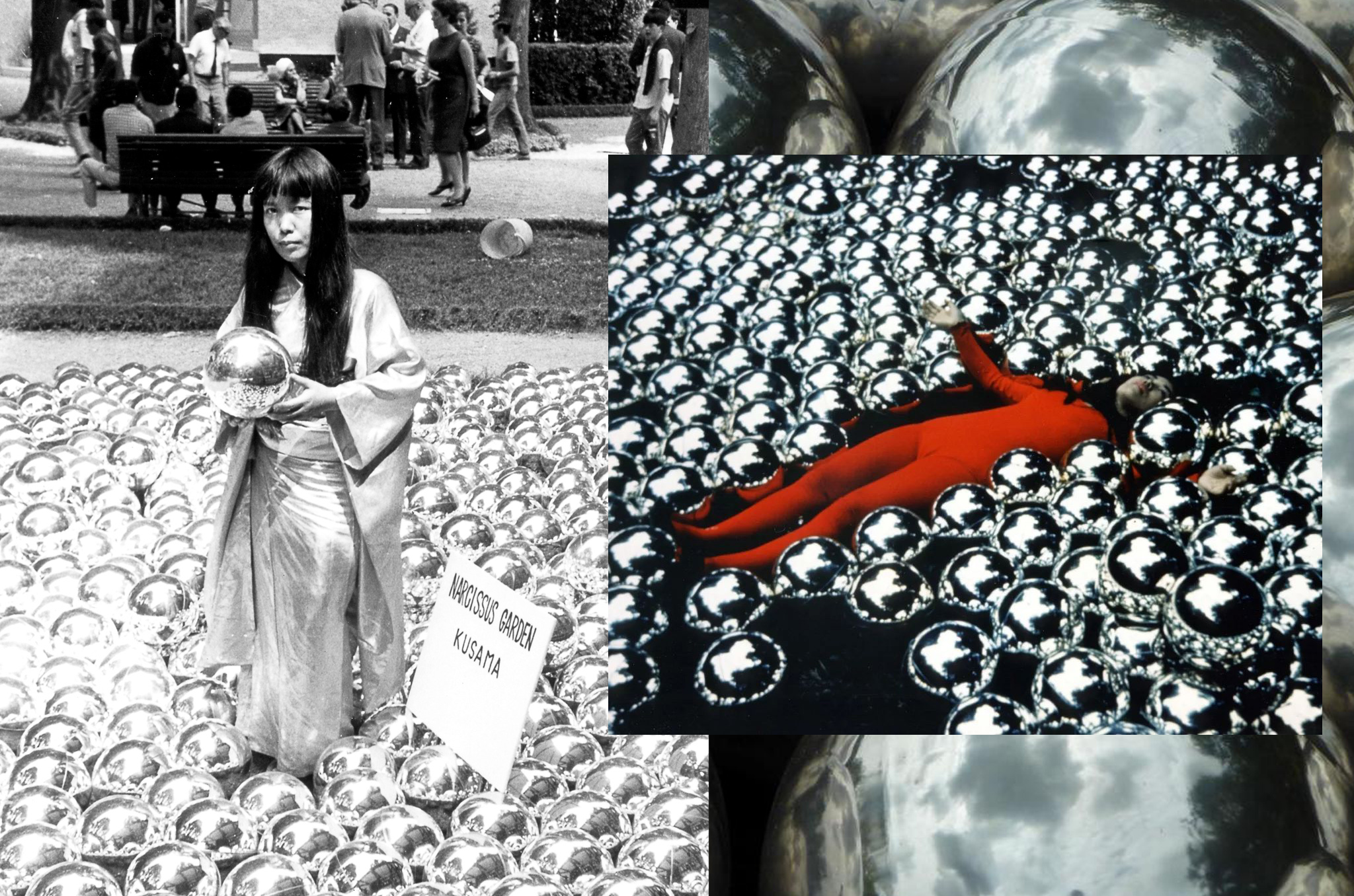
“Narcissus Garden” (1966), at the Venice Biennale © Yayoi Kusama
Narcissus Garden (1966)
When visitors walked up to the Italian Pavilion at the 1966 Venice Biennale, they were met with an unannounced spectacle: 1,500 gleaming silver spheres scattered across the grass, and Kusama, clad in a gold kimono. Operating without an official invitation, she staged “Narcissus Garden” as a direct provocation, selling the mirrored globes to the crowd for $2 apiece beneath a sign that proclaimed “Your Narcissism for Sale.”
“What was most important about [the piece] was my action of selling the mirror balls on the site, as if I were selling hot dogs or ice cream cones,” she explained.
It was a sharp critique of the art market’s commercialism, turning viewers into active participants forced to confront their own reflections in the hand-held spheres.It remains an iconic milestone in conceptual art, performance and public sculpture; Kusama has since recreated it in various bodies of water and public gardens worldwide over the decades. The moment came full circle in 1993 when Kusama returned to Venice as the first solo artist to officially represent Japan in the country’s pavilion.
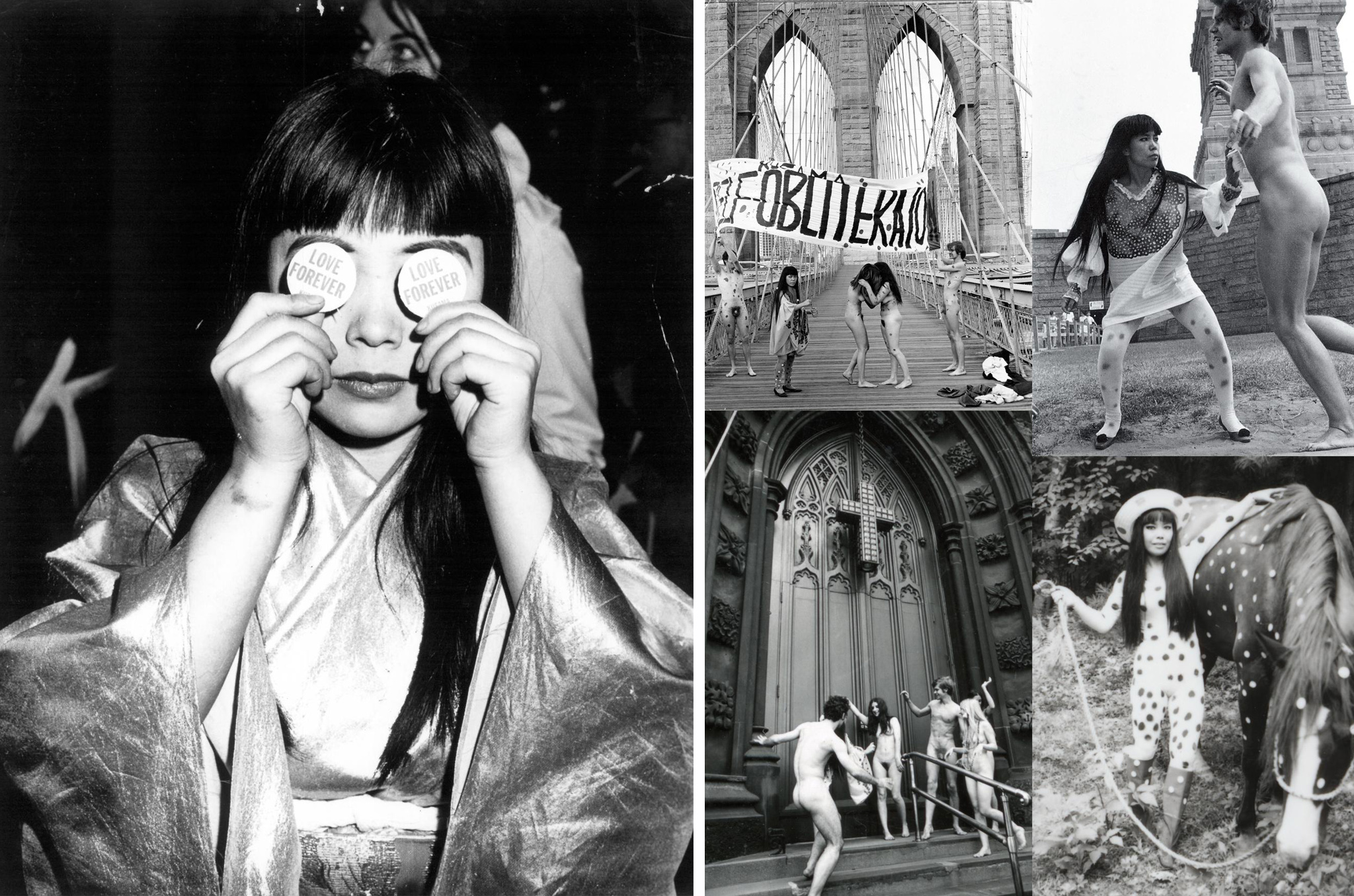
Selected photographs of “Happenings” staged 1967–8 | Images: Collection of the artist © Yayoi Kusama
Anarchic Body Festivals & Public ‘Happenings’ (1965-71)
Audiences who know Kusama primarily through her contemporary museum exhibitions are often surprised by the fierce radicalism of her late-1960s performance art era. In addition to light-show events at experimental venues like the Black Gate Theater and her 16mm experimental film Kusama’s Self-Obliteration (1968), she launched a series of public “happenings” across the streets of Manhattan.
Armed with paintbrushes and cans of fluorescent body paint, Kusama gathered groups of volunteers and performers — often nude — and painted polka dots directly onto their skin in high-profile spots like Central Park, Washington Square Park and the New York Stock Exchange.
According to Kusama, some of the audience would get so into the performance that they would take off their clothes and ask her to paint polka dots on them, too. These controversial “happenings” took aim at the Vietnam war, the Soviet invasion of Czechoslovakia, social conservatism and capitalism, generating sensationalized headlines and, on several occasions, leading to Kusama’s arrest or detention for public indecency.
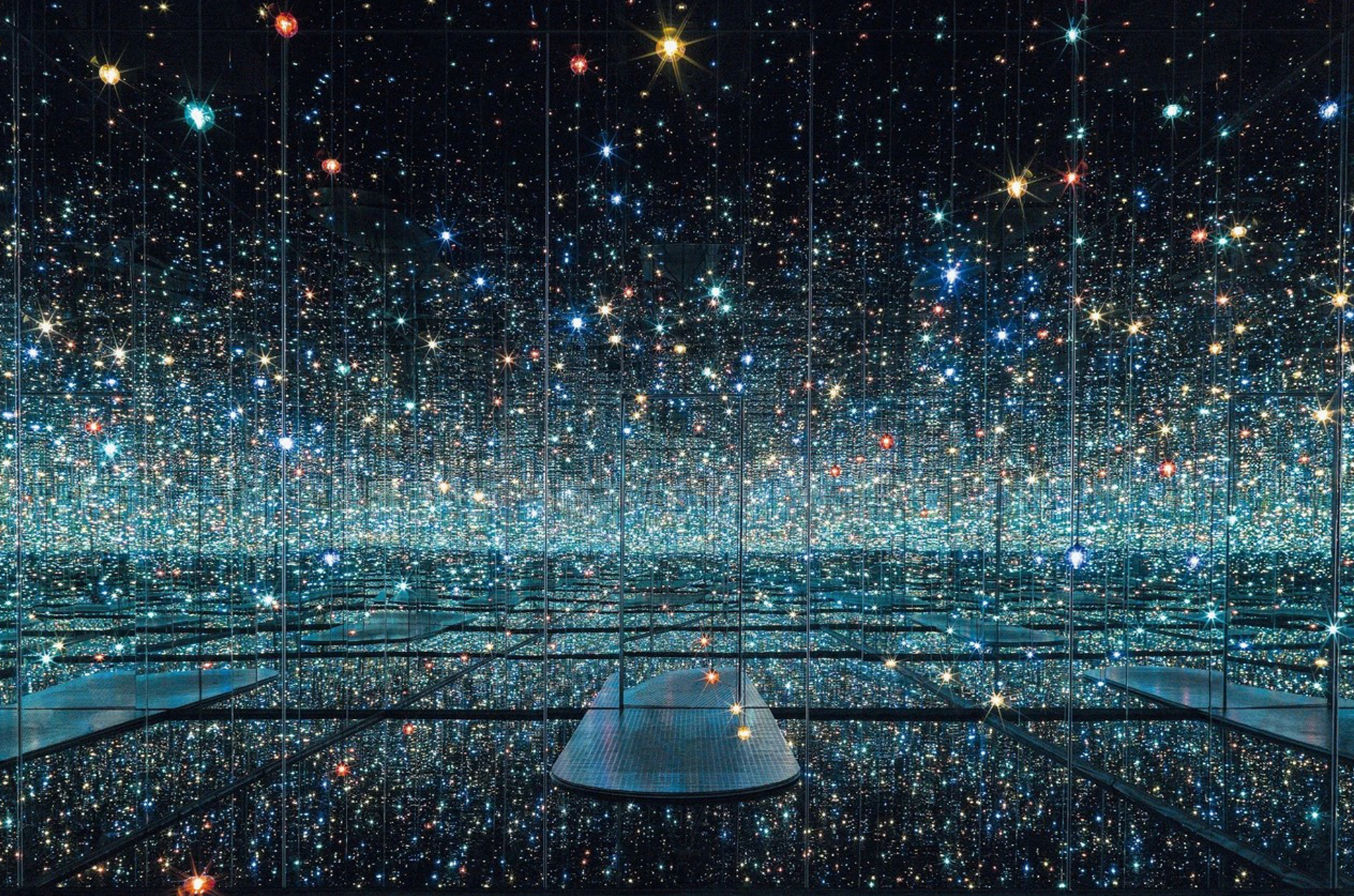
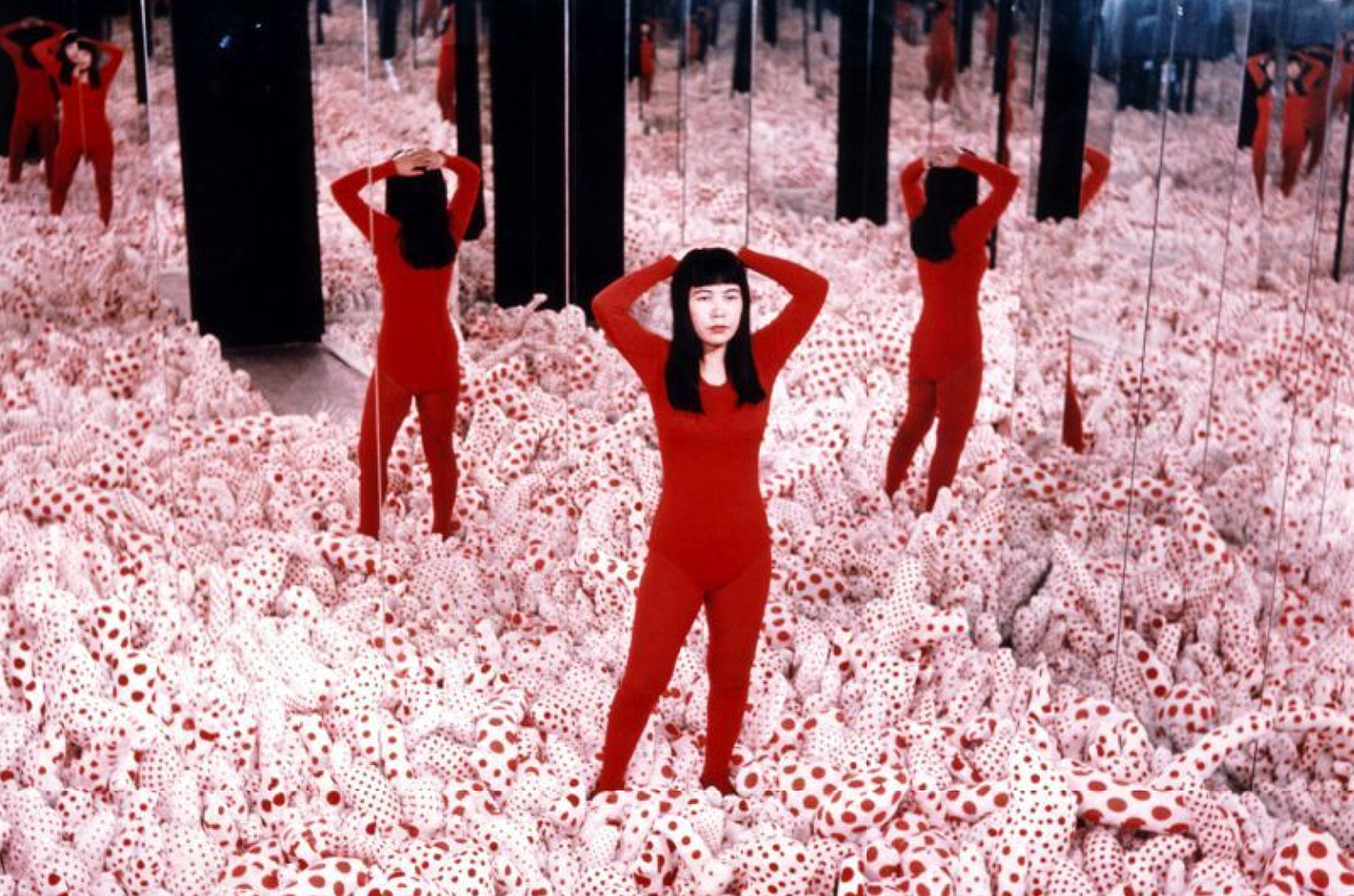
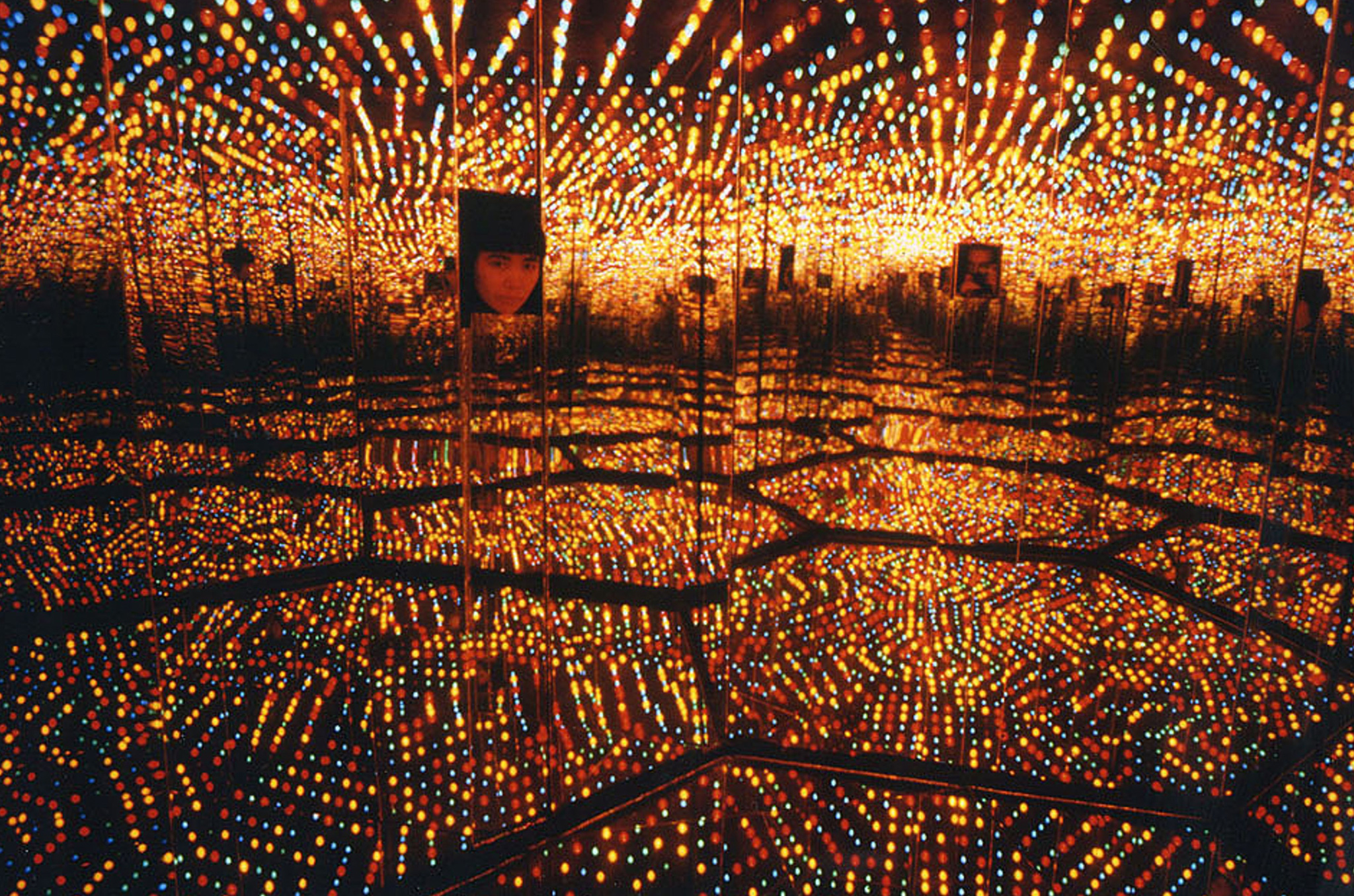
Infinity Mirror Rooms (from 1965)
Kusama introduced her iconic mirrored environments in November 1965 at the Castellane Gallery in New York with “Infinity Mirror Room — Phalli’s Field,” lining a room with reflective glass to multiply her spotted soft sculptures into an infinite optical illusion. She continued exploring spatial light dynamics with works like “Peep Show / Endless Love Show” (1966), a hexagonal chamber reflecting flashing carnival lights.
Newer iterations — such as “Infinity Mirrored Room — The Souls of Millions of Light Years Away” (2013), now permanently at The Broad in LA — refined this spatial concept by suspending hundreds of color-changing LED lights over dark water inside a mirror-lined chamber.
Coinciding with the rise of Instagram culture in the 2010s, these rooms drew massive crowds, with visitors queuing for hours for just a single minute inside. Beyond their virality, the rooms popularized the concept of immersive installations for years to come, prompting the rise of experiential spaces like TeamLab Borderless, Atelier des Lumières and Artechouse.
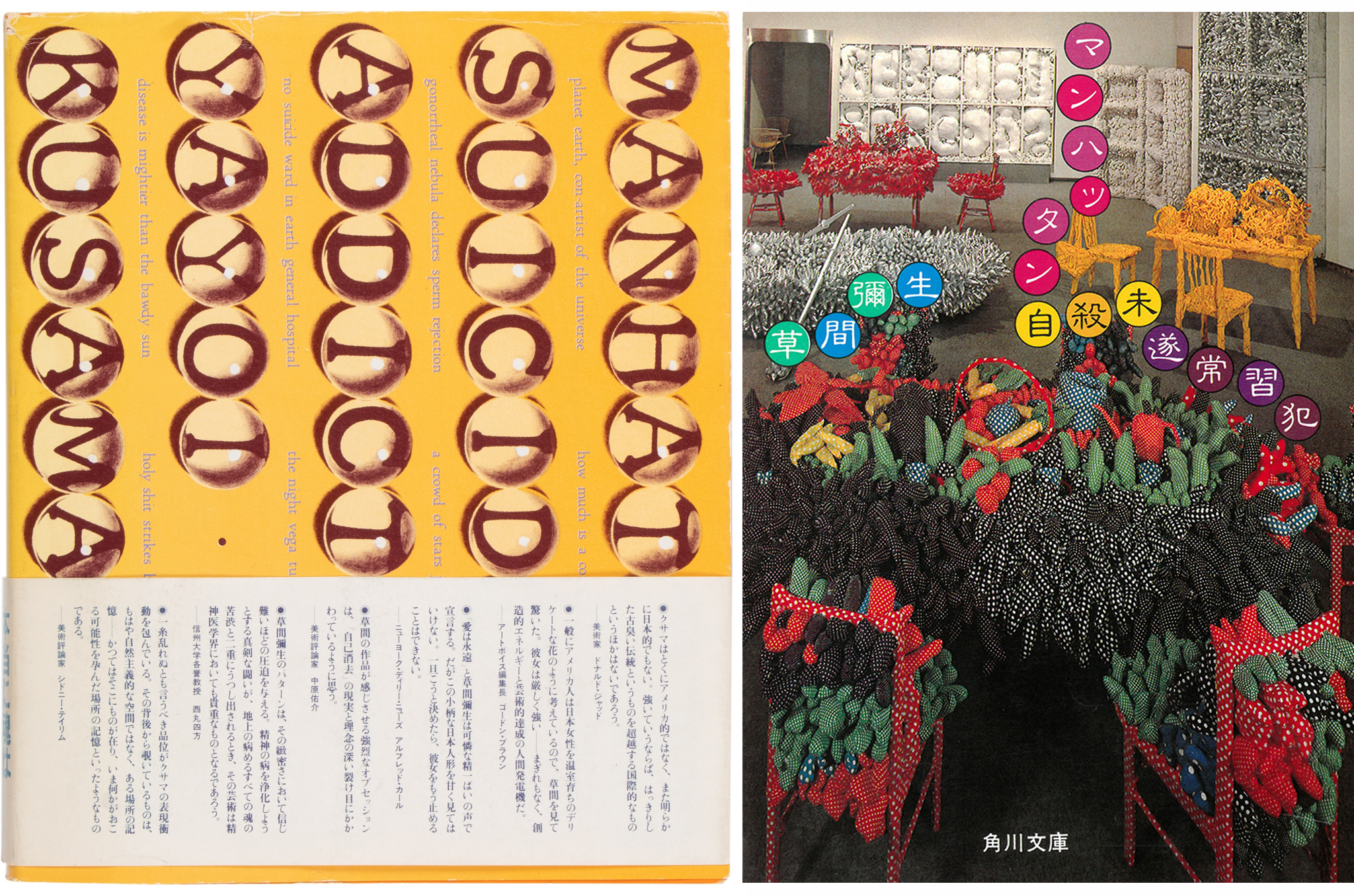
Kusama’s first novel, “Manhattan Suicide Addict” (1978). Left: first edition (1978), right: Japanese pocket edition (1984)
Manhattan Suicide Addict & Literary Career (1977-1980s)
Due to her declining mental health, Kusama returned to Japan in 1973 and voluntarily checked into a Tokyo psychiatric facility in 1977, where she would live and work for the rest of her life, with her studio close by. While some international galleries assumed her career had concluded, she channeled her creative energy into writing, publishing her autobiographical novel Manhattan Suicide Addict in 1978, followed by poetry collections and surreal short fiction like “The Hustler’s Grotto of Christopher Street.”
Her literary output provides vital context for her visual work. In her prose and poems, she articulated the sensory realities of her psychological experiences, describing swarming patterns, talking flora and creeping polka dots. Her writing earned legitimate literary recognition in Japan, including the 10th Literary Award for New Writers from the monthly magazine Yasei Jidai.
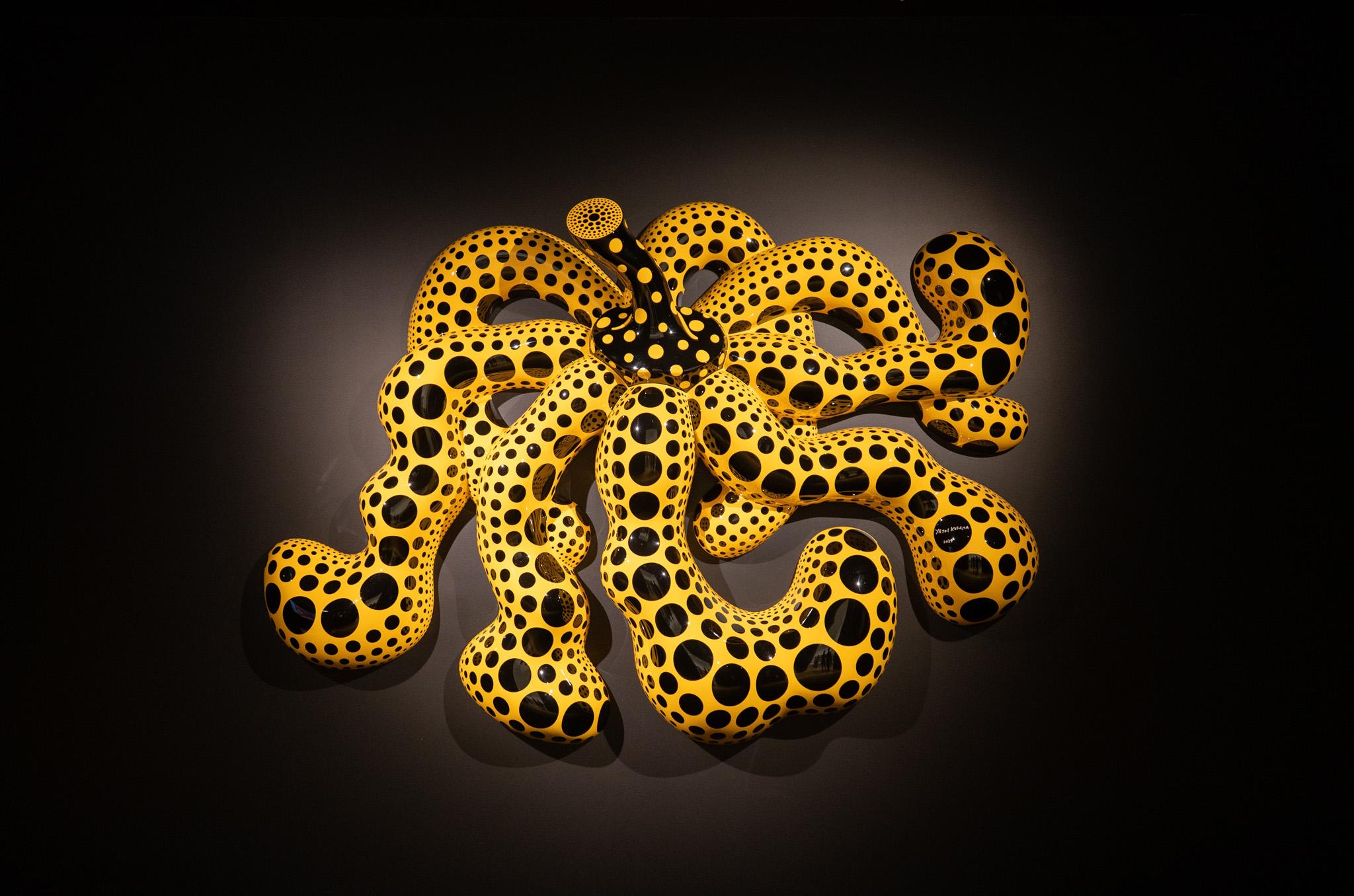
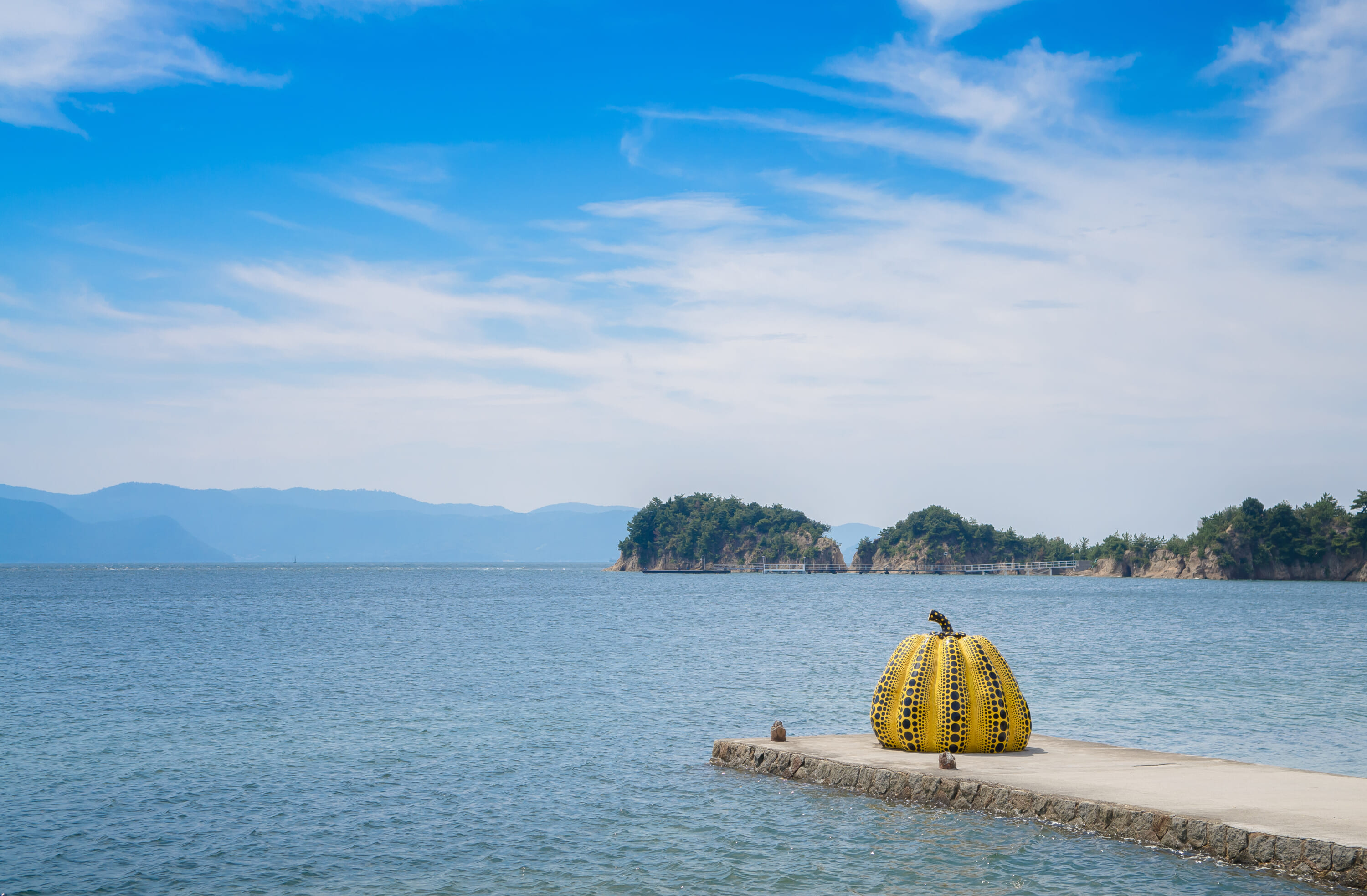
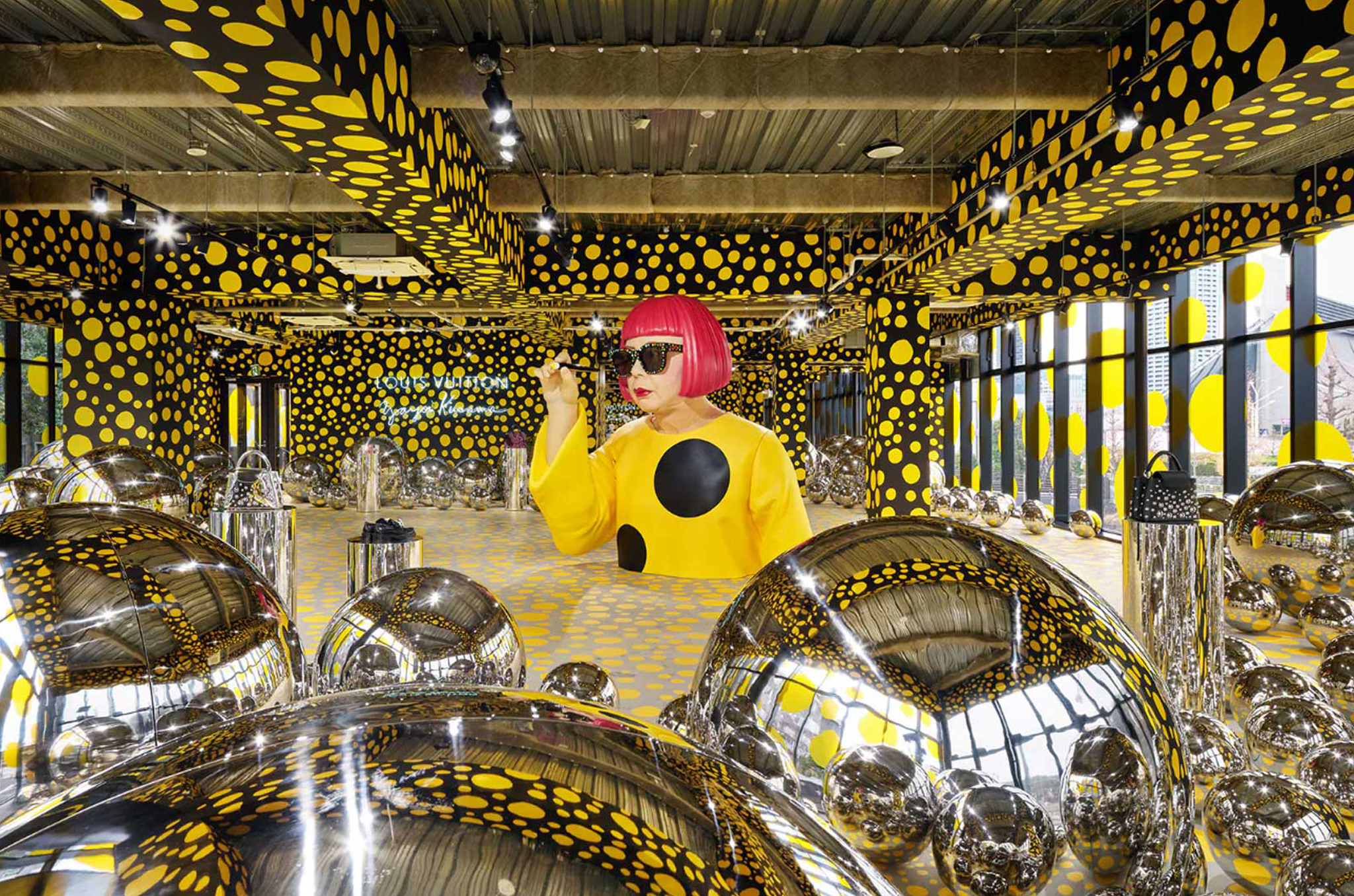
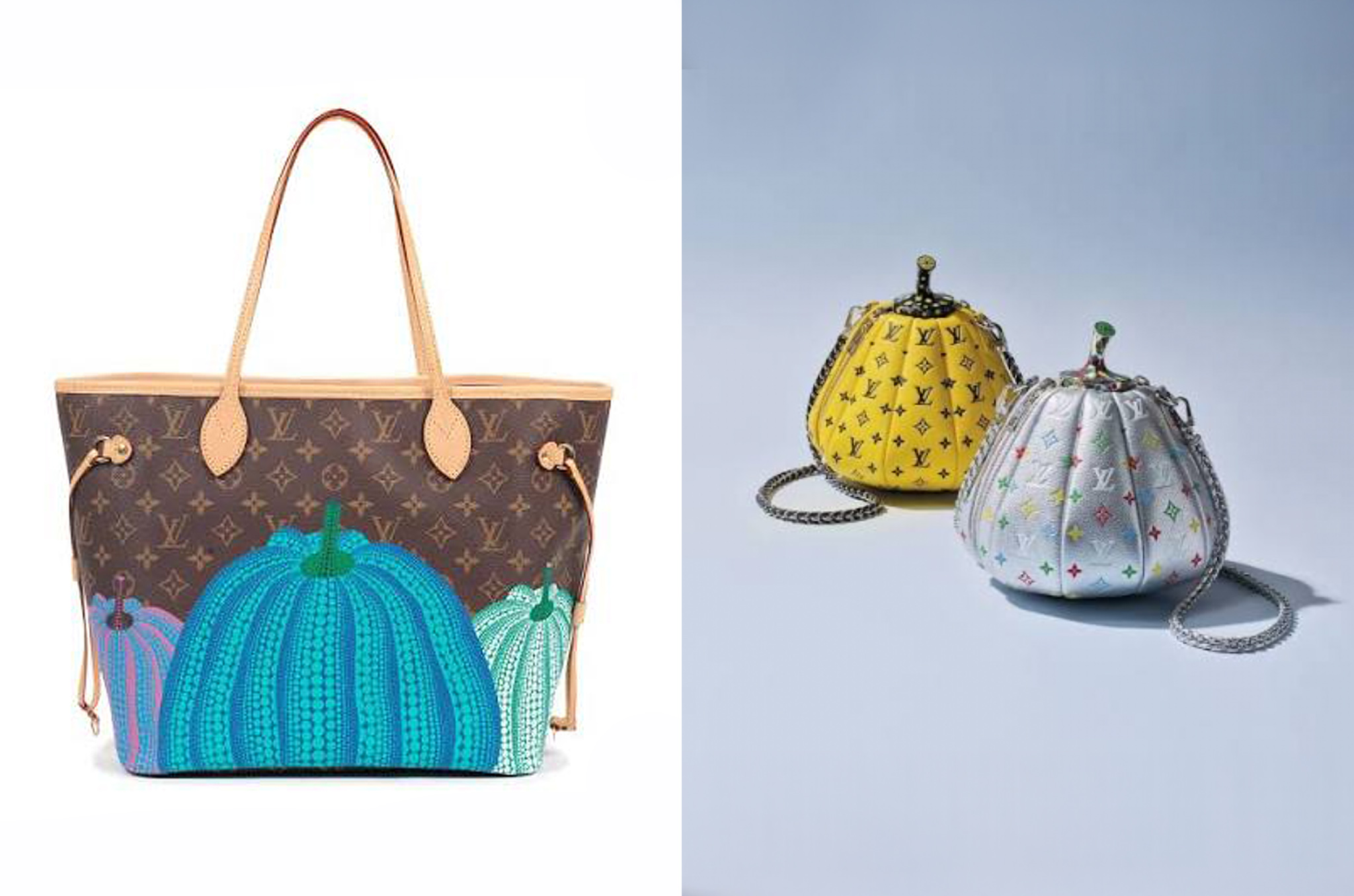
Pumpkins & Louis Vuitton (from 1994)
While gourds appeared in her early childhood drawings and works she made as a student, the 1994 installation of a giant, yellow-and-black polka-dotted pumpkin at the end of a pier on Naoshima Island turned the motif into her signature sculptural icon. Drawn to the vegetable’s bulbous form and organic humor, Kusama transformed the humble gourd into a landmark of contemporary public art in Japan.
The pumpkin motif served as a bridge between fine art, public sculpture and global luxury branding. Her 2012 partnership with Louis Vuitton — six years after Marc Jacobs visited her Tokyo studio during the filming of a documentary — was the most expansive iteration of a template Jacobs had already established with Stephen Sprouse, Takashi Murakami and Richard Prince, and one that continues to influence artist-fashion collaborations today.
By the time Louis Vuitton launched its massive 2023 campaign, wrapping flagship storefronts and leather goods across Paris, Tokyo and New York in vibrant polka dots, her visual language had achieved a rare level of cultural saturation, blurring the line between fine art and commercial design.
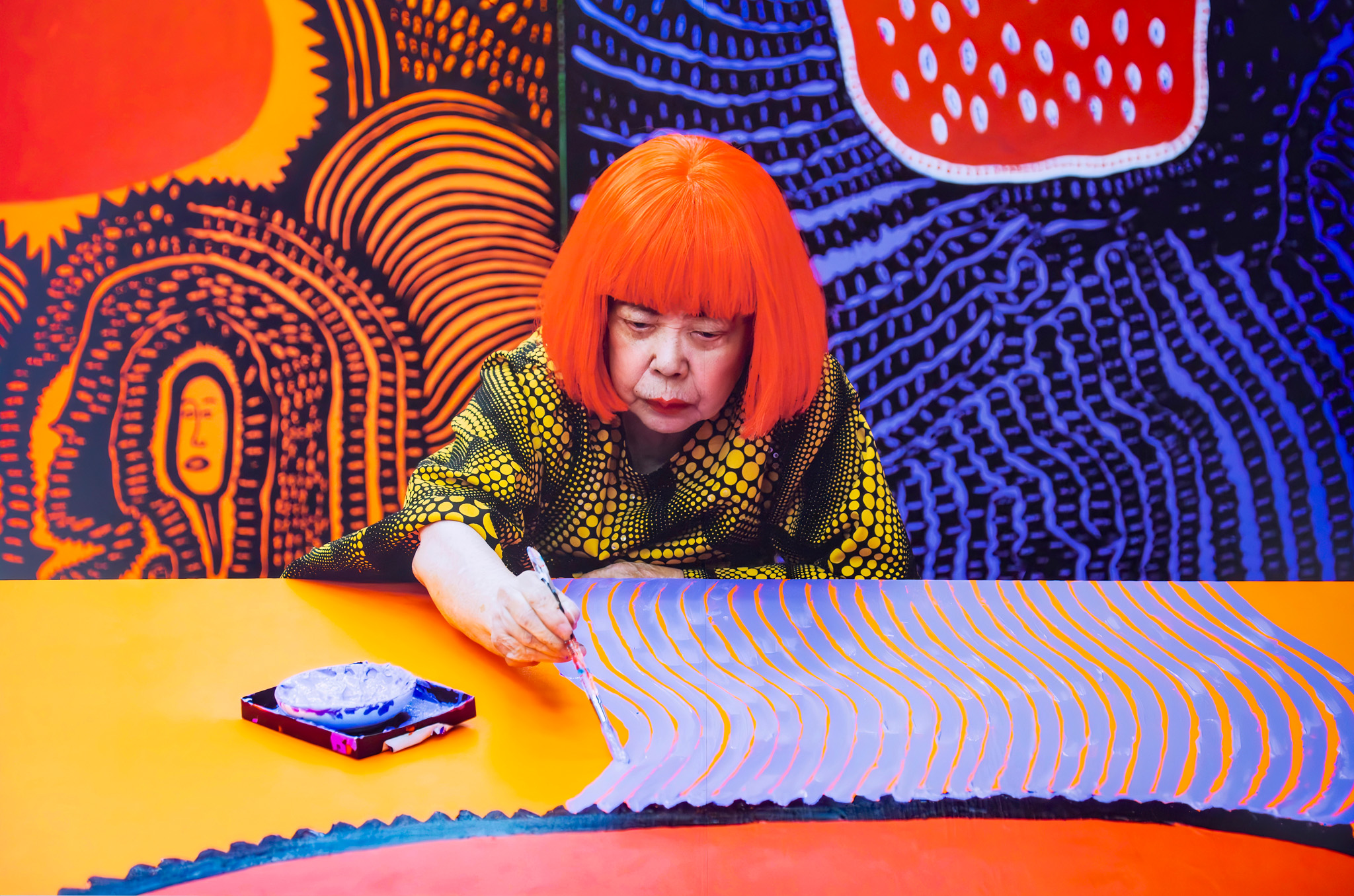
Kusama pictured painting the “My Eternal Soul” series © Yayoi Kusama via Shutterstock
My Eternal Soul (2009-2021)
Around age 80, Kusama began working on an ambitious painting series that would become the defining focus of her late career — My Eternal Soul. Working daily in her Tokyo studio, she completed roughly 900 large-scale canvases before bringing the series to a close in 2021. The works are filled with an endlessly inventive array of motifs: floating eyes, biomorphic cells, swirling tentacles and her signature polka dots.
Executed in bright, flat acrylics, these pieces feel like a culmination of her lifelong visual repertoire. Where her early Infinity Nets consisted of tight, obsessive repetition, muted tones and hypnotic textures, My Eternal Soul features an uninhibited, vivid color palette, fluid linework and expressive, almost childlike motifs.
Exhibited in major retrospectives at The National Art Center, Tokyo, the Hirshhorn Museum and beyond, the series highlights the artist’s enduring, instinctive connection to creation. For Kusama, art was never just a career to retire from, but an indispensable sanctuary until the end of her life.
“In my decades of work, I have always thought of humankind’s love and world peace,” Kusama has expressed. “I fight pain, anxiety and fear every day, and the only method I have found that relieves my illness is to keep creating art.”