
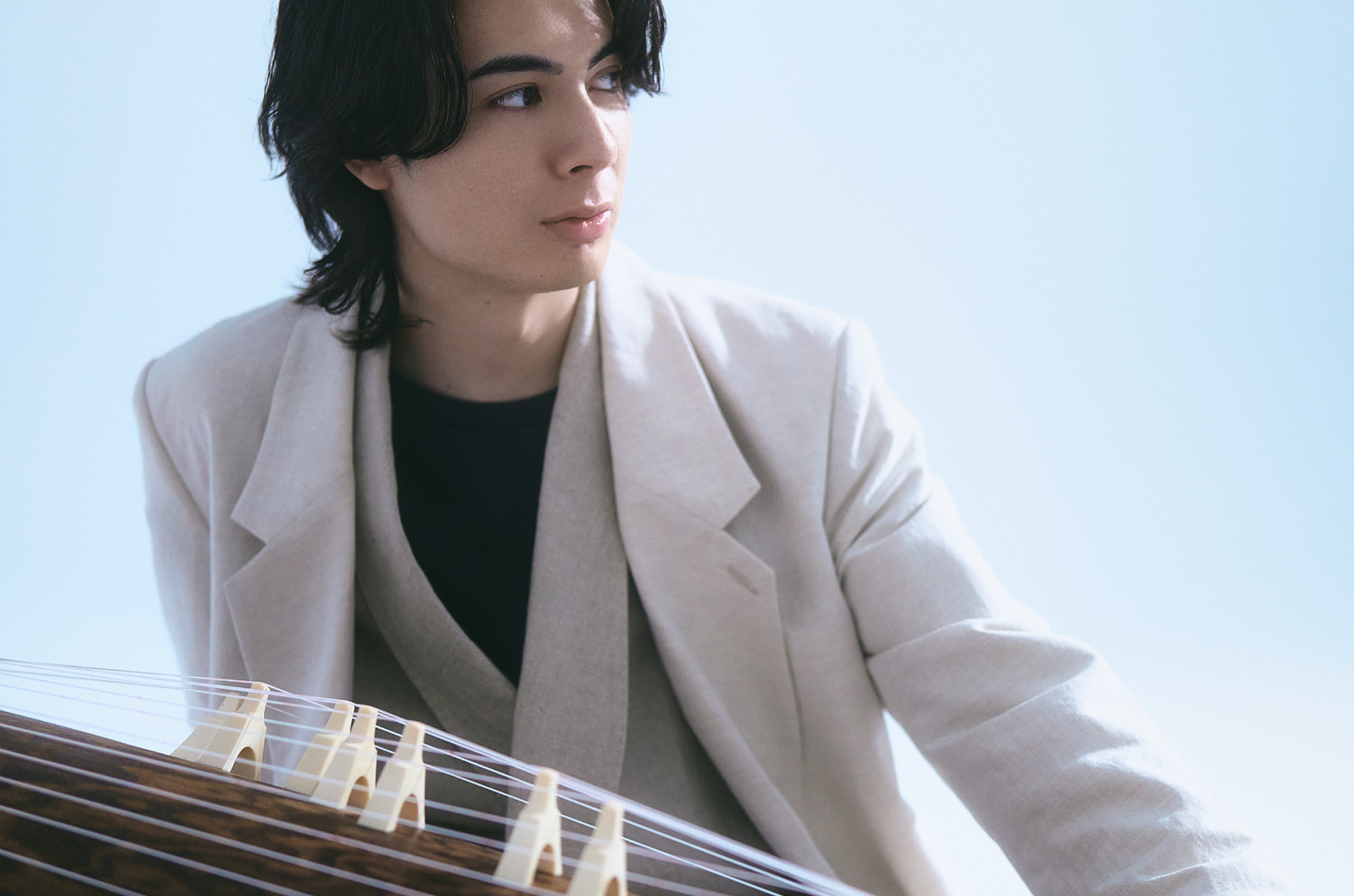
Leo Konno began playing the koto at the age of 9. At the time, he was attending an international school in Yokohama but mostly speaking Japanese at home. Shy, he struggled to express himself in English, so music became a form of communication before language fully did. The koto — the first instrument he ever played — offered a way to connect.
As a teenager, Leo explored a wide range of sounds and instruments, even playing briefly in a rock band. But ultimately, he felt drawn to return to the koto, believing that its quieter presence and nuanced timbre aligned more closely with his own personality.
Konno is virtuosically talented, and his musical career accelerated early. Under the mentorship of Kazue Sawai, a koto player of near-legendary status, he won a major national competition at 16 — the youngest person ever to do so — leading to a major record deal. At 19, he released his debut, Leo: 1st, under the name Leo (stylized as LEO). Now, at 28 years old, he has released a total of six full-length albums and one EP.
Over the years, his style has significantly evolved. Though he started out performing classical pieces, he eventually began composing his own work, incorporating jazz, electronic music and experimental techniques — and, in the process, shifting expectations about what a koto player can and should be. In 2022, he became the first koto player to perform at the famed Blue Note jazz club, and the same year, he appeared at Summer Sonic, one of Japan’s biggest music festivals.
His latest album, Microcosm (2025), expands the instrument’s range, creating a layered sound that juxtaposes delicate plucks with swelling synths. The collaborative effort, achieved with the help of a number of other composers and musicians, blends the delicate sound of the koto with dreamy piano notes, jazzy horns and bass, as well as rhythmic interplay with drums and tabla. The result is a meticulous, band-oriented album that sounds like its own little universe coming to life.
Rather than positioning himself strictly as a koto player, Konno sees himself simply as a musician — one who happens to play the koto and who is committed to making it feel accessible and contemporary at the same time.
Leo Konno Full Interview
TW: You started playing the koto at 9 years old. How did that shape your musical direction?
Konno: I started playing the koto when I was going to an international school in Yokohama. At the time, I wasn’t really fluent in English. When I first met the koto, it was the first instrument I played in my life, but it kind of became another tool to convey my thoughts through. It was almost like another language. Even though I wasn’t very skilled, it still gave me a sense of connection when I was playing with other people.
You experimented with other instruments and genres early on. Why did you ultimately return to the koto?
I tried playing different instruments like guitar, drums and piano, and I was in a band covering Bruno Mars and Maroon 5. But I was more of a shy person, and the smaller volume and timbre of the koto matched my personality better. So even though I tried different instruments, I kind of came back to the koto and started focusing on it more.
When did you realize that playing the koto could become a career?
I think the first time I told my parents I wanted to become a professional musician was when I was around 15. At the time, I didn’t really realize how difficult it was, especially as a koto player. My parents weren’t in the music industry, so I had no idea how to become a professional. But when I was 16, I won a big competition in Japan, and after that I got an offer from a record company. It felt like a puzzle coming together.
How do you approach blending traditional koto techniques with electronic and contemporary sounds?
At first, I was very focused on preserving the raw acoustic sound of the koto. But in recent years, I’ve started experimenting more by altering its sound electronically, using unconventional techniques and approaching it with a fresh mindset. Now, I think of myself less as a “koto player” and more as a musician who happens to play the koto.
What’s a common misconception about the koto that you’d like to change?
Koto kind of screams tradition, especially in Japan, with strict hierarchy. But at the end of the day, it’s just an instrument. The point of playing an instrument is to have fun with it. The koto is the same as a guitar or a piano — it’s just another instrument you can enjoy.
Are there artists who continue to inspire you?
Ryuichi Sakamoto and Tigran Hamasyan have both been huge influences. They work across genres while maintaining a strong personal voice. That’s something I always come back to when I feel stuck creatively.
Sakamoto worked across genres from electronic, film music to classical — yet his voice was always unmistakable. That gave me the courage to explore different styles while staying true to myself. Tigran blends jazz, metal and Armenian folk music in a way that feels completely original. His use of tradition in a modern context inspires me a lot, especially when I feel creatively stuck.
More Info
Leo will be performing at Blue Note Tokyo on April 29. For more information, click here.
Follow him on Instagram.
Related Posts
- ‘Ryuichi Sakamoto: Diaries’ Follows the Final Years of a Musical Genius
- A Century in Sound: A Love Letter to Japanese Listening Cafes
- A Chat With Hyde, Japan’s Biggest Rock Star
Updated On March 27, 2026