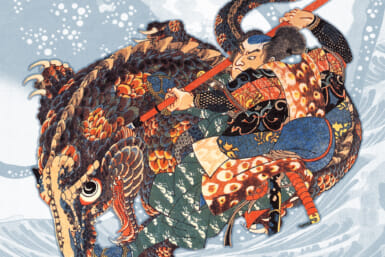

There are many ways to look at a dragon. In The Japanese Tattoo, a new photobook by writer and photographer Manami Okazaki, one can begin with the obvious pleasures: the curve of its body across a man’s back, the dense black of sumi ink sunk deep into skin, the waves and clouds that carry it from shoulder to thigh. Across 240 pages, Okazaki documents wabori — the Japanese tradition of large-scale, often full-body tattooing — in sumptuous detail.
There is another way of looking, though: outward. Beyond the dragon is the body that carries it; beyond the body, the horishi — the tattoo master — who made it; behind his hands, generations of others. Okazaki’s photographs keep widening the frame, from finished bodysuits to the people and places around them, while archival photographs and woodblock prints reach backward into the working-class culture of Edo-period Tokyo.
That wider world is what has occupied Okazaki for nearly two decades. She has been documenting Japanese tattoo culture since 2007, returning to many of the same masters as they have aged, retired and, in some cases, died. Her new book is both a record of their work and an attempt to place it back inside the culture that produced it.
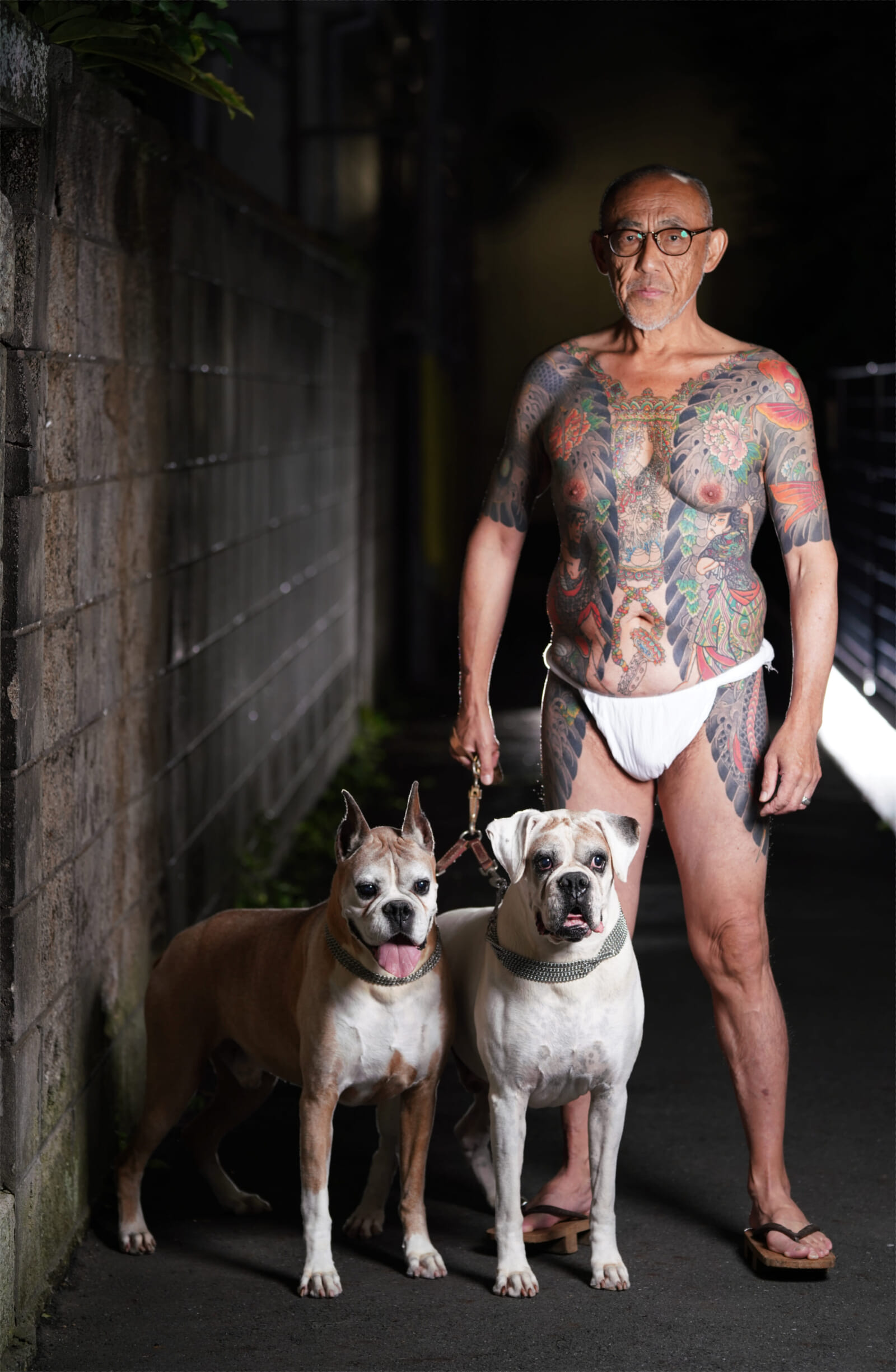
Horishi / Tattoo Artist Horikazu. Photograph by Cory Lum
A First Encounter With Japanese Tattoos
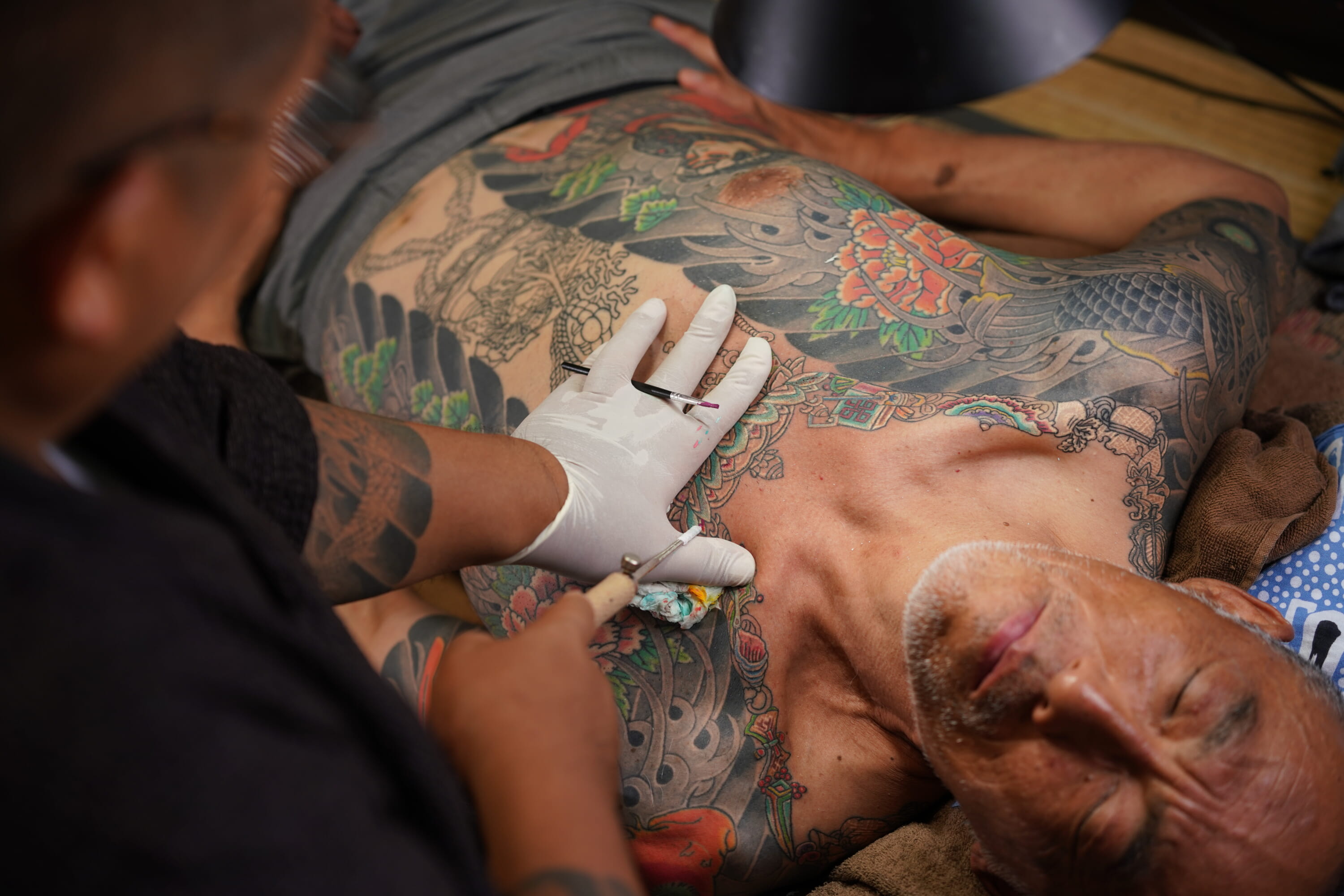
Okazaki’s own introduction to that world came almost by accident. Raised in Australia but accustomed to spending summers in Japan, she was 18 and fresh out of high school when she found a book on traditional tattooing and decided she wanted one herself. Knowing little about its customs, she committed what, in retrospect, she realizes was a faux pas: She cold-called one of the country’s most renowned horishi.
“I was completely clueless and knew nothing. You don’t just call someone like that out of the blue,” she says now.
He was booked for months; she had 10 days before her flight to Thailand. Something about the absurdity of the request amused him enough that he agreed to tattoo her at 2 a.m. He still remembers her, she says, largely because of how ridiculous the whole thing was.
What she recalls most clearly from that first encounter, though, is not the tattoo itself. “It wasn’t just the fact of getting tattooed,” she says. “It was my first encounter with a Japanese artisan.”
Photograph by Cory Lum
The Low City: Tattooing in Edo
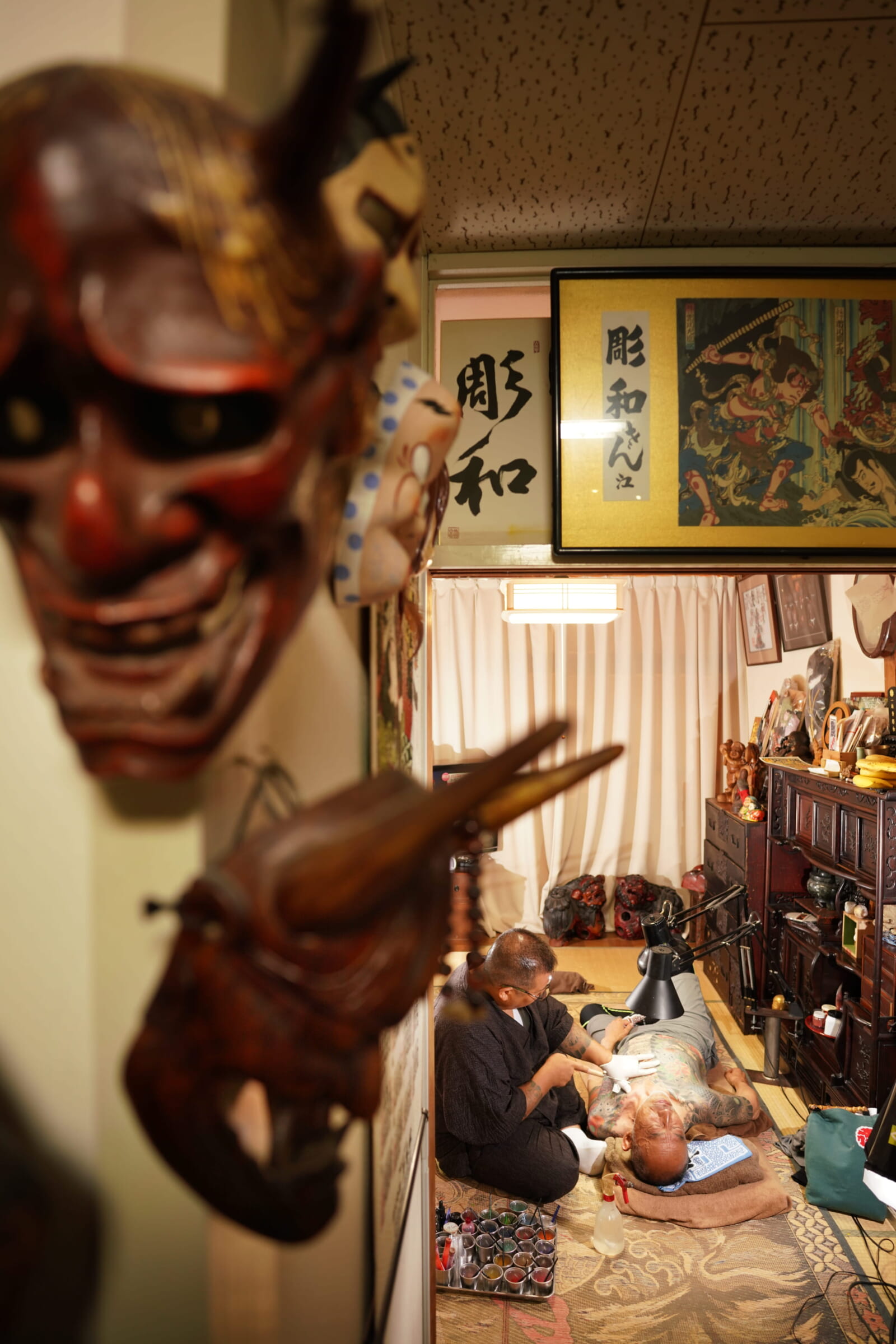
“A tattoo isn’t just the thing you put on your body,” Okazaki says. “Even the process of going to the horishi, then going to the sento afterwards, then getting tattooed specifically for matsuri — it’s all part of the lifestyle of downtown. It’s all integrated. It’s a culture and a context.”
In The Japanese Tattoo, Okazaki reconstructs the social history behind the images, tracing wabori to the commoner culture of Edo and particularly shitamachi, the historically working-class “low city” of merchants, artisans and laborers in what is now eastern Tokyo. Her book makes the case that wabori was never simply a visual style, nor did it carry a single fixed meaning. It took its significance from the lives of the people who wore it: their work, their allegiances, their ideas about status, beauty, danger and death. To understand the tattoo, in other words, requires looking beyond its imagery to the social conditions that made that imagery meaningful.
Edo’s firefighters offer one example. Fire was an ordinary terror in a city built largely of wood, and commoner brigades fought it by climbing onto roofs and tearing down buildings before the flames could spread. Rival brigades competed for prestige, and firefighters became working-class celebrities known as much for their bravado as their tattoos, worn as a sign of both masculinity and trade. Dragons, creatures associated with water and thought to bring rain, were an especially fitting motif for men who routinely entered the flames.
Protective imagery remains common among people in dangerous trades. One veteran horishi interviewed by Okazaki recalls tattooing firefighters, carpenters and construction workers. Men who work at dangerous heights, he tells her, sometimes choose a hawk after seeing co-workers fall to their deaths; the hope is that, should they fall themselves, they will fly.
Photograph by Cory Lum
Notes From Underground: Tattoos and the Yakuza
The yakuza made something different of wabori. Tattoos could mark initiation, intimidate and confer status. Even individual motifs carried particular meanings: Koi, meaning carp, is a near-homophone for the Japanese command “come whenever” — read among yakuza as a vow to be ready to die at any moment, the same readiness expected of the men who wear it.
In The Japanese Tattoo, the horishi Horitoku, who spent decades tattooing yakuza clients in Tokyo, tells Okazaki that bosses would send younger members to him by introduction. Each would announce his group affiliation and rank when he arrived. A good tattoo mattered inside prison, too, he says: With every inmate dressed alike, wabori became one of the few ways to distinguish oneself, and exceptional work could earn even a low-ranking gangster the respect of his superiors.
By the 1970s, yakuza patronage was substantial enough that some horishi spent weeks traveling Japan to tattoo entire groups, with the organizations covering their expenses. Horiyoshi III, the influential Yokohama master, estimates that gangsters once made up around 60% of his clients. Today, he puts the figure at almost zero. Anti-organized crime laws, changing attitudes and the tattoo boom of the late 1990s and 2000s transformed that relationship. Some prominent horishi now refuse gang-affiliated clients altogether.
As the link between wabori and organized crime has started to fray, tattoos are slowly — very slowly — gaining acceptance in Japanese society. Part of that shifting stigma, Okazaki says, is related to the rise of tattooing as fashion. “Once something becomes pure fashion, it loses some of the subversive, underground appeal that attracted people to it in the first place,” she says.
Photograph by Cory Lum
The Last of Their Kind
Nearly two decades into documenting Japanese tattoo culture, Okazaki finds herself working with a much smaller circle of traditional masters. The Japanese Tattoo consequently turns its attention to a handful of them in unusual depth. “The people I focused on felt like the last of their kind,” she says.
What may disappear with them is more than a mere technique. It is a set of values that Okazaki traces to iki, an Edo ideal of urban sophistication that prized restraint. The idea arose partly out of necessity: Sumptuary laws barred commoners from conspicuous displays of luxury, so extravagance retreated to wherever inspectors weren’t looking, most famously into kimono linings, where a sober exterior might conceal silk dense with color and pattern. Over time, discretion itself became an expression of taste.
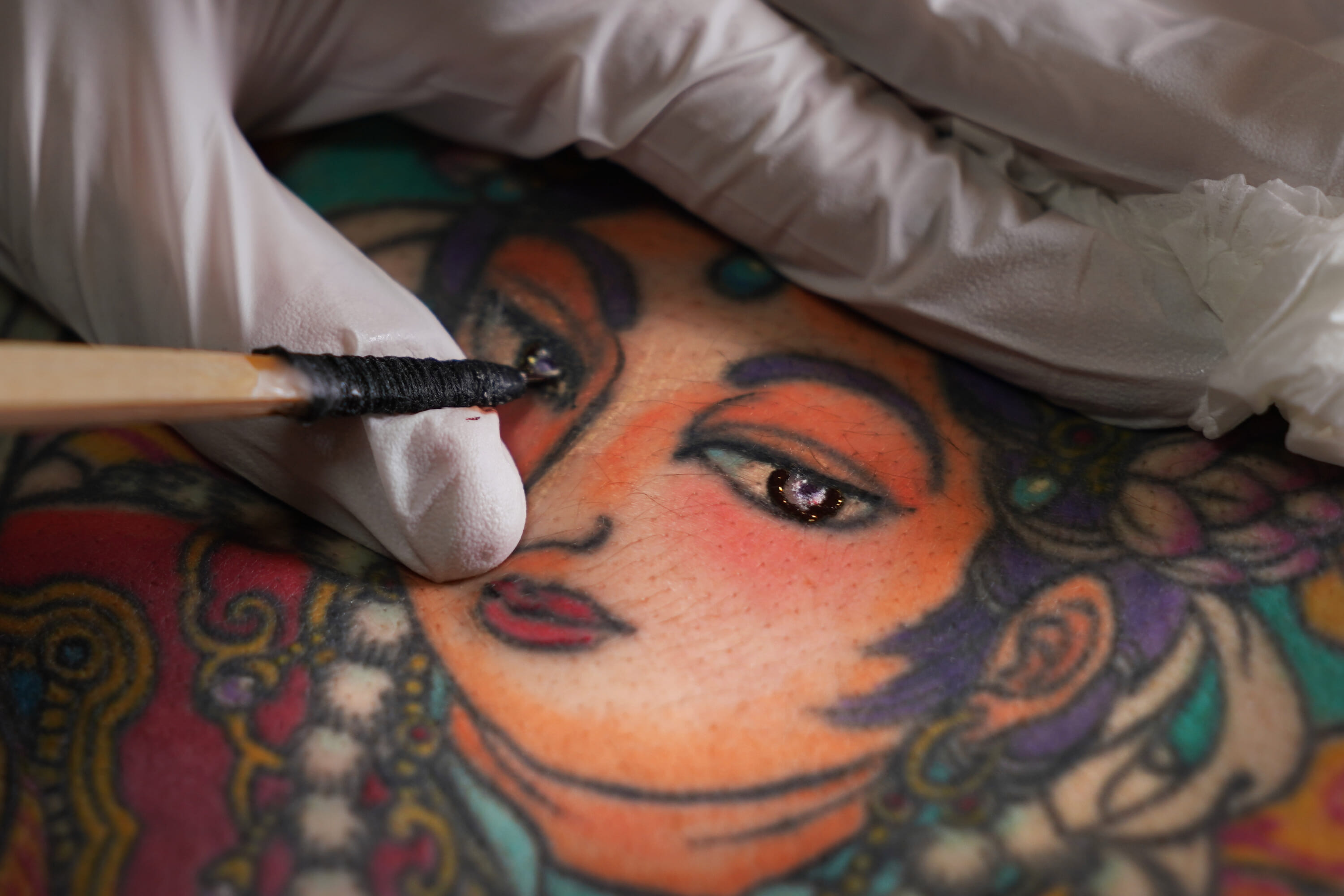
Traditional wabori reflects the same values. A full bodysuit can demand years of work and extraordinary commitment, only to disappear completely beneath ordinary clothes. Horicho II, a veteran tattooist, makes the comparison explicit: Wabori, he says, is like the pattern hidden inside a kimono. “It is beautiful because you only get a glimpse of it.”
The analogy extends to the people who make the tattoos. While tattooists elsewhere, and increasingly in the internet age, may cultivate the persona of artist or celebrity, the masters Okazaki documents tend to describe themselves as craftsmen. Their expertise extends beyond the mechanics of tattooing to the cultural knowledge behind the images themselves. Horitoku explains that reproducing a figure from an Edo-period print requires knowing how its obi is tied, why its sleeves fall as they do and what kind of wig he wears. The Tokyo-based master encourages younger tattooists to attend kabuki and sumo and study these details for themselves.
This is why Okazaki is wary of treating preservation as simply keeping an old visual style alive. Wabori has never been static: Her first tattoo book, published in 2008, featured traditional masters alongside artists incorporating influences from elsewhere. The question is whether the knowledge behind the images proves as durable as the images themselves.
“The beauty of Japanese tattooing comes from the way people live,” she says. “I hope wabori remains a real craft, not just a style. It doesn’t have to stay stuck in the Edo period, but the culture behind it matters.”
More Info
Manami Okazaki’s The Japanese Tattoo: Fights and Fires Are the Flowers of Edo is available for purchase in Japan via a variety of online retailers, including Kinokuniya and Amazon Japan.
Related Posts
- Tattoo-Friendly Sento in Tokyo
- A Conversation With Tokyo Tattoo Artist Keisuke Hirata on Taboo, Acceptance and the In-Between
- Photographing Koenji’s Vibrant Fashion Scene by Night