

Would you love me if I were a dog? It’s not a question I’ve ever had much reason to ask my boyfriend, mostly because I suspect the answer would be yes. I picture a pleasant enough existence, spent dozing off on the sofa and enjoying the kind of unquestioning affection that humans seem to find so difficult to give one another. But according to a new Japanese life simulator called 9億分の1 (1 in 900 Million), I might be considerably less lucky.
Created by Japanese developer Kyodou Kyosa, who also sells beagle merch, the free browser game has been circulating on X since October 18, with its original announcement attracting more than 560,000 views by the following morning. Its premise is simple: You’re randomly born as a dog and live out an entire lifetime in as little as five minutes. You might end up as a pampered household pet in Canada, a village dog in Cambodia (as I was for my first attempt) or a breeding dog spending much of its life producing puppies.
You can choose a 5-, 10- or 20-minute life, pause or speed up the simulation, and enter details about your own dog to compare their circumstances with your simulated life afterward. From there, the simulation unfolds through a running diary, while four colored bars track your health, satisfaction, freedom and attachment to others. You occasionally get to make small choices, such as whether to approach a stranger, though most of what happens is beyond your control. Progress is only saved in your browser.
On my third attempt, I was born beneath a fallen tree on a mountainside in Myanmar, one of eight puppies in a litter. I had no name, no owner and an inherently fearful disposition. I spent five months with my mother, made one decision for myself (which was to approach a child who held out a hand) and died in a traffic accident at three years and three months old. According to the game’s estimates, only 4.9% of puppies born into similar circumstances would have survived as long as I did. Most of the other times, I never made it past four months.
Meanwhile, a panel alongside my own life followed four other dogs born at the exact same second as me, each living through a different set of circumstances. Watching their lives unfold alongside mine made the arbitrariness of my own fate rather difficult to ignore.
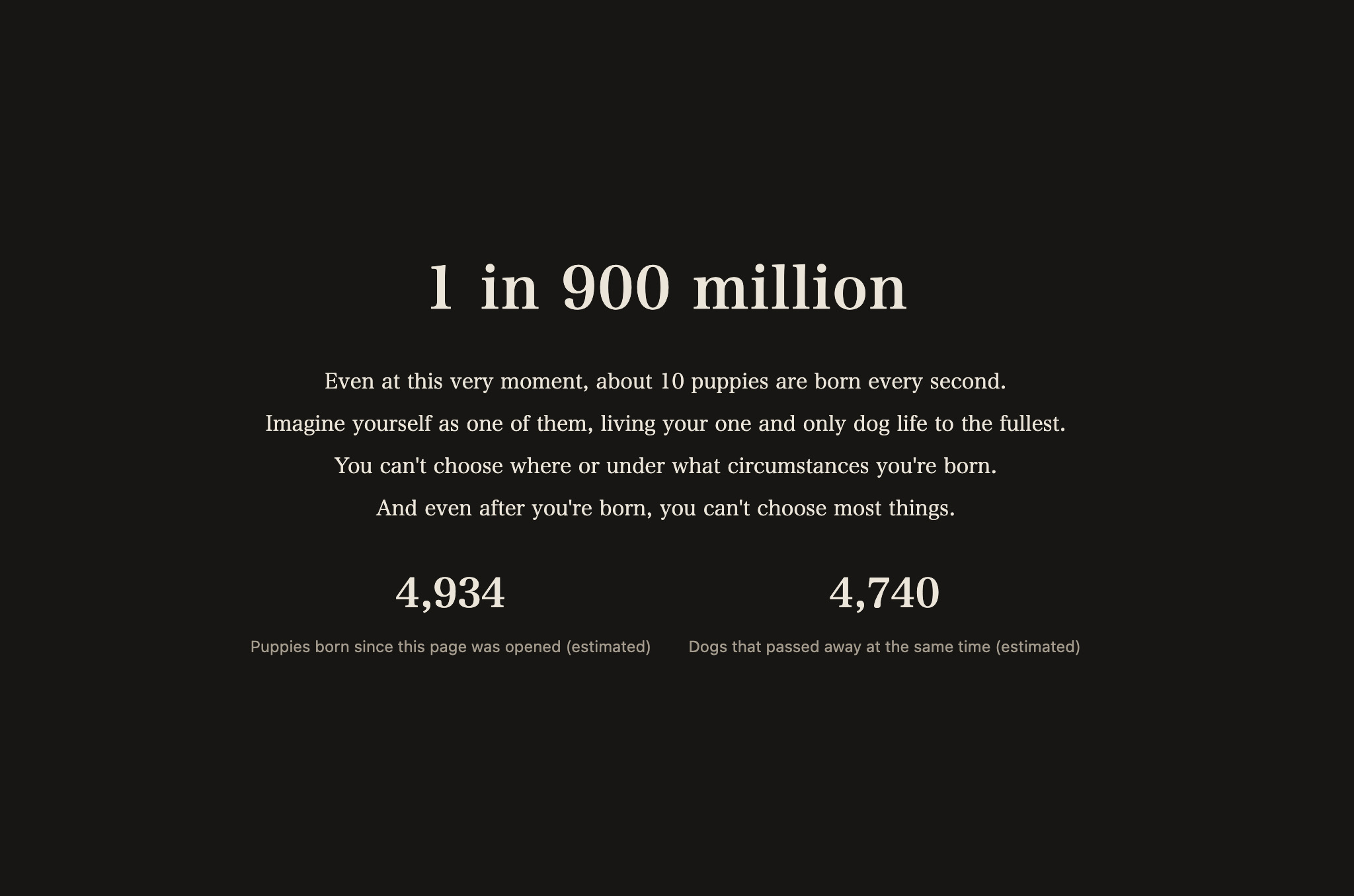
Screengrab of game homepage | via 9oku.kodow.net
A Dog’s Life, Decided by Chance
The game was inspired by another Japanese browser simulator, 1 in 8 Billion, which randomly assigns players a human life based on demographic statistics. Kodou says they applied a similar premise to the world’s dogs.
The game draws on research into dog populations, puppy mortality and animal welfare, although many of its probabilities are necessarily estimates. According to the World Organisation for Animal Health, roughly 75% of the world’s dogs are free-roaming, a category that includes street dogs, village dogs and dogs that belong to families but are allowed to wander freely. One study cited by the game followed 364 free-ranging puppies in West Bengal, India, over five years. Published in Scientific Reports in 2016, it found that only around 19% survived to reproductive age, with human-related factors contributing to 63% of recorded deaths.
The simulation incorporates findings like these alongside the developer’s own estimates, which are necessary because reliable international statistics on dogs are far less comprehensive than those on humans. Its probabilities shouldn’t be mistaken for exact predictions of what happens to dogs worldwide.
Even in Japan, where the number of dogs entering government shelters has declined considerably, thousands still end up in municipal custody every year. According to the Ministry of the Environment, local authorities took in 17,399 dogs during fiscal 2024. Of those, 1,571 were euthanized, while another 393 died in custody.
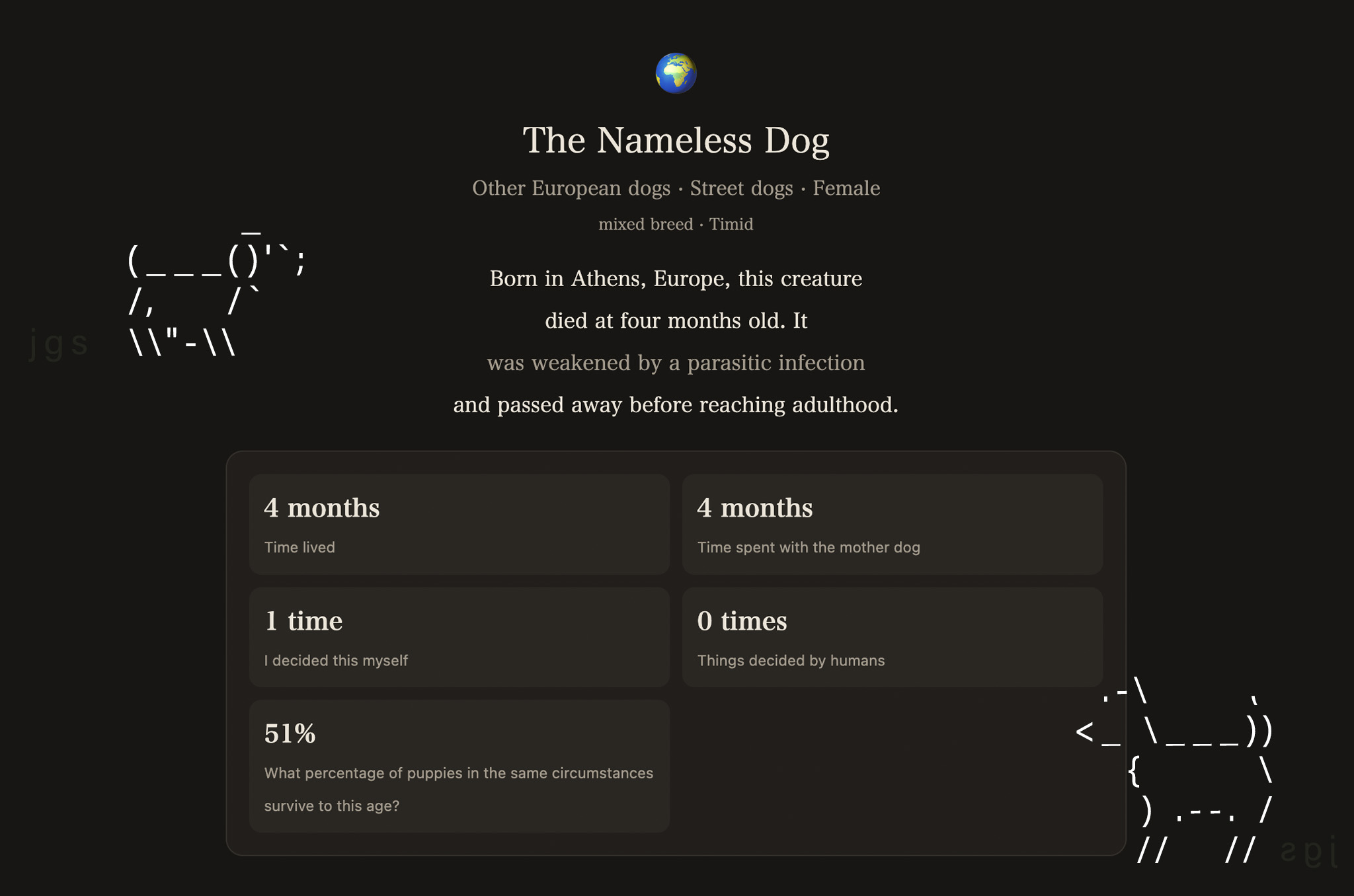
Screengrab of our puppy’s unfortunate end :'( | via 9oku.kodow.net
The Lives We Don’t Usually See
What makes 1 in 900 Million particularly unsettling is how little control you have over the outcome. A dog born into a loving household might receive veterinary care, regular meals and years of companionship. Another, born somewhere else, might never experience any of those things. The game also includes outcomes involving puppy mills, hunting dogs, laboratory animals and the commercial dog trade. An October 18 update even introduced the possibility of being born as a research dog, drawing on official animal-testing figures from several countries.
These are subjects that rarely feature in the cheerful dog content that dominates social media. There is something especially uncomfortable about watching a simulated animal endure a difficult life when the game gives you so little power to improve it.
As the developer explains on the website, the biggest difference between this game and its human predecessor is that almost all the important decisions in a dog’s life are made by people.
Players can save their previous lives, compare outcomes and share their results online, turning what initially appears to be a novelty game into an unexpectedly effective way of confronting the circumstances in which dogs live.
Of course, 1 in 900 Million is only a simulation, and its outcomes are based partly on assumptions rather than comprehensive worldwide data. But the questions it raises extend well beyond the screen.
Play the game at 9oku.kodow.net