There are many things a man might invent for a fictional woman. A name. A face. A political affiliation. Maybe even a personality. The man behind Nakamura Riho went considerably further. He gave her a pregnancy.

A Politician Who Didn’t Exist
Until recently, the X account “Nakamura Riho @ Constitutional Democratic Party” appeared to belong to a young Japanese woman with political ambitions and an unusually eventful personal life. Her bio identified her as “Nakamura Riho, official” and described a pregnancy and childbirth resulting from sexual violence as the experience underpinning her advocacy for women. Childcare, agriculture, regional revitalization and welfare rounded out her political interests. Her face appeared frequently on the account, alongside updates on her work, her family and, increasingly, her body.
There was just one problem. Nakamura Riho did not exist.
Freelance journalist Jun Hori, a former NHK anchor, began looking into the account after readers came to him with a fairly basic question: was this woman real? Hori called the Constitutional Democratic Party’s Tochigi prefectural chapter to ask. According to its secretary-general, Junya Ogawa, she wasn’t. The account belonged to an actual dues-paying CDP member, though not a certified candidate.
He was also a man.
The party says it had no involvement in creating Nakamura and had already instructed the operator to stop using the CDP name and AI-generated imagery. But by then, the account had been active since June 2024, and its creator had done considerably more than slap an AI woman’s face on an anonymous political account. He had given her a life, and an extra corporeal one at that.
A Very Specific Fake Person
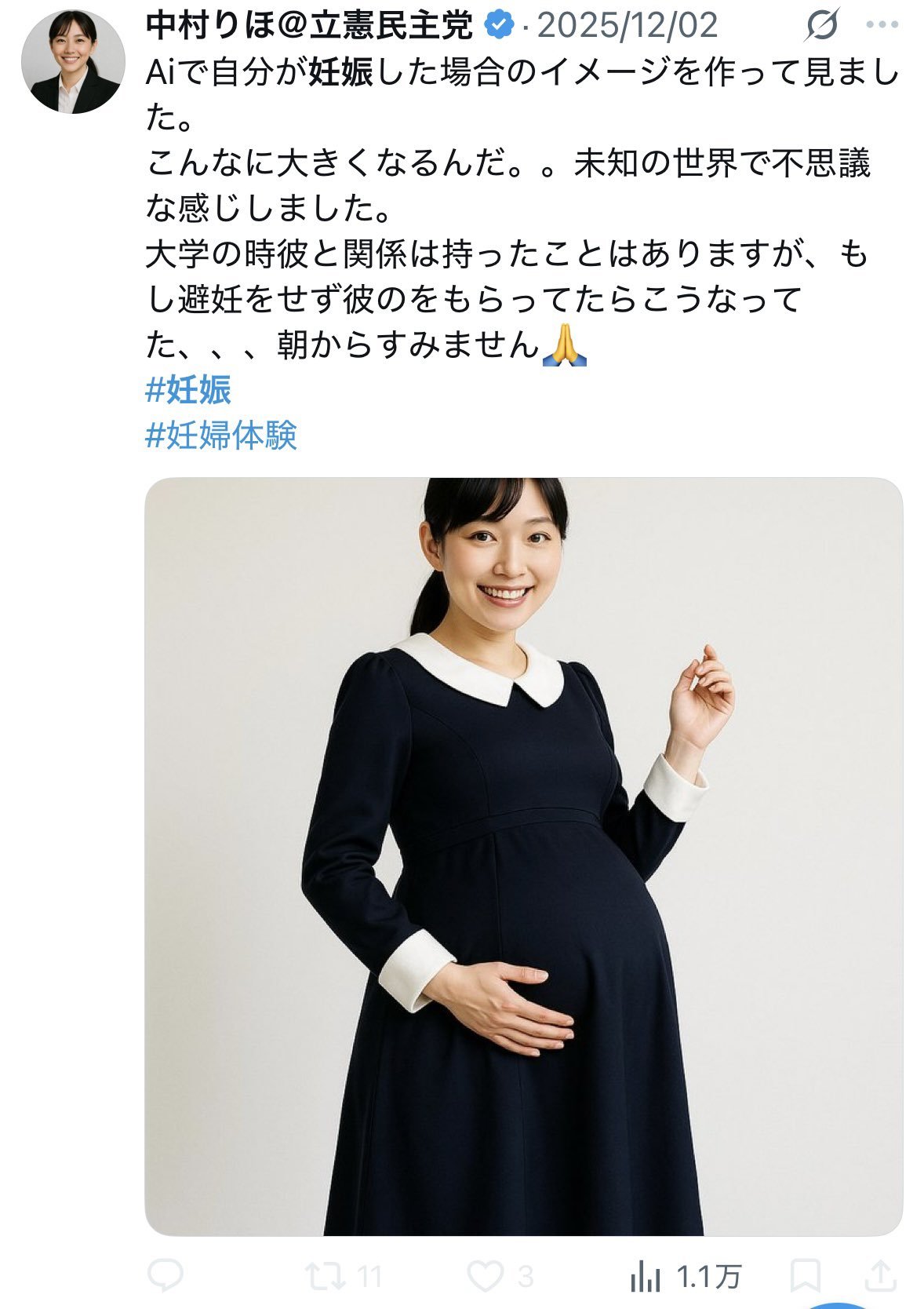
On December 1, 2025, she tweeted:
“I asked AI to show me what I would look like pregnant. It was strange to see. I did things with a guy in college, and looking at it made me think: if we hadn’t used protection, if his child had taken root in me, this might be exactly what I’d look like right now.”
On August 9, 2026, Nakamura returned from a year-long absence with another update:
“It’s been a while! I’m back after taking about a year off. A lot happened while I was away, but my pelvic fracture is almost completely healed — I can finally use a squat toilet again.”
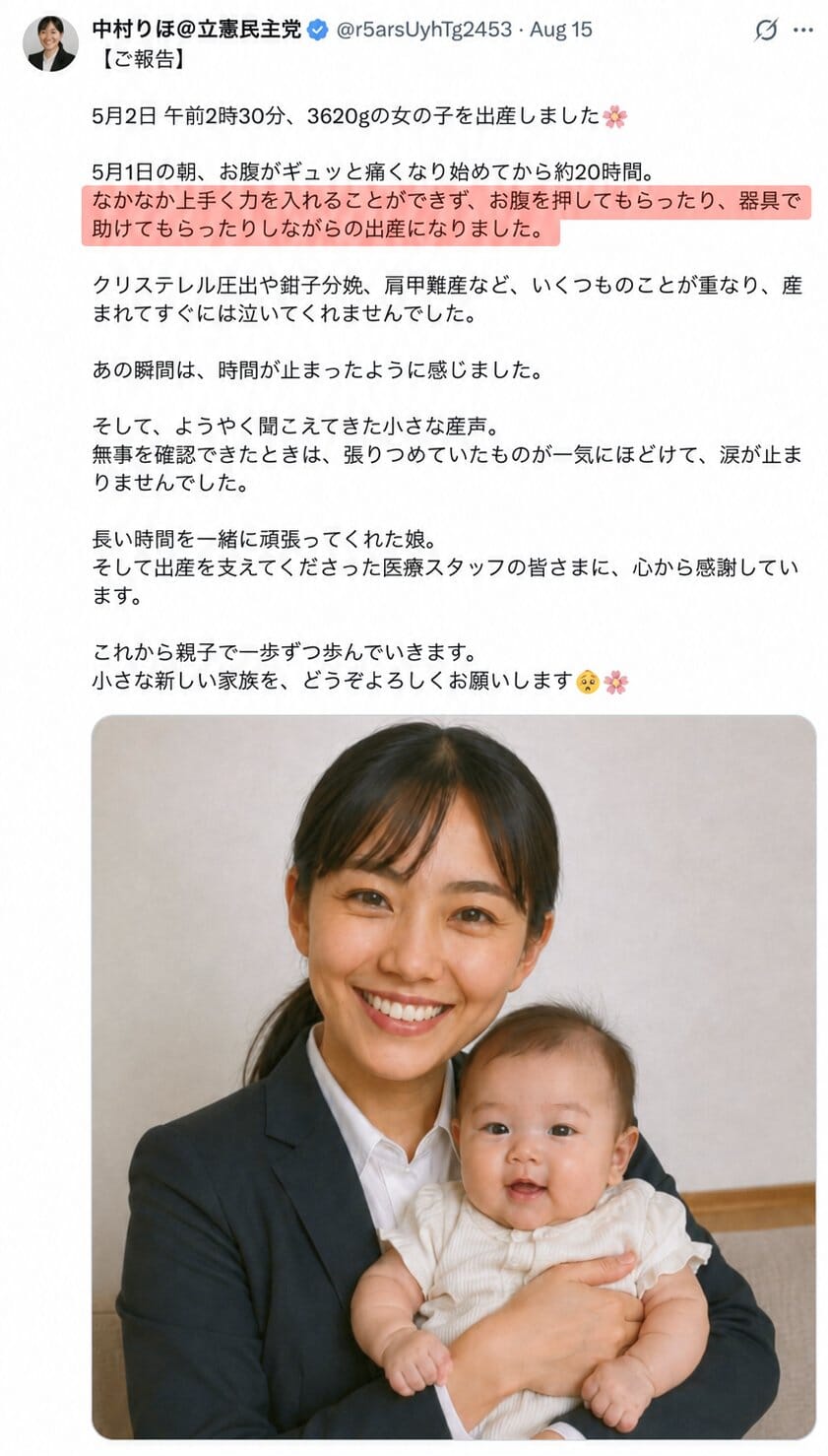
Six days later, Nakamura announced that she had given birth to a 3,620-gram baby girl. Her account of the delivery was remarkably specific: some 20 hours of labor, difficulty pushing, forceps and fundal pressure, shoulder dystocia, then a terrifying interval in which the baby didn’t cry. When she finally heard her daughter’s “tiny first cry,” she wrote that everything she’d been holding inside gave way and she couldn’t stop crying.
Political Ambitions, Invented
All the while, Nakamura had political ambitions. She publicly aligned herself with the Constitutional Democratic Party and discussed eventually running for office. In one post, she claimed she would run for election in two years, carrying on the ambitions of a father who, according to the account, had once lost to a sitting cabinet minister by 39 votes.
Hori eventually contacted the man behind the account, who acknowledged his behavior and described it as “extremely thoughtless.”
Thoughtless seems almost unfair to the amount of thought involved. Because whatever his political intentions, Nakamura was an extraordinarily particular fantasy of a woman. Plenty of fake women exist online. Most get a face, a name and whatever personality is required to make the scam work. Nakamura was imagined in considerably more intimate detail.
This is where the account starts to reveal a very particular male fascination, directed not just at the woman as an object of desire, but the female body as a site of experience. Nakamura’s body is interesting precisely because things can happen to it: It can be humiliated, penetrated, impregnated, injured, healed, forced through labor and made into a mother.
The fantasy of total access to a woman usually runs up against the annoying fact that women have interior lives. You can look at someone, sleep with her, marry her, even watch her give birth and still not possess her experience of any of it. She gets to tell you what happened to her and how she felt about it. She can also decide not to.
Nakamura presented none of these inconveniences. She’d been furnished with the intimacies of female embodiment while being denied its most elementary prerogative: the possibility of withholding herself.
That kind of access gets especially uncomfortable when so much of Nakamura’s invented life concerns bodily vulnerability. He invented the pregnancy, inhabited the pregnant woman’s voice, narrated her changing body and eventually delivered the child himself. The familiar fantasy of the synthetic woman is largely one of external control, of possession of the body, but here, possession extends to the supposedly unknowable experience inside it.
There’s an obvious irony here. Japan really does need more women in politics. Women remain badly underrepresented in elected office, and pregnancy, childbirth and childcare are all subjects on which female experience might reasonably be considered useful.
There are plenty of women in Japan who have actually been pregnant. Some of them, presumably, would even like to be politicians. Next time, maybe ask them instead.