
Across Japan, some of the most ambitious architectural projects are not in Tokyo or Osaka, but in places much farther afield. Some are purpose-built cultural sites, while others are set within temple grounds or natural landscapes, where contemporary architecture is used to frame, extend or respond to what’s already there.
Seen across a map, these sites are scattered: the Sea of Japan coast, the forests of Nara, the hills of Fukushima, rural Hokkaido. Getting to them is rarely direct — a local train that runs once an hour, a transfer that doesn’t quite line up, a station that opens out into a town with no clear center.
The buildings are the reason to go. But they also present a way of moving through the country: following lines that extend outward, away from the obvious, into something quieter and more deliberate. And somewhere along that route — between the last train, the walk and the first moment inside — the experience of the architecture has already begun.
Church on the Water: Shimukappu, Hokkaido
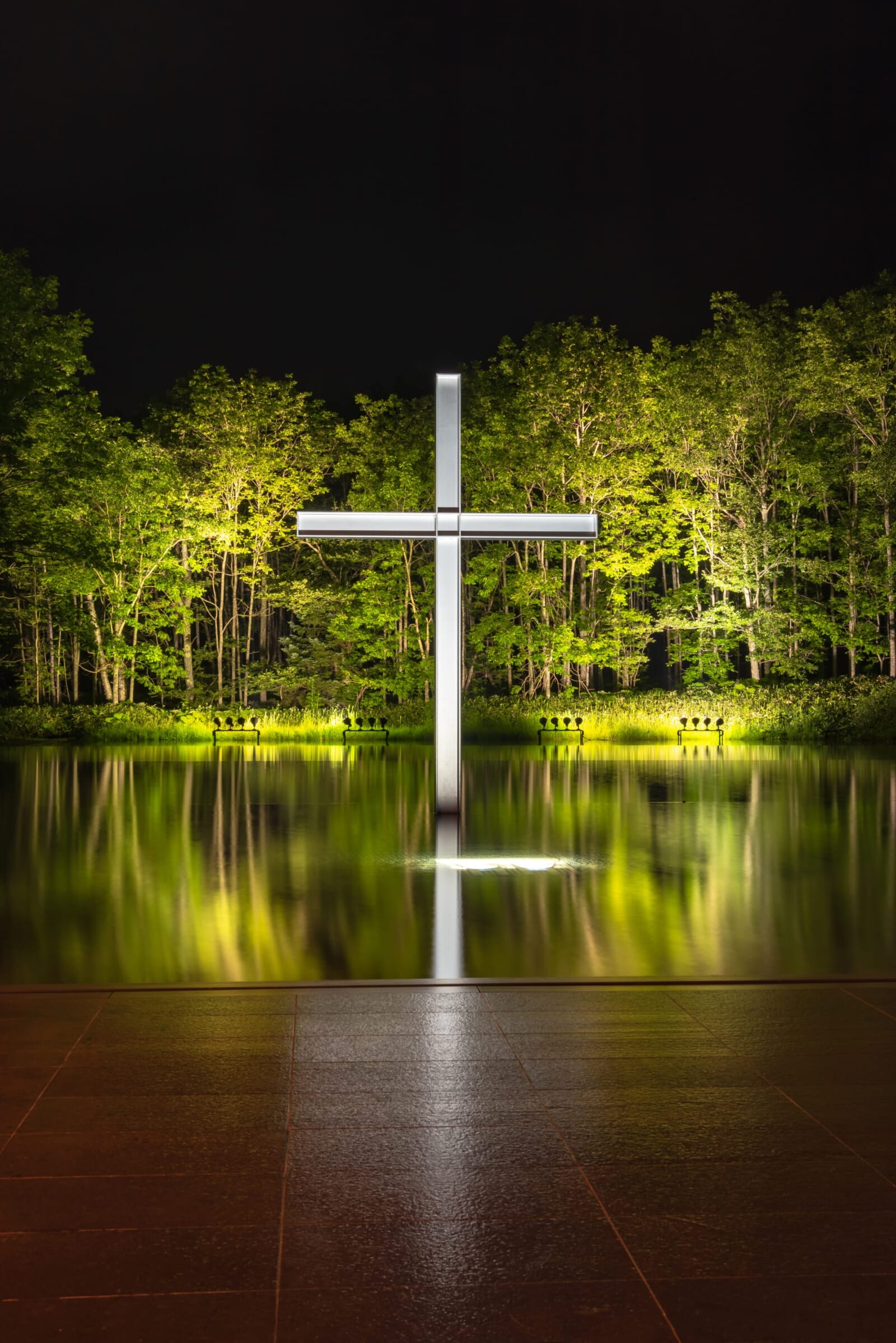
The Church on the Water in Hokkaido is one of Tadao Ando’s most widely recognized early works, completed in 1988 and often cited as a defining expression of his approach to light, concrete and nature. Set within the grounds of Hoshino Resorts Tomamu, it transforms faith into spatial experience, where architecture is reduced to a few precise elements: water, glass and a cross.
The approach is indirect. A freestanding concrete wall blocks any immediate view of the chapel, forcing a change in direction. Visitors move along the perimeter before entering a darker, enclosed volume. Only after this compression does the main space open.
Inside, one entire wall is glass, looking directly onto the water outside. In the center of the pool stands a simple steel cross, placed in the landscape rather than inside the building itself.
The composition relies on shakkei, or borrowed scenery, integrating the surrounding landscape into the architectural frame. The building itself is minimal, made up of two intersecting rectangular volumes, but its spatial effect is produced through contrast: enclosure and openness, opacity and transparency.
Although privately owned and primarily used as a wedding chapel, it is open to visitors for scheduled viewing hours in the morning and evening.
Site of Reversible Destiny – Yoro Park: Yoro, Gifu Prefecture
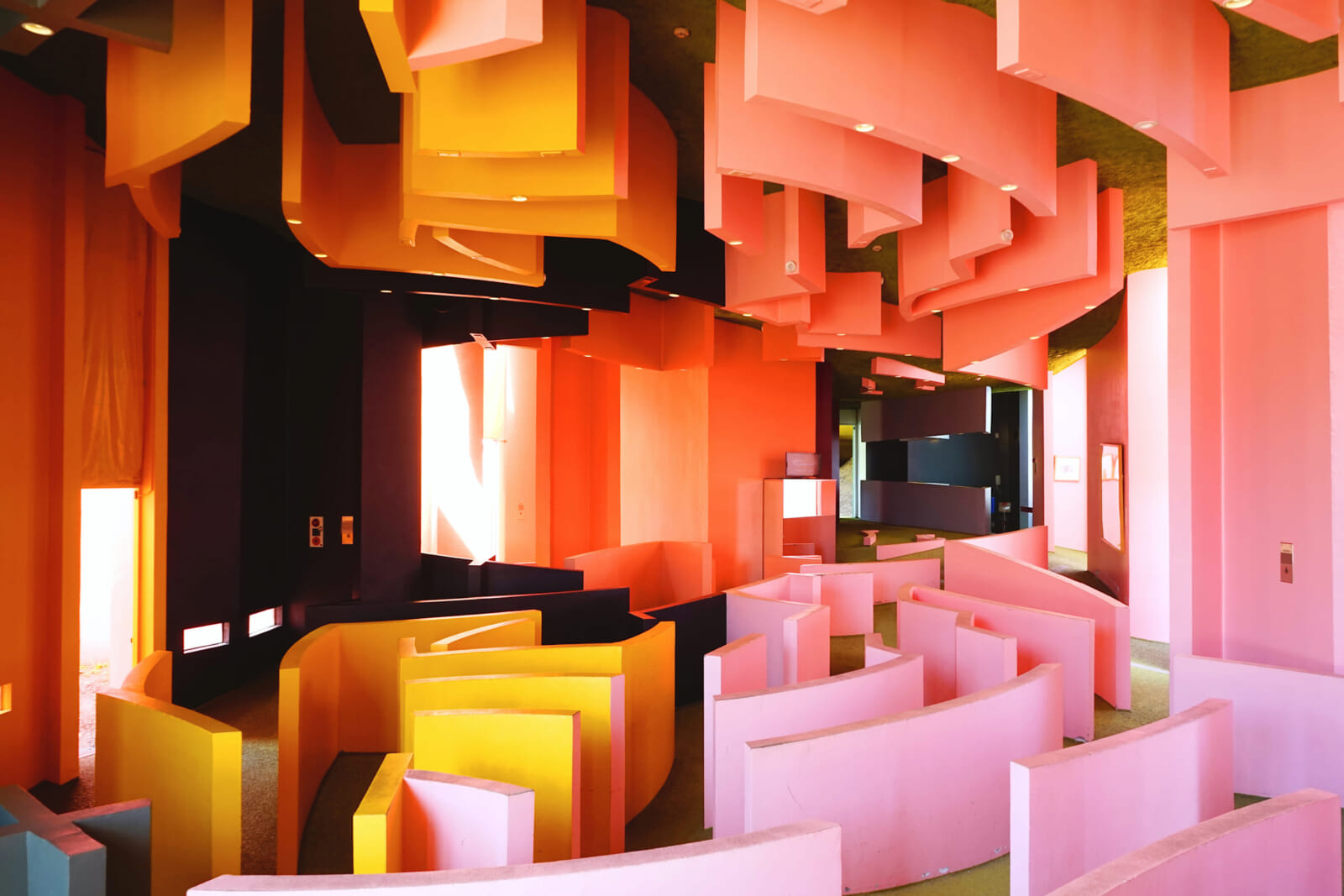
Nothing in the Site of Reversible Destiny in Yoro Park behaves quite the way you expect it to. Completed in 1995, it was designed by Shusaku Arakawa and Madeline Gins as a large-scale experimental work exploring how architecture might actively shape perception, attention and the body itself.
The park is organized as a series of interconnected zones defined by uneven terrain: sloped floors, abrupt level changes and irregular geometries. There are almost no continuous flat surfaces, and even areas that appear level often shift underfoot. Movement through the space is intentionally unstable, requiring constant adjustment of the body.
Arakawa and Gins described the project as an attempt to “reverse destiny” — based on a belief that physical and cognitive comfort leads to decline, and that resistance within the built environment can instead keep the mind and body active. In their view, architecture should not resolve difficulty but introduce it. Unlike conventional parks, which prioritize ease of movement and clear circulation, Yoro Park is structured around friction. It is not designed for passive viewing, but for active navigation.
Shinshoji Zen Museum and Gardens: Fukuyama, Hiroshima Prefecture
Shinshoji Zen Museum and Gardens is part of Shinshoji Temple, a Rinzai Zen complex about 15 kilometers southwest of Fukuyama. The grounds spread across forested terrain shaped by a pond at the front and a wooded hill behind, with buildings connected by walking paths and Zen gardens.
Visitors move through gardens, teahouses, museum spaces and areas for meditation. Historic structures have been relocated and integrated alongside contemporary additions, creating a layered environment of old and new.
The site is experienced on foot. From the entrance, it takes around 15 minutes to reach the main hall, passing the pond and walking along forest paths. At the top of the hill, the hall includes a museum space dedicated to Zen master Hakuin, whose calligraphy and paintings are shown in rotation.
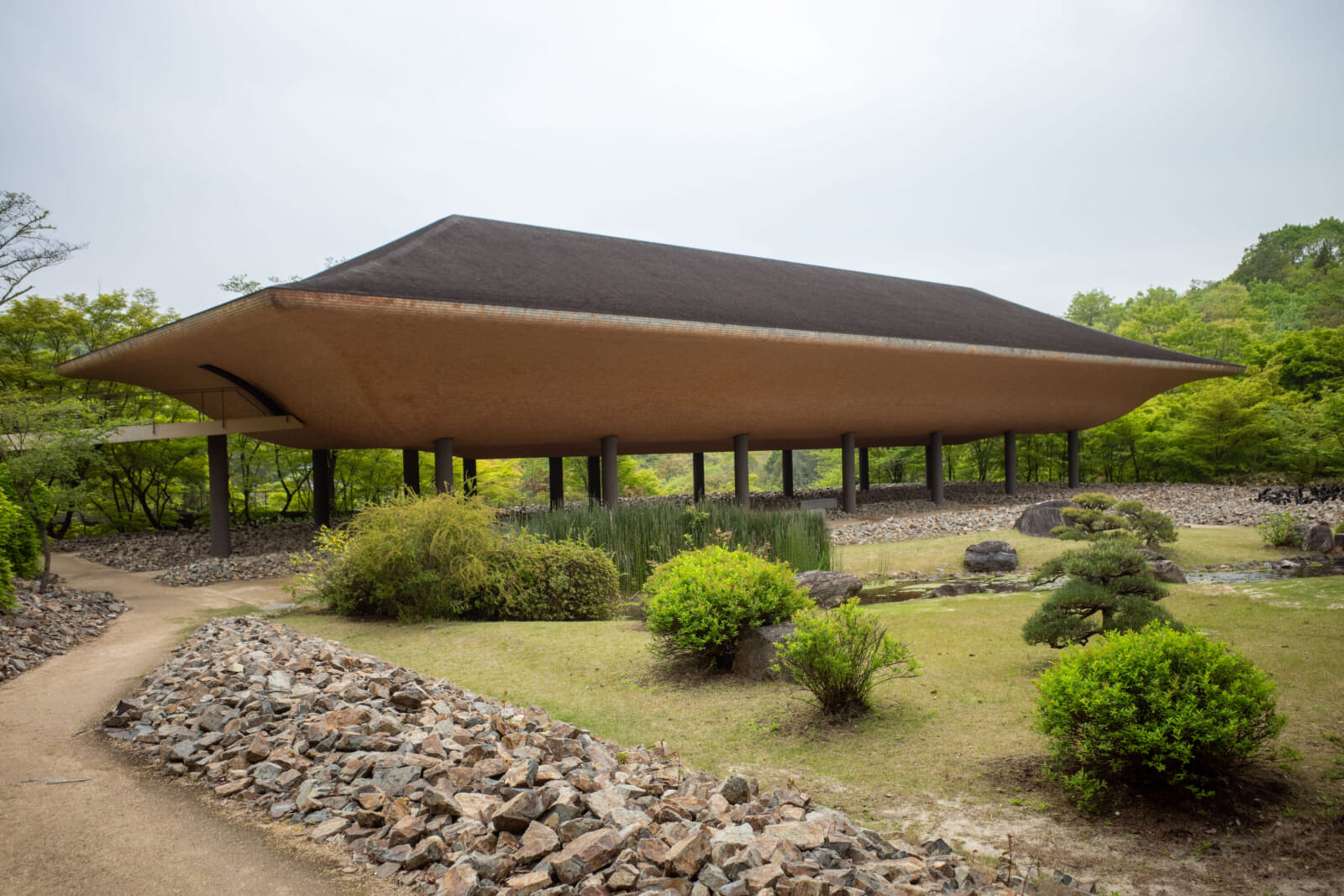
One of the complex’s most striking features is Kohtei, an art pavilion by Kohei Nawa and the creative platform Sandwich, shaped like a ship and raised above a field of stone, its surface wrapped in hundreds of thousands of cypress shingles. A narrow bridge leads into the interior, where a 25-minute installation unfolds in near darkness — a slow sequence of shifting light reflected across water, turning the space into a quiet, immersive experience.
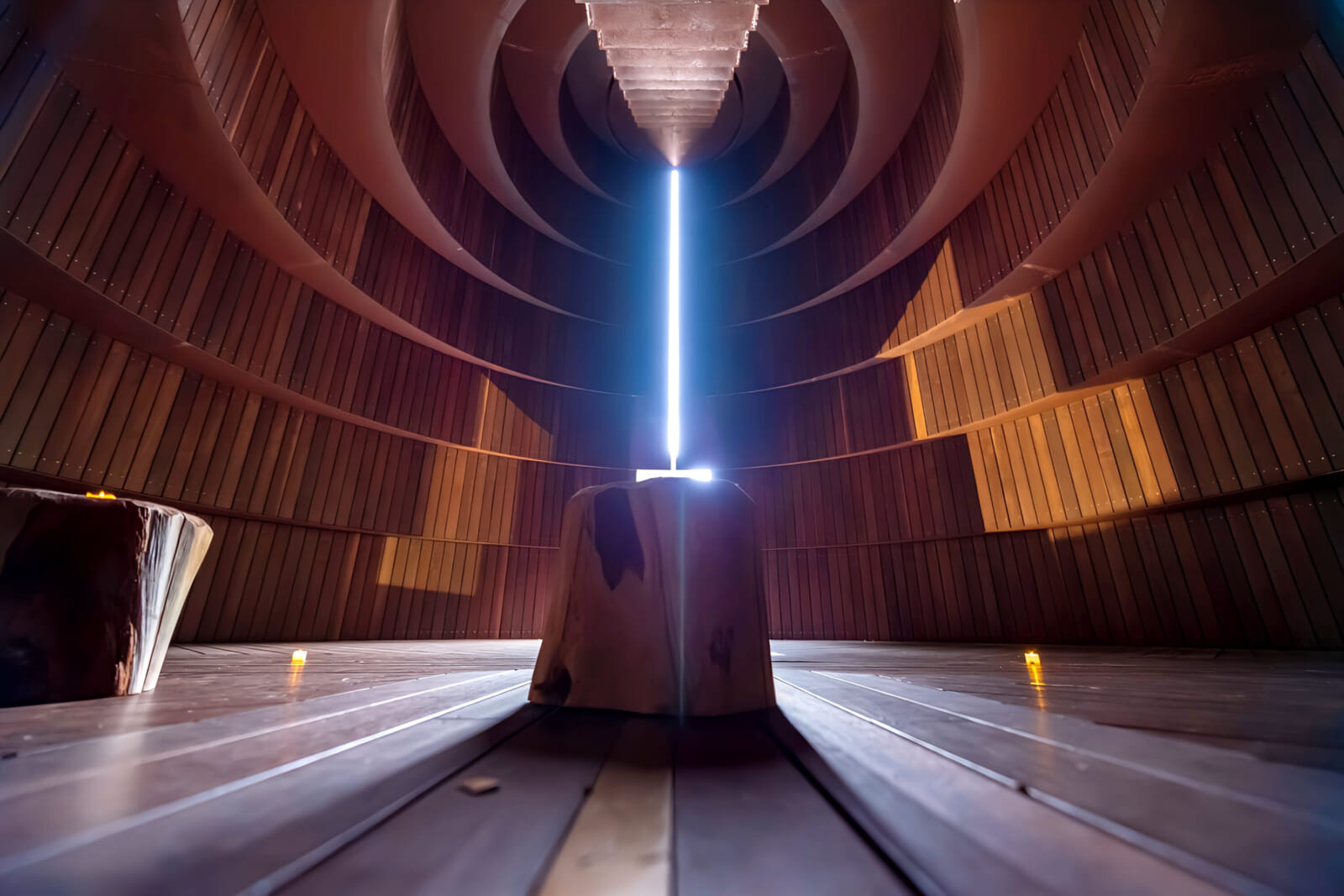
Murou Art Forest: Uda, Nara Prefecture
The Murou Art Forest is set within the wooded hills near Muroji Temple, a historic site known for its Japanese cedar forests and mountain terrain.
The sculpture park is laid out along a network of forest paths that follow the natural contours of the landscape. There is no single central exhibition space; instead, visitors move through the site on foot, encountering artworks gradually along the way. Some pieces are positioned close to the paths, while others sit further into the trees or emerge around bends, slopes and changes in elevation.
The large-scale installations are abstract in form and made from steel and other industrial materials, constructed to harmonize with the landscape. They arc, twist and extend into the surrounding space, often appearing to grow out of or respond directly to their environment. Their placement takes cues from the terrain, including the incline of the hills, gaps in the forest and the density of the surrounding Japanese cedar trees.
Sazaedo Temple: Aizuwakamatsu, Fukushima Prefecture
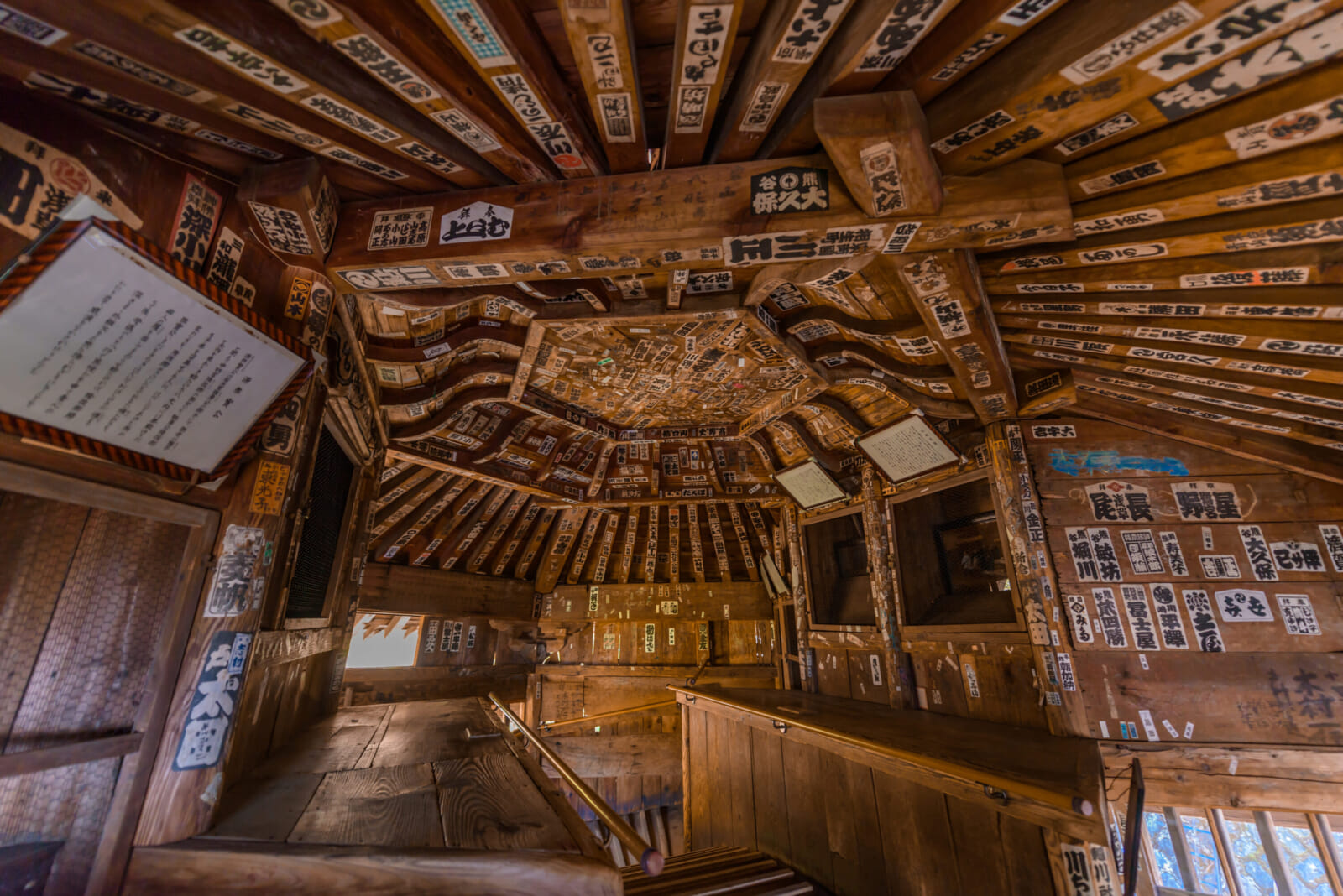
Though not a work of contemporary architecture, Sazaedo Temple is widely known for the ingenuity of its design. Built in 1796, it is one of the most unusual surviving wooden structures in Japan. From the outside, it appears as a simple hexagonal tower in timber, raised slightly above the ground and almost understated in form.
Inside, however, it forms a double helix-like circulation system: Two interlocking ramps spiral through the same space, carrying visitors up one side and down the other in a continuous loop. The ascent and descent are completely separated, so you never encounter people moving in the opposite direction.
Along the route are 33 statues of Kannon, the bodhisattva of compassion, placed so visitors can pause and pray as they move through the structure. The temple was designed as a condensed version of the Saigoku 33 Kannon Pilgrimage, allowing worshippers to complete the entire journey within a single building. Visitors complete a full circuit without retracing their steps, moving through what is effectively a self-contained pilgrimage route.