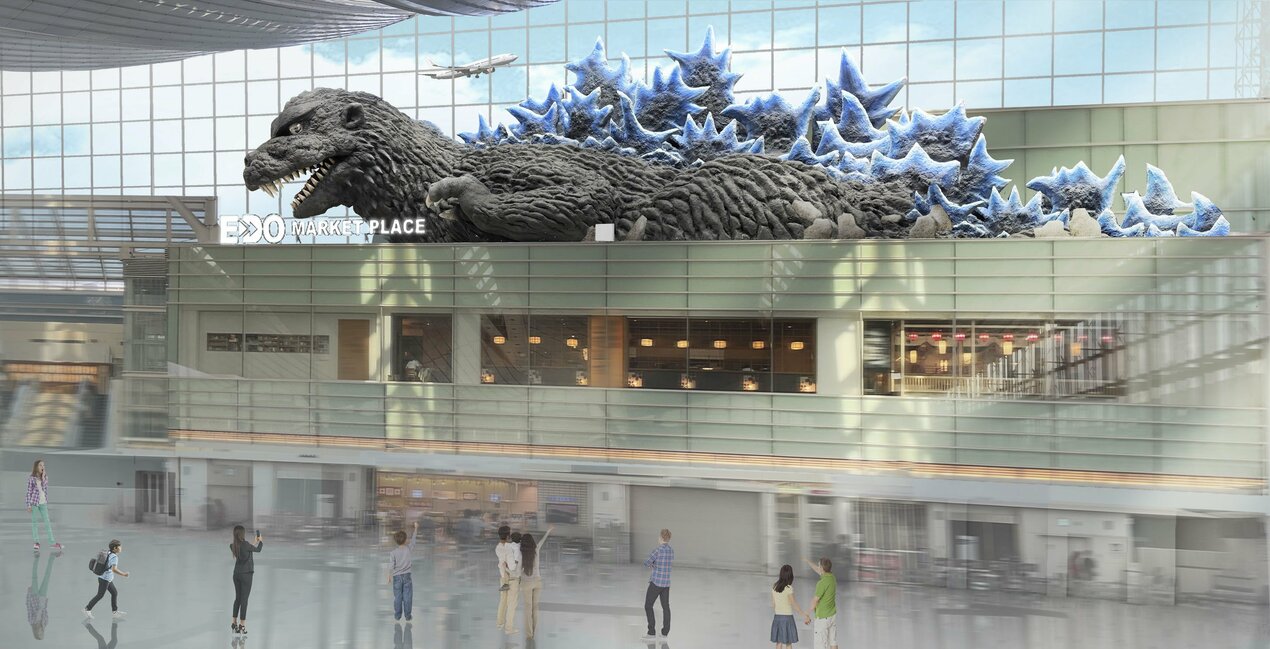
We all know and love the giant Godzilla head that looms over Shinjuku’s Kabukicho district. Now, you can gaze at the iconic monster one last time before you leave Japan, as Tokyo’s Haneda Airport will feature the world’s largest indoor Godzilla installation, arriving this December.
Designed to look as if it’s bursting dramatically from a building, the massive installation will be placed in the departures lobby of Terminal 3. It measures approximately 40 meters long and stands 9 meters high.
An Icon of Japanese Pop Culture
Godzilla, pronounced Gojira in Japanese, is far more than just a fictional character; it’s an icon of Japanese popular culture and a global cinematic phenomenon. Since its big-screen debut in 1954, the creature has appeared in over 30 films.
Originally serving as a metaphor for the trauma and anxieties surrounding the atomic bombings of Hiroshima and Nagasaki, Godzilla has evolved in its portrayal over the years. It has been depicted as a terrifying destructive force, a reluctant anti-hero and a defender of the Earth.
The installation is a collaborative effort between Toho Co., the studio behind the legendary film series, and the companies that operate the Haneda airport terminal buildings. “Through Godzilla, who is known both at home and abroad, we hope to enhance our appeal as a hub for promoting Japanese culture,” stated a project official.
More Godzilla Fun at Haneda
In addition to the gigantic Godzilla in the departures lobby, there will also be some monster decorations in the arrivals area. On the terminal’s second floor, visitors will be greeted by images of Godzilla and other famous kaiju (monsters) from the film franchise above the information counter.
A statue of Godzilla from the 2023 film Godzilla Minus One will also be on display at the arrivals lobby. The movie won a US Academy Award in 2024 for visual effects.
Travelers and locals can enjoy these Godzilla installations up until December 2026. The attractions complement the terminal’s existing efforts to showcase Japan’s heritage, which includes a shopping area designed to recreate a traditional Edo-period cityscape.