
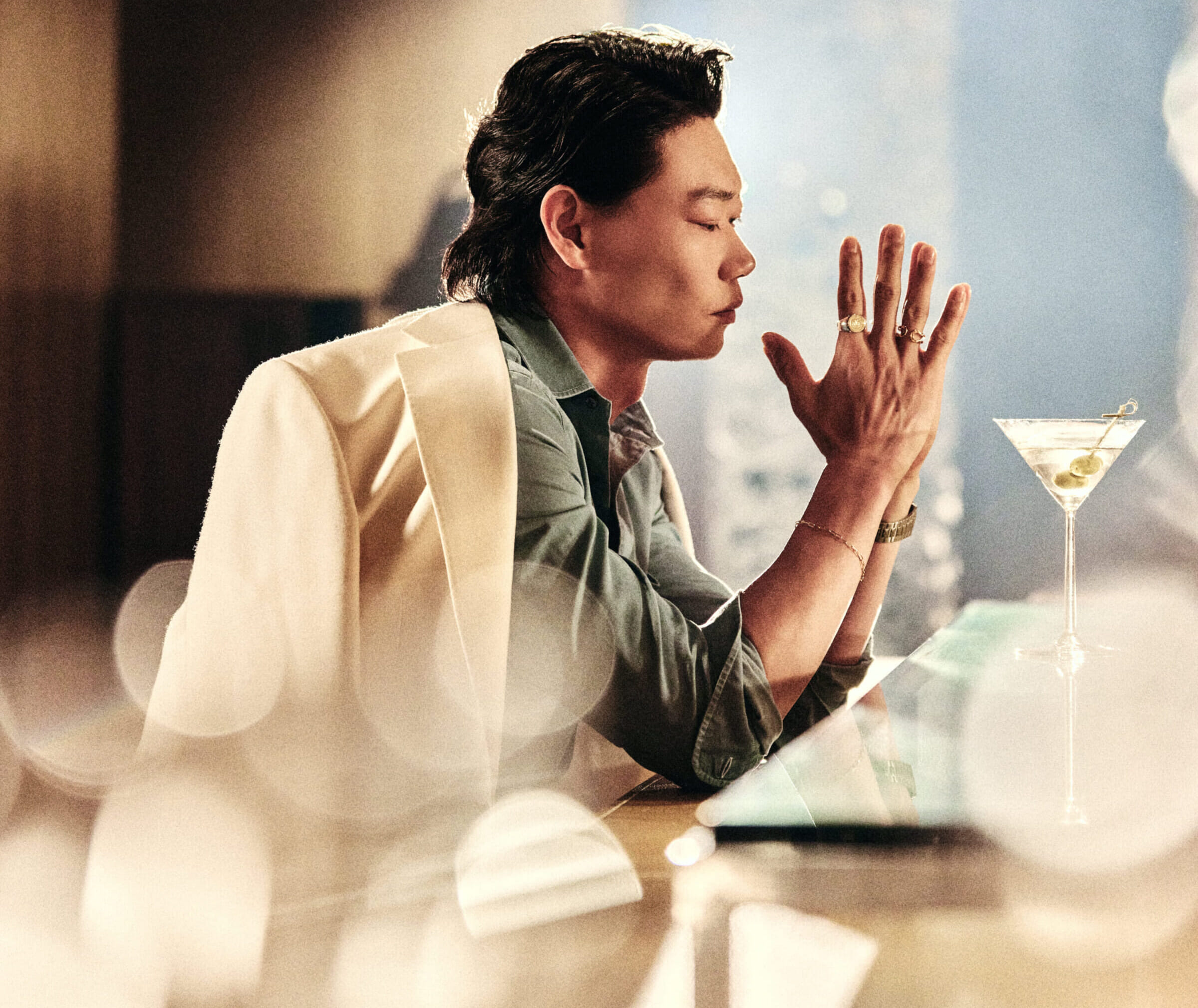
There’s something unmistakable about a Show Kasamatsu performance; his characters are usually marked by a restrained, quietly dangerous presence. The actor has a particular knack for inhabiting morally gray characters. In recent years, his work has begun to extend beyond Japan — he broke through internationally with Tokyo Vice, and since then, he’s taken on various projects overseas, including the Australian miniseries The Narrow Road to the Deep North and, more recently, the South Korean drama Taxi Driver 3.
Onscreen, he moves with an effortless, unstudied coolness; one might be forgiven for thinking he was born in front of a camera with a cigarette in his hand. But his current career is the result of years of diligent work. The 33-year-old Nagoya native started out as an extra, spending several years piecing together a living through part-time jobs. “I worked at yakiniku and yakitori restaurants, at the fast-food chain Subway and as an assistant at a nursery school, among other things,” says Kasamatsu. “The extra work was hit-and-miss. Sometimes I wouldn’t pass the screening process, and even when I did, I was often as far in the background of a scene as you could get.”
From Contentment to Frustration
“It wasn’t my ambition when I was young to be an actor,” continues Kasamatsu. “I was scouted in my second year at high school, and even though the agency was tiny with no known actors, I decided to give it a go. I left Nagoya for Tokyo at 18. In those first few years, I was content picking up roles as an extra, but I eventually grew frustrated. I wanted more lines and to be acknowledged. Rather than just playing a part anyone could take on, I wanted to find one only I could do.”
That shift in mindset marked the beginning of a transition from the margins to more substantial roles. He began appearing in independent and student films, where the smaller scale offered room to develop his craft. Small parts gradually gave way to more defined ones. It was his appearance in the suspense flick Day and Night, produced by Takayuki Yamada and directed by Michihito Fujii, that he points to as a turning point. It was, he says, his first taste of a “real” acting environment.
In the film, he plays a seemingly cheerful member of the underworld who undergoes a shocking transformation at a pivotal point of the story. Kasamatsu prepared carefully for the role, building a series of subtle details into his performance before filming began. He was praised for the way he balanced light and darkness in the performance, without leaning too heavily into either. There’s a sense of restraint in how the shift unfolds, emerging gradually rather than through any overt turn, and it’s a quality that can be seen in other roles that followed.
Day and Night was part of a period of remarkable activity. According to various sources, between 2018 and 2021, he appeared in more than 50 films and television dramas. ”I wasn’t really in a position to refuse anything,” he says, laughing. “There were some important roles and others with just one line. I worked very hard and got my hopes up, but I just wasn’t getting the results I expected. Then came the audition for Tokyo Vice, which changed everything.”

The Tokyo Vice Breakthrough
Tokyo Vice aired on HBO Max in the US and almost immediately became a small phenomenon. Starring Ansel Elgort and Ken Watanabe, it tells the story of a young journalist as he works his way up to become the first American reporter at a major Japanese newspaper — the Meicho Shimbun. While covering crime, he develops an unlikely, symbiotic relationship with a complex and reluctant yakuza member named Akiro Sato, played by Kasamatsu.
“I don’t know why I was chosen for the part,” says Kasamatsu. “I couldn’t speak English at the time and didn’t have any major roles under my belt. It was probably due to my attitude.” The Japanese casting director for the show, Ko Iwagami, recently reminded him of an exchange he had with the show’s producer — legendary director Michael Mann — at the end of his audition. “I felt he was interested in me, and asked if I had been successful. He told me he couldn’t say anything and went to shake my hand. I refused. My feeling was, ‘I’ll shake your hand when I get the part.’”
Mann was clearly impressed, and so were viewers. Sato, who evolves from a low-level initiate into a trusted, albeit conflicted, leader, is widely viewed as one of the show’s most compelling characters. In some ways, he echoes Chris Shiherlis, played by Val Kilmer in Heat, one of Mann’s most famous films. Both feature an antihero characterized by intense professionalism and emotional detachment; GQ called Kasamatsu’s performance “the quintessential Michael Mann cool guy.” At the same time, there’s a lighter, more unexpected side to the character, seen most clearly when he sits in a car with the journalist, singing along to the Backstreet Boys track “I Want It That Way.”
“That episode was directed by Hikari, who was in the car alongside Ansel and me,” recalls Kasamatsu. “I’m a terrible singer and had to perform while driving, so it was hard, but the three of us had a lot of fun.” According to a rumor Kasamatsu heard, there was talk in the editing room of cutting the scene, possibly due to concerns that Sato wasn’t the kind of character who would be interested in the Backstreet Boys. Says Kasamatsu, “I am glad the scene was kept in as it seems to have stayed with people.”


Drawn to Complexity
It also speaks to the dynamic that developed between Elgort and Kasamatsu. During filming, the pair grew close, with Elgort asking his US agencies CAA and Brookside Artist Management to sign the Japanese actor in 2022. The following year, Kasamatsu established his own agency in Japan. Around this period, he also appeared as Keisuke, the rational yet tortured leader of the powerful Goto family in the Disney+ series Gannibal, a role that further cemented his reputation for inhabiting psychologically complex characters.
From there, he went on to play Major Nakamura in The Narrow Road to the Deep North, an Australian miniseries based on the Booker Prize-winning novel by Richard Flanagan and starring Jacob Elordi. Nakamura is the Japanese officer in charge of a prisoners of war camp, forcing workers to build the Burma–Thailand “Death Railway.” Though capable of extreme savagery, he also has moments of surprising empathy.
Kasamatsu was praised for his portrayal of Nakamura, a character who upholds the strict, brutal codes of the Japanese Empire while also grappling with internal conflict and the pressures of war. “It was a tough role, but I enjoyed playing him,” he says. “People usually describe characters like Nakamura, Keisuke and Sato as complex, but I see them more as figures driven by human emotions. My job is to step into their shoes and enter their psyches.”
Expanding Across Asia
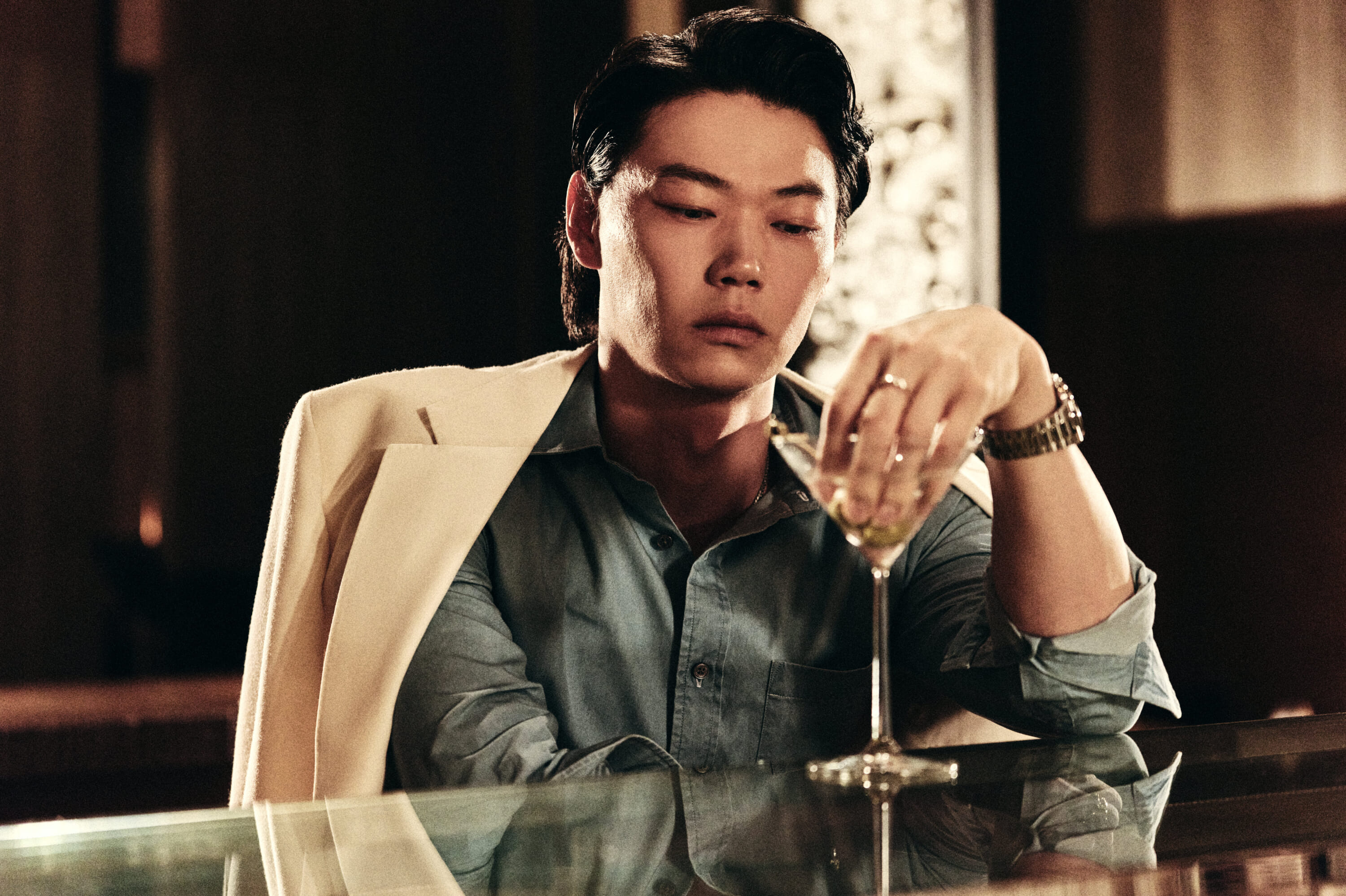
Kasamatsu has also been working on numerous Korean projects. He had a prominent role in Good News, a Korean dark comedy film by Byun Sung-hyun, which debuted last October. The movie is based on the 1970 Yodo Hijacking Incident, a bizarre aviation crime marked by naive idealism, dramatic tropes and logistical errors: Members of the radical left wing group Japanese Red Army Faction hijacked a Japanese airliner and took its 122 passengers and seven crew members hostage, then ordered the pilots to fly to Havana, with the hopes of receiving training from communist military groups. Lacking fuel, they instead headed for Pyongyang via Seoul.
“It’s a crazy story told in an ironic way with a sharp script,” says Kasamatsu, who plays Denji, the group’s unhinged leader. “I didn’t know about the incident and was shocked to learn that some of the hijackers are still in North Korea today.”
The movie premiered to a positive reception at the 30th Busan International Film Festival, with some critics calling it Byun’s strongest work to date. During the post-screening Q&A, Kasamatsu answered questions in Korean with confidence, a detail that stood out in a festival known for its discerning audience. Those language skills proved useful again when he joined the third season of the South Korean series Taxi Driver, playing the ruthless head of a Japanese loan shark ring.
His character serves as a key adversary to Kim Do-gi — a former special forces soldier turned vigilante driver, brought to life by acclaimed actor Lee Je-hoon. “He is not just a great actor, but also a leader who is constantly encouraging the cast and crew,” says Kasamatsu. “It was a valuable learning experience working alongside Lee. I think the fight scenes we had together went well from an entertainment perspective. Fans seemed to enjoy them anyway, which is the most important thing.”
As for Kasamatsu’s next role, details remain under wraps, though it was recently announced that he’ll appear in an upcoming Takashi Miike horror film alongside Kiko Mizuhara and Charli XCX. Kasamatsu can’t say much about that, though he enjoyed his time with Miike — who, despite his reputation, proved less intimidating than expected — and the two have already discussed the possibility of joining forces again. Looking ahead, Kasamatsu says he hopes to continue collaborating with directors he considers geniuses, building on the kind of creative trust he found with Miike.

More Info
Follow Kasamatsu on Instagram at @show_kasamatsu_official.
Updated On May 29, 2026