
The idea of “artificial intelligence” used to mean a planet-sized computer asking what it means to be conscious. It meant immortal machine civilizations orbiting dead stars. It meant robots who had outlived humanity and spent 10,000 years composing poetry about their creators. Now, though, it means a more elaborate autocomplete that sometimes insists there are seven R’s in the word “egg.”
Suffice it to say, it’s good that we got some of the world’s best sci-fi out there before we learned what “artificial intelligence” really was.
But it could have turned out differently. If Japan’s Fifth Generation Computing Project had been successful, we’d have gotten AI 30 years earlier, changing the world in ways we can’t even imagine. Here’s how that almost happened:
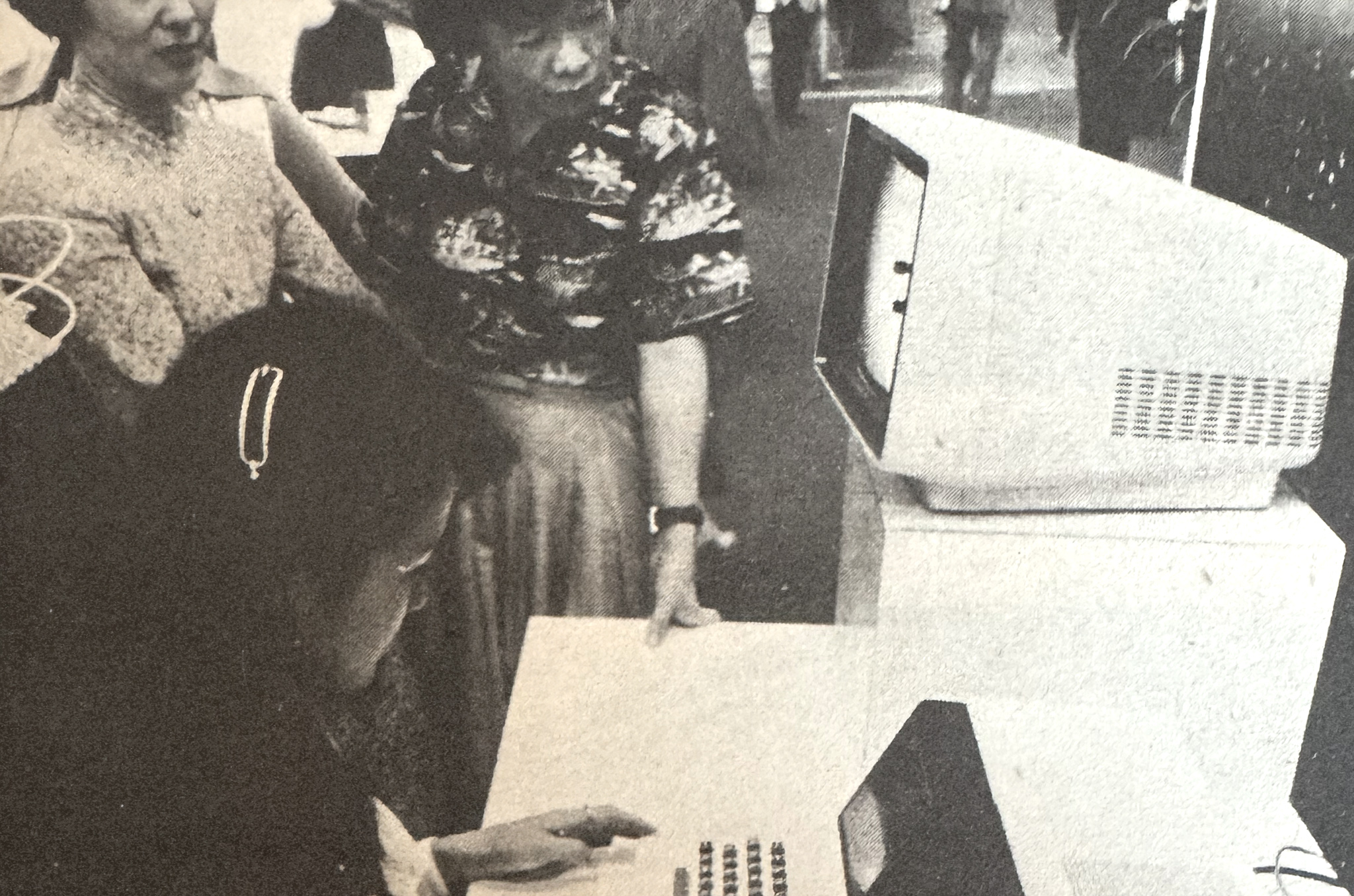
Guests at the “Microcomputer Show 1980” trying the latest systems | Image via “Maikon” magazine 1980, scan by Victoria Bennett
The Pre-Windows 95 Dream of Conversational Computing
The history of computing can be broadly divided into generations. By 1979, the world was in the fourth generation, faster and more powerful than anything that came before it. But the basic principles behind that tech and, say, the first-generation ENIAC vacuum-tube computer (1945), were largely the same, with the machines executing exact, precise instructions supplied by programmers.
Japan’s Fifth Generation Computer Systems (FGCS), proposed in the early 1980s, was meant to be something else entirely. It would infer meaning from incomplete instructions, learn using its own gigantic database of knowledge, solve problems and allow humans to communicate with computers using natural language. FGCS worked nothing like today’s LLMs — it reasoned over a built-in knowledge base rather than generating text from trained patterns — but the promise was familiar: talking to a computer in plain language, much the way people talk to ChatGPT today.
From a purely technical point of view, it wasn’t the AI that we know today, but it was still a kind of AI. For the 1980s, the FGCS was unbelievably ambitious, coming at a time when Japan dreamed big and wild. Even so, the timelines were kept realistic. The project was planned as a 10-year effort, but at the end of that long road there was the promise of science fiction made science reality: actual artificial intelligence before the mid-1990s. Sooo … why didn’t it happen?
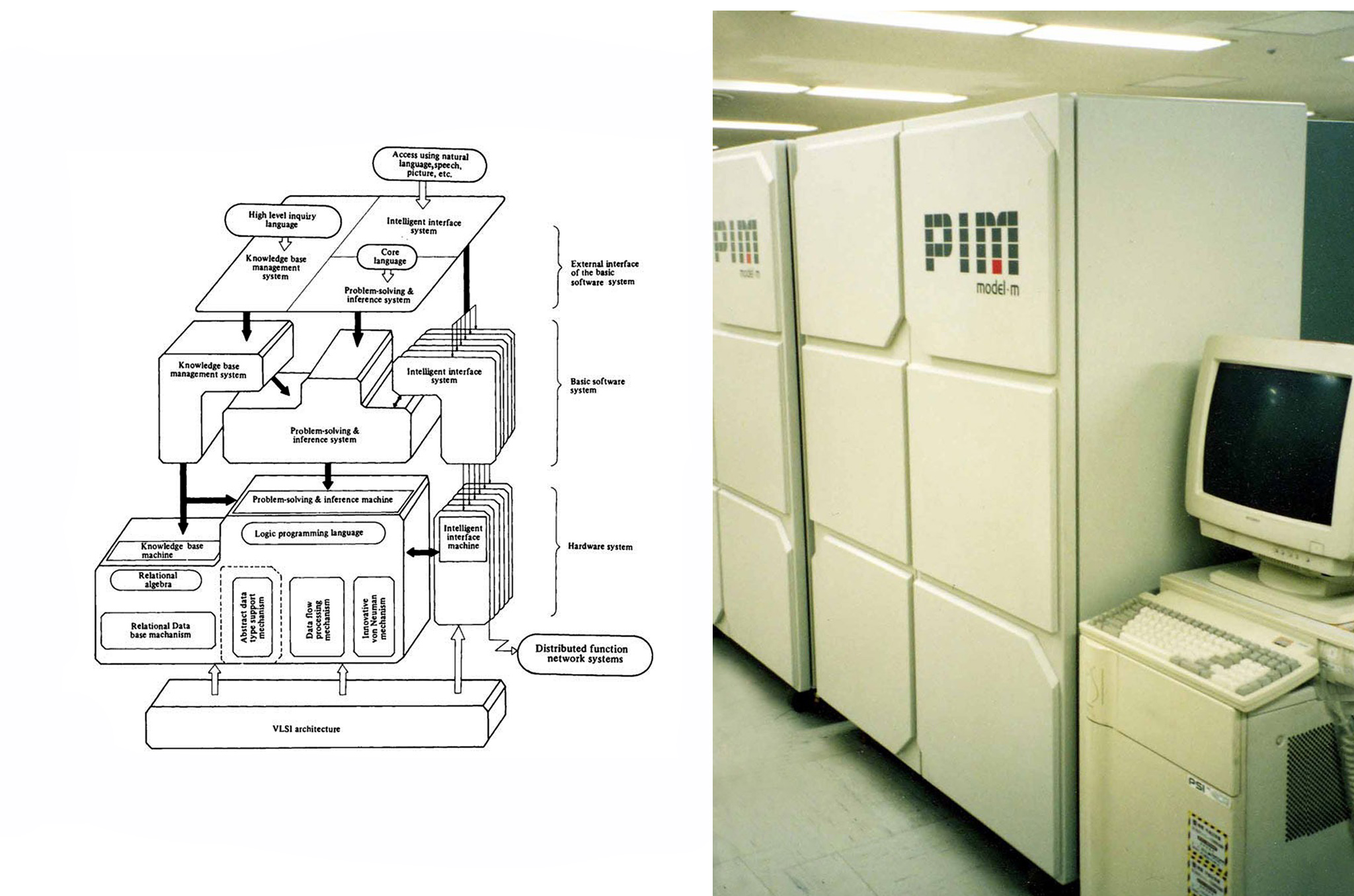
Diagram of the Fifth Generation Computer System (left), with image of the FGCS (right) | Sources © Information Processing Society of Japan / Proceedings of the International Conference on FGCS, Oct. 1981
Slow and Steady Did Not Win the Race
The Ministry of International Trade and Industry, together with researchers at Japan’s Electrotechnical Laboratory, announced the idea of computer inference-based artificial intelligence in 1981. The Japanese government was invested in the project because they wanted to break IBM’s global hold on thinking machines and make Japan a pioneer in next-gen computer technology. But for such lofty goals, they didn’t seem to want to spend too much money on it.
Japan’s government shelled out about ¥57 billion on FGCS research between 1982 and 1994, which amounts to about $320 million USD in today’s money. Sounds like a lot, but it never exceeded 1% of the annual R&D expenditure of Japan’s electronics industry. Even IBM was spending more on research than what the government of one of the largest economies on the planet was putting into inventing new kinds of computers.
The FGCS was like trying to create Star Trek-esque machines that could operate with “Do this” or “Don’t do this if that happens” commands, retrieve information at incredible speed and connect related facts on their own without being told to. And they would have to achieve this using brand-new computer architecture, wholly separate from IBM’s, which dominated the global market. This likely affected the talent pool at the Institute for New Generation Computer Technology, the main center for Japan’s FGCS research.
To the project’s credit, it did hire new PhD. graduates willing to push the technological envelope, but it did so in a very unusual way. It first placed them in private partner companies, and about six months later, those companies temporarily sent them to Institute for New Generation Computer Technology. This system fit Japan’s lifetime employment culture, but it needlessly hamstrung young innovators, who may have had the biggest impact on developing the FGCS.
Task Failed Successfully
After well over a decade, Japan’s FGCS research failed to deliver on its promise of artificial intelligence — but that doesn’t mean that all of the government’s money went to waste. The FGCS project produced 382 patents, 2,371 technical reports and memoranda, 100 software packages released for free over the internet after 1992. It also fostered international collaboration between research institutes.
Most importantly, one committee concluded that the project massively advanced parallel processing, allowing computer systems to divide tasks among multiple processors to finish complex calculations thousands of times faster than before. Parallel processing is the backbone of basically the entire modern world. Search engines, streaming platforms, smartphones, GPUs and even modern AI all rely on the principle of processing unimaginable amounts of data in parallel, and the huge advancements in that field were inspired in part by FGCS research.
Another one of the project’s greatest successes was the fact that it trained scores of computer scientists and architects on the foundations of logic programming and parallel computing. It essentially prepared a whole generation for a new technological landscape that now dominates the world. Whether that is a good thing or not depends on how often the internet makes you sad. But as a silver lining — if it’s “very often,” you now know which early technology to blame, and there is a kind of solace in that.
Related Posts
- How the Sony Walkman Failed To Destroy Civilization
- PlayStation 2 Turns 25: The Console That Revolutionized Gaming Culture
- 10 Japanese Inventions That Changed the Way We Live
Updated On August 31, 2026