
For anyone familiar with her works, the name Mika Ninagawa instantly conjures a very specific visual — most likely a fantastical, neon forest where flowers and goldfish collide in a fever dream of maximalism. Her photographs and films are otherworldly, dripping in femininity yet haunted by a sense of lurking darkness; to step into a Ninagawa exhibition is to be submerged in a world where the saturation is turned up until it vibrates.
As the daughter of legendary theater director Yukio Ninagawa and actress Tomoko Mayama (also known as Hiroko Ninagawa), Ninagawa was raised in close proximity with the avant-garde. She’s been remarkably self-possessed from a young age, and her career is marked by a surgically precise consistency — from her 1990s debut as the figurehead of the “girly photo” movement; to her vision as the director of the 2012 cult classic Helter Skelter; to her most recent publication, Mirror, Mirror, Mirror Mika Ninagawa, a collection of booklets and posters that aims to deconstruct the very concept of a photobook.
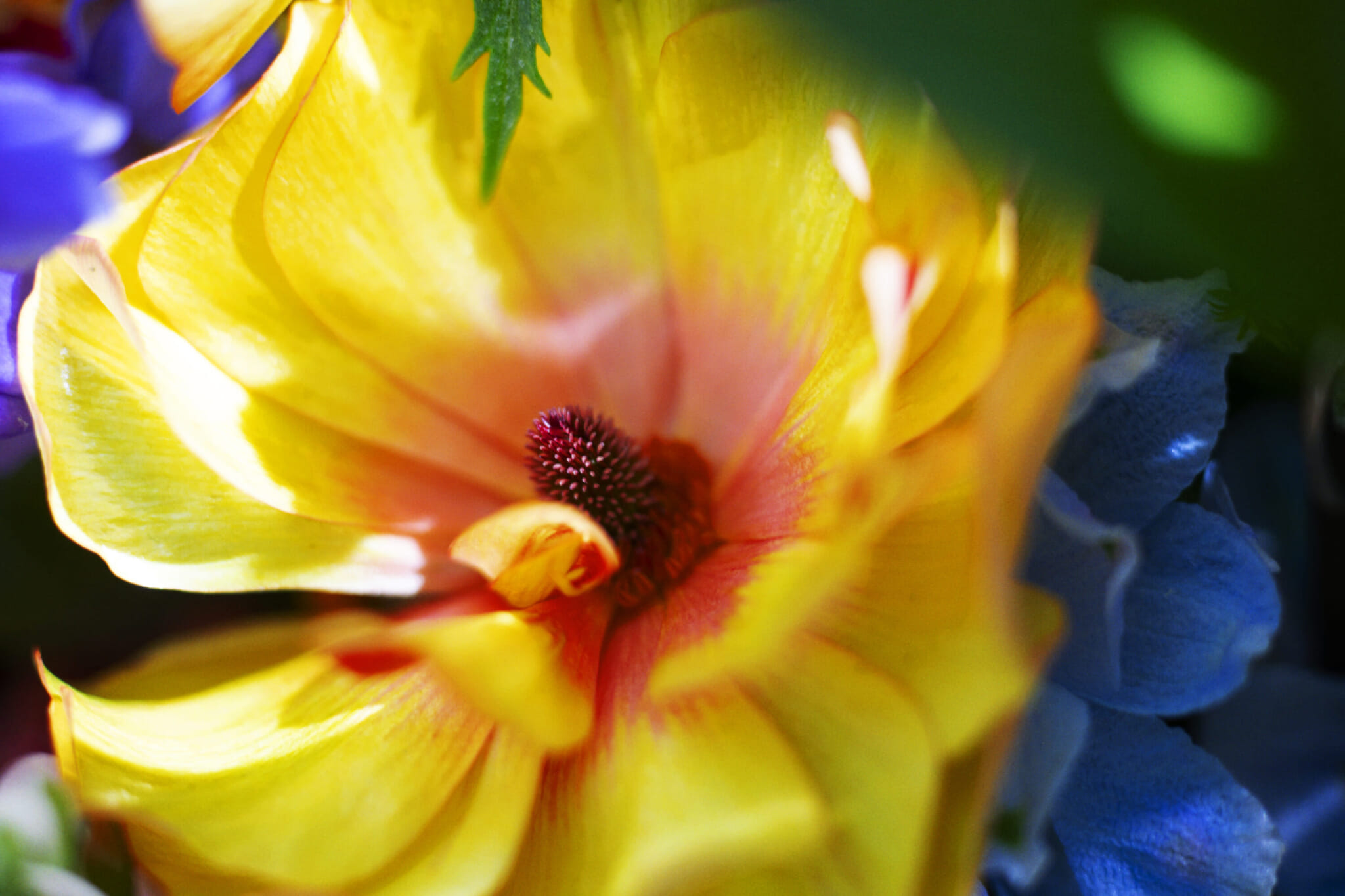
Ninagawa is now one of the most successful photographers in Japan, with over 120 photobooks to her name and a host of prestigious awards. Her aesthetic is so singular that it’s nearly a genre of its own. Her color palette of super-vibrant pinks, oranges and blues is sometimes referred to as simply “Ninagawa colors.” But though her work is glitzy and bright, it’s far from shallow; her signature vibrant saturation and recurring motifs are part of a lifelong, visceral attempt to capture the high-velocity bloom of life before it inevitably fades.
©mika ninagawa, Courtesy of Tomio Koyama Gallery
Birth of the Neon Lens
Ninagawa picked up her first camera in fifth grade. By high school, she was hooked; she saved up her allowance, bought a used SLR and never looked back. “At the time, the medium mattered less than the joy of creating something. I think photography was a good fit for my personality and body, though,” she says. “I’ve never felt it was difficult.”
She quickly made a name for herself. While studying graphic design at Tama Art University in the mid-90s, she became one of the most notable figures in the “girly photo” (onnanoko shashin) movement — a group of pioneering young women who documented their daily lives in intimate snapshots and self-portraits.
While critics often used the term to dismiss a new wave of female photographers as hobbyists, Ninagawa embraced it. The “girly photo” movement was radical in that it gave young women the space to intimately document their own experiences of womanhood, representing themselves on their own terms. For Ninagawa, that kind of expressivity was freeing in another way, too — it allowed her to assert her own identity in a world that would always compare her to her father. “Wherever I went, I was told I was the daughter of Yukio Ninagawa,” she says. “I wanted to express myself — Mika Ninagawa as an individual — from a very young age.”
Ninagawa understood that her work, and her persona, were being consumed by a society obsessed with images of girls and girlhood — typically oversexualized, almost always created by men. But she also knew that she could make work that toyed with — and pushed past — their limited expectations. “I was very aware that I was being consumed through the symbol of a girl,” she explains, “but I still saw the benefits of being seen. I was able to accept that if I just got consumed and it ended there, then that was simply the extent of my ability. I wanted to give it my all.”
In 1996, while still in college, she won the Grand Prize at the seventh “Hitotsubo-Ten,” a key platform for emerging photographers, as well as the Excellence Award at Canon’s New Cosmos of Photography competition. Soon after graduating, she held her first international exhibition at the iconic Parisian concept store Colette.
In 2001, she received the Kimura Ihei Award, one of Japan’s most prestigious photography prizes, though the recognition was a bit bittersweet. For the first time in the award’s history, it was split three ways — between Ninagawa and two other icons of girly photography, Yurie Nagashima and Hiromix. “I thought, ‘Why am I not alone?’ I felt very dissatisfied,” she recalled in a 2018 interview. “But I wanted to use this experience as a springboard for becoming an unrivaled existence.”

©mika ninagawa, Courtesy of Tomio Koyama Gallery
The Anatomy of Distortion
Ninagawa’s works are instantly recognizable, and often employ recurring motifs — namely goldfish and flowers — which are key to understanding her psyche and worldview. “Goldfish are created from the human desire to own something bizarre,” Ninagawa says. Originally bred from crucian carp, these diminutive aquatic beings are, to her, imbued with a unique sense of pathos. They also teach us something about the human condition. “The more we engineer them to have long fins, or some lumps, the shorter their lives get,” she says. “They’re actually quite grotesque and artificial creatures, yet they’re beautiful and cute, and we can’t resist them.”
Goldfish show up throughout Ninagawa’s debut film, Sakuran, a story about a hard-headed girl in the Edo period climbing up the ranks in the red-light district of Yoshiwara to become the oiran, or the top courtesan. “Goldfish can’t survive if they return to nature. They’re doomed to live the rest of their lives in a fish bowl,” Ninagawa explains. In this state of beautiful dependency, the goldfish becomes a mirror for the oiran of Yoshiwara — creatures of exquisite grace trapped within an inescapable world.
Similarly, her obsession with flowers is rooted in the interplay between beauty and decay. “Flowers wither as soon as they bloom,” she notes. “Every year, cherry blossoms fall with great force. With flowers, you can very clearly see the themes of life and death, of light and dark.”
In Ninagawa’s 2006 photobook Everlasting Flowers — a collection of images featuring artificial bouquets left at cemeteries — the connection to death is even more explicit. The book interrogates another dichotomy as well: the tension between the organic and the synthetic. “They’re plastic, yes, but they are filled with the human desire to offer the deceased something that never dies,” she explains. “It made me think — what is ‘real’ and ‘fake’ anyway?”
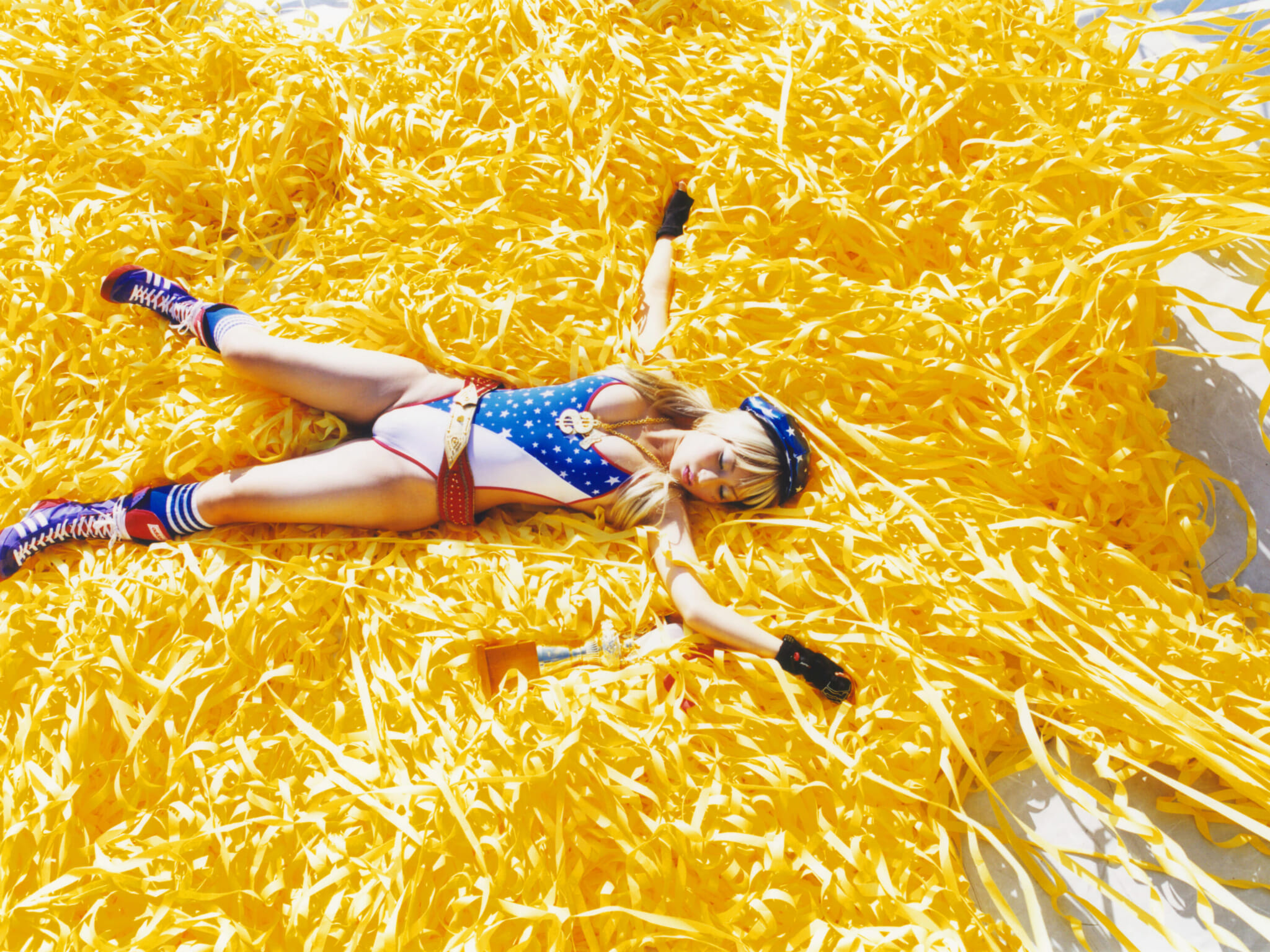
©mika ninagawa, Courtesy of Tomio Koyama Gallery
Narrating Empowerment
“I didn’t work hard to ‘discover’ my style,” Ninagawa says, “but I did have to work hard to defend it. For years, people told me my photos weren’t legitimate.”
This professional friction only intensified as she moved into other fields, including film. “The bigger the project, the more people questioned my vision,” she recalls. “The most difficult part was seeing my style through and learning how to explain exactly why I loved what I loved.”
Ninagawa maintains her signature ultrafemme, hypermaximalist style in her films. The visuals in Sakuran are fluorescent and fashion-forward, each frame composed with a photographer’s exacting eye. In 2012, she released Helter Skelter, which follows a supermodel, Lilico, as her body begins to decompose following a full-body plastic surgery procedure. Grotesque subject matter aside, the film is an explosion of color and sensuality. Lilico’s room is a suffocating, scarlet sanctuary of vanity — an explosion of leopard prints, golden chandeliers, vintage lace and clashing textures that mirror the character’s unraveling psyche.
“A lot of the furniture we used was my own,” Ninagawa says, calling my attention to a leopard-print sofa behind her. “I didn’t have a chair to sit on at home during the shoot,” she adds with a laugh.
While Ninagawa’s photographs gesture symbolically at the fleeting nature of life and the paradoxes of desire, her films tackle these subjects head-on. “In photography, words can come later. I’m taking pictures of the emotions directly,” she muses. “The movie is the opposite — the message comes first.” Her plots tend to deal with women who are boldly — often single-mindedly — chasing after their ambitions. Her lead characters are often beautiful, glamorous and trapped by social pressures they don’t recognize as corrosive. Helter Skelter, for instance, serves as a visceral exploration of beauty as a consumable commodity, drawing from her own experiences as an up-and-coming female photographer in the 90s.
Ultimately, she wants to motivate women to foster a sense of independence. Another thread that weaves its way through her work: the idea that femininity is endlessly complex and beautiful when women define it on their own terms. “It’s important to be [a woman who is] able to love themself and make their own decisions. I want my works to have that kind of message,” she says.
©mika ninagawa, Courtesy of Tomio Koyama Gallery
The New Collective
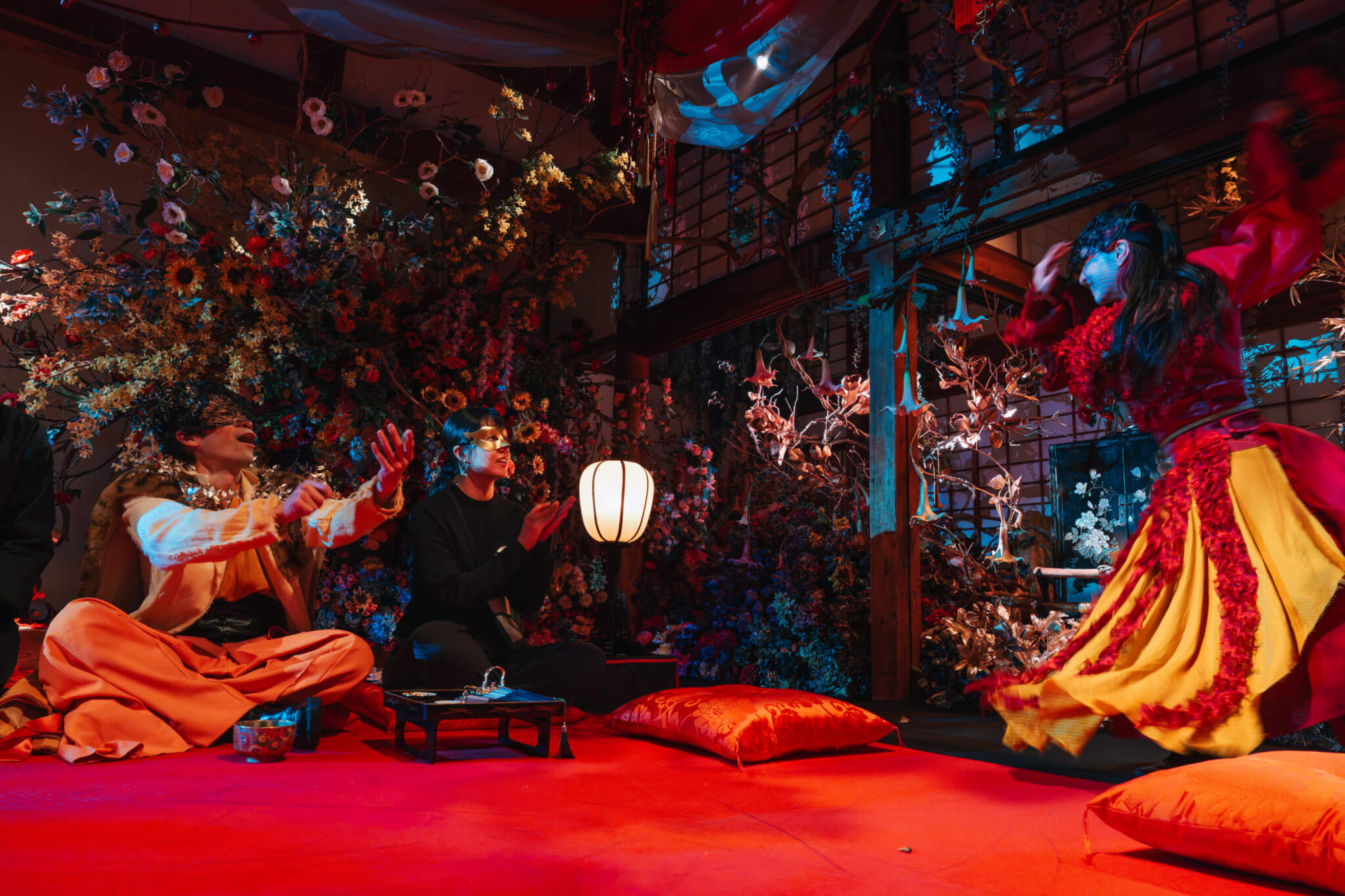
Though her style has achieved cult status, Ninagawa is constantly evolving. Four years ago, she helped establish the creative team EiM; she likens the process to “forming a band.” This shift from the solitary photographer to the collaborative director has opened new doors creatively. This spring, EiM staged an immersive theater project, Hanayoi no Daichakai, held at Kyoto’s Kitano Tenmangu Shrine.
The project blends history, reality and fiction in a 70-minute, nonverbal performance that takes guests into an imagined second day of the Kitano Grand Tea Ceremony, a historical event believed to have taken place across a single day. “I felt like I had a skill set that I hadn’t tapped into before,” she says, referring to her ability to build an entire physical world for audiences to step into.
As she prepares for a series of major international exhibitions across Europe this year, Ninagawa feels finally ready to invite a global audience into her creative universe. But even as her reach expands, her core message remains as concentrated as her famous colors. Whether through a photograph of a dying flower, a film about a crumbling superstar or an immersive tea party with historical spirits, Ninagawa’s intent is singular.
“You’re responsible for making your own life bloom,” she says. “I want to keep empowering women and energizing people. It’s the same message I’ve always wanted to convey.”
More Info
Follow Ninagawa on Instagram at @ninagawamika.
Related Posts
- Hikari Steps Into the Spotlight
- Photographer Herbie Yamaguchi Has a Message for You: Stay Punk!
- Tokyo Love Story: Solène Ballesta’s Provocative Photography
Updated On June 5, 2026