The sexy robot. It’s a distinctly modern archetype that somehow feels like it’s always been around: as a glossy action heroine, a futuristic fantasy, a dystopian metaphor. The trope felt particularly inescapable in the mid-2010s, from the eerie humanoid robot in Ex Machina to Scarlett Johansson’s cyborg in the live-action Ghost in the Shell. But this specific look, where a female body is seamlessly fused with chrome, didn’t suddenly materialize in some Hollywood CGI lab. It was carefully painted on a canvas nearly half a century ago by Japanese artist Hajime Sorayama.
Sorayama is one of the most famous and influential contemporary artists to ever emerge from Japan, and his name is almost synonymous with humanoid robots. Starting out as a commercial illustrator in the 1970s, he became widely known for his hyperrealistic paintings of metallic pinup women. In a time when robots were typically portrayed as clunky, utilitarian and unfeeling, Sorayama’s creations were sleek, supple and seductively witty, drawing upon sex symbols like Marilyn Monroe and Barbarella. These chrome goddesses have influenced everyone from The Weeknd and Aerosmith to luxury fashion houses like Dior and Mugler and, basically, permanently altered our concept of what a robot is.
Sorayama didn’t necessarily invent the concept of the sexy robot, but he did create a whole new kind of visual language, elevating the archetype into an icon — one that’s now firmly embedded in pop culture. If you were asked to imagine an eroticized robot, undoubtedly a Sorayama-esque image would come to mind, whether you’re familiar with his name or not. From today’s viewpoint, his works feel less like a tongue-in-cheek fantasy and more like a strange premonition. He blurred the line between human and machine way before the line became so fuzzy; we are now living in an era where generative AI creates deepfake pornography and clones fashion models with a few clicks.
It’s tempting to say that Sorayama foreshadowed this crisis decades ago by morphing the female body into an idealized, mechanized object — even if his intent wasn’t to criticize. But the artist himself would probably just say it’s not that deep. Catching up with TW ahead of his largest-ever retrospective — “Sorayama: Light, Reflection, Transparency -Tokyo-,” at Creative Museum Tokyo — Sorayama made it clear that these infinitely symbolic robots were brought to life for a pretty simple reason: because they’re cool.


Machines With Meaning
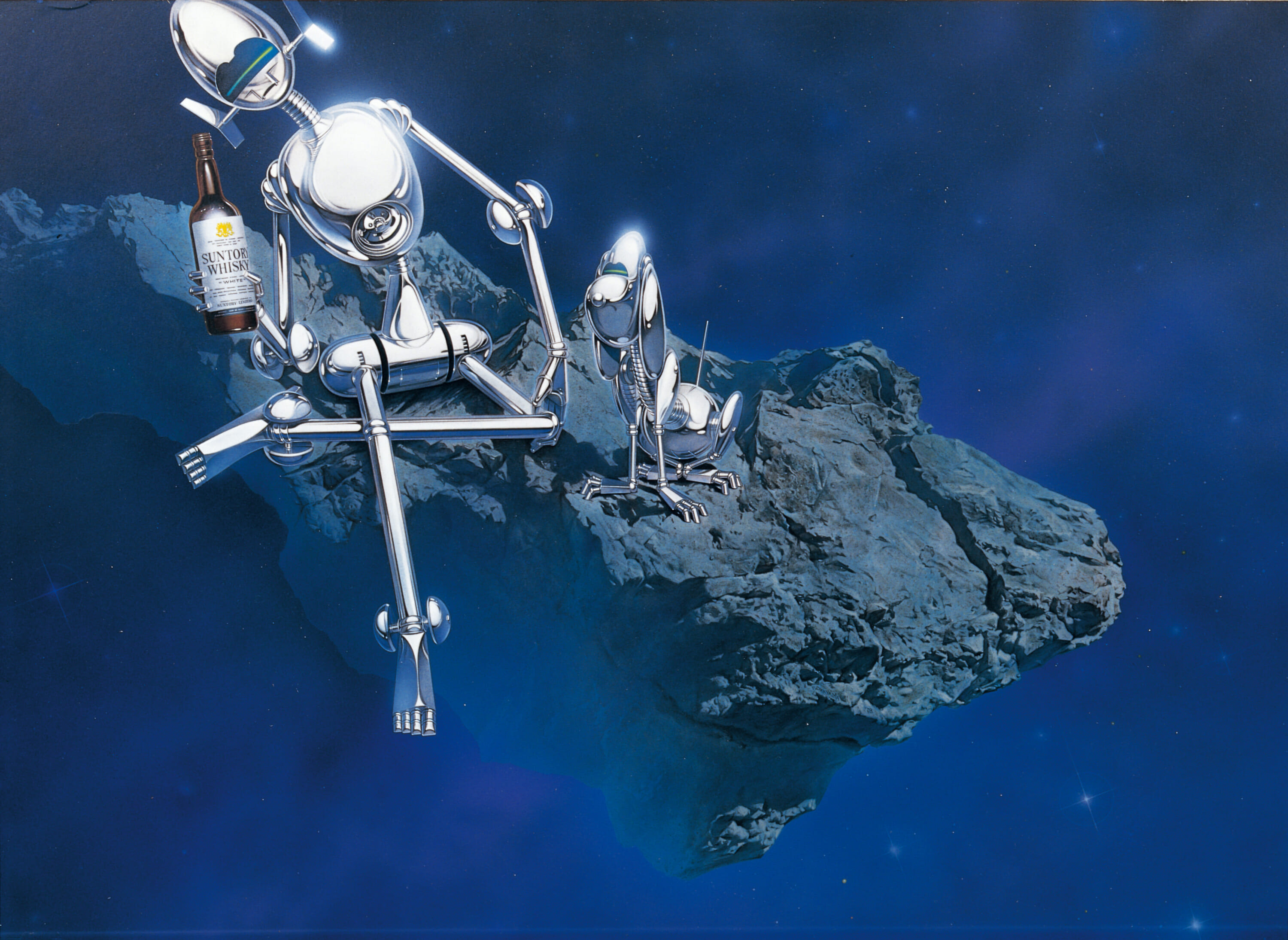
The origins of Sorayama’s visual world were mostly pragmatic. His first robot painting in 1978, which you can spot in the exhibition’s “Pink Tea Room,” was a freelance gig for a Suntory Whisky ad. Star Wars had just hit theaters, sci-fi was huge and the client wanted a robot — specifically a C-3PO. When licensing rights for the Star Wars robot couldn’t be secured, Sorayama was tasked with creating an original alternative.
“I think my younger self worked desperately hard on [the illustration] because I needed the job,” he says. He wasn’t sitting there grappling with lofty themes like transhumanism or postindustrialism; he was just trying to pay the bills. That being said, the project also presented a complex and intriguing technical puzzle for Sorayama — one that would come to define his career.
“It was difficult to paint a metallic body while thinking about reflections,” he explains. “Ever since I was a child, I’ve been fascinated by how light reflects off metal. Once I began painting, I became preoccupied with expressing light and transparency in my pieces — qualities that are impossible to reproduce using paints consisting of the four primary colors.”
This pursuit of technical perfection is an obsession in its own right, but it sits at odds with the high-concept weight often attached to his work; some critics and curators have described his art as subtly subversive, calling into question the voyeuristic and objectifying way women’s bodies have been depicted in art throughout history. Others have called it a metaphor for humankind’s technological narcissism.
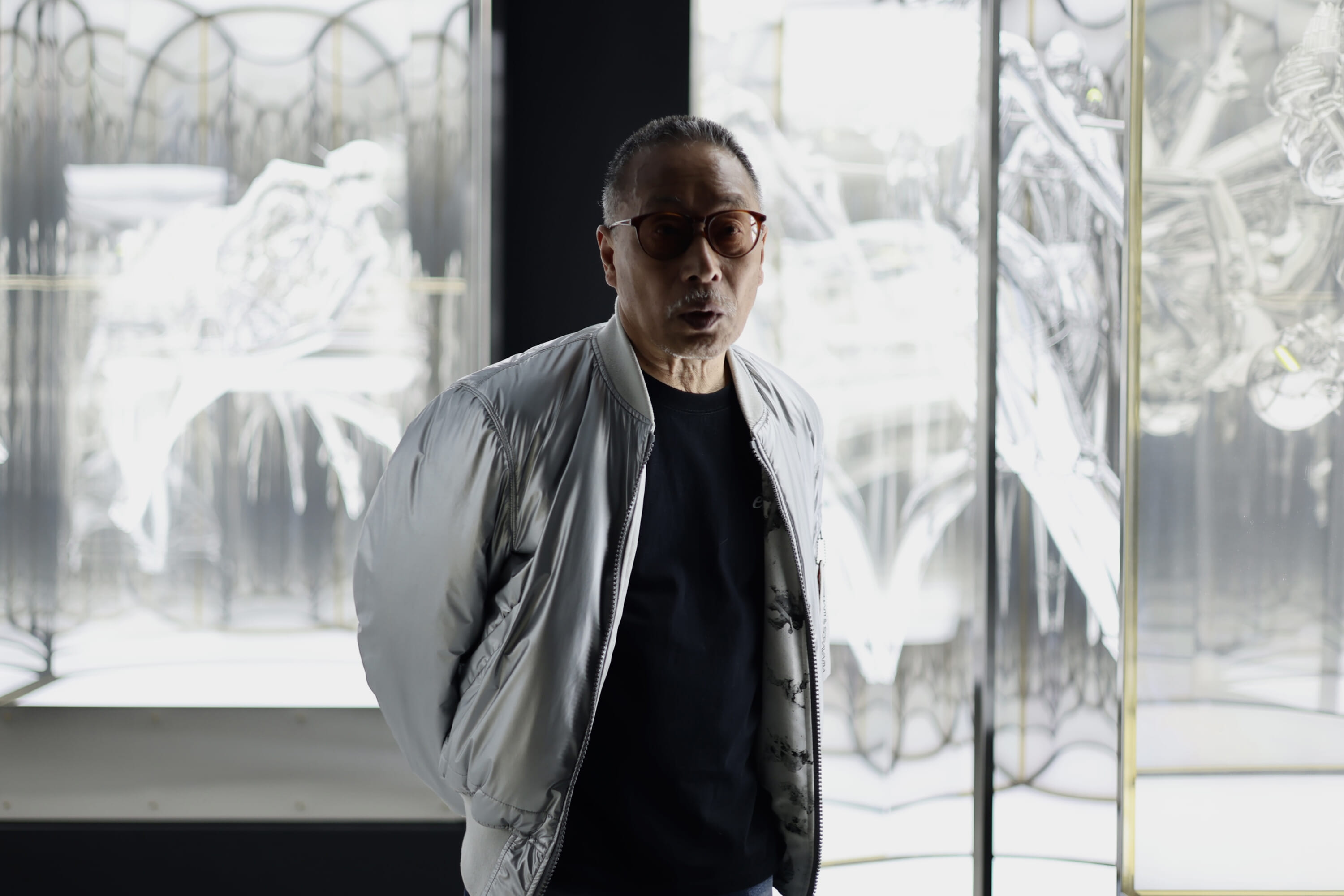
“I don’t think about such difficult things, and I don’t know the answer” is Sorayama’s response when asked about his thoughts on the current relationship between humanity and robots. “I can only create works by staying true to my own aesthetic.”
© Hajime Sorayama. Courtesy of NANZUKA
Entertaining Is a Fine Art
Sorayama has also claimed that, in some ways, his metallic pinups were simply a creative maneuver that allowed him to work around Japan’s famously convoluted obscenity laws. That is, the artist discovered early on that replacing human skin with chrome could get his erotica past censorship. It’s rather ridiculous and honestly kind of funny in principle: If he were to draw a naked woman, it would be seen as “pornography” and be banned; if he renders her in metal, though, it’s “futuristic art,” and he gets paid.
“One time, when an American publisher sent back the negatives of my work, they were seized at Japanese customs. I had a laugh when the government scolded me for possession of ‘harmful materials,’” he recalls. “But for me, getting told ‘no’ is just good fuel for creativity.”
This matter-of-factness when it comes to discussing his artistic intentions has remained a constant over Sorayama’s interviews over the years. And as much as his art has become a marker of cultural cachet around the world, he prefers to call himself an “entertainer” (on his Instagram bio, for instance) rather than an “artist.”
“As long as people see my work, I’m happy — whether it’s in a porn magazine, a prestigious art museum or at a fashion show. I don’t discriminate,” he claims. He also claims that he doesn’t need an audience: He would still be creating what he wants to create “even if it couldn’t be published,” just because it would be entertaining — for himself.


Sexy Sharks and Cool Mirrors
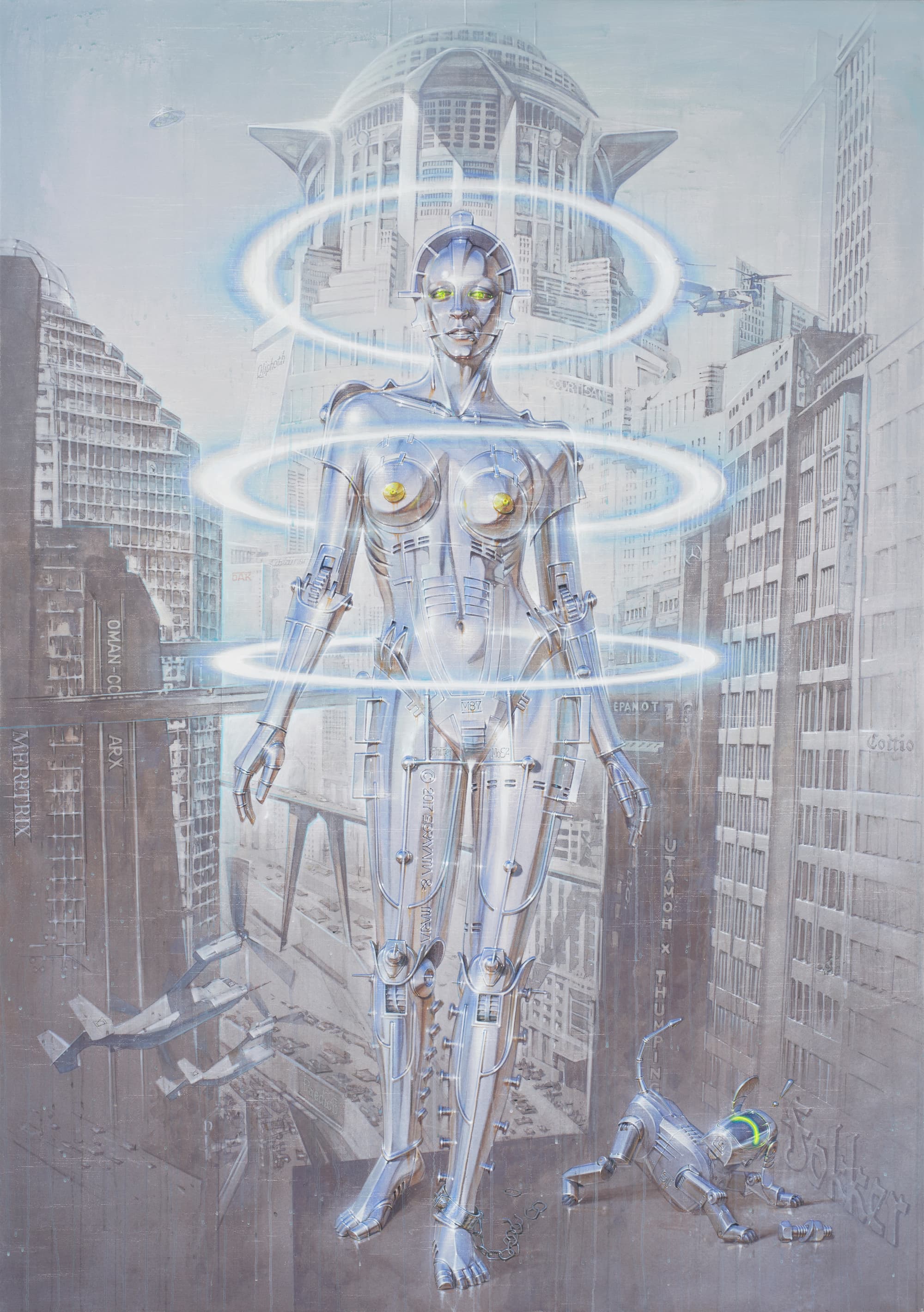
The collection of early paintings at “Sorayama: Light, Reflection, Transparency -Tokyo-” reminds us that his work is, at its core, a feat of manual skill. Each high-gloss highlight and microscopic reflection in his paintings is the result of thousands of tiny airbrush strokes, coming together to create a digital-perfect finish. This is the poetic irony at the center of Sorayama’s oeuvre: It captivates you through its unique brand of uncanny artifice, which is only achieved through a human vision and care that no machine can quite match.
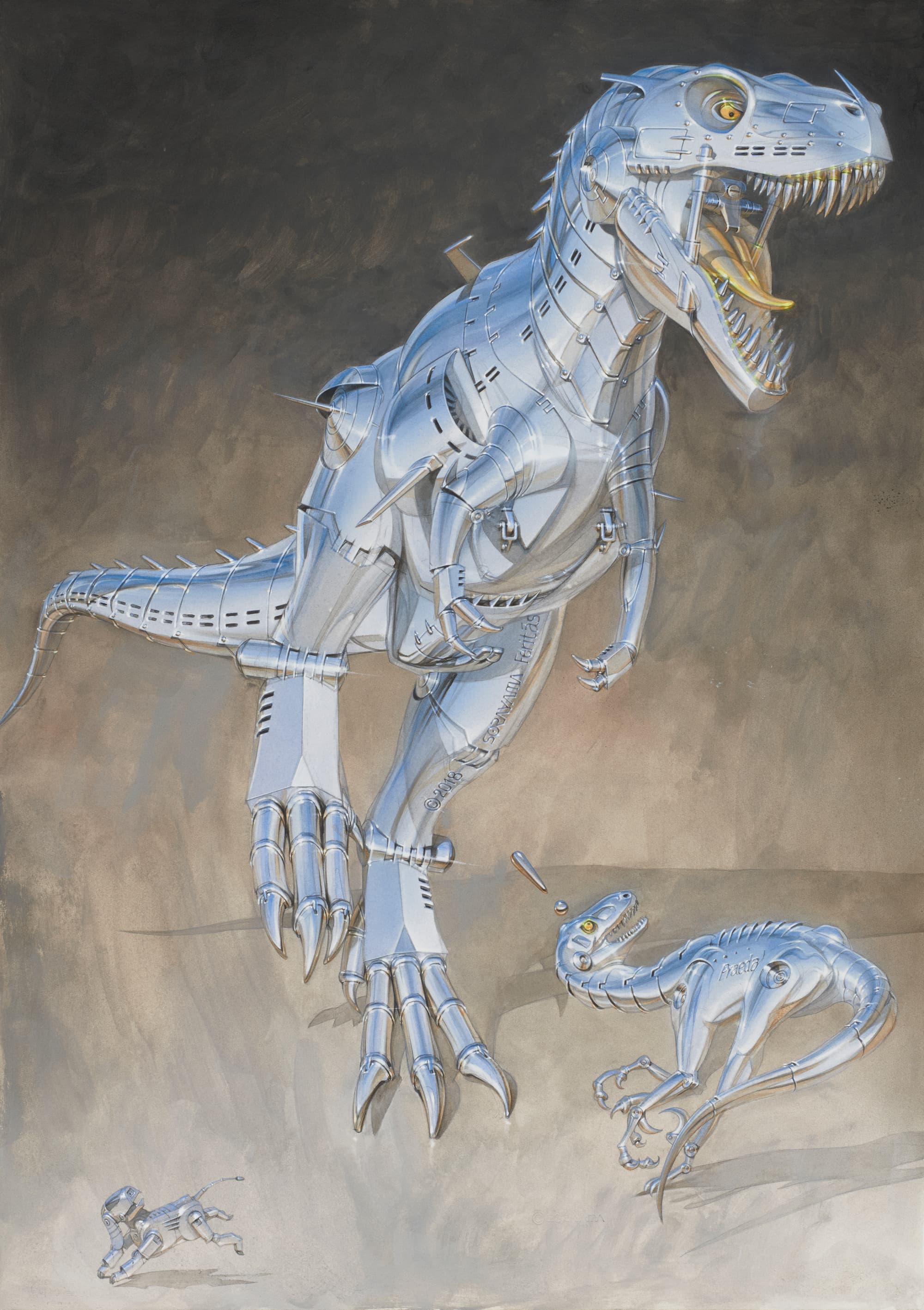
The exhibition’s trajectory reflects this irreplicable, steadily honed visual identity, tracing Sorayama’s creative evolution from his first robot painting to his latest works — including various depictions of robotic dinosaurs, unicorns and sharks, which he has described as “the sexiest fish.” Why robotic dinosaurs and sharks? His answer is, once again, pretty simple.
“I just created works that I felt were the most beautiful and cool, in terms of form,” he emphasizes. “They are essentially just organisms clad in metallic skin — a way of consistently driving my own aesthetic forward. I prefer to leave any deeper preaching or interpretations up to the viewer.”
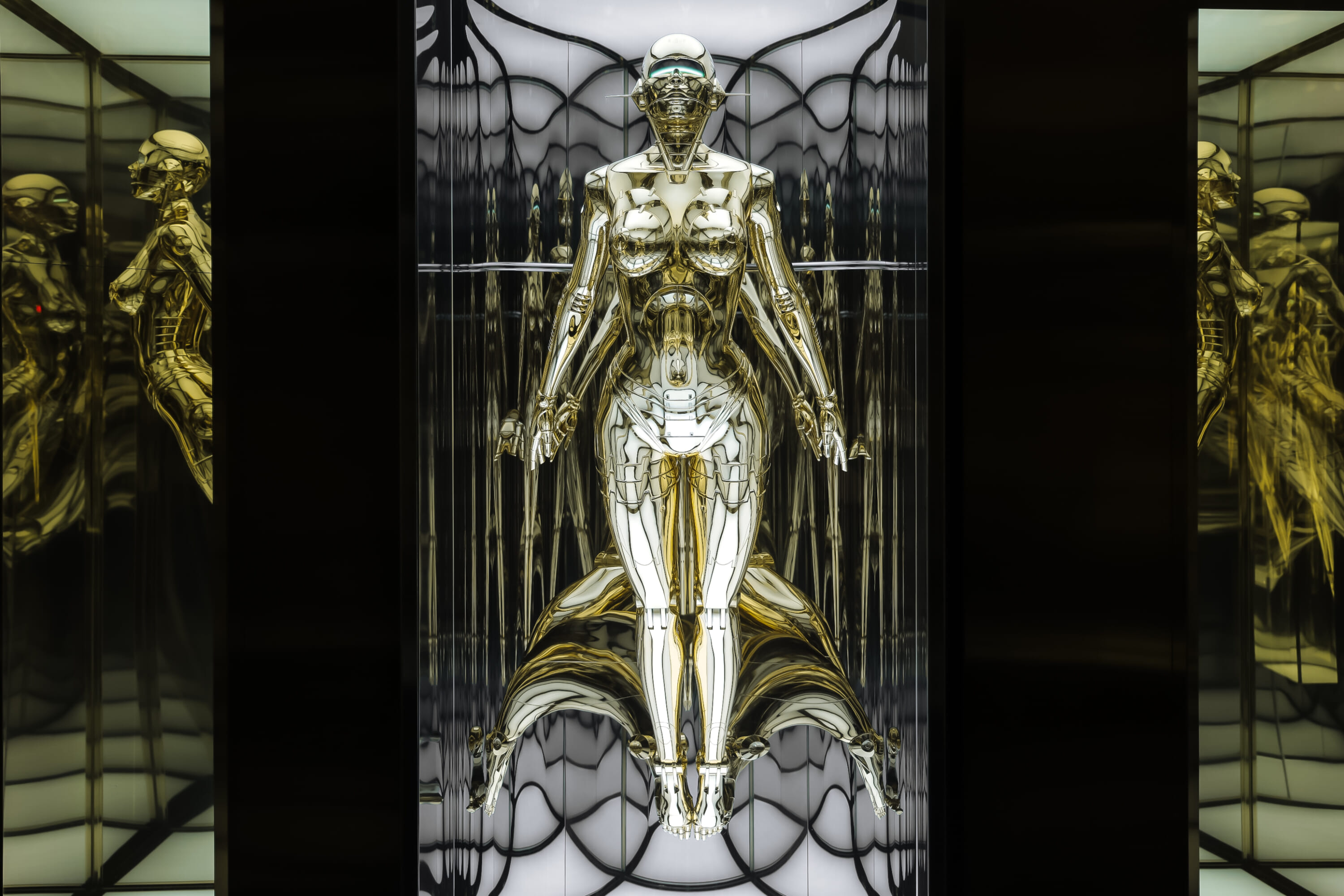
This is something to keep in mind when encountering the centerpiece of the exhibition, the “Mirror Maze” installation, which features a sculptural sexy robot floating in space: “Sexy Robot type II floating_gold” (2025). Surrounded by infinite reflections of itself, the three-dimensional chrome figure seemingly multiplies endlessly into a shimmering, faceless army.
As with most of his works, the number of meanings you could extrapolate from the piece itself feels endless: It could be a commentary on the deification of technology … a parody of the male gaze … a confrontation with the viewer’s ego … so on and so forth. Not that these interpretations aren’t productive; they’re certainly a big part of why his art has such universal allure. But as Sorayama suggests, it’s also perfectly fine to appreciate the piece for what it ultimately is — something striking, memorable and, of course, supremely entertaining.

More Info
“Sorayama: Light, Reflection, Transparency -Tokyo-” is on view until May 31, 2026, at Creative Museum Tokyo. For more information, click here.
You can keep up with the artist on Instagram at @hajimesorayamaofficial.
Related Posts
- Happy Victims: Inside the Homes of Tokyo’s Fashion Obsessed
- Tsuguya Inoue: The Father of Japanese Cool
- Inside Proleta Re Art, Tokyo’s Most Elusive Fashion Label
Updated On March 26, 2026