Hayao Miyazaki’s 1997 anime Princess Mononoke is widely considered great art, and the thing about great art is that it doesn’t change. Instead, it allows us to discover more of what was always there as we get older and accumulate more life experiences, or opens itself up to reinterpretation as the world around it changes. With this year’s surge in bear attacks in Japan — more than double the number in 2024 — and the question of how much of it is humanity’s fault, now is the perfect time to return to Princess Mononoke after almost 30 years and see what it has to say about the complex relationship between man, technology and nature.

© Studio Ghibli c/o ghibli.jp
What Is a God?
The main conflict in Princess Mononoke is between humans, represented by the coal-mining, deforesting, gunsmithing inhabitants of the Irontown settlement, and the animal gods of the surrounding woods like apes, wolves and boars. However, the core of the movie isn’t fantastical or theological and can be understood by answering the very simple question of: what, exactly, is a god?
It’s not someone who takes care of humans, that’s for sure. The “gods” of Princess Mononoke want nothing to do with humanity and don’t, for instance, help lepers or rescue women from a life of prostitution. Those things are done by the leader of Irontown: Lady Eboshi. Also, the supposedly divine forces of nature are actually pretty bad for the forest.
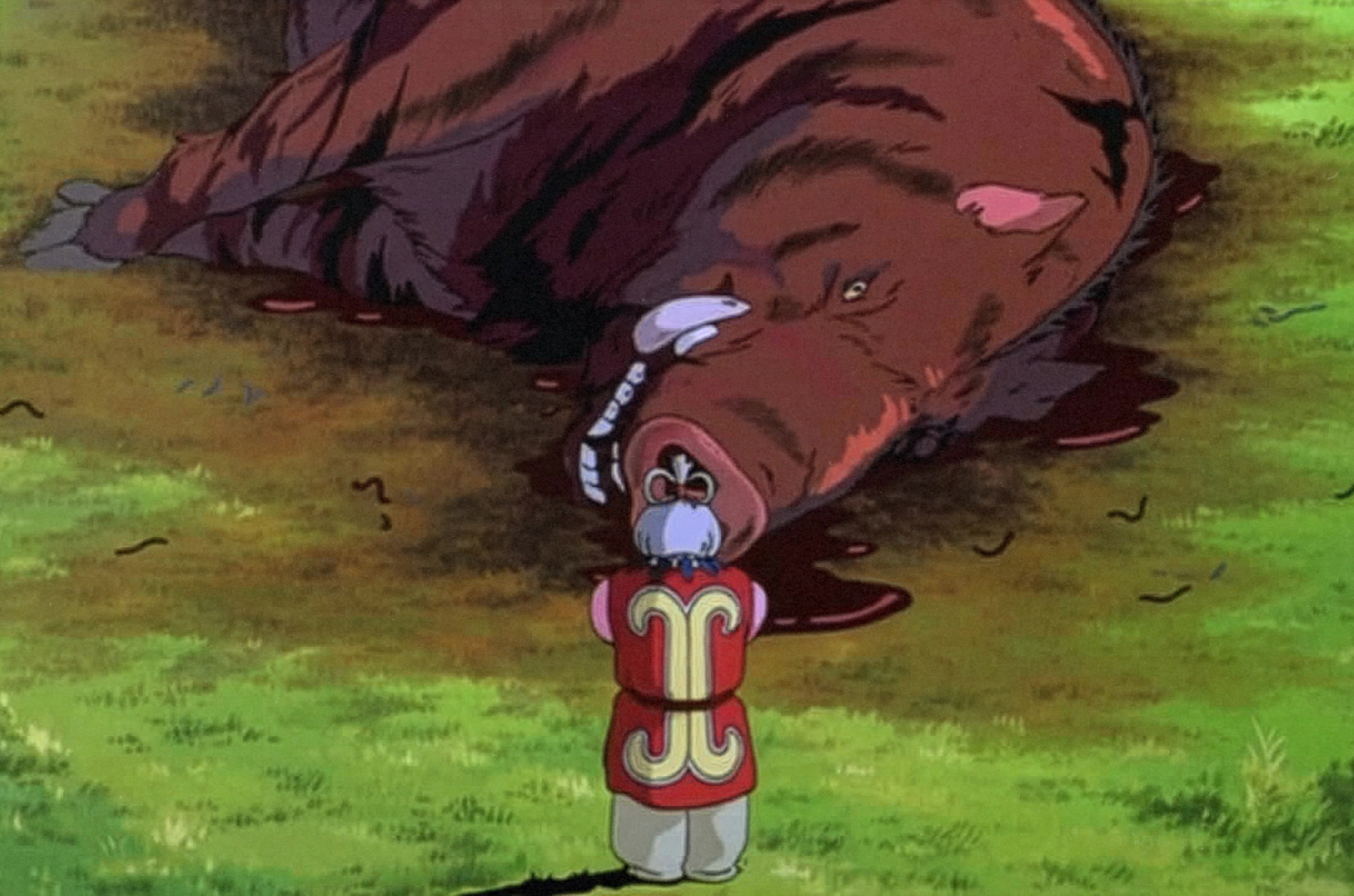
When boars march to war against Irontown, they trample the woods and make them cry out in pain. These “gods” fight, argue, hold grudges and act out of fear and ignorance. Just like humans. So… if Princess Mononoke’s gods aren’t that different from humanity, then what are they?
They are exactly what it says in the Japanese dialogue: they are kami, a word that, for efficiency, is often translated into English as “god” or “deity” but means much more, from spirits of the inanimate to powerful supernatural forces. Princess Mononoke, following the tenets of Shinto, reframes “gods” as simply powerful non-humans with their own agendas, thus making the film’s question of coexistence a practical problem instead of a spiritual one. This way, the movie may actually have something to say about how Japan should tackle its bear problem.

© Studio Ghibli c/o ghibli.jp
One But Separate
One of the main characters in the anime is Ashitaka, a prince of the Emishi, an indigenous Japanese group that is being pushed out by the ethnically distinct Yamato who now make up the majority of Japan’s population. It’s very easy to treat Ashitaka as another victim of human’s inherently destructive expansion represented by the Yamato people of Irontown, but that is a too shallow reading.
The Emishi people are portrayed as much closer to nature than the Yamato, true, but their village still contains fortified trenches, observation towers, and walls. Those are boundaries. They exist to separate human life from the wild. The Emishi do not draw an equal sign between themselves and animals. They live alongside nature, giving praise and thanks to it but still believing in defenses in order to protect themselves.
They represent coexistence without unification. Ashitaka’s journey reveals that neither humans nor kami TRULY want bloodshed but they also do not want fusion. Humans cannot abandon growth and the kami cannot tolerate endless intrusions. The repeated question from the movie “Heeey, can’t we just share?” is answered plainly and painfully: “No. Not fully.” There must be clear borders set between us, but not an iron curtain.
San, the titular Princess Mononoke, a human raised by wolf kami, and Ashitaka symbolize this message. In the end, Ashitaka, changed by his journey, stays in Irontown while San stays in the forest, but they agree to meet, without merging their worlds. This is not tragic; it’s realism. Such must be Japan’s approach to bears: they must have their place in this world. They must have their domain. But they also must keep to their turf. And if they go outside it, humanity must be ready to pull out the literal big guns.

© Studio Ghibli c/o ghibli.jp
Guns Aren’t the Problem – Hatred Is
In Princess Mononoke, the key to survival is technology. That’s why it doesn’t feel fair to say that the anime condemns guns. Miyazaki actually presents them with a bit of pride, with the improved models being wholly Japan-made and superior to the Chinese hand-cannons that Irontown has been using until now. They are also made exclusively by people with leprosy, giving them a purpose and a calling. Finally, they are primarily given to women, granting them power to protect themselves in a world where female life was easily discarded. That is not corruption. That is everything good about progress.
It is true that firearms are involved in turning kami into tatarigami demons, but what ACTUALLY transforms them aren’t the bullets themselves but rather hatred. Hatred is the root of all suffering in Princess Mononoke, and the film definitely condemns that while presenting guns as tools, and a tool cannot be good or evil.
So, the ultimate lesson of Princess Mononoke is not “do not kill.” Ashitaka in fact kills A LOT of people throughout the movie, but only when necessary, and never with malice in his heart. Japan should keep that in mind when dealing with bears. If a bear threatens human life, it’s right to shoot it. But there should be no joy in it. It should be a matter of necessity, conducted calmly and with a non-bloodstained future in mind. The problem is ongoing, and right now the local governments’ solutions do involve guns, which might be the right call. But it all should coexist alongside peaceful measures and policies to keep the bears to their own neck of the woods. The details will have to be hammered out as we go along but, “let’s not turn this thing into an excuse for a gun-fueled ursine killmageddon” feels like a good place to start. Thanks, Princess Mononoke!