Serene faces, intricately carved robes, hands frozen in gestures of compassion — Buddhist sculptures distill centuries of belief and discipline into a single moment of stillness. Though they may seem to belong to a distant past, the craft of busshi, or Buddhist sculptors, continues to thrive in Japan today.
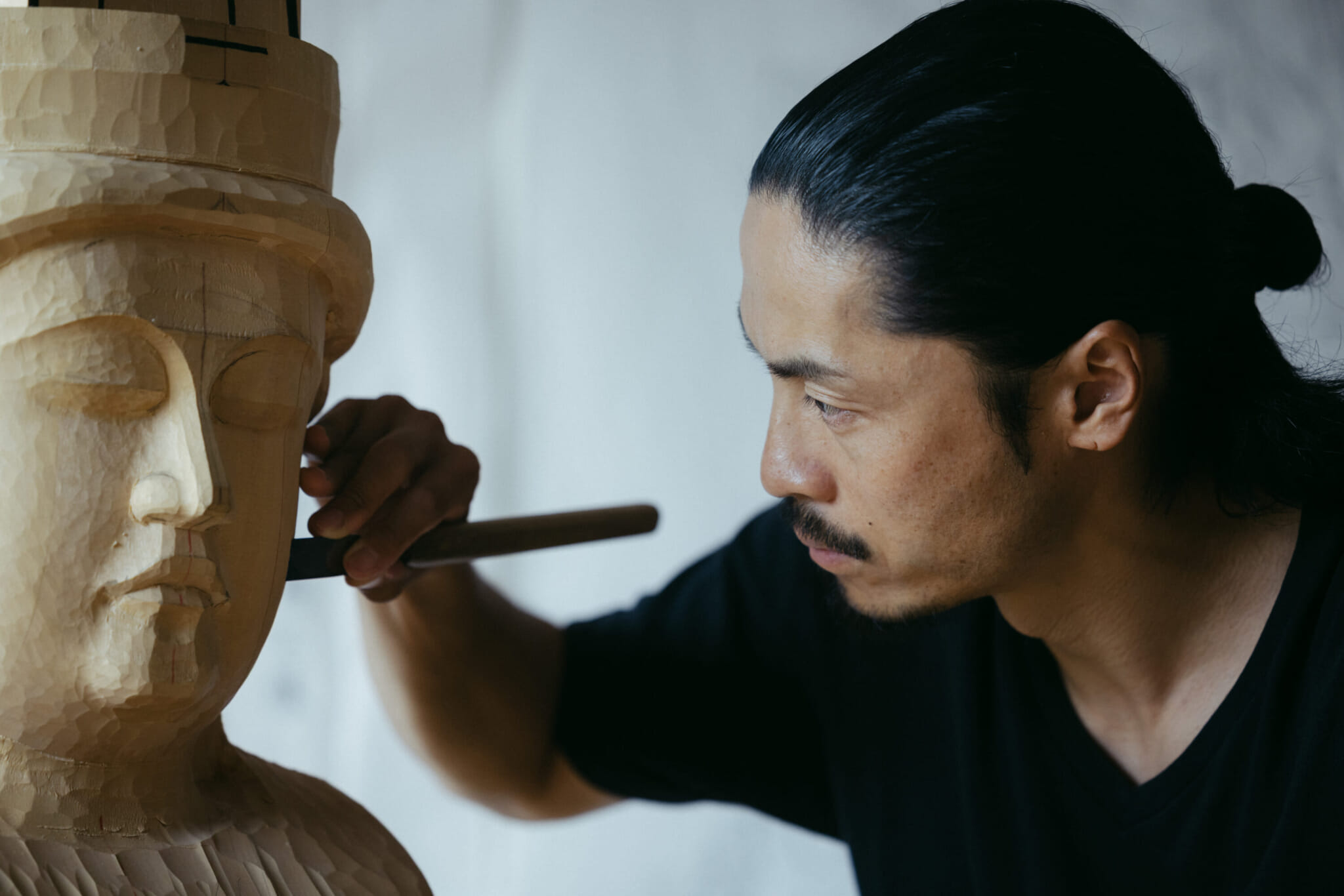
For Kyoto-born sculptor Gakyu Miyamoto, one of the most preeminent busshi in Japan, the ancient art is not only about preservation. It’s about shaping a beauty that will outlast him for centuries through a modern perspective — capturing eternity in a way that resonates in the present.
One Must First Get Lost
Miyamoto was not raised in a religious household, but in Kyoto, spirituality waits in every corner. “Kyoto is the kind of place where you see stone statues of Jizo [a child-protection deity] everywhere you go,” Miyamoto recalls. “In the Kyoto dialect, we call them Manman-chan, and my mother always told me, ‘Manman-chan is watching, so if you lie or do something bad, you’ll get what’s coming to you.’”
As a young boy, Miyamoto loved drawing and building things with his hands. By middle school, he had set his sights on designing clothing. “Even when I was young, I was drawn to becoming a craftsman, and fashion design seemed really cool,” he says. After two years at a university fashion program and three more at a vocational school, he entered the industry as a fashion illustrator, contributing to magazines.
But the shine of the industry quickly dulled. “During university, I already started to feel restricted by fashion and having to appeal to a broad range of modern customers,” he says. Illustration felt freer, but trends moved too fast. “The things you design are outdated in a year.” Restless, he began painting abstract canvases, but that, too, began to feel limiting.
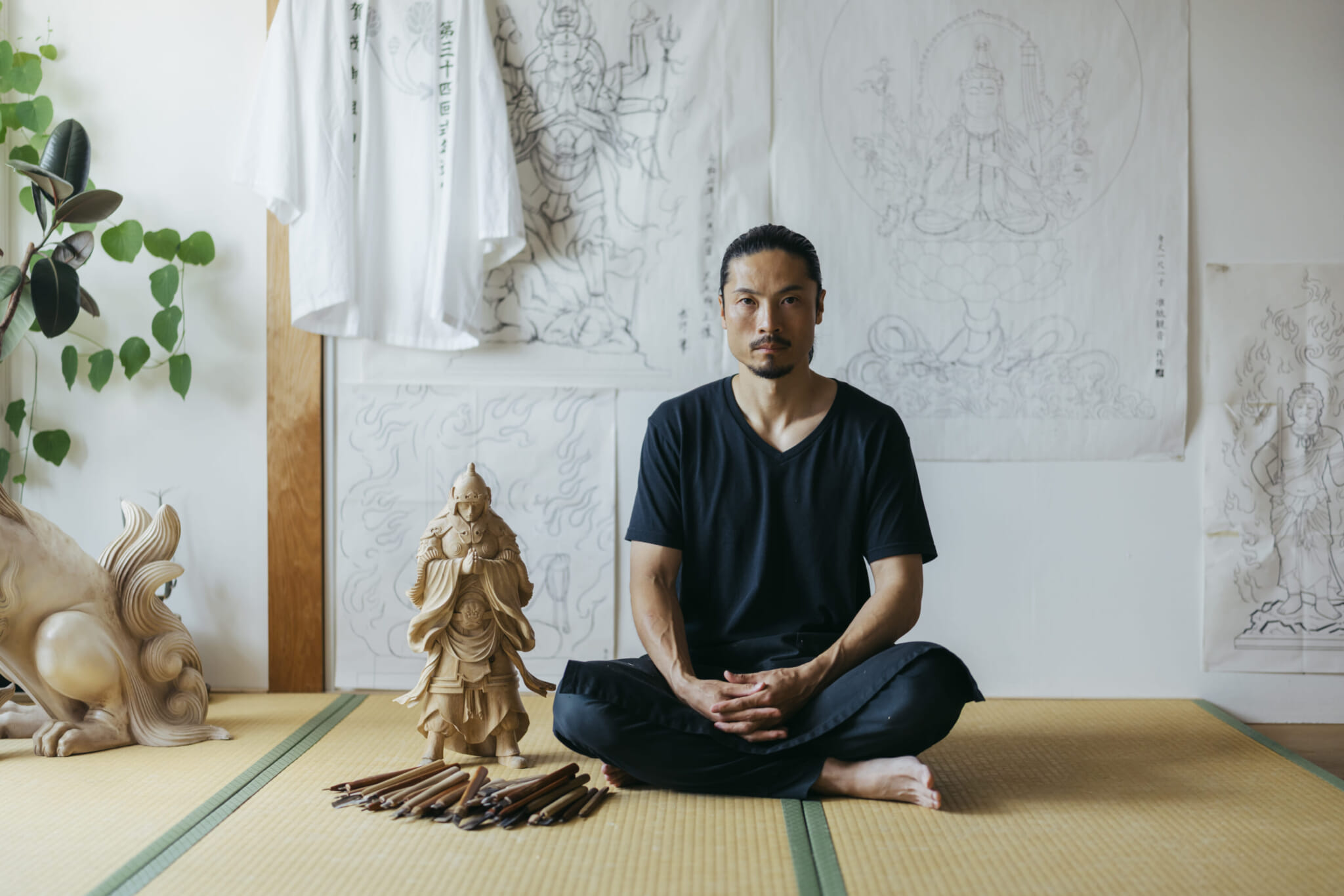
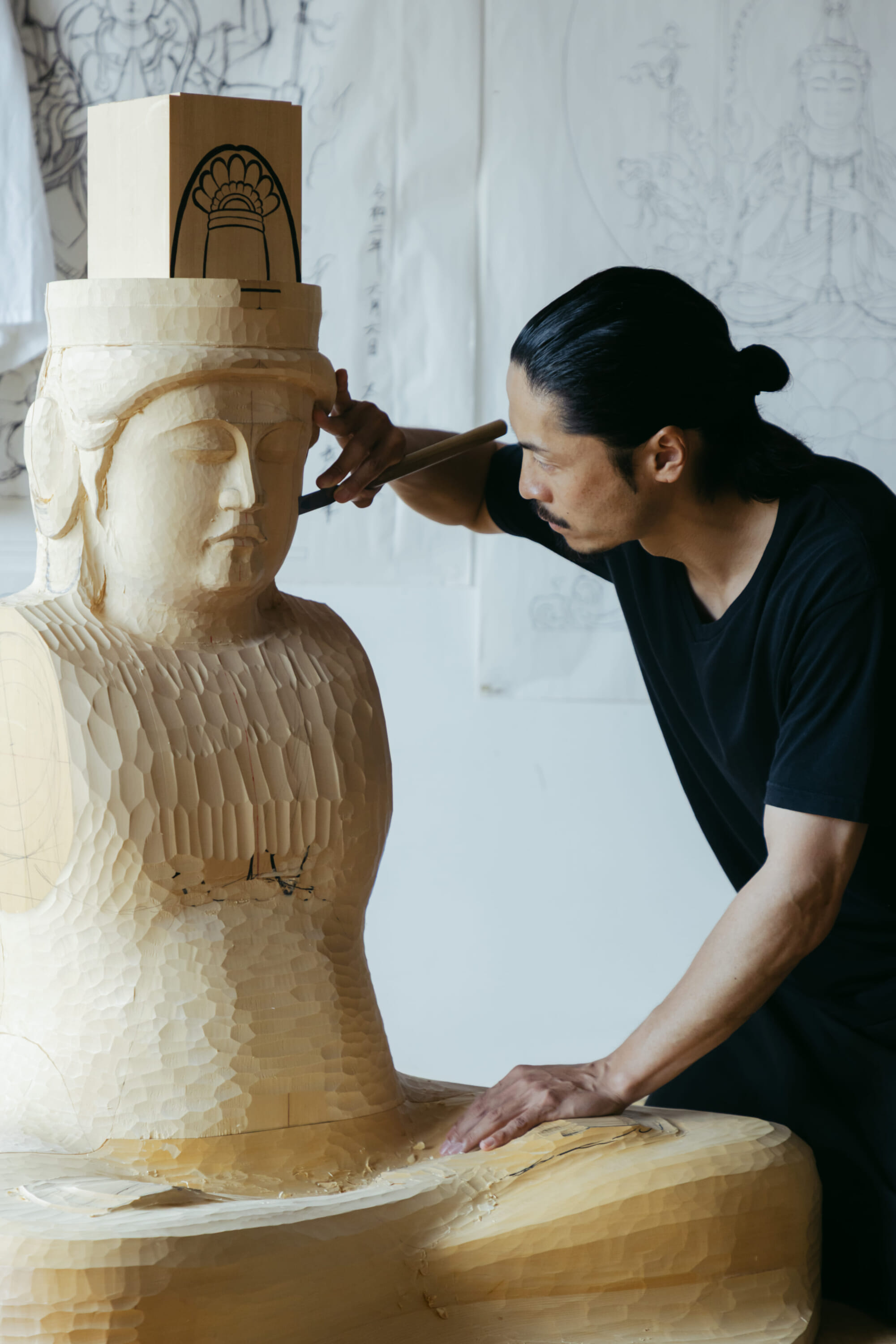
It was then, through his brother’s introduction, that he first entered a sculpture studio. He was there to help paint the robes of a 3-meter-tall statue of a Buddhist goddess. “I thought it would be a good opportunity to see a new world,” he says. But the moment he stepped into the atelier and saw the sculptors immersed in their craft, something clicked.
“I always thought of fashion as something to flatter the wearer, so I spent a lot of time studying the human body. Initially, I thought sculpture and fashion would have nothing in common, but my knowledge of the human body and fabric textures became really useful. Jumping into the world of sculpture, I felt like I connected the dots — I could hear the gears locking into place. I finally found the right path I was supposed to be on.”
Art That Lasts
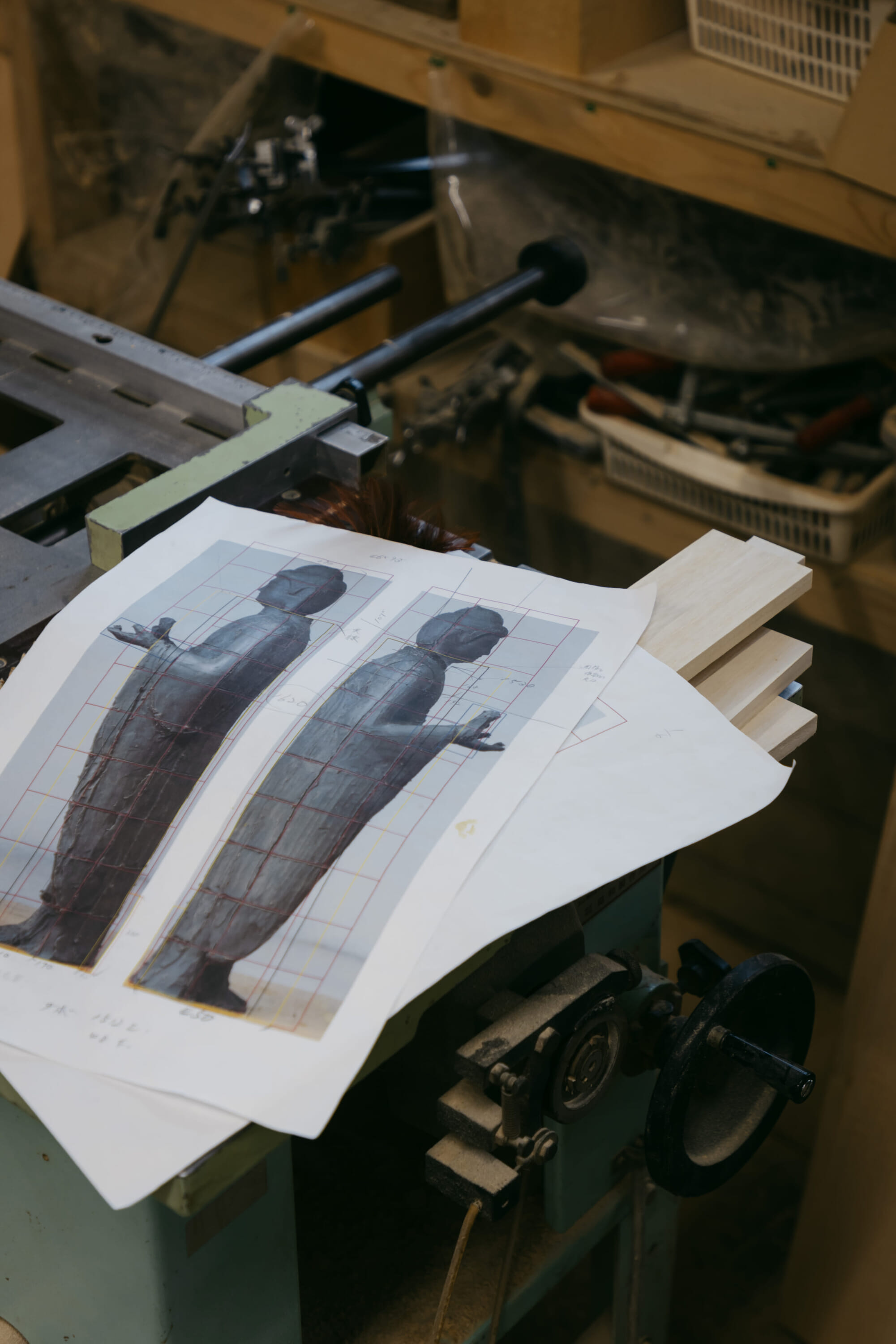
Twenty-five at the time, Miyamoto was considered late to the craft. He managed to find work at the atelier of two brothers in Kyoto; the elder, a busshi, created and repaired Buddhist sculptures, while the younger, an ihaishi, specialized in memorial tablets to honor the spirits of the dead. Miyamoto became their first apprentice, and his days were spent carving tablets and dismantling centuries-old statues for repair. At night, he practiced carving at home, trying to make up for lost time.
“The first thing I did as an apprentice was take apart a 1,000-year-old sculpture to wash it,” he says. “I learned firsthand how these sculptures were made centuries ago.” For a young artist who had grown weary of fashion’s fleeting cycles, the shift was dizzying. “With clothes, trends are fast. With sculpture, you’re making things that last 100, 500, 1,000 years — for a world you’ll no longer be in. The difference in scale was astounding.”
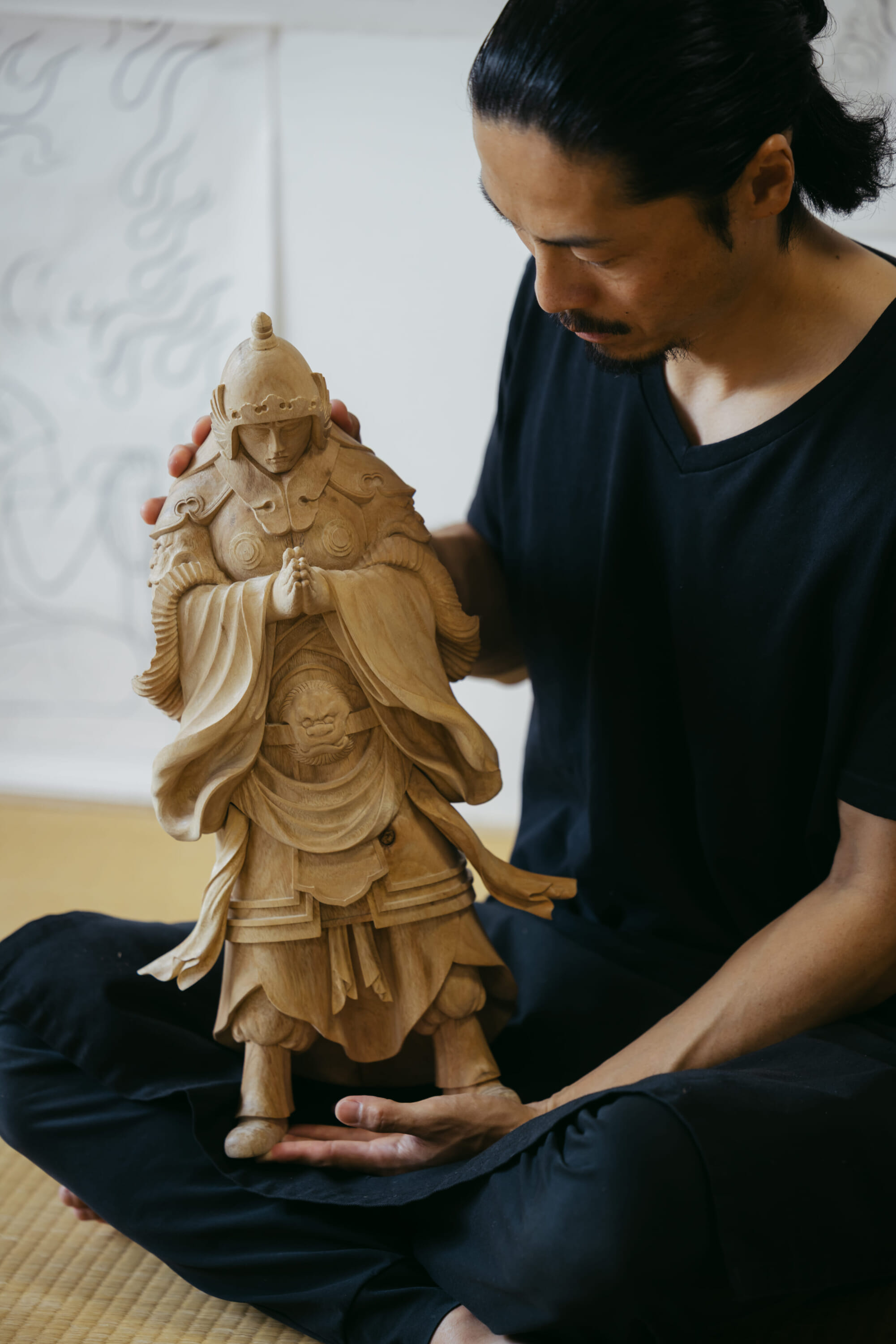
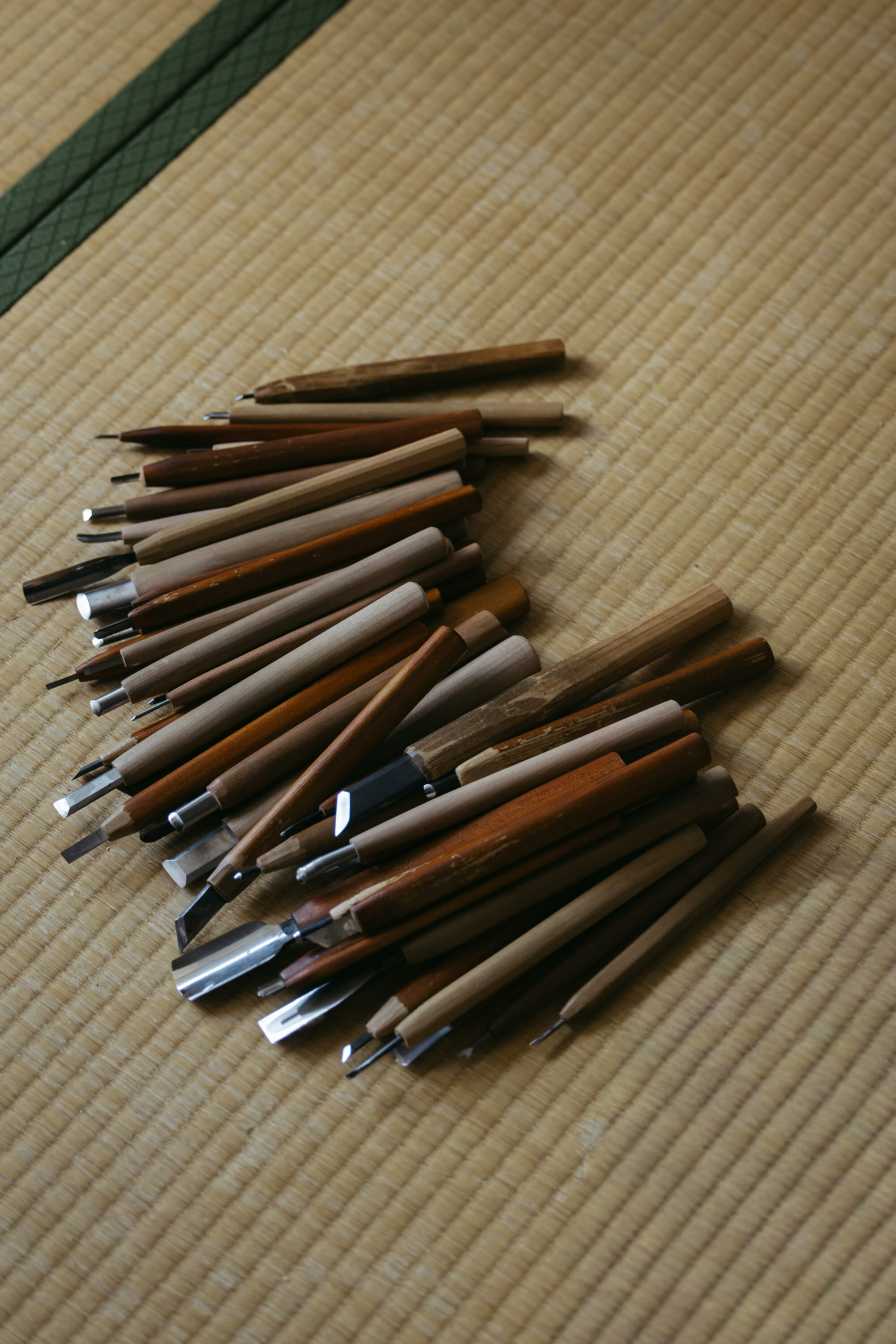
Like all busshi, Miyamoto took on a sculptor’s name: Gakyu. Typically, apprentices will choose a name that’s composed of two kanji characters, with one inherited from their master. Miyamoto broke with tradition. “Usually, you inherit one character from your teacher. When I asked, though, he said my style was so different that I should choose my own name,” he recalls. “I promise I’m on good terms with my masters,” he adds, chuckling.
He chose to combine the kanji “ga” (“self”) and “kyu” (“rest”). “Throughout my training, my teachers told me my ‘ga’ — my sense of self — was too strong, and that it would negatively impact my work. I combined it with ‘kyu’ as a reminder to myself to check my ego whenever someone calls my name.”
Destruction and Creation
After nine years of training, Miyamoto left his masters’ atelier to become independent, setting up his own studio, Miyamoto-kogei, in the Nishiyama area of Kyoto. For nearly a year after leaving, however, he had no commissions. Normally, busshi work on a few large-scale commissions a year, usually from temples or galleries, and these tend to come from personal connections. Having started his own atelier, Miyamoto didn’t have such contacts, and he had to find a way to establish himself.
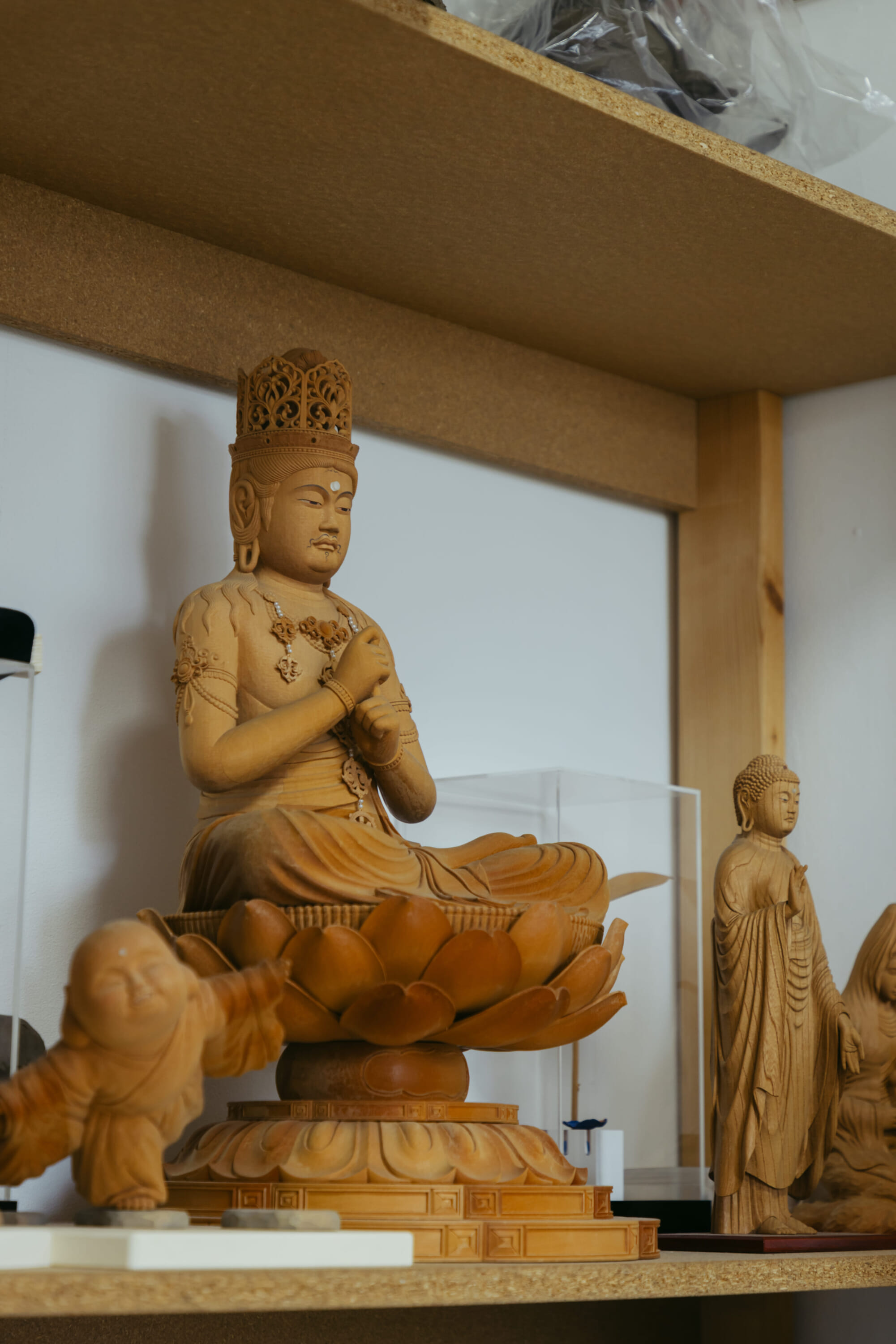
Without paid work, he spent his time creating his own versions of a symbol that every Japanese person would recognize: the daruma. “I happened to have a picture of a daruma from my father in my workshop,” he recalls. “I thought, ‘If I redesign it with a modern twist, people might learn about me.’” He reimagined the traditional doll — round, wide-eyed, its gaze intense yet somehow also sweet-looking — by creating smooth-textured, bushy-browed versions with cartoonish expressions, often balancing miscellaneous objects on their heads.
Then came his first true commission, quite literally born from fire. Just as he was about to put his head down and beg his masters to take him back, a priest approached him. A member of their community’s home had burned down, the priest explained, and he wondered if Miyamoto could make a sculpture from the destroyed house. “Basically everything had turned to ashes, but there was one large pillar where the inside of the wood was still fresh.” The finished piece became both an offering and a memorial, and for Miyamoto, a meaningful first commission that had a domino effect, connecting him to more inquiries.
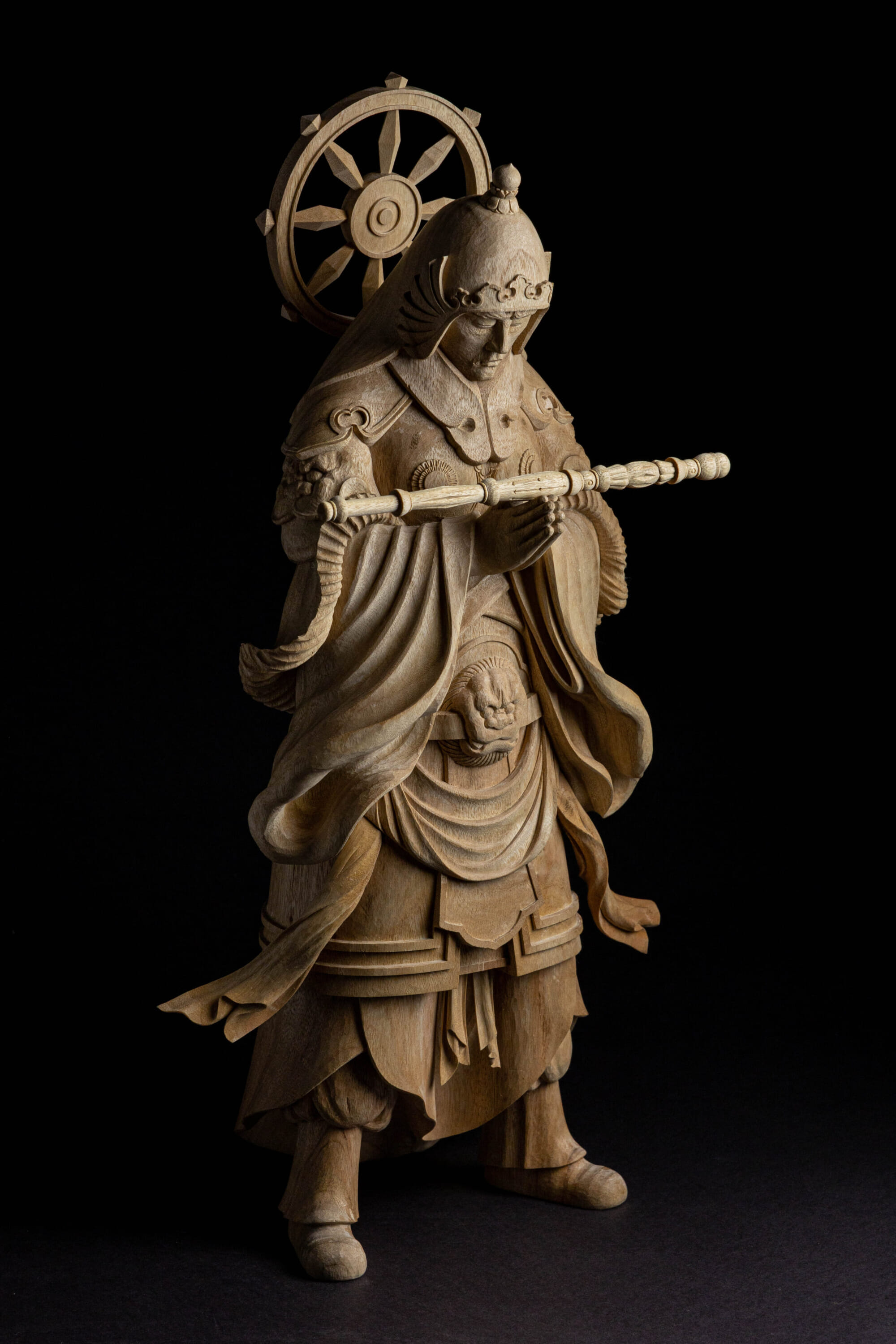
Now, Miyamoto’s works have grown in stature along with his reputation. One of his most significant commissions came just last year from Shimogamo Shrine, a UNESCO World Heritage Site and one of Kyoto’s oldest sanctuaries. The shrine had him create new guardian lion-dogs for the temple — statues that hadn’t been changed in 150 years.
“It was an honor to receive such an important inquiry from a shrine that’s so well-known,” Miyamoto says. The resulting creations stand sentinel at the entrance, embodiments of power and protection, but also of continuity, linking the 2,000-year-old shrine to the hands of a living artist.
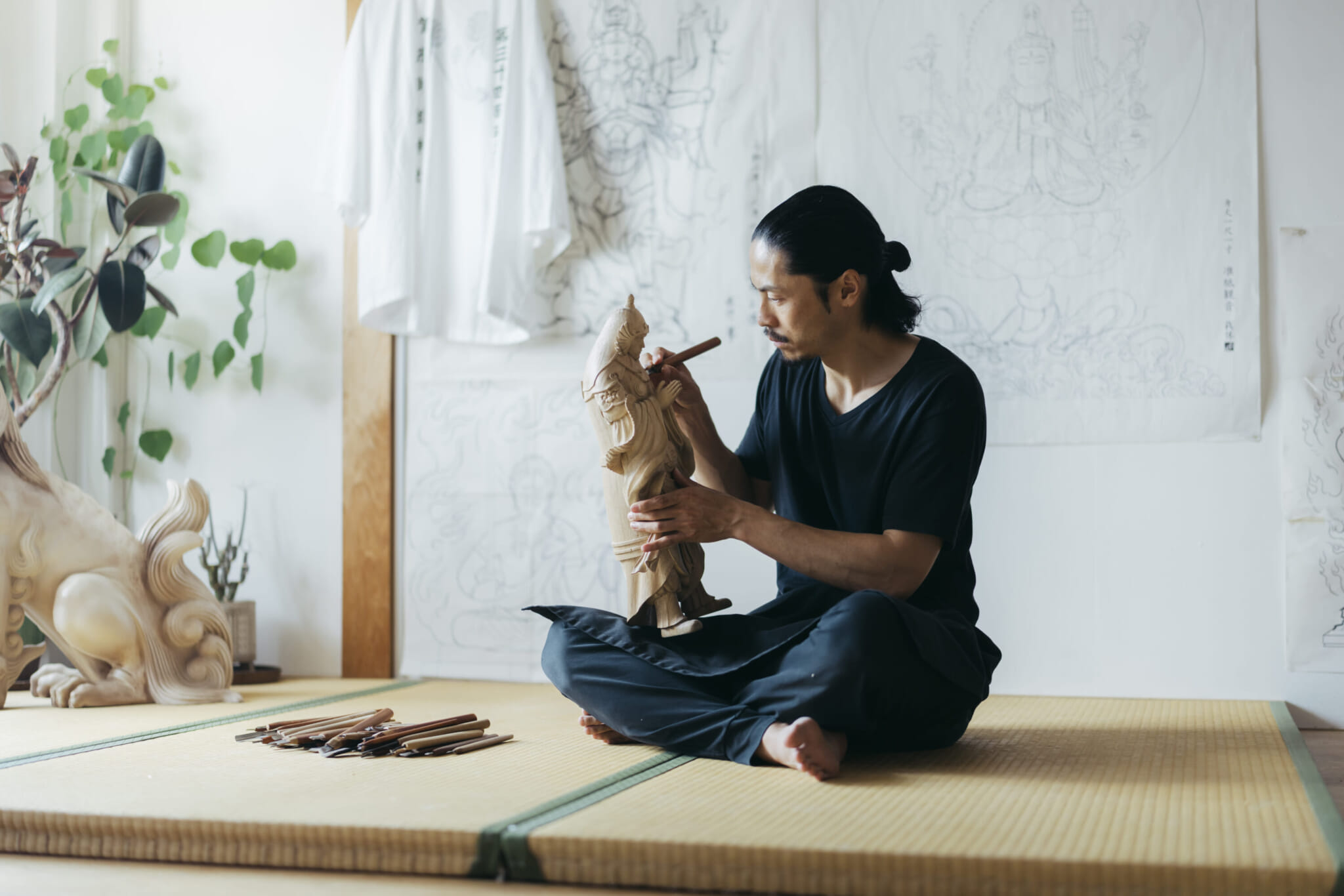
Repair work is also central to Miyamoto’s practice, a process that requires not only technique but discernment. Sometimes statues are restored to appear as they once did; other times, their aged patina is preserved as part of their story.
Today, he handles sacred statues from Kiyomizudera and Nanzenji — temples that draw millions of visitors a year. “I still get really nervous handling ancient sculptures,” he admits with a laugh. “If my skills aren’t up to par with the original creator, it won’t come out properly. It’s a different kind of responsibility than making something from scratch.” For Miyamoto, the process of repair is an act of reverence and humility before the hands that carved it centuries ago.
Space for Self-Expression
Over time, Miyamoto’s perspective on the role of the artist has evolved. “I’ve come to believe that sculptures also require self-expression,” he says, citing medieval masters Unkei and Kaikei, who respected tradition but also developed distinct styles that were revolutionary at the time. “It’s important to honor the traditional method, but also to be conscious of modern beauty and how your own expression fits within it. I’ve come to think that ‘ga’ is actually quite valuable.”
Even if you try to suppress your individuality, he’s found, it will find its way into your work somehow. “Human sculpture is like a looking glass — the emotions you’re having are reflected in the sculpture. So I try to work on the kind of piece that reflects my current mood. For example, I often work on kind-looking Jizo or animal sculptures on Sundays, after I’ve spent time with my two toddlers.”
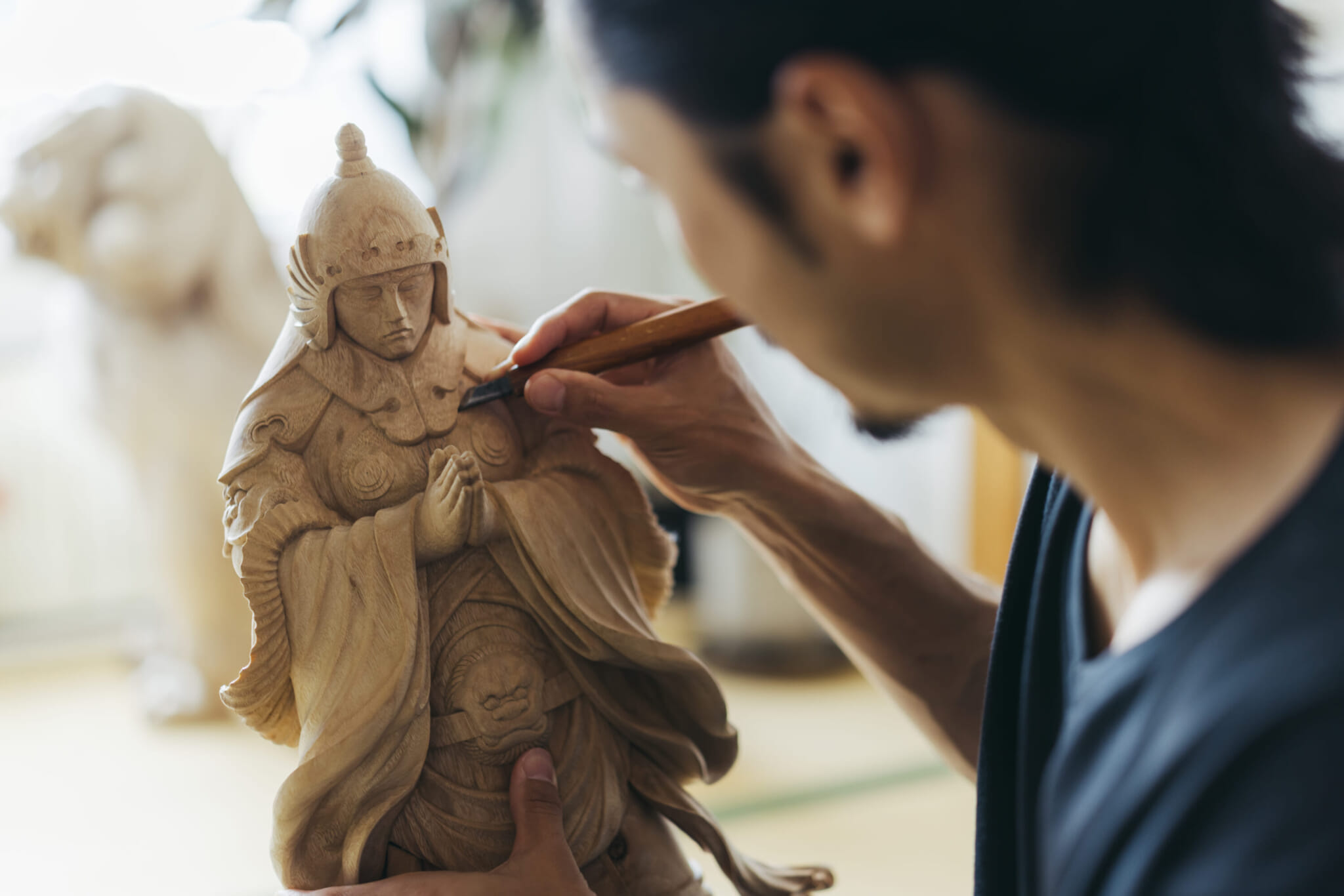
For all his accomplishments, Miyamoto speaks most passionately of a dream not yet realized: the creation of a shikou no shinbutsu — a supreme deity, one that possesses a true sense of the divine. “To me, that’s a piece that’s loved 1,000 or 2,000 years from now, as well as in the modern day,” he says. “A sculpture with a universal, unchanging beauty.”
In order to reach that goal, he believes, one must constantly oscillate between past, present and future. “To get a glimpse into the future, you first have to learn about the past. I learn about the past from repairing works, and I try to connect with the modern audience to figure out what resonates right now.”
Miyamoto’s sculptures carry a multilayered balance within them: tradition and individuality, reverence and playfulness, stillness and expression. Each gives form to something formless, inviting admiration and reflection — on the nature of the divine, on devotion, on what it means to create something meant to outlast one’s own life.
More Info
To learn more about Miyamoto’s work, visit his website.