
A small-town bakery in a world populated by humans and anthropomorphic animals. All seems well at first glance. But then you see it. One of the loaves of bread has limbs and a face. A shifty-looking face that scopes out its surroundings and, after confirming that the coast is clear, bolts out the door carrying its bread brethren. But it’s not a loaf of bread at all. It’s a mouse in a bread costume. The bakery has just been hit by the Pan Dorobo (Bread Thief).
That’s the teaser trailer for the upcoming Pan Dorobo anime, which was viewed nearly 320,000 times in its first four weeks. Set to premiere in October, the anime is the latest stage of a Bread Thief mania that’s been sweeping Japan. Why is the country obsessed with the story of a thieving rodent? Let’s find out.

“Pan Dorobo” author Keiko Shibata at a fan club event in Tokyo | Image courtesy of PR Times
Rise of the Bread Thief: Decoding Japan’s Pan Dorobo Mania
Pan Dorobo started out as a children’s picture book by Keiko Shibata and was an instant hit. After Kadokawa published the first volume in 2020, the Bread Thief series sold over 3 million copies by 2023, a figure that soared to 4.5 million in 2025. The franchise is currently the best-selling Japanese children’s book series of the Reiwa period (2019–present).
On the Border of Kawaii and Neo-Kawaii
But despite being a recent phenomenon, Pan Dorobo has an old-school quality to it — like a 20th-century classic that’s never gone out of style. It’s the very definition of cutesy and timeless, two important characteristics of a global trend known as “neo-kawaii.” Its final and arguably most important element? An adult edge.
Neo-kawaii is an evolving concept, but in a nutshell, it’s an attempt to expand the idea of “cuteness” beyond its original inoffensive and harmless boundaries into more adult territory like irony, fashion and real-world issues. Examples include the Bearbrick and Labubu collectibles: toy-like figures embraced by adults that blend childlike aesthetics with art and expressions of personal identity. Pan Dorobo isn’t fully in that category; its primary audience is kids. But adults are definitely responding to it, possibly because of the tongue-in-cheek centering of theft as the book’s main theme.

A page from the picture book “Pan Dorobo vs. Nise Pan Dorobo” | Image courtesy of PR Times
More Than Just Half-Baked Crime Fantasies
The titular Bread Thief does ultimately reform and go straight, but later books introduce other costumed bandits. This presents readers with a form of cozy escapism: a world where the main characters are technically criminals, yet the stakes remain low and the tone firmly comedic. The crimes are silly, bloodless and correctable, framed more as mischievous antics than genuine wrongdoing. It’s not surprising that such themes would find an adult audience in Japan’s strict society, where even not turning over small amounts of found money to the police is technically a crime: embezzlement of lost property.
To be clear — none of the Pan Dorobo books celebrate stealing. There is absolutely no suggestion anywhere in them that theft is admirable or consequence-free in real life. At the same time, the stories aren’t rigid morality tales either. Rather than delivering heavy-handed lessons, they invite readers to enjoy the thrill of rule-breaking — without endorsing it — in the safe environment of make-believe. It also helps that the Bread Thief doesn’t steal out of hunger (because that would have been a whole other can of worms) but rather out of LOVE.
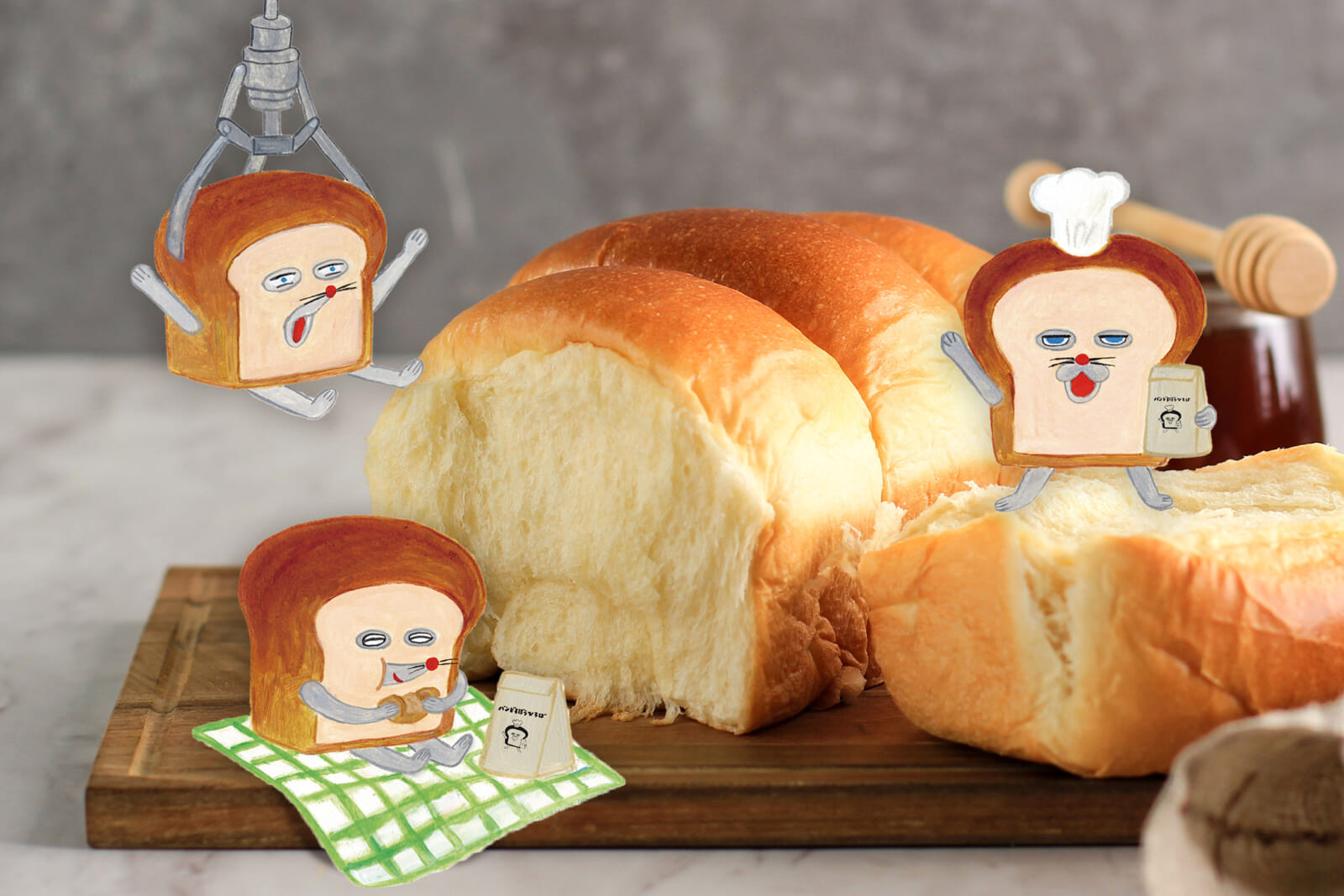
Pan Dorobo loves “shokupan” milk bread | Source image courtesy of PR Times, edited by Aya Sato
Bread: The Language of Love
One of the most frequently seen depictions of the character in merchandising — which is aimed as much at adults as at kids, with bags and other accessories — is the Bread Thief with his eyes closed, a look of utter serenity on his masked face, hugging a piece of bread. This is the key to understanding the crossover appeal of Pan Dorobo: It all starts with bread.
Bread has been eaten widely in Japan since the Meiji period (1868–1912), but it has absolutely exploded in popularity in the 21st century. The Japanese bread market is worth nearly ¥2 trillion. In one survey, close to 50% of respondents said they ate bread almost every day. But as you may know if you’ve lived in the country, Japanese bread is a little different from the Western variety.
The latter is relatively easy to find here, but the kind that Japanese people like the most is soft, fluffy and moist, like shokupan milk bread, which some foreigners describe as almost cake-like. But while not everyone agrees that Japanese bread is “real” bread, they can’t deny that it’s really great comfort food. It’s easy to see how, in a country like Japan, bread could become a symbol of, well, joy.
The Bread Thief taps into those feelings. When reading the books, kids see a funny mouse in a funny costume engaging in some pretend mischief, and adults enjoy that as well. But underneath that, they may also feel the Bread Thief’s open, unrestrained LOVE for soft, warm, delicious bread. The character, whether intentionally or not, embodies a refreshingly unashamed passion for the small pleasures of life, and adults instantly respond to it because it’s the little pleasures that keep us going.
Put it all together, and you have a character that appeals to both younger and older readers, giving them joy, laughs, a warm, fuzzy feeling inside and a kind of social release valve. The success of Pan Dorobo was basically guaranteed the moment the first book hit the shelves.