
Shuzo Hamachi is unusually tall for someone who works with diminutive trees. At nearly 2 meters, he dwarfs the bonsai he trims, tends and studies each day in his Fukuoka studio. The scale is inverted: an artist of stature devoted to the discipline of miniature worlds.
Bonsai traces its origins to the ancient Chinese art of penjing, which typically composes miniature landscapes from multiple elements — rocks, water and trees — to evoke the vastness of nature within a tray. When the practice reached Japan during the Heian period, it gradually narrowed in focus: the landscape distilled into a single tree, a symbol standing for an entire environment. Over centuries, this shift produced a discipline shaped by proportion, restraint and formal balance. To depart from those conventions was to challenge the order of the craft itself.
Hamachi’s work begins at that point of tension.
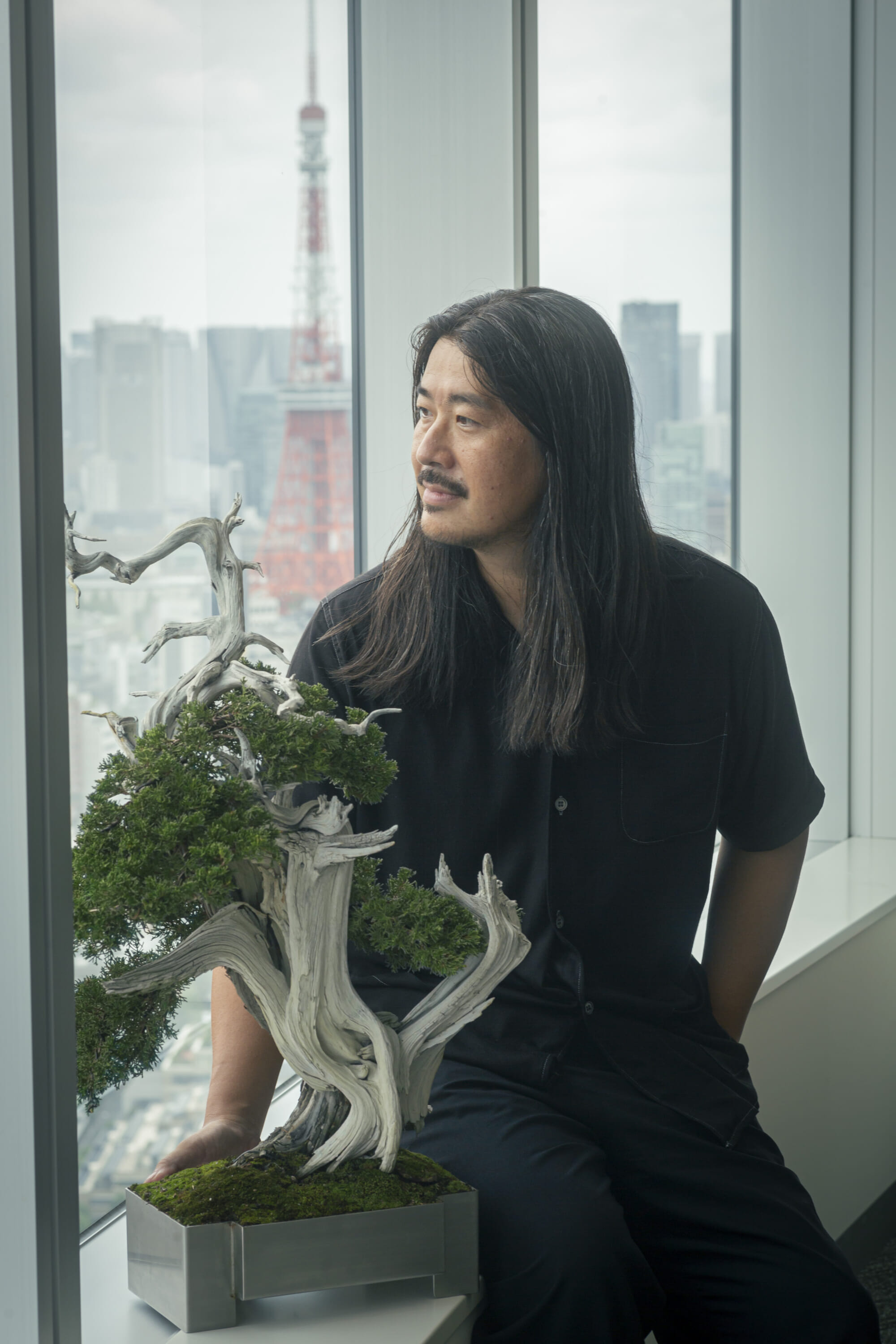
Philosophy in Form
Born in Kamakura, a coastal city in Kanagawa, Hamachi grew up among salt air and low mountains. His father had settled there after university in Tokyo, drawn by its close-knit seaside community and slow-living ease. In their garden stood a single bonsai. It died after a few years, but something about it stayed with him.
For years, bonsai drifted to the periphery. He sold cars, then started his own business. Then, at age 36, he reconnected with a former classmate, the bonsai artist Isao Tokunaga. He began experimenting with plants, and his initial curiosity quickly bloomed into a study of balance itself — not only in the trees, but in the structures that sustain them.
In Japan, bonsai remains a hierarchical world, with six-year apprenticeships and closed associations governing who may call themselves professional. Hamachi entered from the margins — guided by his mentor Tokunaga, but without the sanction of a lineage. That freedom shaped his sensibility.
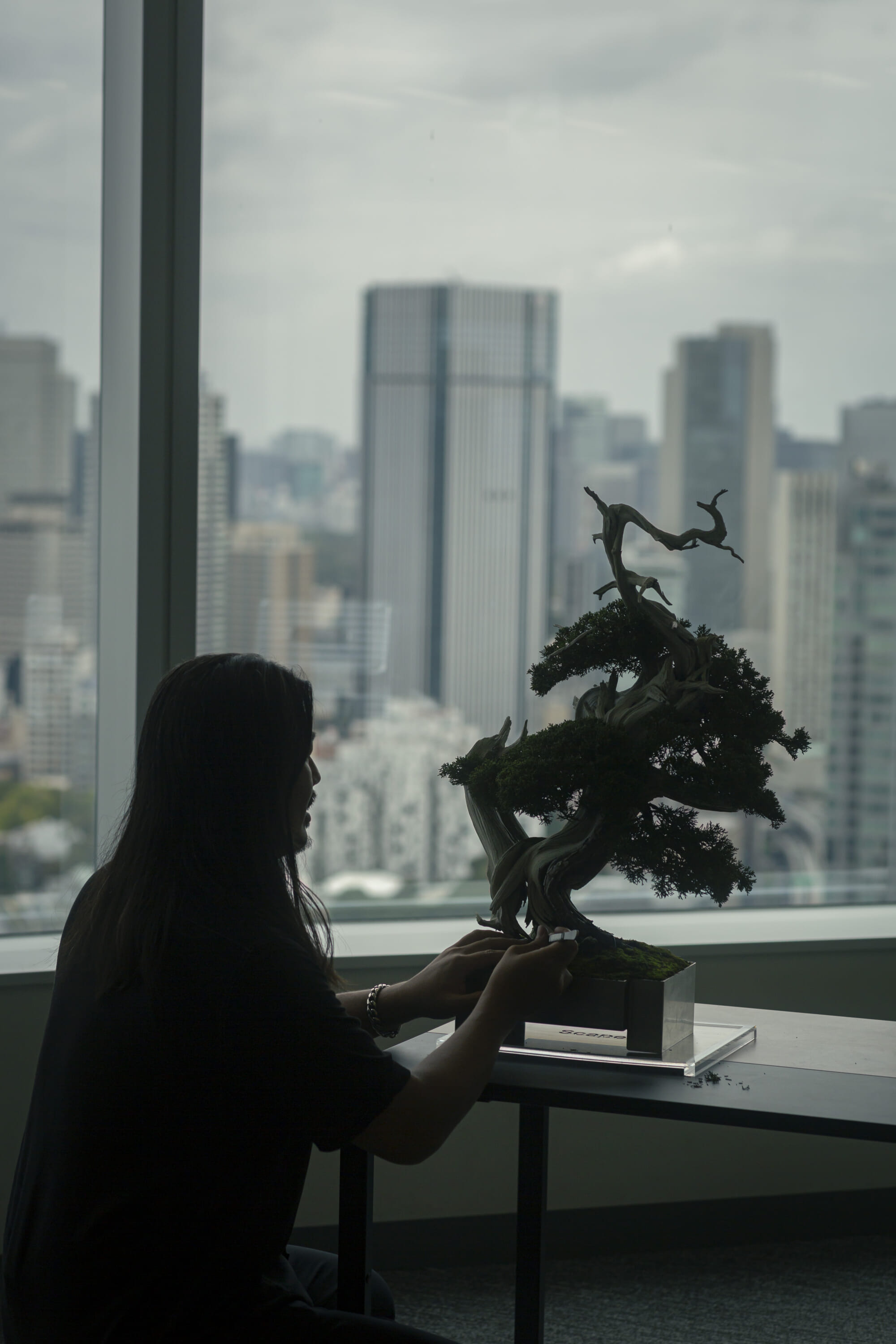
Traditionally, bonsai artists practice hachi-awase: the careful selection of a pot that harmonizes with the shape, size and character of the tree. Often, the selected pot is an antique ceramic vessel prized as much as the tree itself. Hamachi’s approach is different. In his studio, trees rest in gleaming stainless-steel vessels that catch light like mirrors. The effect is precise but not cold, the organic vitality of the tree meeting the engineered clarity of its container. “When those two sensibilities meet — the natural and the industrial — they balance each other,” he says. “It feels right for our era. A hint of warmth amid the concrete jungle.”
The decision was practical as well as aesthetic: “Some trees grow horizontally, almost lying down,” he explains. “A light ceramic pot would just topple over. Urban materials like metal, steel and acrylic let you control mass.”
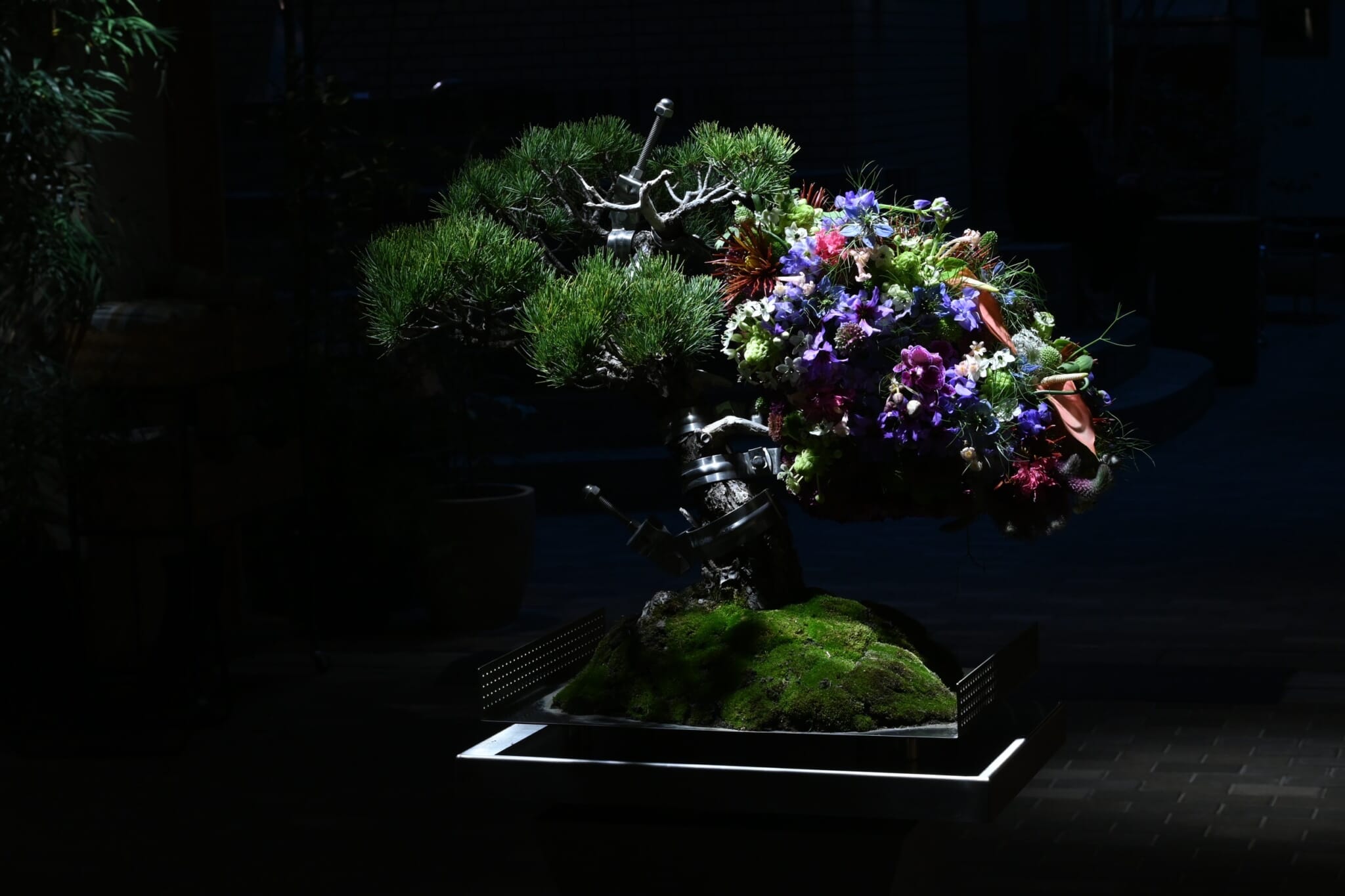
Reshaping Tradition
For Hamachi, this opened a larger question: what counts as bonsai at all. “I call what I do reconstruction,” he says. “It’s not just about trimming branches — it’s about designing the pots, the fixtures, the whole environment. If someone wants to cut a baseball in half and plant a bonsai in it, that’s perfectly fine.”
To purists, such freedom once bordered on heresy. Bonsai has long been treated as a high craft, its methods preserved with almost religious care. Hamachi’s openness reframes it as democratic and playful — an art form meant for daily life rather than mere display. “To me, reconstruction means breaking down that wall,” he says. “Tradition doesn’t need protection behind glass; it needs participation.”
This is the core of his philosophy: not rejecting tradition, but reshaping its conditions for survival. “Even a decaying tree, even an unfinished tree can be beautiful,” he says. “Just because something’s been ignored doesn’t mean it isn’t worth seeing.”
Two of his compositions, Sosei and Issen, make that idea visible. In them, he threads short-lived cut flowers through a centuries-old tree, letting one element blaze and vanish within days while the other endures for generations. The friction is the point: ephemera against longevity, bloom against bark.
“Bonsai is grown through time,” he says. “The short-lived works dazzle because they’re fleeting; the long-lived have weight and dignity. Together, they carry both meanings — the finite and the continuous. That mixture of time scales is part of my signature style.”
For Hamachi, bonsai is a way of thinking about time — and about the responsibility that time demands. Some of his trees are centuries old, passed through many hands before his. “They’ll live far longer than I ever will,” he says. “In that timeline, I’m just a baby. Each tree carries its own history — it’s endured, struggled, broken and still reached for the light.”
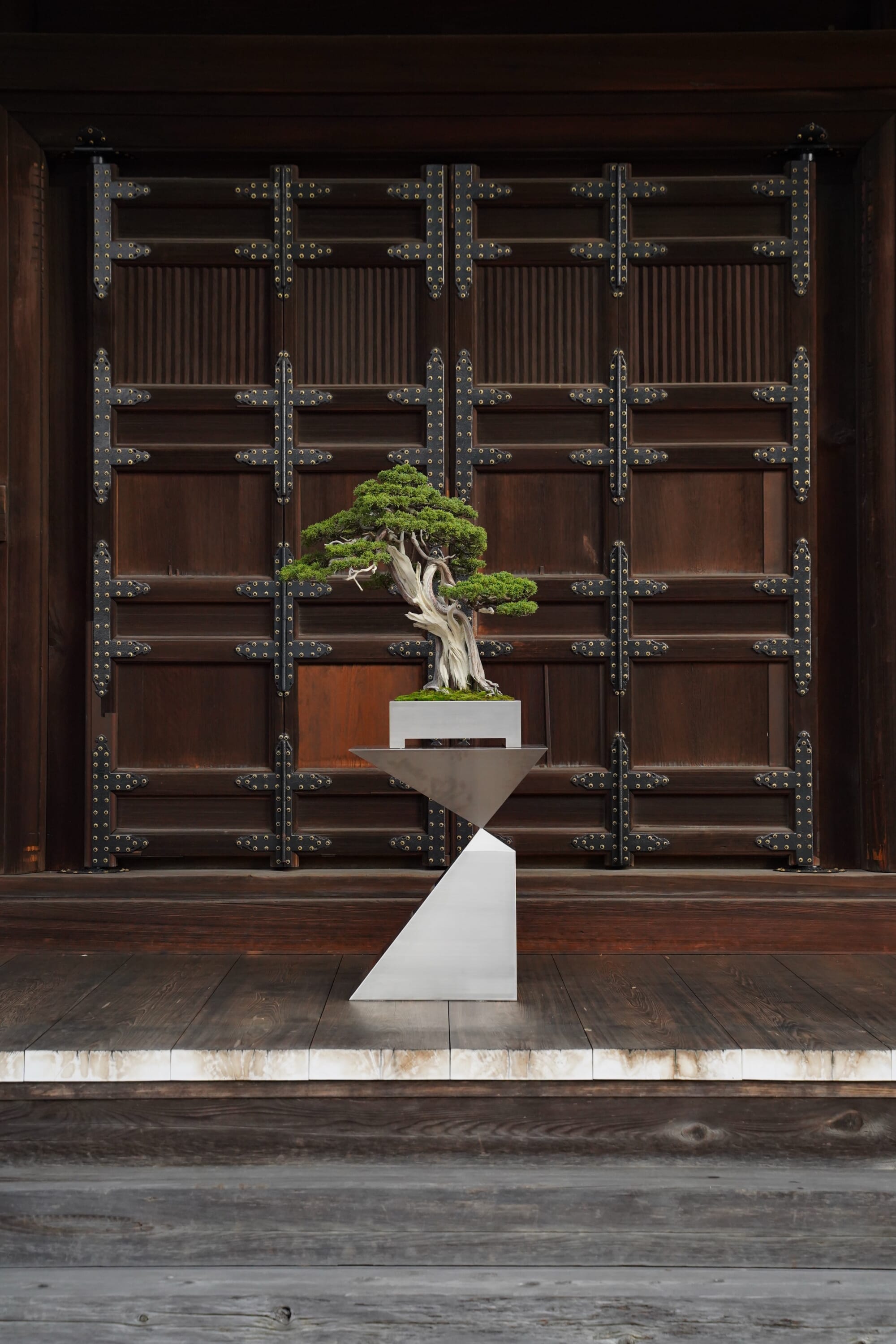
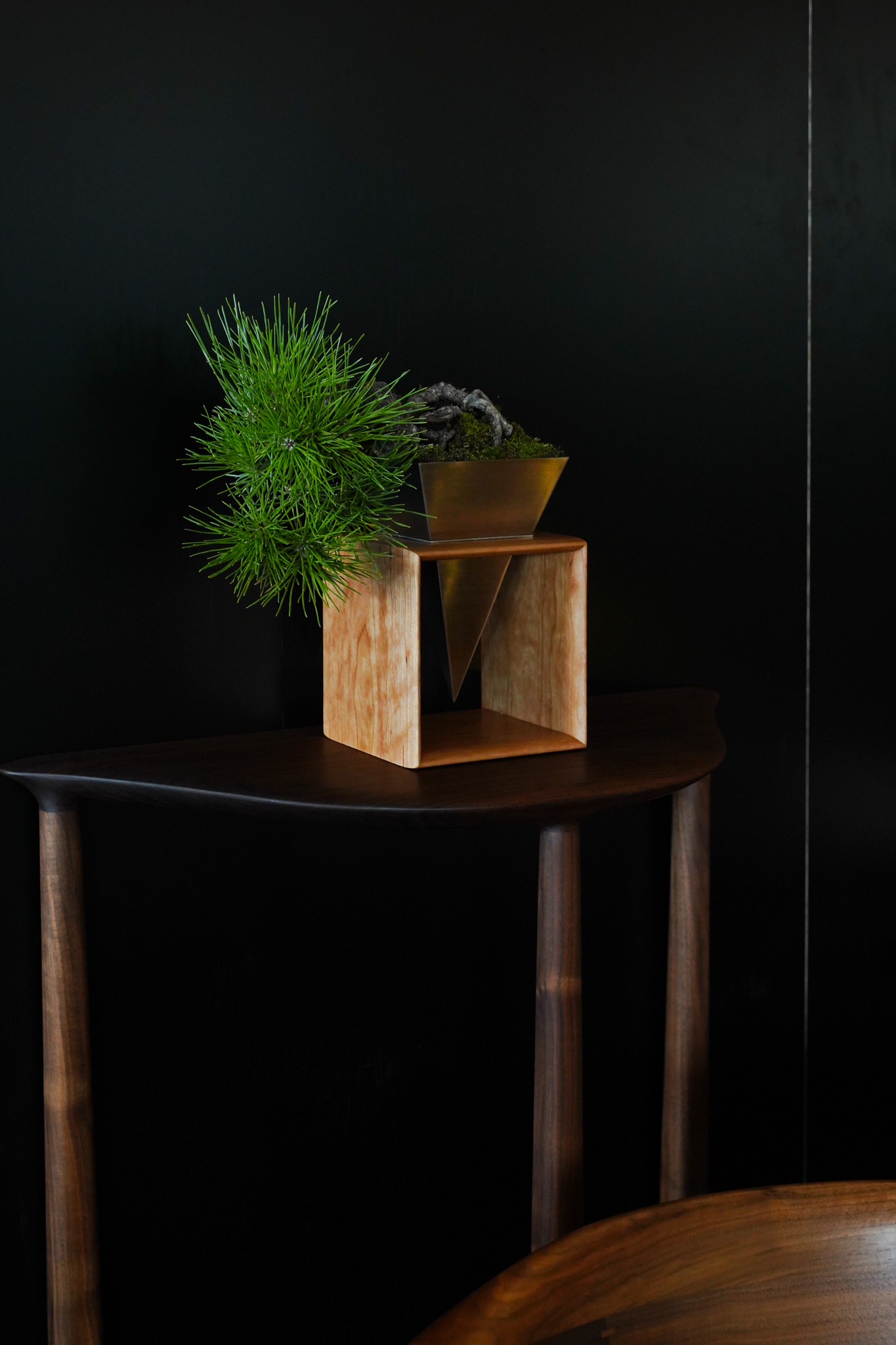
Scapes: A Living Gallery
The idea of reconstruction extends beyond his trees. In Fukuoka city’s Hakata ward, Hamachi runs Scapes, a studio that functions as gallery, workshop and caretaker’s bench. People from all generations come to buy bonsai, learn how to keep them alive or leave their trees in his care while they travel. Others stop in simply to sit, drink tea and talk. “I wanted a place anyone could walk into,” he says.
That openness carries through to his collaborations. Hamachi works with metalworkers, architects and ceramicists, who bring new materials and sensibilities to his creations. One of his current projects pairs him with Hataman Touen, a renowned Imari kiln. Together, they’re developing new bonsai pots that reinterpret Nabeshima ware, an Edo-era porcelain style known for its geometric patterns and restrained palette.
He’s also participating in a much more unusual collaboration with researchers at Kyushu University, who are analyzing the mathematical rhythms of his compositions: the ratios between trunk and branch, the spacing of negative voids, the asymmetries that still read as balance to the human eye. The approach treats bonsai as perceptual architecture — a form whose harmony can be described, studied and measured, not only intuited.
Hamachi himself is drawn to digital preservation — the idea of using blockchain or similar systems to document bonsai. “Not for money,” he clarifies, “but for history.” A living database, he suggests, could record each tree’s lineage — its owners, exhibitions, transformations — safeguarding knowledge often lost to private collections. “Some of these trees have lived for centuries,” he says. “But their stories disappear with their owners. That’s the real loss.”
Taken together, these efforts describe the scale of his ambition. Hamachi isn’t just refining bonsai. He’s rebuilding the ecosystem around it — how it’s displayed, how it’s taught, how it’s measured, how it’s remembered. “The craft, the setting, even where people encounter bonsai — all of it can evolve,” he says. “I want it to feel as natural as saying, ‘I like to draw.’ To let people touch it, enjoy it, make it part of life.”
More Info
Follow Hamachi on Instagram.