On this day in 1932, 11 naval officers stormed Prime Minister Tsuyoshi Inukai’s residence and assassinated him in what became known as the May 15 Incident. The plot, which also included plans to kill Charlie Chaplin during his visit to Japan, aimed to spark an uprising against political and business elites. Though the revolt never materialized, the assassination marked a turning point, accelerating the decline of party politics and strengthening military influence.

Tsuyoshi Inukai (left), Keisuke Mochizuki (middle) and Fusanosuke Kuhara (right) | Image courtesy of Wikimedia Commons
Background to the May 15 Incident
The attack was the culmination of years of deepening political unrest, economic instability and rising militarism. While some historians trace the roots of this instability to the aftermath of the Great Kanto earthquake, which strained the economy and unsettled society, a more immediate turning point was the 1927 Showa Financial Crisis. Triggered by bad loans, the crisis brought down the government of Reijiro Wakatsuki and weakened confidence in the banking system while strengthening the influence of the zaibatsu — the industrial and financial conglomerates of pre-World War II Japan.
Two years later, the Wall Street crash caused a collapse in global trade, devastating demand for Japanese raw silk and plunging the country into the deep Showa Depression. Rural communities were hit particularly hard, with falling incomes and widespread hardship in northern regions. Beyond the economic damage, the crisis eroded faith in democratic governance. Politicians were seen as beholden to large corporations, while people in rural areas felt abandoned by the state.
In 1930, the Japanese government, led by Osachi Hamaguchi, was a full signatory to the London Naval Treaty alongside the United States and the United Kingdom, agreeing to limit naval armaments despite strong opposition from senior officers in the Imperial Japanese Navy. Critics argued that the treaty infringed upon the emperor’s supreme command authority. In November of that year, Hamaguchi was shot at Tokyo Station by a member of the ultranationalist Aikokusha group. He succumbed to his wounds nine months later.
The Invasion of Manchuria and the League of Blood Incident
Hamaguchi’s death further weakened civilian leadership, creating an opportunity that military factions were quick to exploit. In September 1931, the Japanese Kwantung Army staged the Mukden Incident — also known as the Manchurian Incident — acting largely without authorization from Tokyo. To justify the invasion of Manchuria, they detonated a small charge on a railway near Mukden (modern-day Shenyang) and blamed Chinese dissidents. Fueled by intense nationalism and a widespread belief that control of Manchuria was vital to Japan’s economic security, the army’s actions were met with broad public support.
At the same time, ultranationalist violence was intensifying within Japan itself. The League of Blood Incident in 1932 marked a significant step in this trend, as extremists turned to assassination to reshape the nation’s political order. Masterminded by self-styled Buddhist preacher Nissho Inoue, the Ketsumeidan (Blood Brotherhood) — a group of civilian right-wingers and young farmers — aimed to kill 20 moderate political and business leaders to eliminate corrupt, Western forces and restore power directly to the emperor.
In the end, they murdered two people: Junnosuke Inoue, a former finance minister and head of the Rikken Minseito (Constitutional Democratic Party), and Takuma Dan, director-general of Mitsui Holding Company. Although the plot fell far short of its intended targets, the attack set a dangerous precedent by normalizing assassination as a political tool. This logic of violence resonated with radical young military officers, helping set the stage for the assassination of Inukai in the May 15 Incident.

A page from Asahi Shinbun newspaper reporting on the May 15 incident | Image courtesy of Wikimedia Commons
The Assassination of Tsuyoshi Inukai and the Plot To Kill Charlie Chaplin
Inukai was at his Tokyo residence when a group of young naval officers and army cadets broke in and shot him. According to widely reported accounts, he attempted to reason with the attackers, famously saying, “Hanaseba wakaru” (“If I could speak, you would understand”). However, the assailants reportedly responded with “Mondo muyo, ute” (“discussion is useless, shoot”) and took his life before any meaningful exchange could take place.
The insurgents also launched a series of coordinated attacks across Tokyo, targeting the headquarters of the political party Rikken Seiyukai (Association of Friends of Constitutional Government) and Mitsubishi Bank, as well as several electrical transformer substations to disrupt infrastructure and communications. They also struck the residence of Nobuaki Makino, the Lord Keeper of the Privy Seal and a key figure in the imperial court, though he escaped injury. The attacks were intended to spark a broader uprising that never materialized.
Another intended target was Charlie Chaplin. He arrived in Kobe on May 14 during a round-the-world tour and soon traveled to Tokyo, where Inukai’s secretary invited him to a welcome reception. Naval officer Kiyoshi Koga believed that killing him in the presence of senior politicians could provoke a war with the United States, despite Chaplin being British. At the last minute, however, the comic actor and filmmaker changed plans and went to watch sumo with Inukai’s son. The decision likely saved his life.
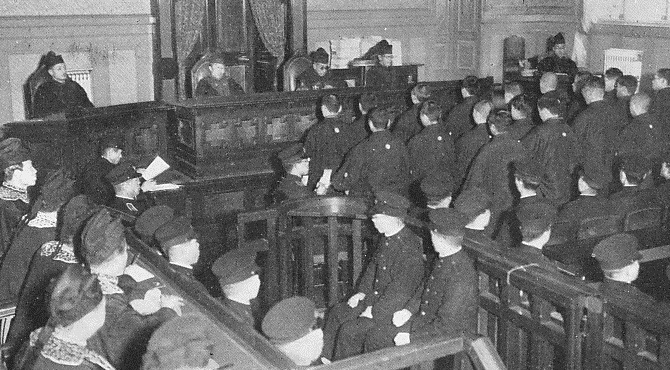
Trial of the civilian activists accused of aiding May 15 Incident | Image courtesy of Wikimedia Commons
A Turning Point in Japanese Democracy
While the overall plot to take over the government failed, historians view the May 15 Incident as a pivotal turning point that effectively ended Japan’s Taisho-era parliamentary democracy. Power shifted from party politicians to a “national unity” cabinet dominated by bureaucrats and military leaders. The new government, led by Navy Admiral Makoto Saito, was seen as a compromise intended to prevent a full military takeover, with backing from elder statesman Prince Saionji Kinmochi.
Under Saito’s administration, Japan recognized the state of Manchukuo and later withdrew from the League of Nations. In November 1933, the May 15 conspirators were sentenced following court-martial proceedings. The tribunal received more than 110,000 petitions, along with widespread public appeals calling for leniency. The attackers were openly hailed as patriots by many, reflecting the extent to which their actions had resonated with nationalist sentiment. They received relatively light sentences ranging from one to 15 years in prison.
The leniency reinforced growing concerns among civilian politicians that the rule of law was being steadily undermined by rising militarism and public sympathy for political violence. Those concerns were borne out just a few years later in the February 26 Incident, when over 1,400 young Imperial Japanese Army officers attempted to overthrow the government and establish a “Showa Restoration.” The failed coup marked another step in the steady collapse of civilian government in prewar Japan and accelerated the country’s slide toward military dominance.
More From This Series
- Roman Porno Actor Mitsuyasu Maeno’s Kamikaze Attack on Yoshio Kodama
- The Battle of Okinawa Ends
- Queen Arrives in Japan for First Asian Tour
Updated On May 15, 2026