Before 21st-century Japanese smart toilets with built-in bidets, seat warmers and the Otohime flushing sound effect for drowning out the natural bathroom noises of shy privy users, there was the kawaya. Literally meaning “river house” or “side house,” it was a structure built over a river or an irrigated ditch that acted as a simple flushing mechanism. The word “kawaya” was actually recorded in the 8th-century Kojiki, the oldest literary work in Japan … in the story about folk hero Yamato Takeru ambushing his brother in a kawaya, crushing him to death and tearing off his limbs. For the record, pre-modern Japanese toilets weren’t usually that dangerous. They were actually quite fascinating.
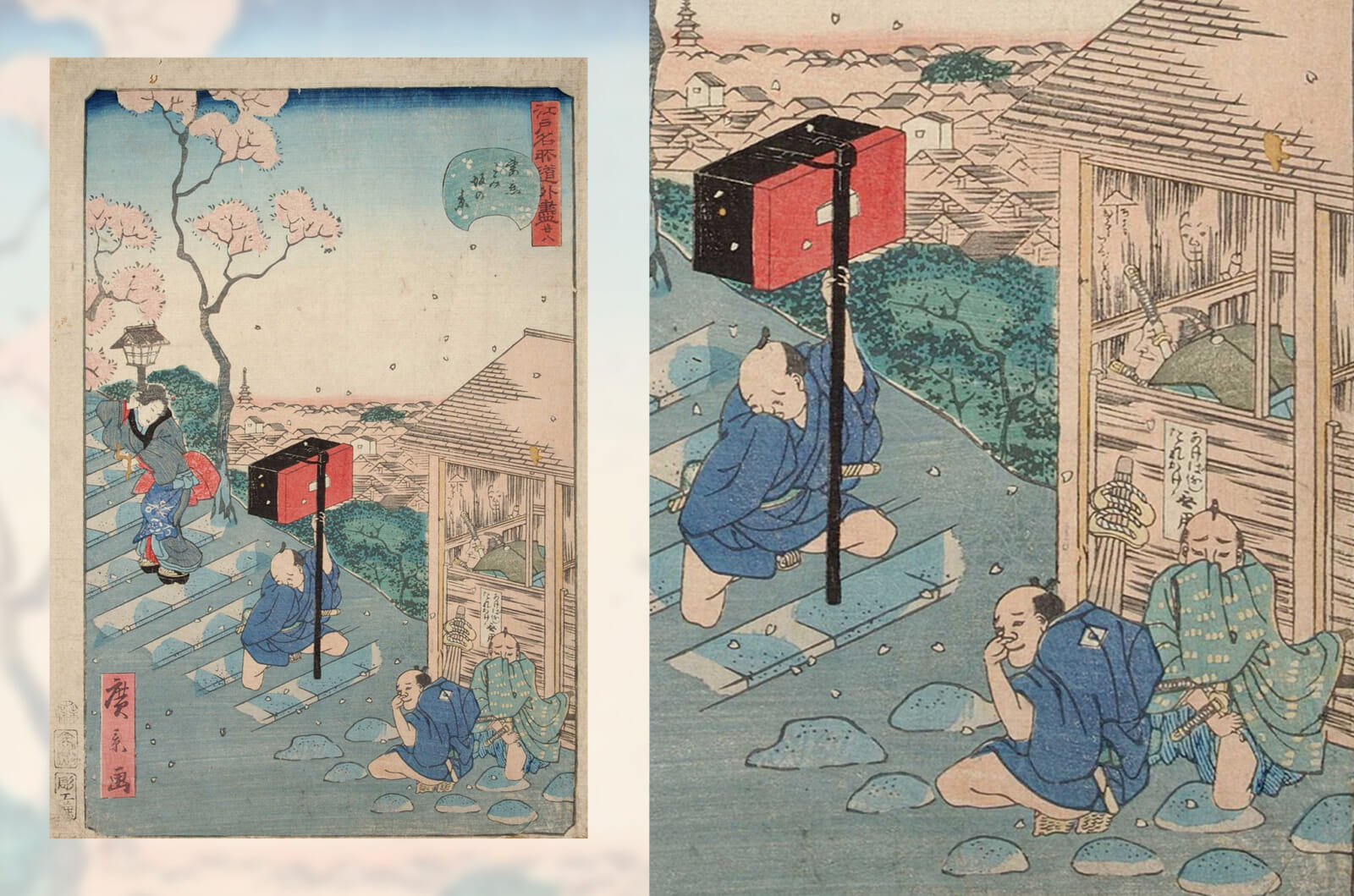
Depiction of men waiting for the toilet by Utagawa Hirokage (c. 1859)
Not-So-Private Privies
Archeological evidence confirms the existence of kawaya possibly as early as the Yayoi period (900 BCE – 300 CE). This is fairly unsurprising, as early civilizations around the world tended to gather along rivers, hence the early creation of “river houses.” However, the earliest kawaya weren’t actual huts. Instead, the “facility” was just a simple platform for squatting over running water with no surrounding walls. The Kojiki is full of stories of gods and humans pooping out in the open, so privacy when defecating may not have been a concern in those days.
As the population spread out, cesspits became an alternative to kawaya in areas away from rivers, though they most likely kept the name. These were merely holes in the ground that were buried when full, and hopefully carefully marked because new ones had to then be dug up. We don’t have a lot of information about the presence of walls in these latrines. However, since technology rarely regresses, and since later toilets in the Edo period (1603–1867) were only semi-private, it’s not unreasonable to assume that the cesspit kawaya also did not live up to the name “privy.”
The nagaya outhouses of Edo (modern-day Tokyo) consisted of a wooden floor with a single long hole running through the latrine longhouse, where throngs of people defecated. Sometimes, the defecating was done in full view of each other; sometimes, half-doors created little cubicles that left users with some dignity, though not all of it. This was all, of course, reserved for the common people. The rich and powerful evacuated their bowels in finer surroundings, and possibly with more power (decadent food has a tendency to plug up the old gutty works).
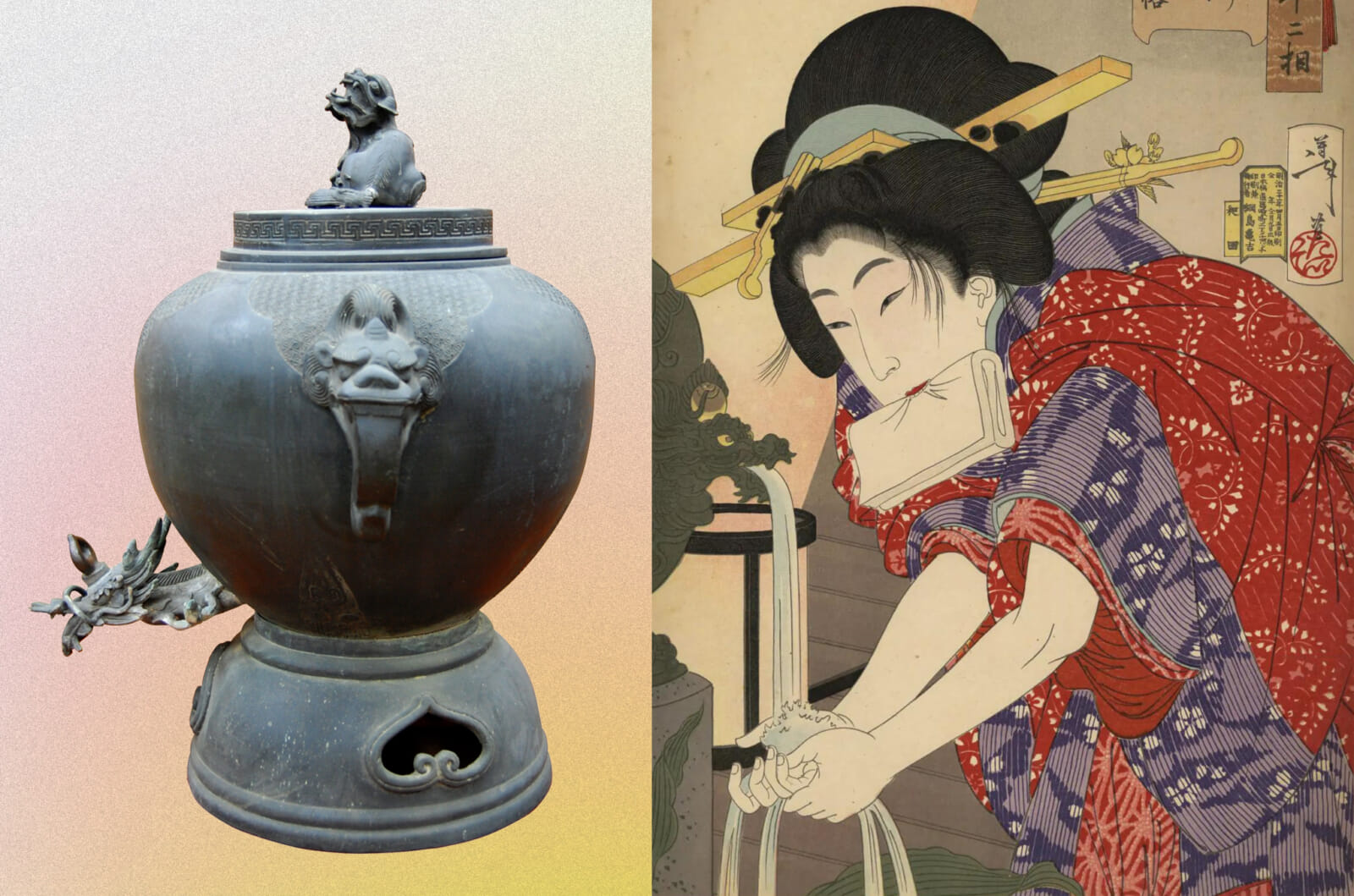
Oto-keshi tsubo: Left, from the former Ueda Family residence in Yao City, Osaka. Right: A woman washes her hands, from “The Manners of Concubines” by Yoshitoshi (1888)
Royal Relieving
Aristocrats in Fujiwara, which served as the Japanese capital from 694 to 710, used kawaya-style flush toilets built above privately dug ditches carrying water diverted from rivers, streams and reservoirs. There are mentions, though, that topography wasn’t always taken into consideration, and some of the toilets failed to carry the waste away, making them smell something awful. At least the blue bloods of ancient Japan didn’t live under the assumption that their poop didn’t stink.
Flushing toilets remained popular until the Nara period (710–794), when they were situated on slopes and carried waste away via wooden pipes. Though the toilets had to be manually flushed with water by servants, it was still a surprisingly sophisticated system. In the Heian period (794–1185), however, we see various chamber pots becoming popular, especially among aristocratic women. Primarily made from lacquered wood, these regal reeking receptacles had the benefit of being inspected by a lady’s private physician for signs of any illnesses before emptying.
In later periods, latrines made a big return in the form of man’nen (“ten thousand years”) cesspits accessible from private toilet rooms by the shoguns’ wives. Their name is a very poetic way of saying that the incredibly deep pits could not be filled up in one lifetime. These restrooms (and other places used by feudal highborn) were highly ornate and, in the 1800s, included the height of toilet technology: oto-keshi tsubo, or “sound-erasing jars.” These bronze containers dripped water onto tiles to mask the sounds of peeing or defecation, a direct precursor to Otohime technology! Truly, there is nothing new under the sun. Or under where the sun don’t shine.
Clearing the Air About Cleaning Up
The evolution of “hind hygiene” implements in Japan reads like a reverse tale of The Three Little Pigs. It started with stone, or at least pottery, specifically pottery shards (hopefully rounded out to remove any sharp edges) that were used to scoop and scrape the behind to remove any residual … residue, so to speak.
After that came wood in the form of spatula-shaped sticks, used basically in the same way as the shards. In academic speak, the sticks are called chugi, but they’re apparently more commonly known as kuso-bera, or “shit spatulas.” When it comes to the toilet, Japanese people have little use for euphemisms. Fun fact: The shit spatulas are NOT the source of the phrase “have a stick up one’s ass,” but they very much should be.
Then, in the end (pun very much intended), there was straw, or rather, highly processed plant material. In the Edo period, old rags, scraps of cloth and recycled paper were seen as a less rural (and therefore cool) option for city-dwellers. Once again, though, this was for commoners. We have records of Japanese aristocrats being wiped down with delicate fabrics and fresh and soft washi paper since at least the Heian period. Japan probably picked the custom up from China, AFTER it had already made its first robot — because Japan’s technological priorities can sometimes be a little ass-backwards.