
Tokushima Modern Art Museum can finally breathe a sigh of relief after years of displaying a phantom masterpiece. One of its paintings, long admired as the work of French Cubist Jean Metzinger, has been exposed as a sophisticated fake by the infamous “genius forger” Wolfgang Beltracchi. As of last Wednesday, the museum has secured a full refund of ¥67.2 million (approx. $426,000) for the counterfeit painting, closing the book on one of the country’s most expensive art scandals.
Synthetic Pigments Betray the Forgery
The painting in question, At the Cycle-Race Track 55, was purchased by the Tokushima Prefectural Government in January 1999. At the time, it was believed to have been created by Jean Metzinger between 1911 and 1912.
Suspicions began arising in 2024, when a rigorous investigation launched by the museum, aided by the Tokyo National Research Institute for Cultural Properties, revealed the shocking truth: the artwork contained synthetic pigments that were not commercially available until after the mid-20th century — decades after Metzinger was active.
Instead, the hand behind the brush turned out to be Wolfgang Beltracchi, a German artist and convicted felon who served a three-year sentence for flooding the global market with hundreds of convincing forgeries of masterpieces by the likes of Max Ernst and Fernand Léger. Beltracchi claimed to have faked some 300 works.
“I didn’t paint for money alone,” Beltracchi told NHK in an interview last year. “The ecstasy was irresistible. Just imagine it. Everyone nods in agreement, moved, saying ‘This is truly wonderful.’ I enjoyed that.”
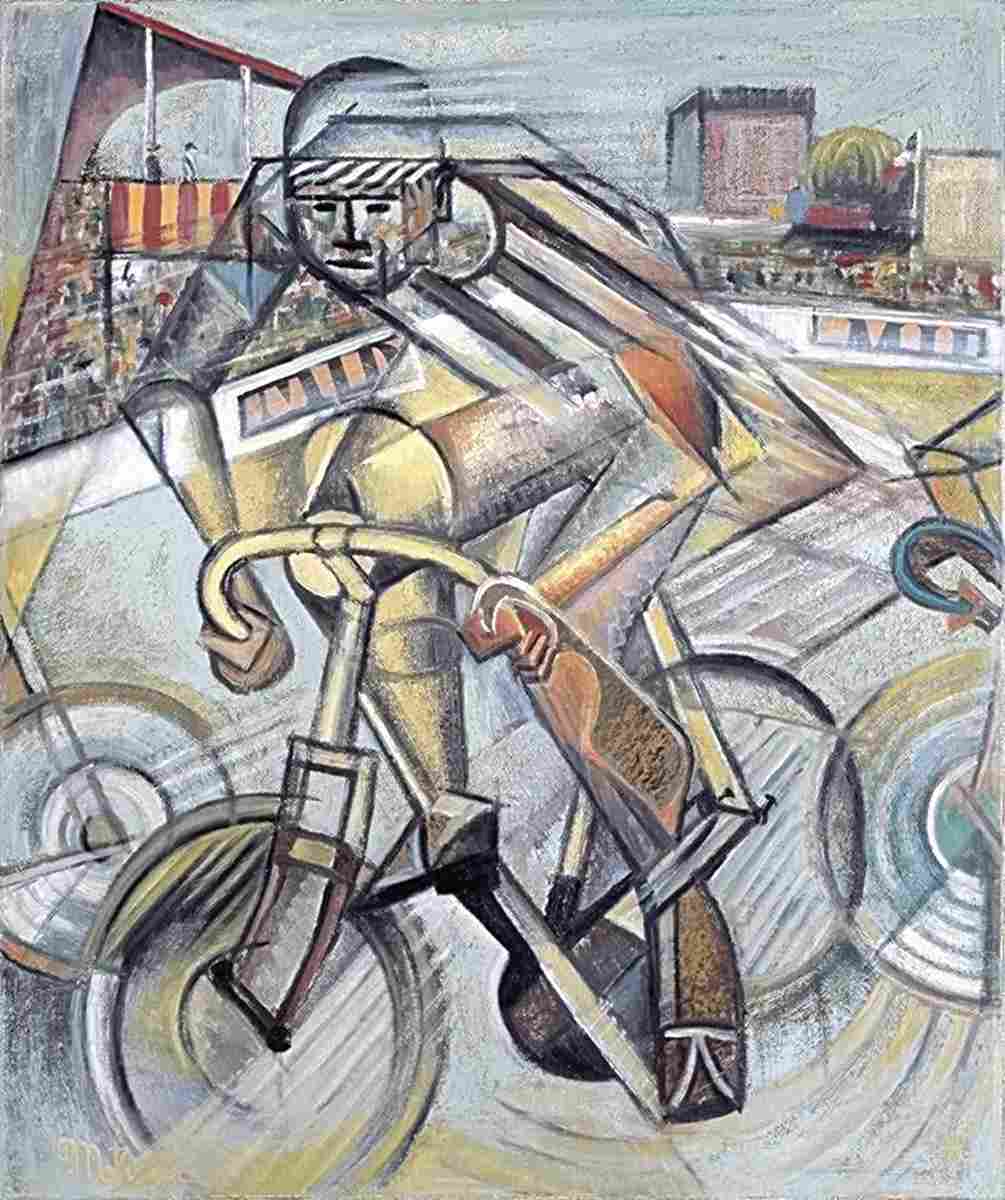
“At the Cycle-Race Track 55,” previously attributed to Jean Metzinger. Courtesy of the Tokushima Modern Art Museum
Decades of Deception Come to a Close
Fortunately for the museum, the saga ended with financial recovery. The painting’s seller, who also thought the artwork was legitimate at the time of purchase, has agreed to a return and refund of the piece.
The prefectural government secured a full refund of ¥67.2 million on October 22, and the forged canvas was formally returned to the company on November 18. The museum is now handling the bureaucratic steps to wipe the fake — and the corresponding acquisition price — off its official asset ledgers.
Before it shipped out, the museum gave the public a final, honest look — the forged At the Cycle-Race Track 55 was displayed in May and June, but this time, it was paired with panels detailing the fascinating circumstances of its deceptive history.
Tokushima’s high-profile forgery is the latest case to illustrate the shocking extent of Beltracchi’s reach into Japan’s art world, following the exposure of several other forgeries: a painting thought to be Kiki de Montparnasse by Moïse Kisling in Okayama Prefecture; a fake of Heinrich Campendonk’s Girl with Swan in Kochi prefecture; and a suspected forgery of Alfred Flechteim by Marie Laurencin, found in a Tokyo gallery collection.
Related Posts
- Hokusai’s Great Wave Sells for Record Amount at Sotheby’s Auction
- Japanese Company Buys Original Birkin Bag for ¥1.47 Billion
- How a ¥15 Japanese Snack Became a ¥100,000 Art Sensation in Tokyo
Updated On November 26, 2025