
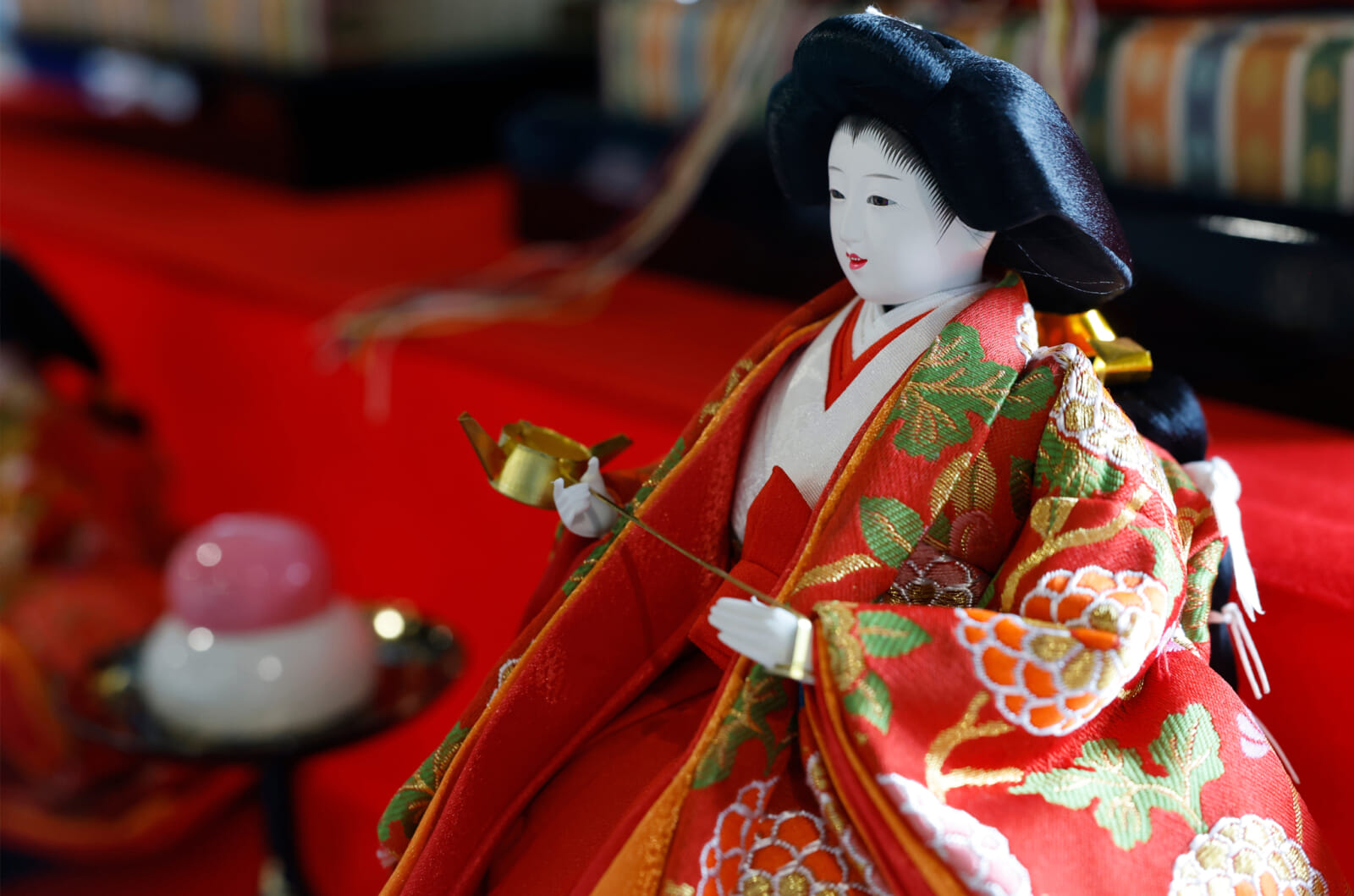
Every March 3, the Emperor and Empress make an appearance in family homes all across Japan. As expected, the royals don’t arrive alone, bringing with them court ladies, musicians, ministers and even their furniture in some cases. Thankfully, they all don’t take up a lot of space because the imperial pair and their aforementioned entourage are represented by the elaborate hina dolls displayed on tiered platforms in traditional court dress during hinamatsuri, or the Doll/Girl’s Festival. It is an ancient Japanese custom during which families pray for the happiness and wellbeing of their daughters. The celebrations are nice, colorful and beautiful. But their origins are far from light-hearted. This is the dark origin of the hinamatsuri festival:
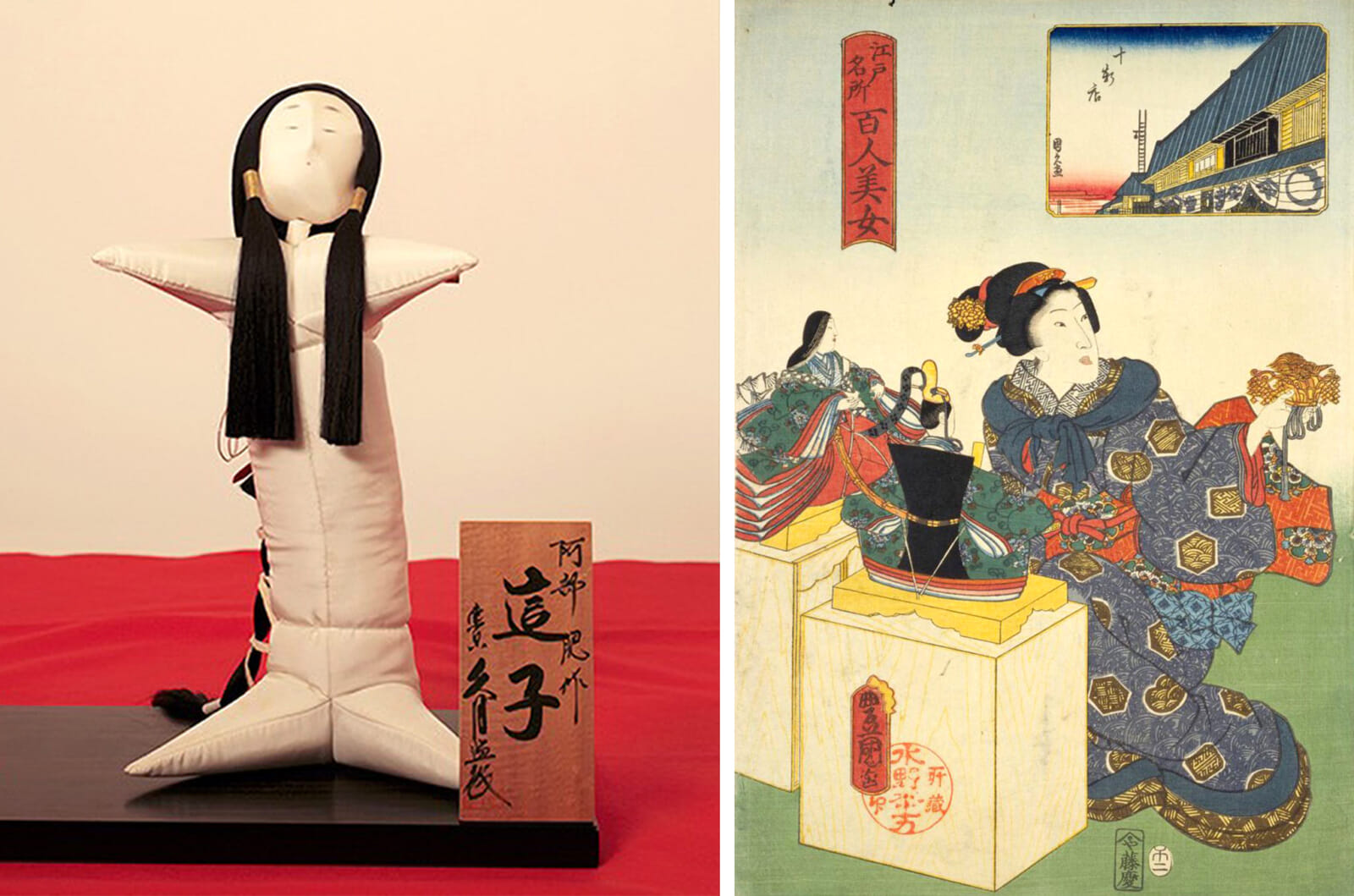
Example of an amagatsu silk doll typical of the 1300-1500’s (left) and a depiction of a woman with hina dolls during the Edo Period (c. 1858) by Utagawa Toyokuni
It’s Basically an Exorcism
Nowadays, the only halfway-sinister part about the Doll Festival is the belief that if the dolls aren’t put away promptly, the daughter(s) in the family will marry late. Another key difference between the now and the past is that, over a millennium ago, the precursors of the hina dolls weren’t simply bringing “luck” to a household but were actively protecting children from evil, demons and “spiritual pollution.”
The idea of exorcism dolls first arrived in Japan from China and instantly became more elaborate and ominous with each generation. The first precursors to hina dolls were most likely the hitogata paper effigies used for purification, which date back to the Kofun period (250–710). These were followed by the amagatsu silk dolls placed beside infants’ pillows to absorb misfortune, as well as the hoko doll talismans.
When the name “hina” was eventually applied to human-shaped purification objects, it appeared in the form of “nagashibina” (the “h” turning into a “b” sound) during the Nara period (710–794). These were dolls made specifically for floating down rivers and symbolically carrying away a family’s bad luck, and they together with all the other dolls arose from the simple if depressing fact that, centuries ago, child mortality was all too common.
In the presence of bacteria, viruses and other lethal things that they couldn’t see, the people of Japan started trying anything to protect the most vulnerable from “the hidden ones,” which we now know as oni demons, the embodiments of calamity and malevolence in Japanese mythology. That’s why these early protection rituals were performed for both boys and girls.
A Sister Celebration to the Demon-Banishing Setsubun
Setsubun is observed in early February, around one month before hinamatsuri. Its exact date changes from year to year but is always celebrated the same way: with throwing beans inside your home to attract good luck and throwing beans outside your home to drive away oni (unless you share a name with the original demon slayer). The two holidays share much more than a close-ish schedule and an association with battling evil.
In the Shinto faith, it’s believed that seasonal transitions invite misfortune as things that are in flux tend to be the most vulnerable. The lunar calendar declared that spring started at the beginning of February, hence the need for a ritual like setsubun. However, winter on the Japanese mainland doesn’t really start to go away until about March, making the third month a vulnerable time, spiritually speaking. Hence the need for another protective ritual, which is how we eventually got hinamatsuri.
The festival as we know it today took form around the Heian period (794–1185) when the various forms of purification dolls got sort of mixed together with the more realistic toys of Kyoto court nobility. Since then, the hina dolls have existed in two worlds. On the one hand, they represented the beauty and splendor of the imperial palace (modern designs are still based on Heian fashion) but they also started to shoulder the responsibility of protecting children. Over the years, that second role got mostly forgotten, but there are places in Japan where it is still remembered.
In some areas, people there still send dolls filled with malevolent energies down rivers in March or brush their bodies or their children’s bodies with simple effigies that act like sponges for evil, before burning the dolls. It’s all superstition but one that actually makes a lot of sense. After all, if there is unseen evil out there that likes to target humans, it makes sense to give them a human-shaped decoy.
The Japanese Art of Substitution
Hina dolls seem to fit into the Japanese tradition of migawari, meaning “proxy,” or “a substitute.” According to this logic, the dolls are spiritual doubles, or ritual scapegoats, like, say, migawari omamori talismans made from ginkgo nuts which are said to absorb bad luck. If you carry one and the nut cracks, that’s how you know that you’ve just dodged a bullet.
Even in modern times, when someone in a Japanese household breaks a bowl or a cup, some families say that this was an act of migawari and that the person has avoided something bad happening to them down the line. These beliefs are the spiritual cousins of the protective role of hina dolls, which may be additionally and distantly related to the haniwa clay figures that were left in tombs of emperors and aristocrats in lieu of human sacrifices. If that has ruined hinamatsuri for you, think of it as an act of migawari that has saved you from a future misfortune!