
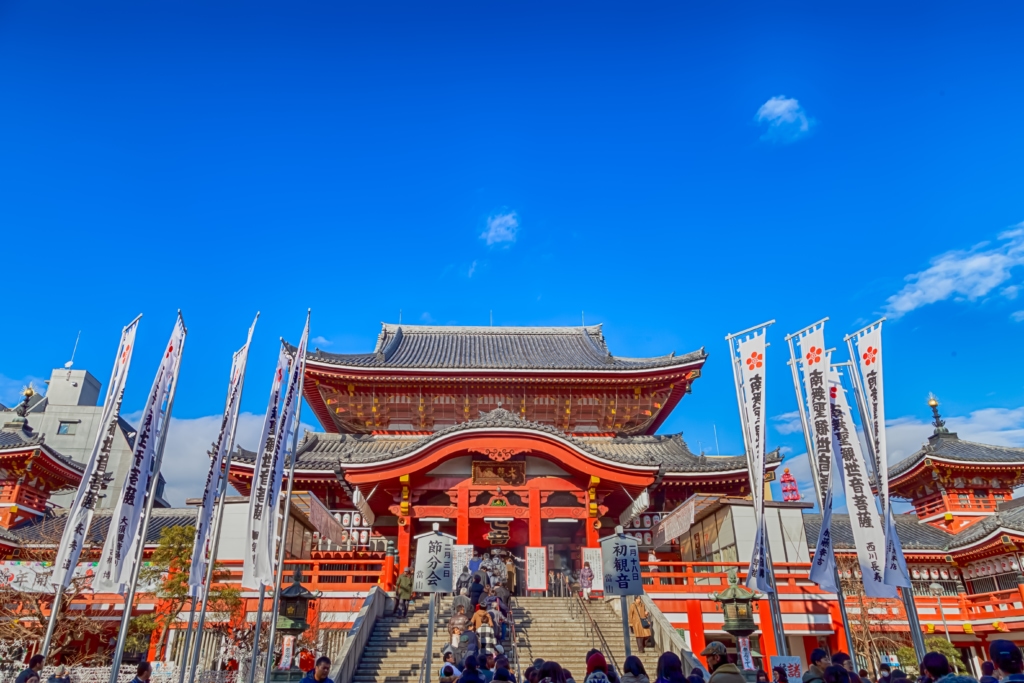
Overview of Osu Kannon Temple
At the entrance to one of Nagoya’s liveliest neighborhoods, Osu Kannon Temple stands as a striking counterpoint to the streets around it — brilliant red pillars rising above rows of covered arcades, its forecourt perpetually busy with worshippers, pigeons and curious visitors alike. Officially known as Kitanosan Shinpukuji Hoshoin, the temple belongs to the Shingon sect of Buddhism and is considered one of Japan’s three great Kannon temples, alongside Senso-ji in Tokyo and Tsu Kannon in Mie Prefecture.
The temple’s origins lie far from its current home. It was first built in 1333 in what is now Hashima city in Gifu Prefecture, under the patronage of Emperor Go-Daigo. Repeated flooding at that site prompted Tokugawa Ieyasu to order its relocation to Nagoya in 1612, as part of his broader development of the city around the newly constructed Nagoya Castle. The surrounding area quickly grew into a thriving monzen district — a temple town — and has remained a commercial and cultural hub ever since. The current building is a 1970 reconstruction, following damage from fires in the 1820s and the wartime bombings of Nagoya in 1945.
Inside the main hall, a large red paper lantern hangs from the ceiling — a focal point for worshippers who tie small paper wishes to its supporting wires. The principal object of veneration is a wooden statue of Kannon, the Buddhist goddess of mercy, said to have been carved by Kobo Daishi (774–835), the revered monk who founded the Shingon sect. Beneath the main hall, the Shinpukuji Library houses over 15,000 classical Japanese and Chinese texts, among them several national treasures including some of the oldest known handwritten manuscripts of the Kojiki, Japan’s earliest chronicle of history and mythology.
The temple grounds host a popular antique fair on the 18th and 28th of every month, with around 60 stalls selling vintage kimono, pottery, books and assorted curiosities. Year-round events include the Setsubun bean-throwing ceremony in February and the Osu Street Performers Festival each October. After visiting the temple, the adjacent Osu Shopping Arcade — a sprawling network of eight covered streets with over 1,200 shops — is well worth exploring for its mix of retro game stores, secondhand fashion, street food, and electronics.
Best Times To Visit Osu Kannon Temple
The temple can be visited at any time of year and is always free to enter. The 18th and 28th of each month are particularly lively thanks to the antique fair, and visiting on those days adds an extra layer of atmosphere. Early February brings the Setsubun celebrations, when monks throw beans from raised platforms — a festive and crowd-pleasing event. October is another highlight, with the Osu Street Performers Festival drawing artists, musicians and acrobats to the arcade streets surrounding the temple. New Year’s is exceptionally busy, with thousands gathering for hatsumode. For a quieter visit, a weekday morning outside of festival periods is ideal.