

A Fortress That Shaped Japanese History
Perched at the summit of Mount Kinka, 300 meters above the city of Gifu, Gifu Castle is one of central Japan’s most iconic landmarks — and one of its most historically charged. Together with the Nagara River and the forested peak it crowns, the castle has long served as the defining symbol of Gifu city. Designated a National Historic Site in 2011, it draws visitors as much for its sweeping 360-degree views as for the outsized role it played in some of the most dramatic episodes of the Sengoku (Warring States) period.
The site’s origins trace back to the Kamakura period, when a fort was first established here between 1201 and 1204 by Nikado Yukimasa, a steward serving under the Kamakura shogunate. The castle — then known as Inabayama Castle — changed hands repeatedly over the centuries, but it was the warlord Oda Nobunaga who transformed it into a place of national significance. In 1567, Nobunaga captured the castle from the Saito clan after a two-week siege, renamed the surrounding town “Gifu,” and made the fortress his primary base of operations for nearly a decade as he pursued his ambition to unify Japan. His red-ink seal, bearing the phrase tenka fubu — roughly translating to, “unify the realm with military might” — became synonymous with this era and this place.
Nobunaga reportedly renovated the castle into a magnificent structure, impressing even foreign visitors. The Jesuit missionary Luis Frois, personally invited by Nobunaga, praised its extraordinary beauty. The warlord eventually relocated his seat of power to the newly constructed Azuchi Castle in 1576, leaving Gifu Castle in the hands of his son Nobutada. The castle’s fate was sealed at the Battle of Gifu Castle in 1600 — a prelude to the decisive Battle of Sekigahara — when Tokugawa Ieyasu’s forces captured it and ordered it demolished.
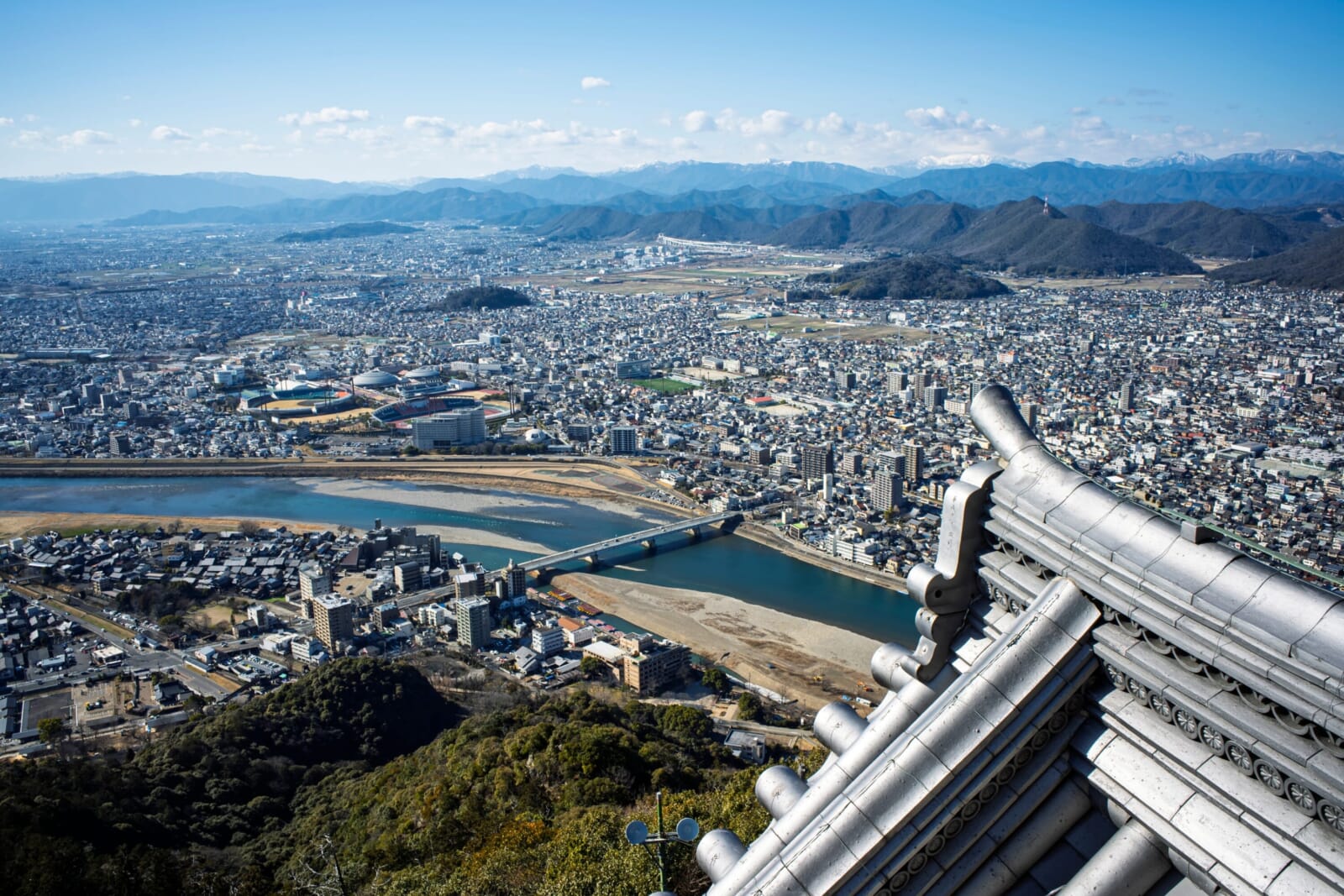
The current three-tiered, four-story structure is a reinforced concrete reconstruction completed in 1956, based on original drawings. Inside, exhibits cover the castle’s history and Nobunaga’s campaigns, with the top floor serving as an observation deck. The climb up is rewarded with panoramic views stretching from the Nagara River and Mount Ena to the Japan Alps. The Gifu Castle Archives Museum, included with admission and located an eight-minute walk down the mountain from the keep, holds additional historical materials and period artifacts.
During summer and selected weekends in spring and autumn, the castle opens at night for its popular Panoramic Night View event, when the city lights of Gifu — and on clear nights, distant Nagoya — spread out below like a jeweled canopy.
Best Times To Visit Gifu Castle
Autumn is the standout season, with the forests of Mount Kinka turning vivid shades of red and gold from mid to late November, contrasting sharply against the castle’s white walls. Spring brings cherry blossoms in Gifu Park below, where around 400 trees bloom from late March through April. Summer offers the added draw of the night viewing event and extended ropeway hours into the evening. Winter is quieter; while the views remain stunning, some seasonal closures apply. Weekday mornings are best for avoiding crowds, particularly during autumn foliage and the spring cherry blossom peak. The summer night view event, typically running from mid-July through late August, is worth planning around.