

Overview of Gero Onsen
Gero Onsen is a hot spring resort town in Gero city, Gifu prefecture, set along the banks of the scenic Hida River. The springs were originally discovered during the early 10th century, and both the Muromachi era Zen monk Banri Shuku and the Edo period Confucian scholar Hayashi Razan praised Gero as one of the three finest hot springs in Japan, alongside Arima Onsen in Hyogo prefecture and Kusatsu Onsen in Gunma prefecture. With over 1,000 years of history, the town remains one of the country’s most beloved bathing destinations.
According to local legend, the original hot spring source stopped flowing after a major earthquake, but was rediscovered when villagers noticed a white egret repeatedly landing in the same spot on a dry riverbed. This tale is commemorated in the name of the town’s main bridge, Shirasagibashi (White Egret Bridge), and at Onsenji Temple, which sits on a hillside above the town and enshrines Yakushi Nyorai, the Buddha of healing.
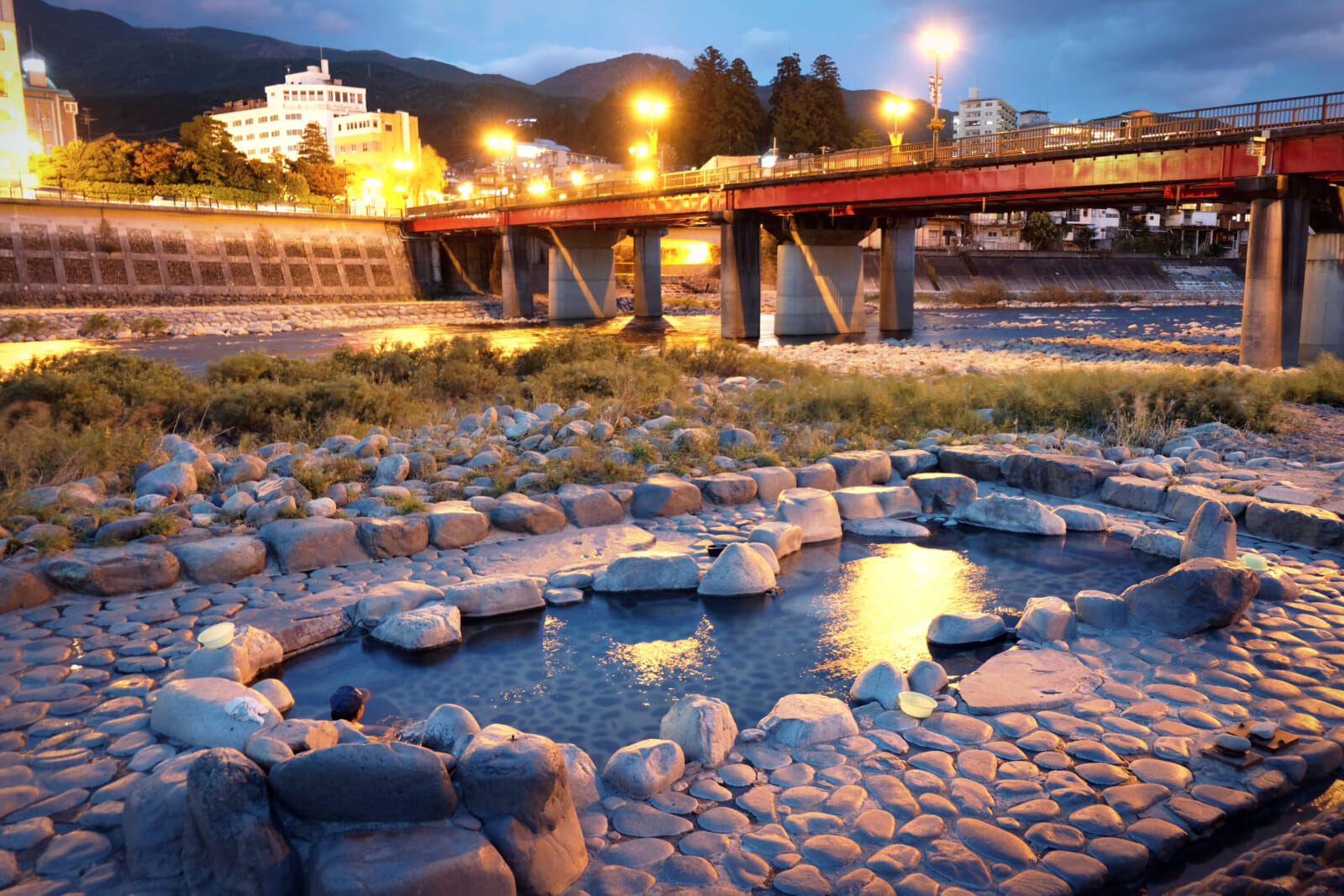
The spring water has a source temperature of 84 degrees Celsius and a pH value above 9, giving it a gentle, soap-like quality that leaves skin feeling remarkably smooth. The water is classified as a simple alkaline hot spring and is widely known as bijin no yu (beauty water). Beyond the many ryokan baths, the town offers three public bathhouses and an open-air bath called Funsenchi along the Hida River, plus numerous free foot baths scattered throughout the streets. A popular way to explore is with the Yumeguri Tegata, a wooden spa pass that grants entry to three participating ryokan baths for ¥1,300 and doubles as a souvenir.
The town’s unofficial mascot is the frog — “Gero” sounds like “gero-gero,” the Japanese onomatopoeia for a frog’s croak — and playful frog statues and motifs pop up all over town.
Best Times To Visit Gero Onsen
Gero Onsen is enjoyable year-round, and each season brings a different charm. Spring brings cherry blossoms along the Hida River, and summer heats up with the Ryujin Fire Festival (August 1–3), which features geisha dances, music and fireworks. Autumn transforms the surrounding mountains into a tapestry of red and gold foliage. Winter is arguably the most atmospheric time to visit — soaking in an outdoor bath while snowflakes drift down is a quintessential Japanese experience. The town is conveniently located between Nagoya and Takayama, making it an easy stopover or an alternative base during busy periods like the Takayama Festival, when lodging in Takayama fills up quickly.