
On this day 80 years ago, the Japanese public — with a few exceptions — heard the voice of Emperor Hirohito for the first time. Addressing the nation via a phonograph record, he announced that the government had accepted the Potsdam Declaration, which called for the “unconditional surrender of all Japanese armed forces.” Known as “Gyokuon-hoso” (the Jewel Voice Broadcast), it was delivered in formal Japanese and did not actually include the word kofuku (surrender).
Events Leading to Hirohito’s Surrender Broadcast
Six months prior to Hirohito’s surrender broadcast, the heads of the governments of the so-called Big Three — Franklin D. Roosevelt, president of the US, Winston Churchill, the prime minister of the UK, and Joseph Stalin, the premier of the Soviet Union — met in Yalta, a coastal town in the Crimean Peninsula, to decide what to do with Germany and Europe after the war. With an Allied victory in Europe looking inevitable, attention also turned to the Pacific theater, with Roosevelt keen to get assurances from Stalin regarding Soviet participation in the war against Japan.
Stalin agreed to enter the Pacific War within two to three months of Germany’s surrender on the condition that the USSR would gain control of southern Sakhalin and the Kuril Islands, in addition to economic concessions in Manchuria. On August 8, 1945, Soviet foreign minister Vyacheslav Molotov informed Japanese ambassador Naotake Sato that the USSR had declared war on Japan. The Soviet invasion of Manchuria commenced the following day, with more than 1 million troops being deployed. A few hours later, the US detonated an atomic bomb over the city of Nagasaki.
This followed the bombing of Hiroshima three days earlier. Hundreds of thousands were killed or maimed due to the attacks. Secretary of War Henry L. Stimson described the decision to use atomic weapons on Japan as the “least abhorrent choice.” He added that “there was a very strong possibility that the Japanese government might decide on resistance to the end” and that “major fighting would not end until the latter part of 1946.” This, he said, would have led to millions of casualties. Critics, however, argue that the two bombings were immoral and unnecessary, as Japan was already on the brink of surrendering.
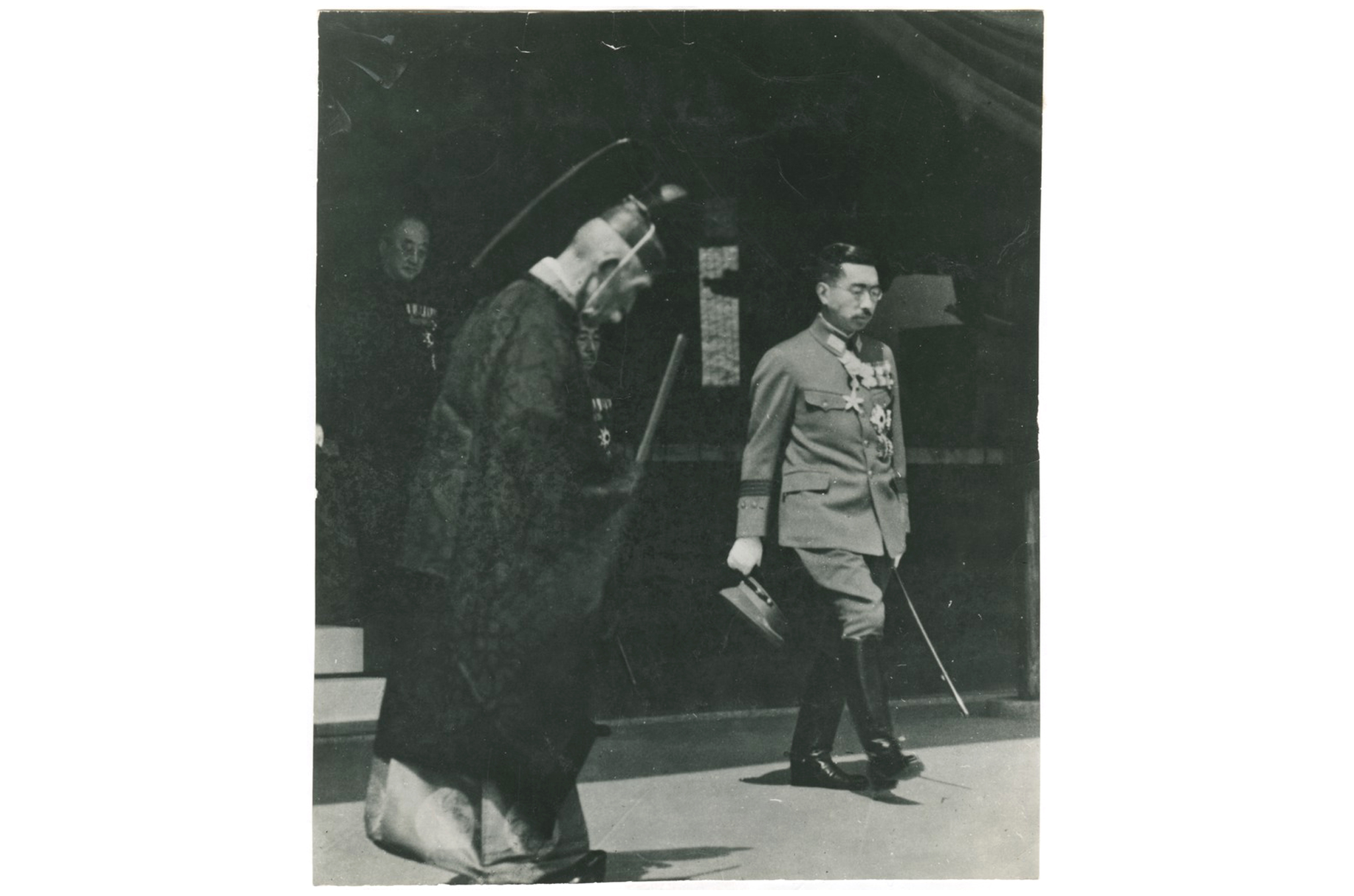
Emperor Hirohito in 1945 | Theodore Akimoto Family Collection / Wikimedia
Japan Accepts the Potsdam Declaration
Two weeks before the bombing of Hiroshima, the US, the UK and China issued the Potsdam Declaration, which stated that, if Japan didn’t surrender, it would face “prompt and utter destruction.” It also called for the elimination of authorities who’d “deceived and misled the people of Japan into embarking on world conquest,” yet didn’t mention the emperor or specifics about the government. In response, Prime Minister Kantaro Suzuki used the word “mokusatsu,” which literally means to “kill with silence.” An ambiguous word that could be translated in different ways, it was taken by the Allied powers as a de facto rejection.
Following the atomic bombings and the USSR’s invasion of Manchuria, Suzuki, along with Foreign Minister Shigenori Togo and Navy Minister Admiral Mitsumasa Yonai, was ready to accept the Potsdam Declaration on the condition that the emperor not be abolished. Opposing them were War Minister General Korechika Anami, Chief of the Army General Staff Yoshijiro Umezu and Navy Chief of Staff Admiral Soemu Toyoda. They were prepared to surrender, provided that Japan disarmed itself, conducted its own war trials and remained unoccupied after the war, in addition to the emperor retaining his position.
Late on August 9, a gozen kaigi — a conference before the emperor — was called. In the suffocating heat of an underground shelter, the two deadlocked sides presented their arguments. Then came the historic moment when Emperor Hirohito addressed the room. Toward the end of his speech, he said, “I swallow my tears and give my sanction to the proposal to accept the Allied proclamation on the basis outlined by the Foreign Minister. I’ve given serious thought to the situation prevailing at home and abroad and have concluded that continuing the war can only mean destruction for the nation and prolongation of bloodshed and cruelty in the world.”
The Kyujo Incident
Tokyo subsequently released a message to its ambassadors in Switzerland and Sweden, which was passed on to the Allies. Japan was prepared to accept the Potsdam Declaration as long as it didn’t “comprise any demand which prejudices the prerogatives of His Majesty as sovereign ruler.” The response from US Secretary of State James F. Byrnes, however, didn’t explicitly guarantee the emperor’s position. “The ultimate form of government of Japan,” he wrote, “shall, in accordance with the Potsdam Declaration, be established by the freely expressed will of the Japanese people.”
Many officers at the War Ministry were concerned that the Japanese government and emperor would be sublimated under Allied command, forcing Hirohito into a ceremonial role. That was an outcome they couldn’t tolerate. Led by Major Kenji Hatanaka, they took their concerns to General Anami — Japan’s most important military figure — requesting his support in a coup d’état to prevent the acceptance of the Potsdam Declaration. He refused. Hatanaka, though, wasn’t about to give up on the plan just yet. Gathering support from other officers, he prepared for one last push to keep the war going.
At approximately 9:30 p.m. on August 14, Hatanaka’s rebels put their plan into action. Their goal was to occupy the Imperial Palace — then known as Kyujo — in the hope that it would inspire the rest of the army to revolt. They also aimed to intercept Hirohito’s surrender broadcast. To seize the palace, the rebels needed the cooperation of Lieutenant General Takeshi Mori. After refusing, he and his brother-in-law, Michinori Shiraishi, were murdered. Another group of Hatanaka’s rebels planned to kill Prime Minister Suzuki at his office, but he escaped just before they arrived. General Anami also took his own life during the coup.
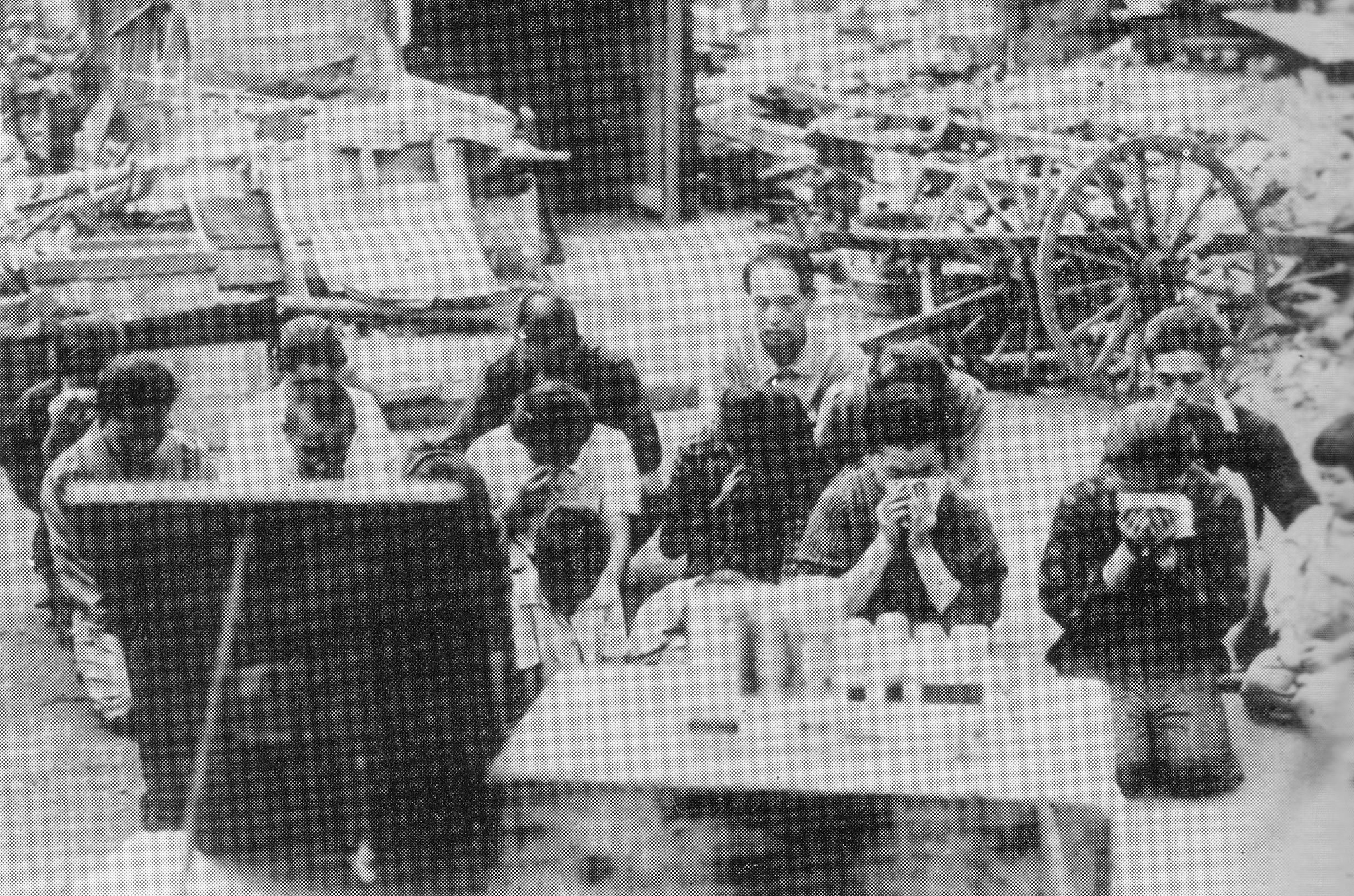
Japanese civilians listening to the surrender broadcast, August 15 1945 | Wikimedia
The Jewel Voice Broadcast
By 8 a.m. on August 15, the rebellion had been entirely dismantled. Hatanaka then shot himself in the head shortly before Hirohito’s surrender broadcast aired around midday. Recorded the previous day, it was reportedly smuggled to safety in a laundry basket. Lasting around four and a half minutes, it began with the words, “To our good and loyal subjects: After pondering deeply the general trends of the world and the actual conditions obtaining in our empire today, we have decided to effect a settlement of the present situation by resorting to an extraordinary measure.”
He went on to say that “the war situation has developed, not necessarily to Japan’s advantage,” adding that “the enemy has begun to employ a new and most cruel bomb, the power of which to damage is indeed incalculable, taking the toll of many innocent lives.” The emperor acknowledged Japan’s acceptance of the Potsdam Declaration, but didn’t use the word “surrender.” This lack of clarity, added to his use of formal courtly language and the poor quality of the audio, meant there was some confusion among the public following the speech.
On September 2, 1945, Japan formally signed the Instrument of Surrender aboard the USS Missouri in Tokyo Bay, officially ending World War II. The Allies considered trying Emperor Hirohito as a war criminal, but ultimately decided against it. General Douglas MacArthur, who served as Supreme Commander for the Allied Powers overseeing the occupation of Japan from 1945 to 1951, believed the emperor was a key symbol uniting the Japanese people and, therefore, vital to the peaceful occupation of the nation. However, Hirohito was pressured to renounce his divinity, announcing on New Year’s Day, 1946, that he wasn’t a living god.
More From This Series
- The Battle of Okinawa Ends
- Queen Arrives in Japan for First Asian Tour
- The JAL Mass Food Poisoning Incident
Updated On August 15, 2025