

Takachiho Gorge Overview
Carved by the Gokase River through ancient volcanic rock in the mountains of northern Miyazaki Prefecture, Takachiho Gorge (高千穂峡, Takachiho-kyo) is one of the most visually striking landscapes in Kyushu — sheer basalt cliffs rising up to 100 meters, narrowing in places to just three meters wide and a slender white waterfall threading down into emerald water at the gorge’s heart. It is also, according to one of the foundational stories of Japanese culture, the place where the gods first descended to earth.
This combination of dramatic landscape and deep mythological significance is what makes Takachiho an unmissable stop on any Kyushu itinerary, and what justifies the effort of getting there. There is no train station to Takachiho Gorge; visitors arrive by rental car or by bus, after a winding mountain drive. The reward for the journey is one of Japan’s most photographed natural sites and one of its quietest spiritual hubs — and a gorge you can row directly into.
The gorge is designated as both a National Special Place of Scenic Beauty and a Natural Monument — two of Japan’s highest cultural-landscape protections, rarely held by a single site. Its 80-to-100-meter cliffs were formed from lava ejected by Mount Aso, the still-active volcano roughly 90 kilometers to the northwest, in a series of major eruptions beginning more than 100,000 years ago. As the pyroclastic flows cooled rapidly against the older rock, they fractured into the interlocking hexagonal columns that line the canyon walls today. The Gokase River then spent tens of thousands of years cutting downward through the cooled lava, eroding the spectacular V-shaped gorge that stretches roughly seven kilometers through the mountains.
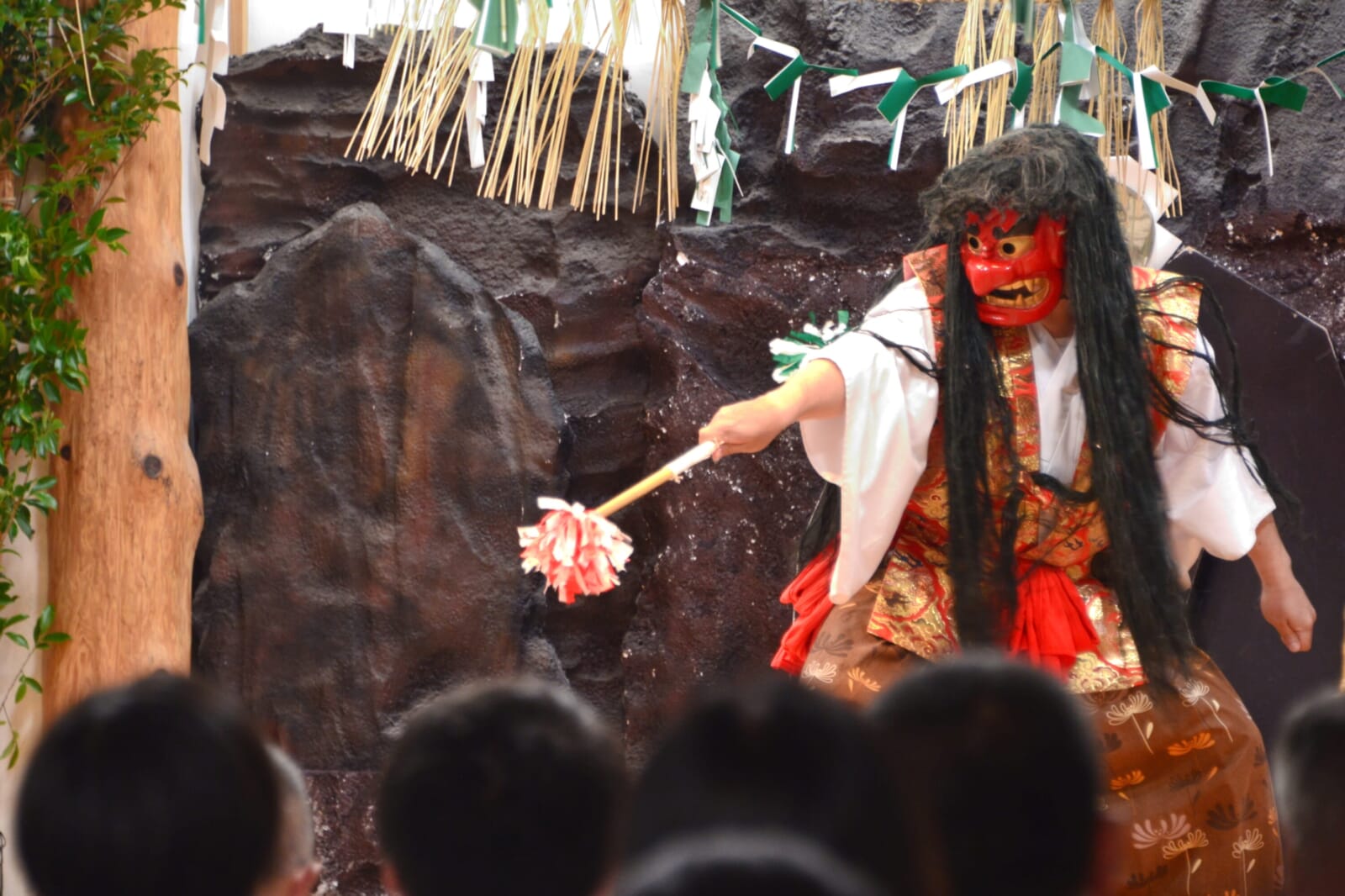
a kagura dance being performed in miyazaki prefecture
The Mythology of Takachiho
Takachiho occupies a unique place in Japanese cultural memory. According to the Kojiki and Nihon Shoki — Japan’s oldest historical chronicles, both compiled in the early 8th century — this is the site of Tenson Kōrin, the descent from heaven.
Ninigi-no-Mikoto, grandson of the sun goddess Amaterasu, is said to have stepped down from the high celestial plain onto a mountain in Takachiho, bearing the three sacred imperial regalia and establishing the divine lineage that, in the founding mythology, becomes the Japanese imperial family.
A second, equally famous story is set in the nearby Amano Iwato cave: when Amaterasu, infuriated by the misbehavior of her brother Susanoo, hid herself away inside a cave and plunged the world into darkness. The other gods coaxed her out by performing a raucous dance outside the cave — an event traditionally identified as the origin of kagura, Japan’s oldest form of sacred theater, which is still performed nightly at Takachiho Shrine today.
The combined effect of these two myths is that Takachiho is one of the most spiritually significant power spots (パワースポット) in Japan — a designation applied by both serious practitioners and casual visitors to places believed to carry unusual spiritual energy. You’ll see this taken seriously here. The town has been associated with somewhere between 500 and 1,500 small shrines historically, and many still stand.

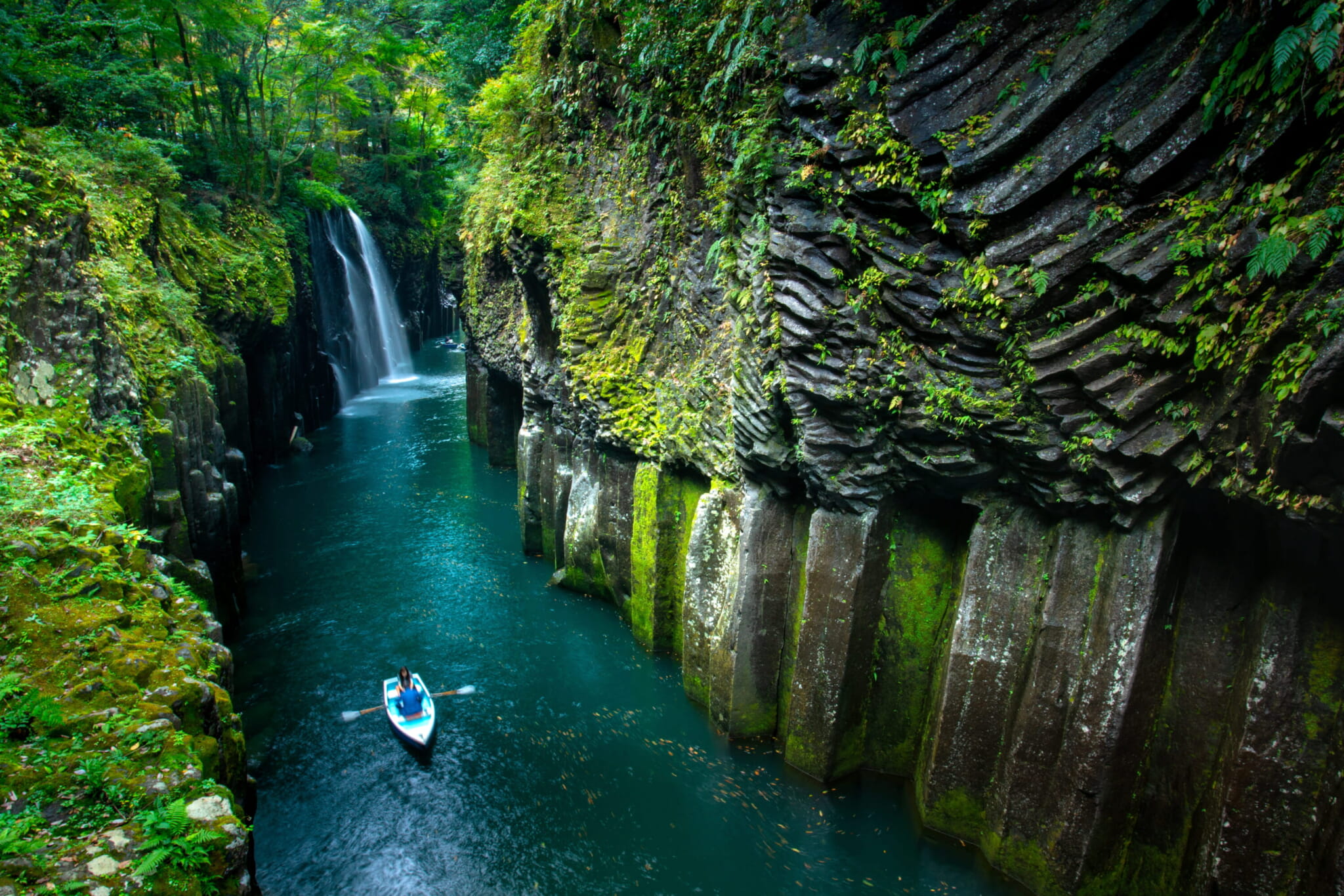
visitors passing through takachiho gorge via rowbaots
What To See at Takachiho Gorge
Manai Falls and the Rowboat Ride
At the heart of the gorge is Manai Falls (Manai-no-taki), a 17-meter cascade that drops in white threads between the basalt columns into the emerald-green river below. The waterfall is listed among Japan’s top 100 waterfalls, and the best way to see it — widely regarded as unmissable — is from below, aboard one of the rental rowboats that carry visitors directly into the spray at its base. Boat rental costs ¥4,100 per boat from Tuesday to Thursday or ¥5,100 per boat from Friday to Monday and during peak seasons (cherry blossom, Golden Week, summer, autumn foliage), covering a 30-minute session for up to three passengers.
Advance reservations are essentially mandatory. Boats can be booked online up to a week ahead through the official Takachiho Tourism Association site, and same-day tickets sell out within an hour or two of opening during peak season. If you’re determined to row, plan to either arrive at the boat house before 8:30 or reserve online days in advance.
If the boats are sold out, the view from the observation platform above the falls is still worth the visit — but the rowboat experience is the best way to experience the gorge.
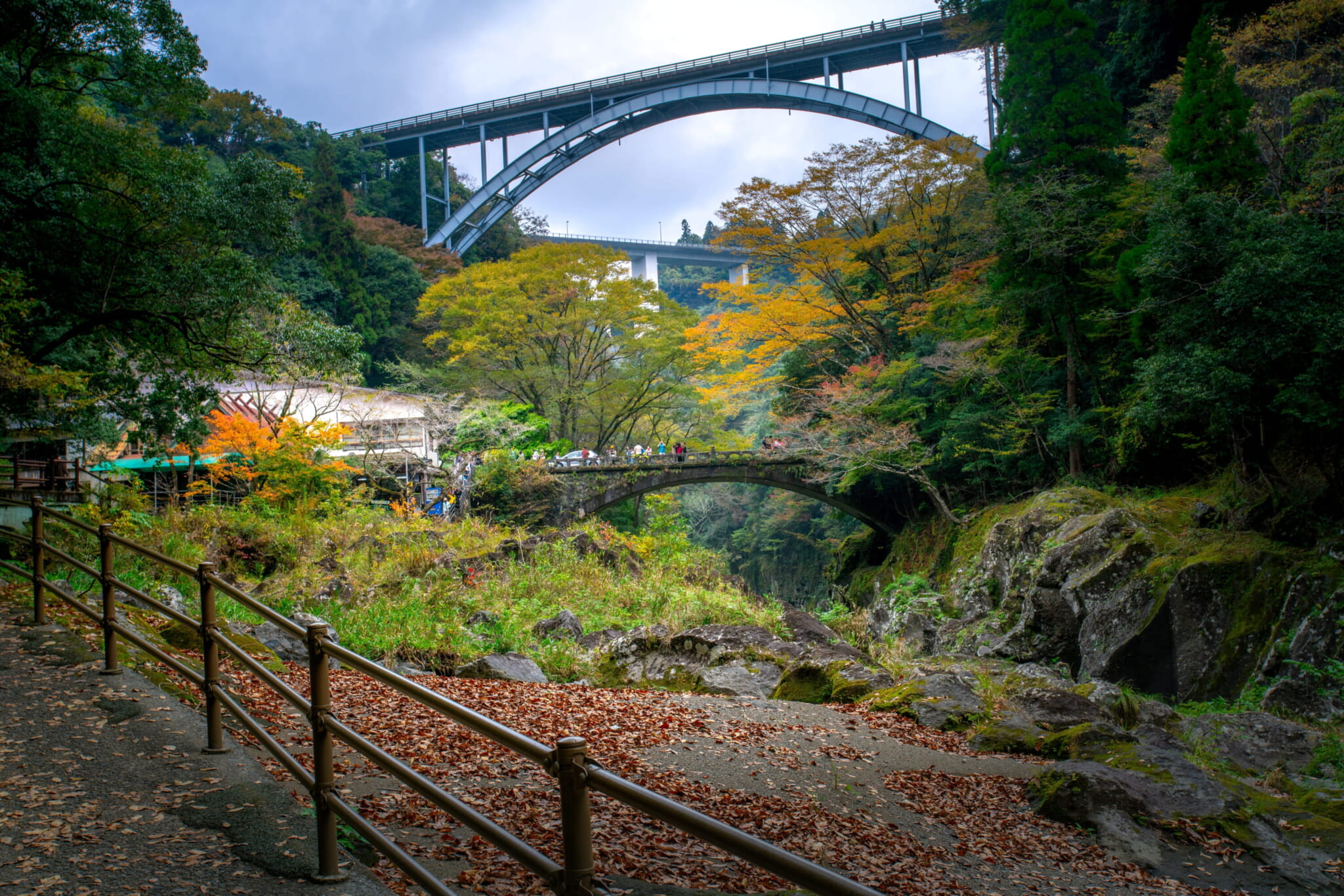
the three bridges viewpoint from Takachiho Gorge
The Walking Path and Three-bridges Viewpoint
A roughly 1-kilometer paved walking path runs along the rim of the gorge, free to access and open at all hours. It takes 40 to 60 minutes to walk at an unhurried pace, with multiple viewpoints down to the river and across to the basalt walls. The trail is mostly level and partially wheelchair accessible; in winter it can be icy in spots.
About midway, from Yarittobashi Bridge, you can see one of the gorge’s signature views: three arched bridges stacked across the river at different heights — the Shinbashi (lowest, 1947), the Takachiho-ohashi (1955), and the Shinto-Takachiho-ohashi (highest, 2003). It’s reportedly the only place in Japan where three arched bridges are visible in a single frame, and it has become one of the most-photographed compositions in Kyushu. The trail ends at Takachiho Shrine, a roughly 10-minute walk further on through the forest.
The Evening Illumination
From mid-May through November, the gorge and Manai Falls are illuminated each evening until 22:00, with lighting designed to play off the basalt walls of the gorge and the white threads of the waterfall. The effect is particularly dramatic in summer, when the surrounding foliage is densest, and in autumn, when the illuminated leaves layer over the lit-up cliffs. The walking path remains accessible during illumination hours.
Best Times To Visit Takachiho Gorge
The gorge is open year-round. Spring sees mountain cherry blossoms, rhododendrons and wisteria blooming along the cliffs. Summer is lush and green, with the evening illuminations at their most vibrant and the boat rides most popular. Autumn is considered the most spectacular season — the canyon walls flame red and gold from October through November, and clear skies make for ideal conditions.
Winter transforms the gorge into a frost-edged landscape, with the basalt darkened against pale water and ice forming at the edges of the falls. Crowds are minimal and the trail feels almost private. Boat rentals still operate on most days, weather permitting, and are dramatically easier to book.
Regardless of season, arriving early is always a good decision. The boat house opens at 8:30; arriving before opening gives you the best shot at same-day boats and the quietest light along the trail. By 11 a.m. during peak season, the parking lots are full and the boat queue can be hours long.
Note that sections of the walking trail may occasionally be closed following typhoons or heavy rainfall; check the official Takachiho Tourism Association website before visiting.