

Matsuyama Castle Overview
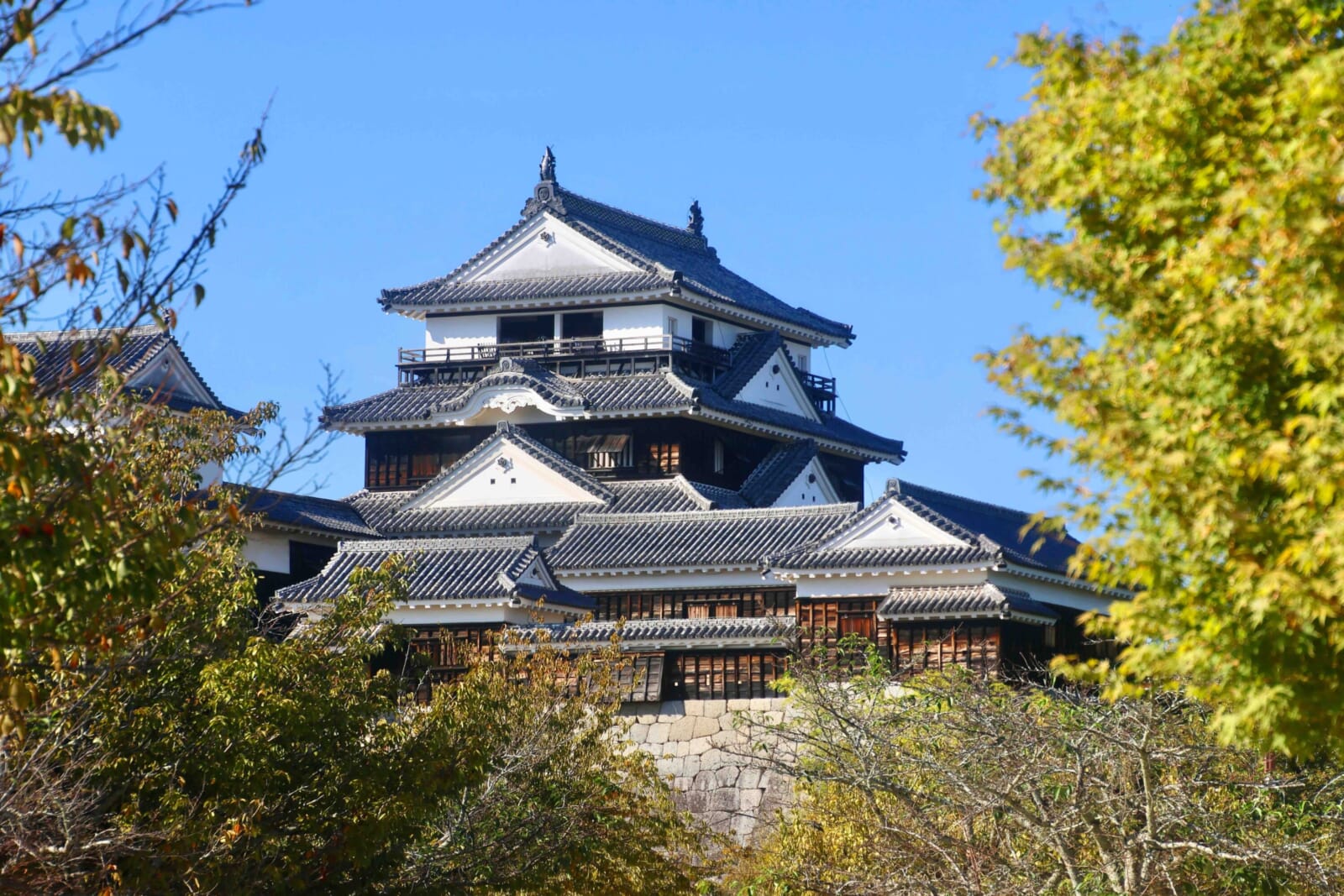
Matsuyama Castle, also known as Iyo Matsuyama Castle, sits in commanding fashion on the summit of Mt. Katsuyama, a 132-meter hill rising from the center of Matsuyama city in Ehime Prefecture. It is one of just 12 castles in Japan whose original wooden keep still survives from the Edo period — a rare distinction it shares with sites like Himeji and Hikone, alongside which it is counted among Japan’s three great hilltop castles.
Construction began in 1602 under the warlord Kato Yoshiaki, one of Toyotomi Hideyoshi’s celebrated “Seven Spears of Shizugatake,” and took roughly 25 years to complete. The original five-story keep was struck by lightning and destroyed in 1784, and the present three-story keep was rebuilt in 1854, just before Japan’s feudal era came to an end. It is widely considered the last full-scale Edo-period castle keep ever constructed in Japan. From 1635 until the Meiji Restoration in 1868, the castle was governed by the Hisamatsu-Matsudaira clan, close relatives of the ruling Tokugawa family.
The sprawling complex includes 21 structures designated as Important Cultural Properties — gates, watchtowers, corridors and the connected main keep itself — making it one of Japan’s most architecturally complete original castles. Visitors can climb the steep wooden staircases inside the keep to a third-floor observation deck offering 360-degree panoramas of the city, the Seto Inland Sea and, on clear days, distant Mt. Ishizuchi, Shikoku’s highest peak. Around 200 cherry trees line the grounds, the keep was awarded one star in the Michelin Green Guide Japon, and the surrounding Honmaru and Ninomaru areas form a designated National Historic Site. Hands-on exhibits inside let visitors try on samurai armor and inspect matchlock guns.
Best Times To Visit Matsuyama Castle
Cherry blossom season from late March to early April is the standout — about 200 Somei Yoshino trees frame the keep in pink, and the annual Matsuyama Spring Festival is held on the first weekend of April. Autumn foliage in November adds warm color to the stone walls, while clear winter days offer the sharpest distant views toward Mt. Ishizuchi. Early mornings just after opening or late afternoons are best for avoiding crowds, especially during cherry blossom season. Evenings during illumination events offer a romantic look at the white-walled keep against the night sky, though the keep interior closes earlier.