
Hamanoura Terraced Rice Fields Overview
Tucked into a narrow coastal valley in Genkai town, Higashimatsuura District, Saga Prefecture, the Hamanoura Terraced Rice Fields — known in Japanese as Hamanoura no Tanada — are among the most photogenic agricultural landscapes in Japan. Designated by the Ministry of Agriculture, Forestry and Fisheries as one of the country’s 100 most beautiful terraced rice fields, the site spans approximately 11.5 hectares and comprises 283 individual rice paddies stepped in tiers from the hillside down toward the Genkai Sea.
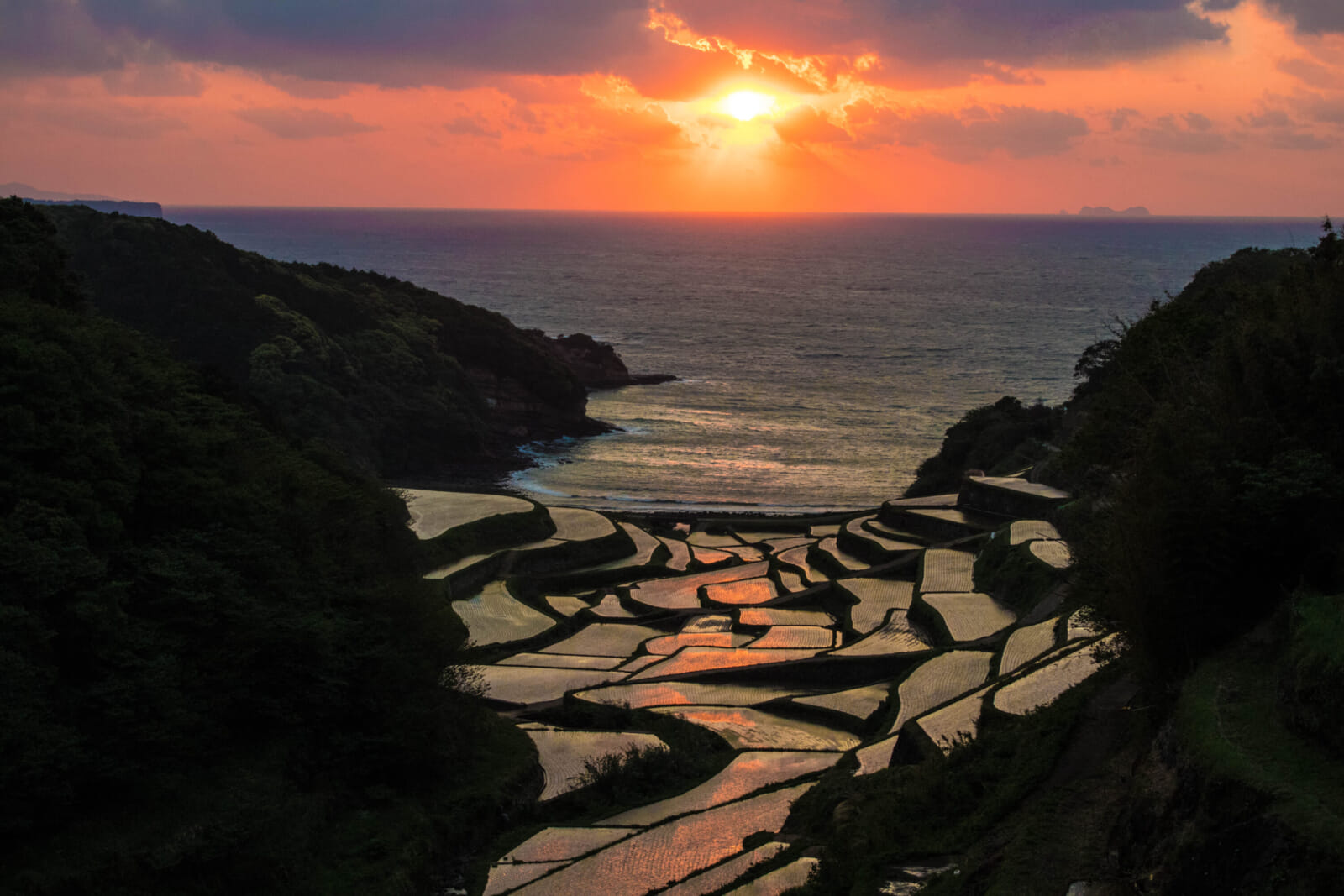
What sets Hamanoura apart from most tanada in Japan is its orientation: rather than sitting in an inland valley, the fields face west directly over the ocean. This positioning creates the site’s defining spectacle — during rice planting season in mid-April to early May, the flooded paddies mirror the setting sun and the sea in a blaze of orange and gold, a view that draws photographers and visitors from across the country. The rice grown here is Koshihikari, one of Japan’s most prized varieties.
The stone-paved footpaths threading between the terraces date back to the Warring States period (around the late 16th century). The site has since been designated as a protected tanada, and the local community continues to maintain the fields by hand in keeping with traditional methods. The observation deck above the terraces offers a panoramic view of the entire landscape, and is also home to the “Eternal Rock,” a romantic monument that has earned Hamanoura certification as a “sacred lovers’ spot” by a local tourism organization.
Best Times To Visit Hamanoura Terraced Rice Fields
The undisputed highlight is mid-April to early May, when the paddies are flooded for planting and reflect the sunset sky. Photographers begin gathering at the observation deck around 17:00 during this period, and the view is considered one of the finest sunset panoramas in Kyushu. Late afternoon visits are strongly recommended at this time of year.