
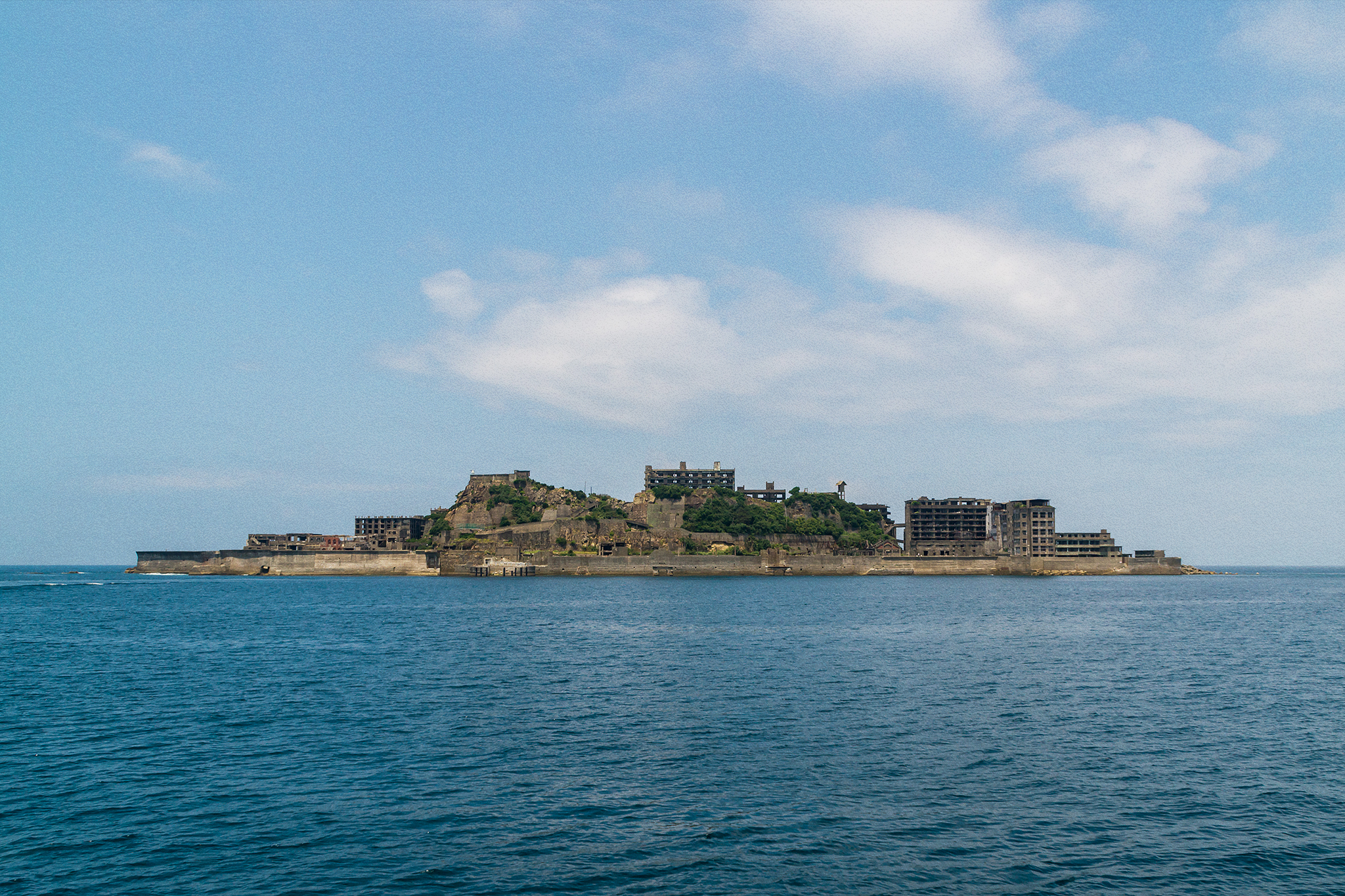
Gunkanjima Overview
Officially named Hashima, Gunkanjima — or Battleship Island — is a small uninhabited island located approximately 15 to 20 kilometers southwest of Nagasaki Port. It earned its nickname from its striking resemblance, when viewed from a distance, to the Japanese battleship Tosa. Today, its silhouette of crumbling high-rise concrete apartment blocks rising from the sea makes it one of the most visually arresting abandoned sites in the world.
Coal was first discovered on the island around 1810, and undersea mining operations began in earnest in 1887. Mitsubishi purchased the island in 1890 and steadily expanded it through land reclamation, tripling its original size and constructing seawalls, residential blocks, schools, a hospital, shops and even a movie theater. At its peak in 1959, the island was home to 5,259 people on just 6.3 hectares — a population density that remains the highest ever recorded in history. Japan’s first high-rise reinforced concrete apartment building was constructed here in 1916.
As Japan shifted from coal to oil as its primary energy source, the mine became unsustainable. It closed in January 1974, and by April of that year every resident had left. The island has remained uninhabited ever since. In 2015, Gunkanjima was inscribed as a UNESCO World Heritage site as part of the Meiji Industrial Revolution Heritage Sites of Japan.
For those unable to make the boat trip, the Gunkanjima Digital Museum near Oura Church in Nagasaki offers an immersive alternative, including a simulated descent into a working mineshaft and exhibits drawing on survivor testimonials and photographs.
Best Times To Visit Gunkanjima
Tours to Gunkanjima operate year-round, but the island is highly weather-dependent. Landing can be canceled at short notice if wave heights exceed safe limits — a common occurrence, particularly in typhoon season from summer through early autumn. Spring (March to May) and autumn (October to November) tend to offer the calmest seas and most reliable conditions for landing. Advance reservations are strongly recommended regardless of season, as tours frequently sell out weeks or even months ahead, especially on weekends and public holidays.
Morning tours allow for a longer day in Nagasaki afterward, while afternoon departures can offer different light for photography of the ruins. Note that only a 220-meter path along the island’s southern perimeter is accessible to visitors.