
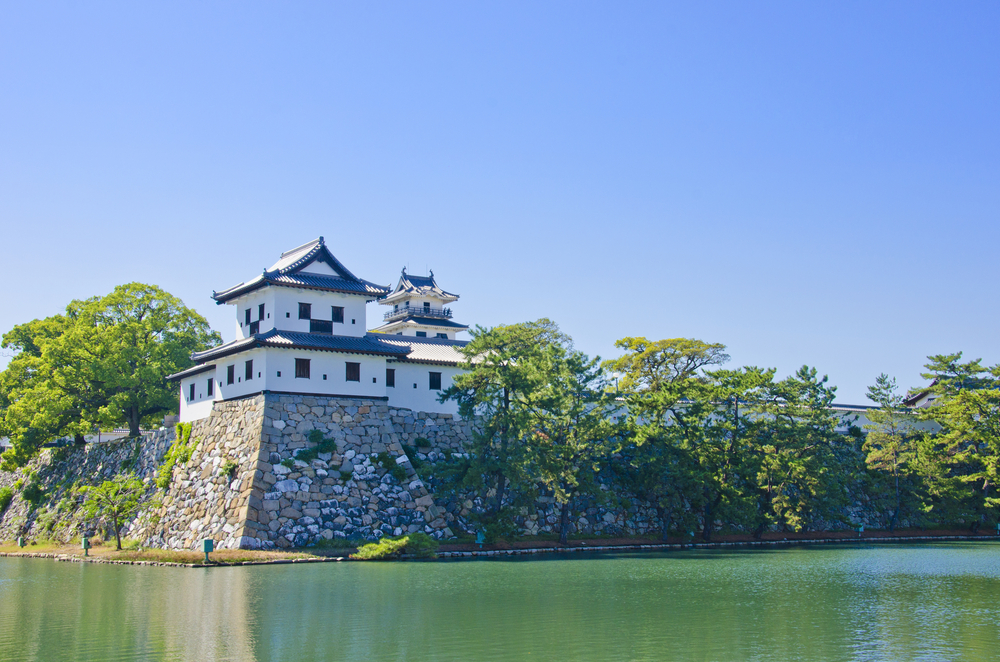
Imabari Castle Overview
Standing at the edge of Imabari city on the northern coast of Shikoku, Imabari Castle is one of Japan’s most distinctive feudal fortresses. It belongs to a rare category known as mizujiro — “castles on the sea” — alongside Takamatsu Castle in Kagawa prefecture and Nakatsu Castle in Oita prefecture. What sets Imabari Castle apart is its extraordinary moat: rather than being fed by a river or reservoir, it draws directly from the Seto Inland Sea, meaning the water level rises and falls with the tide. Fish — and occasionally larger marine life — can be spotted swimming in its depths.
The castle was designed and built by Todo Takatora (1556–1630), one of the most celebrated castle architects of the Edo period. Following the Battle of Sekigahara in 1600, Tokugawa Ieyasu rewarded Takatora by granting him the Imabari Domain. Construction began in 1602, and the completed castle — featuring three concentric enclosures each surrounded by seawater moats — gave Takatora a commanding position over the maritime traffic of the Seto Inland Sea. A small anchorage within the second enclosure even allowed ships to enter the castle directly from the sea.
In 1609, Takatora was reassigned to Tsu Domain in Mie prefecture, and the original keep was eventually dismantled and relocated to Tanba Kameyama Castle near Kyoto. In 1635, the Hisamatsu-Matsudaira clan, relatives of the Tokugawa shogunate, took control of the domain and ruled Imabari through the rest of the Edo period. After the Meiji Restoration of 1868, most of the castle’s structures were demolished. The current reinforced-concrete keep was rebuilt in 1980, with additional turrets reconstructed in 1985 and 1990. In 2006, Imabari Castle was designated one of Japan’s Top 100 Castles.
Today the six-story keep houses a museum spanning floors two through five, with exhibits of samurai armor, weapons, documents and artwork from the Edo period. The top floor serves as an observation deck with panoramic views stretching across Imabari city to the Seto Inland Sea and the Kurushima Kaikyo Bridge. After dark, the castle is illuminated nightly until 22:00, its white walls and stone base glowing dramatically over the moonlit water of the moat.
Best Times To Visit Imabari Castle
Evening visits are particularly rewarding. The nightly illumination transforms the castle into a striking spectacle that photographers and couples frequently seek out. The golden hour just before sunset is also an excellent time to photograph the moat’s reflections.
Weekday mornings are the quietest time to visit. The castle sees increased foot traffic on weekends and during national holidays such as Golden Week and Obon. As a relatively compact site, however, it rarely feels overly crowded even during busier periods.