
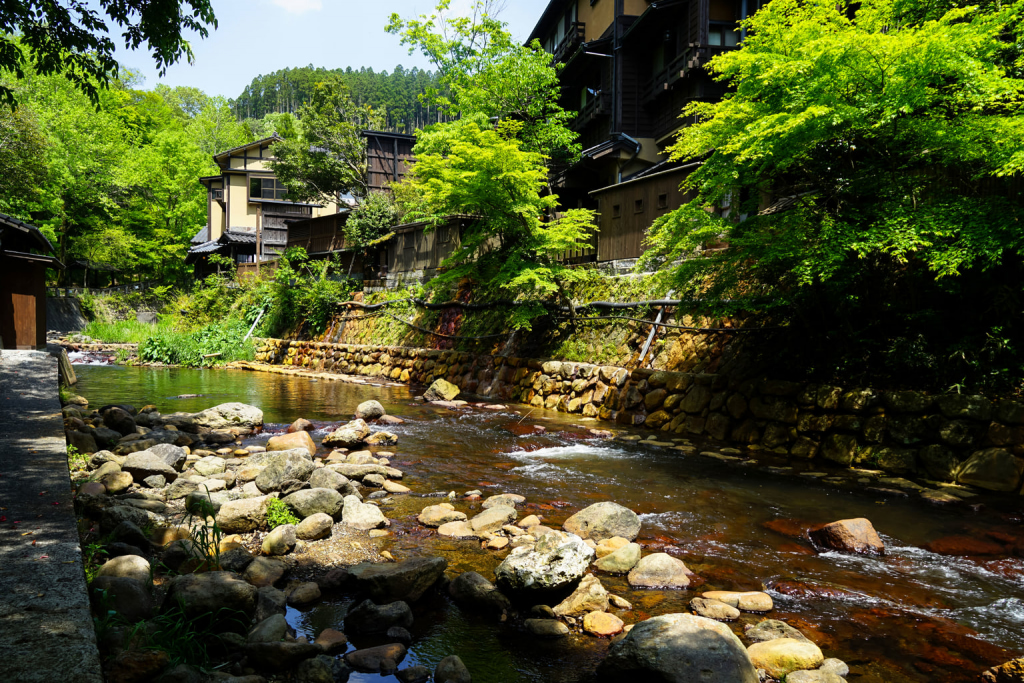
Kurokawa Onsen Overview
Nestled in a narrow, forested valley at around 700 meters above sea level in the Minamioguni area of Kumamoto Prefecture, Kurokawa Onsen is widely regarded as one of Japan’s most beautiful and well-preserved hot spring towns. Located approximately 20 kilometers north of Mount Aso, it draws visitors seeking a traditional Japanese retreat far removed from the concrete and neon of larger resort destinations.
The town’s history as a hot spring retreat stretches back over 300 years, when feudal lords traveling between Hita and Taketa are said to have stopped here to recuperate. Today, around 25 to 30 ryokan line the river and surrounding hillsides, each offering its own distinctive outdoor bath — a rotenburo — with different mineral compositions, settings, and seasonal atmospheres. The spring water here comes in six distinct types, including sulfur, acidic, and ferruginous springs, with water color and temperature varying from bath to bath. Some baths are built directly above the rushing river; others are carved from rock faces or hidden in cave formations.
The centerpiece of any visit is the nyuto tegata, a round wooden pass made from local cedar that grants access to the outdoor baths of three ryokan of the visitor’s choice, valid for up to six months. The pass costs ¥1,500 and is available at the Kazenoya tourism information center in the heart of the town. Individual baths at participating ryokan can also be accessed from around ¥500 per person. Private baths can be rented by the hour at many establishments from ¥1,000 to ¥2,500.
What makes Kurokawa distinctive beyond its waters is its conscious commitment to aesthetics. The town has no large modern hotels, no neon signs, no convenience stores. Buildings are constructed from natural wood and earth tones, earthen walls and stone stairs frame the lanes, and the overall effect is of a townscape that has changed little in character over generations. Strolling through town in a yukata and wooden geta sandals — provided by most ryokan — is very much part of the experience.
Each winter, Kurokawa hosts the Yu Akari illumination event, in which hundreds of handcrafted bamboo lanterns light the streets and riverbanks from nightfall until 22:00. Entry to the illumination is free.
Best Times To Visit Kurokawa Onsen
Kurokawa is a year-round destination, with each season offering its own character. Autumn (October to November) is the most popular time, when the valley fills with vivid red and gold foliage framing the wooden ryokan — widely considered the most photogenic season. Winter brings snow, quiet lanes and the warm contrast of steaming outdoor baths, as well as the Yu Akari bamboo lantern illumination. Spring arrives gently with cherry blossoms, and summer offers cool relief from the lowland heat. Weekdays are noticeably quieter than weekends; for New Year and Golden Week, ryokan reservations should be made as far as a year in advance.