

Shukkeien Garden Overview
Tucked behind the Hiroshima Prefectural Art Museum, just 800 meters from Hiroshima Station, Shukkeien Garden is one of the city’s most serene corners — a traditional stroll garden whose long history encompasses feudal splendor, near-total destruction and patient recovery.
The garden was created in 1620 by Ueda Soko, a senior retainer of the Asano clan, skilled warrior and renowned tea master, on the orders of Asano Nagaakira, the newly appointed lord of the Hiroshima domain. Its name, Shukkeien, translates roughly as “shrunken-scenery garden,” which describes its defining characteristic: the compression of vast natural landscapes — mountains, valleys, rivers, forests, and islands — into a compact, intricately composed space. Ueda designed it in the kaiyushiki (circular tour) style, where a single winding path guides visitors around the central pond, Takuei, revealing a series of carefully arranged miniature scenes.
In 1940, the garden was donated to Hiroshima Prefecture by the Asano family and designated a National Place of Scenic Beauty. Five years later, on August 6, 1945, the atomic bomb devastated the garden completely. The site became an area for survivors in the immediate aftermath; the pond water was used to treat burn victims. Restoration began in 1949 and took approximately 30 years to complete.
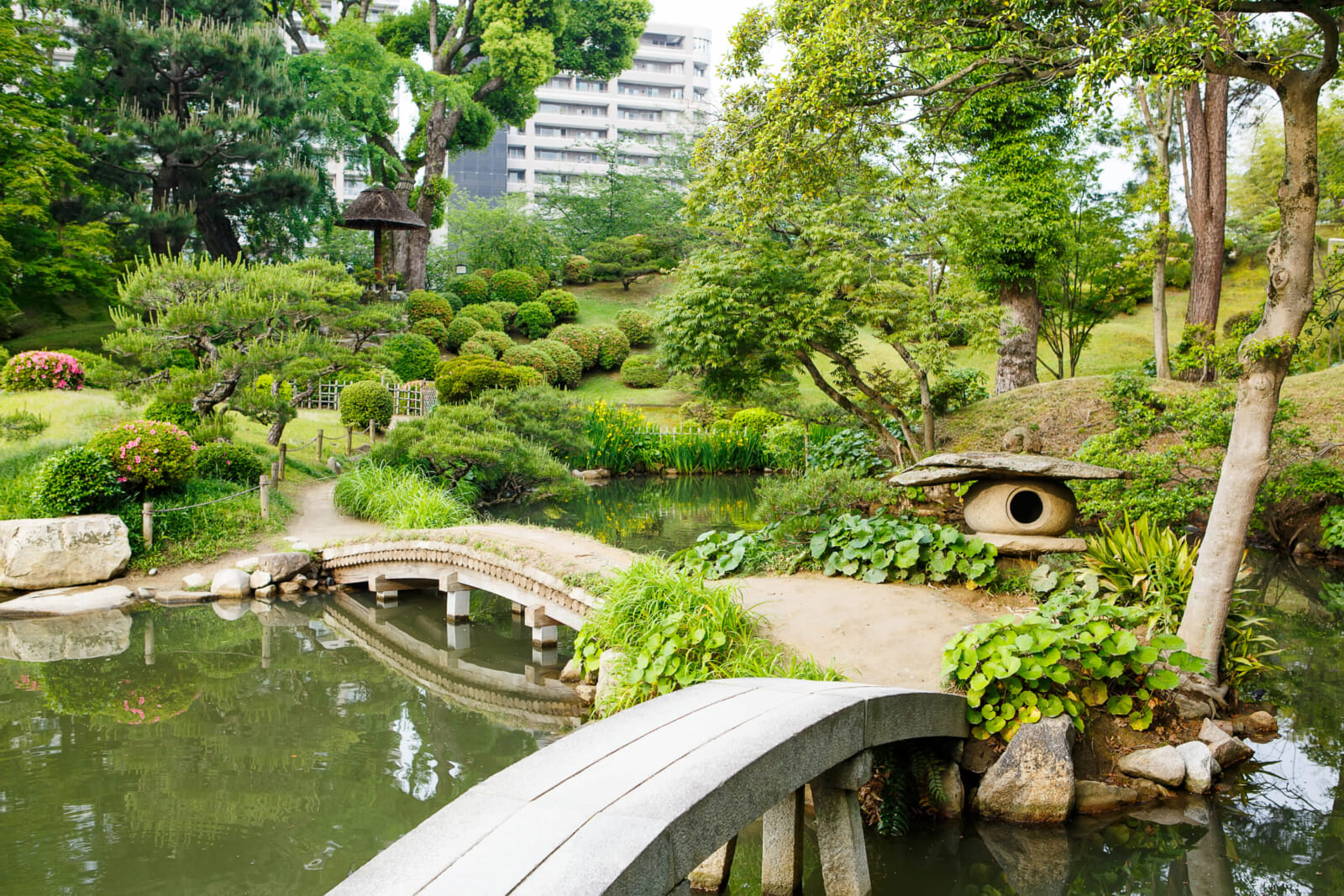
The Koko-kyo stone bridge over the pond is one of the few structures to have survived the bombing. Tea houses, including the Seifukan and Meigetsu-tei pavilions, are scattered throughout the grounds. The iconic drum bridge, with its distinctive arched silhouette, is one of the garden’s most photographed features.
Best Times To Visit Shukkeien Garden
The garden rewards visits in every season. Late March to early April brings cherry blossoms and plum trees into bloom, and special evening illuminations are held during this period. Summer offers full, vivid greenery; autumn transforms the maple trees into deep reds and golds, the most photographed season in the garden. Winter is quiet and uncrowded, with camellias and plum blossoms providing color in the cooler months.
Weekday mornings are consistently the least crowded time to visit and allow for the most contemplative experience.