

Overview of Sandankyo Gorge
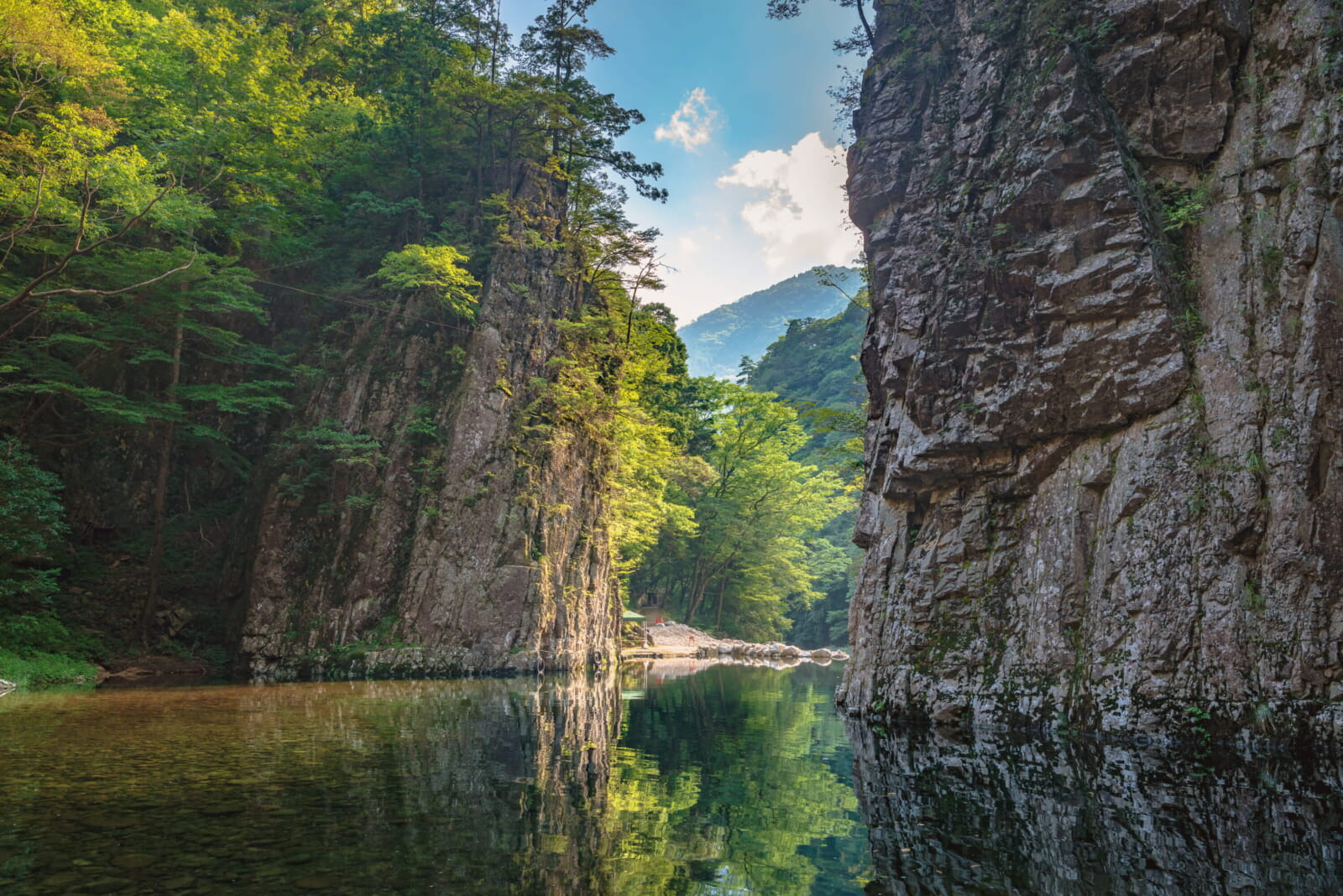
Sandankyo Gorge cuts 16 kilometers through the upper reaches of the Shibaki River in Akiota, northwest of Hiroshima city. Part of the Nishi-Chugoku Sanchi Quasi-National Park, it is one of only six gorges in Japan to hold the designation of Special Place of Scenic Beauty — and the only one in the western half of the country. Towering cliffs rise above jade-colored pools, and the trail that threads through the valley takes hikers past waterfalls, mossy boulders, narrow rock passages and some of the most intact cedar forest in the Chugoku region.
The gorge’s modern story begins in 1917, when photographer Kuma Nanpo first ventured into what was then largely unexplored terrain. Captivated by the scenery, he spent decades advocating for its protection. His efforts, alongside those of local residents, led to the gorge being designated a Place of Scenic Beauty in 1925 and then upgraded to a Special Place of Scenic Beauty in 1953 under the Law for the Protection of Cultural Properties. Sandankyo celebrated the 100th anniversary of its “discovery” in 2017.
The gorge’s highlights are spread across a range of trails suited to all fitness levels. The most popular route runs 3 kilometers from the main entrance to Kurobuchi Pool, a basin of startlingly clear water enclosed by 100-meter cliffs, taking roughly 50 minutes one way. From here, a small wooden ferry (¥500 round trip) crosses to Kurobuchiso, a riverside restaurant famous for grilled local salmon. Further in, Sarutobi — a point where the cliff walls narrow to just 2 meters apart — can be reached by a second ferry, which threads through the passage to reveal the hidden Nidandaki Falls. For those with more time, the full trail to Hijiri Lake stretches approximately 12 kilometers one way and takes up to 5 hours.
Best Times To Visit Sandankyo Gorge
Late October to early November is peak season, when the gorge walls are painted in red and gold autumn foliage and the contrast with the emerald river below is at its most striking. Crowds are larger during this window, but the spectacle justifies the company. Summer brings lush greenery, cooler temperatures inside the ravine, and the option of wading in the pools. Spring, once the trails reopen in mid-April, offers fresh vegetation and far fewer visitors.
Winter visits are possible but conditions can be hazardous — sections of trail may be icy, several paths are officially closed, and neither ferry operates.