Hikone Castle Overview
Rising above the city of Hikone on the northeastern shore of Lake Biwa in Shiga Prefecture, Hikone Castle is one of the best-preserved and most historically significant feudal castles in Japan. Together with Himeji, Matsumoto, Inuyama and Matsue, it is one of only five castles in Japan designated a National Treasure — the country’s highest cultural designation — recognizing the exceptional historical and architectural integrity of its original structures.
Construction of Hikone Castle began in 1622 under Ii Naomasa’s successors — most notably Ii Naokatsu and Ii Naotaka — and was completed in 1622. The castle served as the seat of the Ii clan, one of the most powerful feudal domains of the Edo period, for over 260 years until the Meiji Restoration. The Ii clan is perhaps best known historically for Ii Naosuke, the chief minister of the Tokugawa shogunate who signed the controversial Harris Treaty with the United States in 1858 and was assassinated outside Edo Castle in the Sakuradamon Incident of 1860.
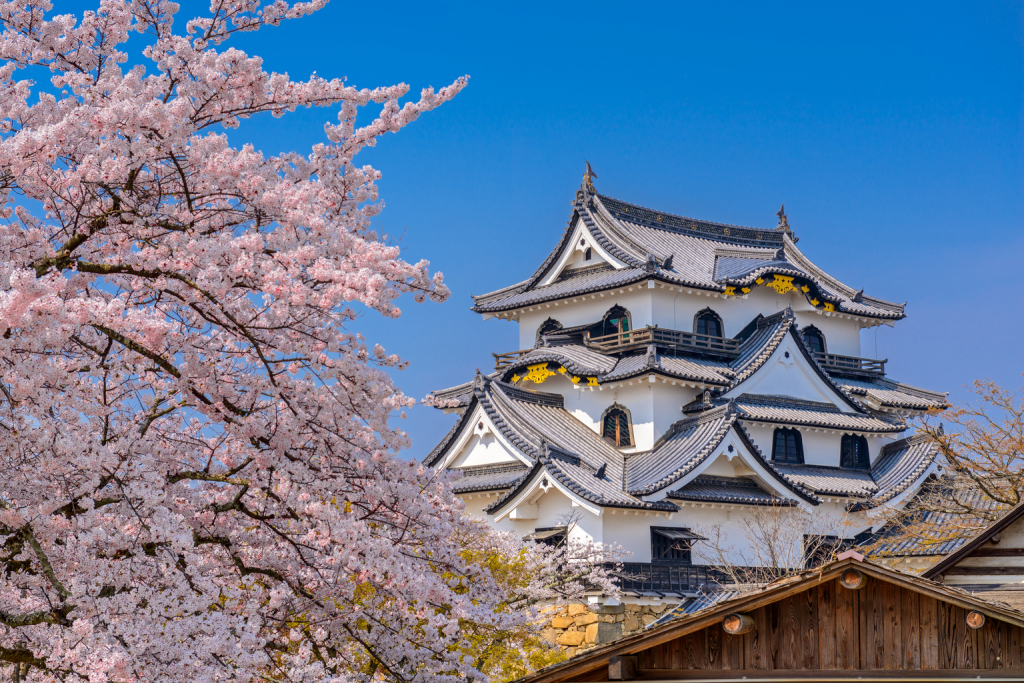
The three-story tenshu (keep) is the castle’s defining feature, characterized by its elegant, complex roofline incorporating multiple architectural styles drawn from several other castles that were dismantled to supply materials for Hikone’s construction. The castle grounds also include the Genkyuen Garden, a classical Japanese stroll garden established in 1677 that incorporates Lake Biwa as part of its design through the technique of shakkei (borrowed scenery), and the Hikone Castle Museum, which houses an outstanding collection of Ii clan armor, tea ceremony utensils and artworks.
Best Times To Visit Hikone Castle
Spring is the most celebrated time to visit, as approximately 1,200 cherry trees on the castle grounds burst into bloom in late March to early April, consistently ranking Hikone among Japan’s finest cherry blossom destinations. The castle’s white walls and tiered rooflines framed against the pink blossoms and the blue waters of Lake Biwa beyond create one of the most iconic seasonal scenes in the Kansai region.
Autumn (October–November) brings vivid foliage to the castle grounds and the surrounding lakeshore, with the Genkyuen Garden particularly atmospheric during this season. Summer offers long days and views across Lake Biwa, while winter visits are quieter and occasionally dusted with snow, lending the castle a stark and contemplative beauty.