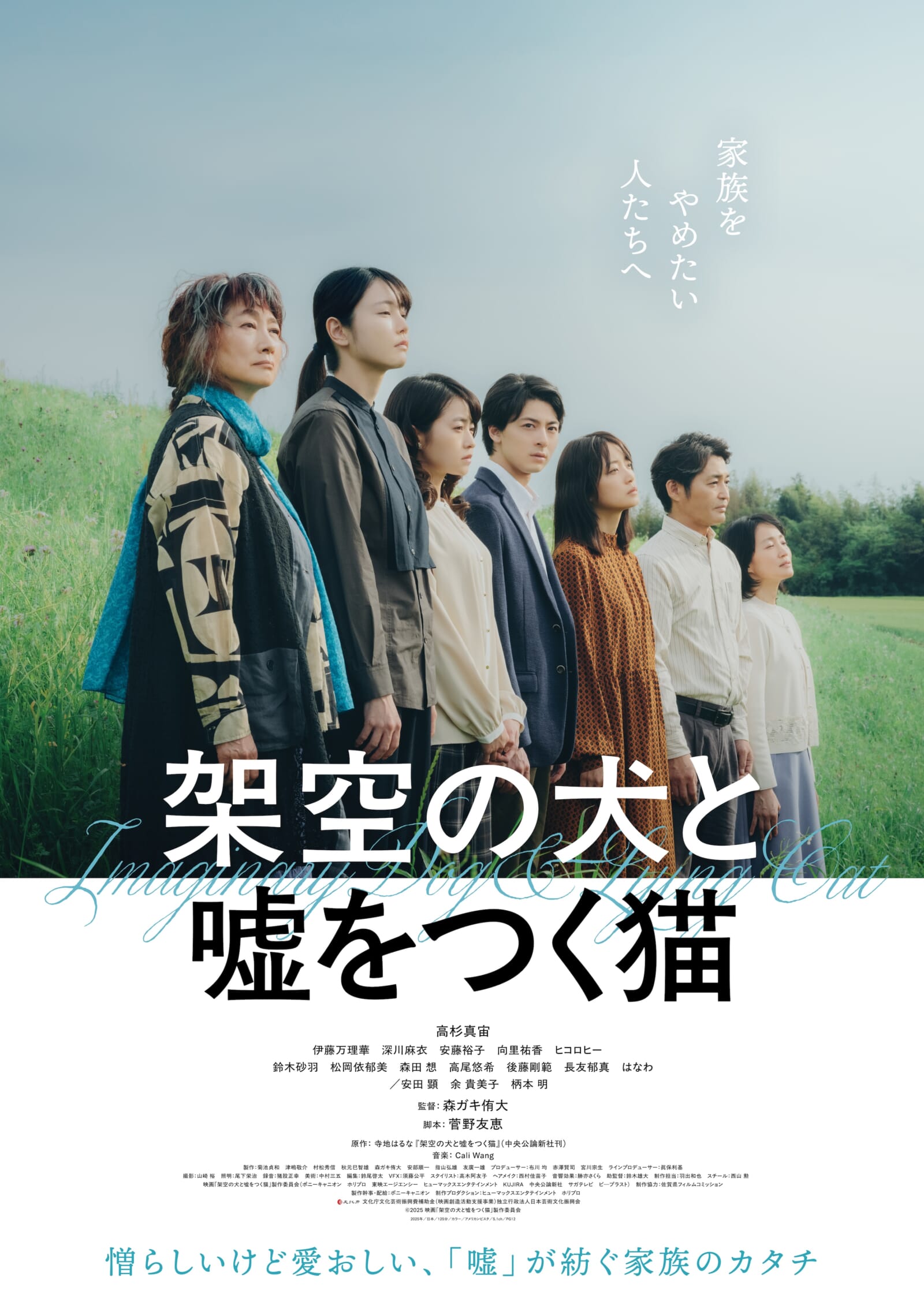
From director Yukihiro Morigaki and screenwriter Tomoe Kanno comes a movie that asks you to pay attention to the things that aren’t there. The Imaginary Dog and the Lying Cat, which opens in 1988, follows the Haneko family after the tragic death of their youngest child, Seiji.
While Seiji never appears onscreen, his absence lingers across 25 years as the family struggles with loss. It’s one of many “missing things” that define this imperfect yet deeply moving portrait of grief.
Nowhere is that absence more striking than in the Haneko home itself. The film never shows a butsudan (Buddhist altar). No incense smoke. No offerings. No quiet rituals of remembrance. In a Japanese cultural context, that absence is deafening.
A butsudan isn’t merely a religious symbol; it’s seen as a healthy way to process grief, offering structure when emotions are chaotic. It provides a way of maintaining a connection with the dead through repeated acts such as lighting incense, offering food and speaking to the deceased.
Modern grief psychology calls this “continuing bonds,” the idea that mourning involves reshaping and redefining one’s relationship with the dead rather than severing it entirely. It’s not about denying death or pretending that they’re still alive, but rather acknowledging that they still matter.
The process can be painful in the beginning. That’s possibly why the Haneko family avoids it. However, without taking this crucial first step, they remain unable to heal for a long time.
Without that release valve, grief metastasizes, manifesting itself in unhealthy ways such as fantasy, silence, anger and resentment. The mother clings to the belief that her son is alive. The father retreats emotionally and has an affair. The oldest daughter lives with rage.
The family doesn’t process grief: they orbit it, each a lonely planet in a cosmos of suffering of their own making.
When Language and the System Fail Grief
At the emotional center of the film is Yamabuki, who lies constantly by writing letters to his delusional mother in the voice of her dead son. This is not done out of cruelty. He supports the fake realities that he thinks others need to function.
Through falsehoods, this young man is trying to keep a family together. In this context, it feels wrong to call what he does “lying.” The word suggests deception and manipulation, neither of which Yamabuki is doing. His deceptions are acts of care, however misguided.
Perhaps that mislabeling points to something larger: Language often fails in the face of grief. We have words for people who have lost their parents or a spouse, but none for a parent who loses a child, or a sibling who loses a brother. These experiences exist outside vocabulary. And when something cannot be named, it is often difficult to fully process.
Yamabuki’s “deceptions” are neither condemned nor praised. There isn’t a moment where truth is portrayed as inherently virtuous and lies as fundamentally hurtful. Rather, lying is presented as a coping mechanism, one shaped by a desire to survive.
It’s not the healthiest approach to grief, but this actually works in the movie’s favor as it underscores the abysmal state of mental healthcare in Japan. Mental health issues are still stigmatized, but things were even worse in the late 1980s and as early as the 2010s.
It’s no wonder that the Haneko family never got the professional help that they desperately needed.
The time jumps in The Imaginary Dog and the Lying Cat occasionally break the flow of the story but ultimately work to the movie’s advantage. By leaping forward across decades, the film depicts grief not as a process with defined stages and closure, but as a lifelong companion. The pain dulls and recedes, but it never truly disappears.
In this light, seeing Yamabuki break down emotionally more than 20 years after his brother’s death doesn’t feel emotionally manipulative. It feels honest. Anyone who has lived with real loss understands this.
Grief waits. It resurfaces unexpectedly, triggered by the most mundane things. The film rejects the fantasy that time heals all wounds. It can even actually fuel a kind of quiet rage against the world.
The film captures the cold cruelty of a reality that doesn’t pause for tragedy. After a child dies, people still expect you to wake up, shower, work and pay taxes. Each family member responds differently to the impertinence of an existence that dares to continue, but rarely in some big and cinematic way.
The Haneko family’s reactions are fundamentally small and human. That’s what makes grief so devastating. It rarely screams. It prefers to slowly unravel you over time.
Ultimately, the movie offers a glimpse of hope of life after death, but it never promises healing. However, it does offer recognition, and for the kind of grief that lasts a lifetime, it may be the most that a piece of fiction can give us.